Blog Archives
The State of Education

Mending Education offers readers a detailed examination of the ways the COVID-19 pandemic affected changes in the US education system. Why was this an important book for you to write?
We felt it was important to challenge the negative rhetoric surrounding the state of education during and after the Pandemic.
Surely, the Pandemic is not the only crisis that will confront education and best to focus on the positives we learned that we can carry forward. What we learned from the Pandemic can inform how we respond to future crises of a wide-ranging sort.
Can you share with us a little about the research that went into putting your book together?
While our book is deeply grounded in mental wellness and trauma theory, we wanted to ensure that our book was enhanced through and informed by the lived experiences of K—12 educators. To that end, we used several approaches to capture educator voice including: (a) a qualitative survey of educators who worked during the Pandemic; (b) the results of monthly Virtual Teachers Lounge sessions (www.vtl4today.com; and (c) the authors’ own experiences teaching and conducting workshops during and after the Pandemic.
What is one thing you hope readers take away from Mending Education?
Just one? Here’s one of several: crises create opportunities. Indeed, crises can activate creativity. The message: don’t let a crisis go to waste; learn from it, explore its implications and use its teachings to plan and prepare for the next crisis.
Author Links: Website | Facebook | X | LinkedIn | YouTube
Mending Education: Finding Hope, Creativity, and Mental Wellness in Times of Trauma
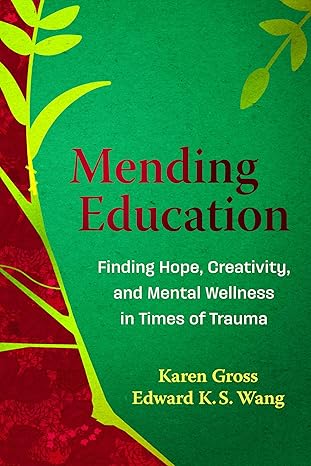

Mending Education, by Karen Gross and Edward K. S. Wang, offers a compelling examination of the U.S. educational system in the aftermath of the COVID-19 pandemic. Divided into three sections, the book focuses on the silver linings of a global crisis, highlighting positive practices that emerged during the pandemic and proposing ways to integrate these lessons into the future of education. The authors open by vividly recounting the unparalleled challenges faced by students, educators, and institutions during the pandemic. From preschoolers to university students, no learner escaped the seismic shift to online education. Gross and Wang explore the rapid transition from in-person instruction to digital classrooms, shedding light on how teachers adapted to an entirely new way of teaching.
While the book does not shy away from discussing the devastating effects of the pandemic, including social, economic, and geographic disparities, the focus remains on identifying actionable positives. The authors delve into creative solutions employed by educators during this time, demonstrating how these strategies can become enduring practices within schools. Chapter 8 stands out as a particularly impactful section. Here, the authors spotlight simple yet transformative practices, such as conducting home visits or starting each day with personalized greetings for students. These small gestures, while born out of necessity, fostered stronger connections and deeper engagement, offering lessons in human-centered education. Similarly, the text celebrates how teachers expanded beyond textbook-based teaching to incorporate diverse, innovative methods. Such shifts, according to Gross and Wang, should be embraced and institutionalized to build a more adaptive and inclusive educational system.
While the insights presented are valuable, I feel the book occasionally lacks conciseness. For readers familiar with the intricacies of education, the detailed descriptions may seem somewhat repetitive. However, for those outside the field or involved in policy-making, the depth provides an illuminating perspective on what educators endured and achieved during this unprecedented time.
Mending Education is a thought-provoking read for anyone interested in understanding the resilience of educators and the transformative potential of the pandemic’s lessons. Gross and Wang skillfully bridge the gap between crisis response and long-term reform, offering a hopeful vision for the future of education. Whether you’re a policymaker, an educator, or simply curious about how the pandemic reshaped learning, this book provides a meaningful lens through which to view the challenges and opportunities that now define modern education.
Pages: 232 | ASIN : B0CWJD6L1H



