Blog Archives
Escaping External Noise

In The Inner Citadel, you explore solitude as a way to recover attention, emotional balance, and a more grounded sense of self. The image of the “inner citadel” gives the book its structure. How did that metaphor come to you?
The idea of the Inner Citadel grew from my own experience rather than from the metaphor itself. During extended periods of solitude on Dartmoor, I realised that the greatest challenge was not escaping external noise, but quietening the noise within. I wanted a symbol of inner strength that protected without isolating, inspired by the Templar fortress of Château Pèlerin. The “inner citadel” became a metaphor for the place within us where we recover clarity, resilience, and authenticity. Solitude is not an escape from life, but a way of returning to it more centred, compassionate, and emotionally whole.
How do you distinguish healthy solitude from loneliness?
Healthy solitude is a choice; loneliness is a condition. Loneliness is the painful experience of feeling disconnected from others, whereas healthy solitude is intentionally creating space to reconnect with yourself. In The Inner Citadel, I argue that solitude isn’t about withdrawing from relationships but about strengthening your inner life so you can return to them with greater presence, patience, and authenticity. If time alone leaves you calmer, clearer, and more compassionate, it is healthy solitude. If it leaves you increasingly isolated, bitter, or disconnected, it has become something different. Solitude should deepen our capacity to love others, not diminish it.
You begin with the pressures of constant notifications and mental overload. Why do you think attention has become one of our most valuable resources?
I believe attention has become one of our most valuable resources because it shapes the quality of every part of our lives. In a world of constant notifications, endless information, and competing demands, our attention is continually fragmented. When we lose the ability to direct it intentionally, we also lose depth of thought, emotional balance, and our connection with ourselves. In The Inner Citadel, I argue that protecting our attention is no longer a luxury – it is an act of self-preservation. Solitude helps us reclaim that attention, allowing us to think more clearly, live more deliberately, and engage more fully with both ourselves and others.
If readers revisit this book ten years from now, what do you hope they’ll discover in its pages?
I hope they’ll discover that The Inner Citadel was never really about solitude – it was about learning how to live well. While technology and the pace of life will undoubtedly change, our need for inner stillness, self-understanding, resilience, and meaningful human connection will remain. I hope the book feels as relevant then as it does now because it speaks to timeless human needs rather than passing trends. Above all, I hope readers return to it at different stages of life and find that it meets them where they are, offering not just comfort, but the quiet encouragement to return to themselves.
Author Links: GoodReads | Facebook | Website
This philosophical self-help book builds the case for what it calls the inner citadel: a deliberate inward structure, built through solitude, from which a person can live more truthfully. Through nineteen chapters rooted in personal
experience and philosophical depth, it guides readers from overstimulation and burnout toward clarity, emotional growth, and genuine self-trust.
· Understand why solitude heals where noise only distracts, with quiet practices you can carry into real, ordinary days
· Build emotional resilience through practical stoicism and honest emotion regulation, not suppression
· Recover from burnout and the weight of midlife with slow, searching reckoning
· Reclaim clear thinking, creativity, and self-worth in a world designed to crowd them out
· Use nature, daily mindfulness, and contemplative spirituality to find what remains when pretense is stripped away
· Face mortality and the work of letting go with clarity rather than dread
This is not a quick fix. It is an invitation back to yourself, written with quiet authority for anyone ready to stop living at the surface.
The Inner Citadel: From Overstimulation and Burnout to Emotional Growth Through the Power of Solitude
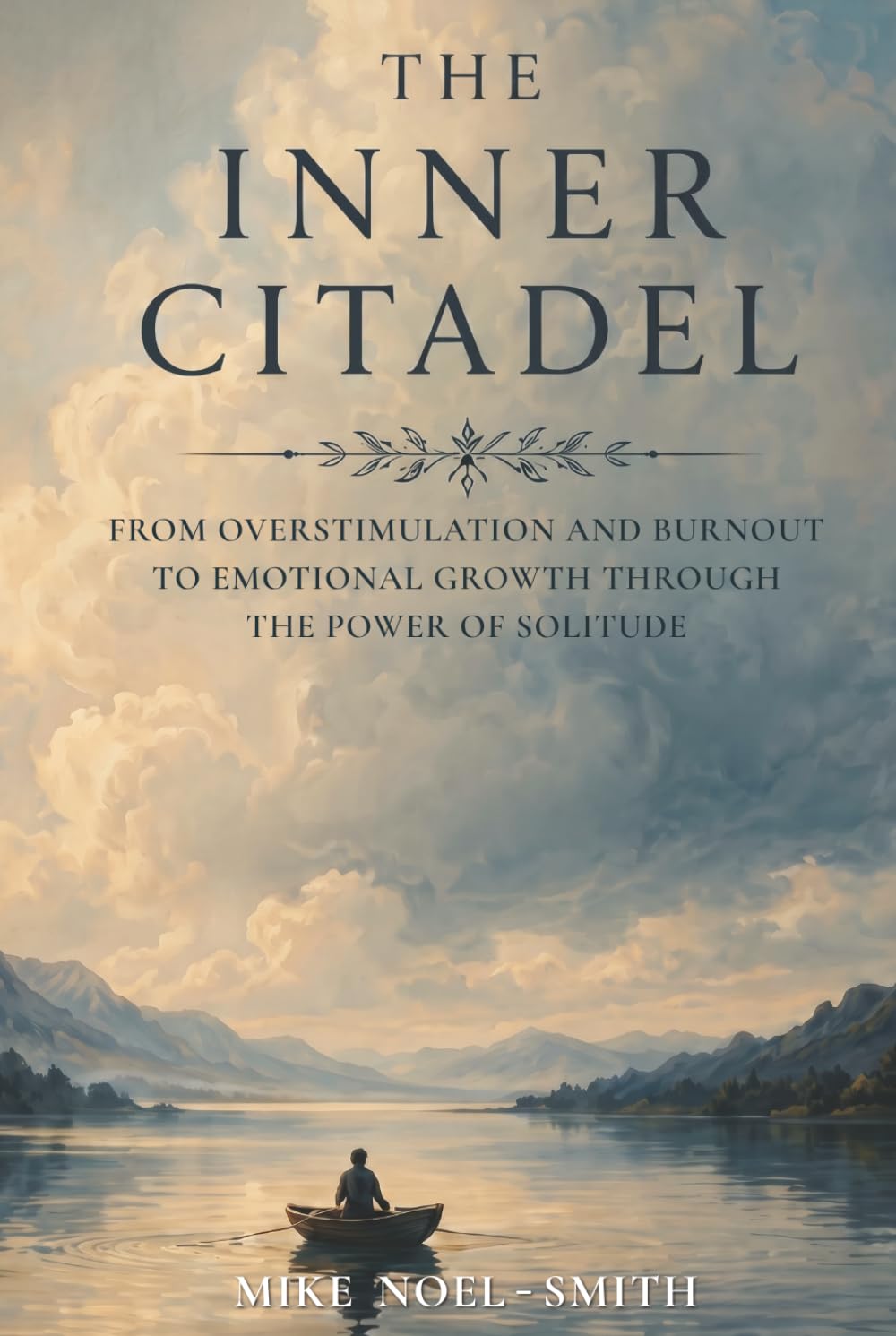

The Inner Citadel is a reflective and practical exploration of solitude as a way to recover attention, emotional balance, and a more grounded sense of self. Mike Noel-Smith begins with the familiar strain of notifications, obligations, constant availability, and mental clutter, then gradually leads the reader toward a quieter way of living. Drawing heavily on his time alone in the wilds of Dartmoor, he treats solitude as an active encounter rather than passive withdrawal. As he puts it, “Solitude did not instantly soothe me; it revealed me.” That distinction gives the book much of its emotional honesty, since silence brings discomfort, loneliness, grief, and fear to the surface alongside clarity and peace.
The central image of the inner citadel gives the book a strong structure. Its walls, gates, and watchtowers represent boundaries, habits, and forms of discernment that protect the inner life from being continually overrun. Across the chapters, Noel-Smith connects solitude with emotional resilience, creativity, clear thinking, self-trust, relationships, nature, ageing, and mortality. The argument expands naturally as the book progresses. Solitude begins as relief from overstimulation, but it becomes a means of living with greater intention. One of the book’s clearest insights is that “quiet is not emptiness, but a threshold,” and Noel-Smith consistently explores what might be waiting on the other side of that threshold.
The book’s most engaging passages come from Noel-Smith’s personal experiences outdoors. Encounters with harsh weather, darkness, animals, physical discomfort, and sudden loneliness keep the discussion rooted in lived experience. His account of meeting a stag at night is especially memorable, capturing the humility and sharpened awareness that can arise when a person stops treating themselves as the center of every setting. The practical exercises at the end of each chapter also make the ideas accessible. Attention audits, short periods without devices, reflective questions, solitary walks, and simple breathing practices give readers manageable ways to test the book’s ideas in ordinary life.
There’s a deliberate, meditative rhythm to the writing, with key thoughts revisited from slightly different angles so they can settle rather than simply pass by. The final chapter’s detailed guidance on spending a week in a wild place adds an unexpectedly concrete conclusion, covering shelter, clothing, food, camp selection, safety, and responsible treatment of the land. It reinforces the book’s larger message that inner reflection is supported by practical preparation and sustained attention. The Inner Citadel is ultimately a thoughtful companion for readers who feel scattered, overstimulated, or disconnected from their own priorities. It presents solitude as a disciplined return to oneself, followed by a fuller and more honest return to other people.
Pages: 321 | ISBN : 978-1919215662



