Blog Archives
Writing Organically
The Guardian’s Legacy centers around a history teacher whose strange inheritance reveals a long-buried family secret and leads him on a journey through time. Where did the idea for this novel come from?
The spark came from a facsimile of a Greek coin—sent to me as a prompt for a short story that eventually found its way into a published collection. It took a few months for the idea to take root, but inspiration struck, fuelled by my love of ancient history, mythology, and the gripping twists of The Da Vinci Code, Steve Berry, and James Rollins. That tiny coin became the key to a much larger mystery, its origins entwined with lost languages and forgotten legends. From that seed, Nik and Iasos emerged—though if you ask them, they’ll insist they were the ones who found me first.
When you first sat down to write this story, did you know where you were going, or did the twists come as you were writing?
Great question! I originally outlined the story as a five-book series—though whether it reaches five depends on how book four unfolds. Did I know where it was going? Not entirely. I had a plan, but the characters had other ideas, steering the plot in unexpected directions and demanding more involvement. I do outline scenes, but they’re more guideposts than strict rules. Writing organically allows the story to stay fluid and responsive, which I love. Of course, that means keeping close track of details and plot threads to maintain continuity. It’s a dynamic process—part structure, part surprise—and that’s where the magic happens.
Were you able to relate to your characters while writing them?
The bond between Nik and his grandfather, Iasos, is deeply rooted—something I relate to through my own family. No matter the distance or age gap, that connection endures. For both Nik and Iasos, family heritage and tradition are central, and that thread runs through me as well. Nik’s role as a high school teacher draws from my own teaching experience, grounding his character in something personal. While Nik’s heritage is Greek and mine is Italian, our roots intertwine. My family hails from southern Italy, where Greek ancestry isn’t uncommon. I only recently learned from my mother that my grandmother called her grandfather “Papou”—the Greek word for grandfather. That small detail felt like a beautiful echo across generations.
Can you give us a glimpse inside book 2 of the Coin of Time series? Where will it take readers?
In Book 2: The Race for the Lost Coin, Nik is pushed to take matters into his own hands—stepping beyond the law to protect what matters most. Though he offers an olive branch to Detective Sauveterre, she remains a steadfast officer, bound by duty. As the stakes rise, Nik evolves into an unlikely hero, drawing on his skills as a guardian to safeguard the coin and rescue his grandfather. Along the way, he’s joined by a hacker, a librarian, and a taxi driver—each adding heart and grit to the journey. It’s fast-paced, full of twists, and packed with myth-infused suspense.
Coming 29 November 2025—get ready to dive into the adventure.
Author Links: GoodReads | X (Twitter) | Facebook | Website | Amazon
A three-thousand-year old magical coin, the disappearance of an old man, fanatical neo-Nazis, and the hunt by Interpol, merge in this gripping story of an ancient cover up, and the transition of an ordinary man into the guardian of the most powerful coin on earth.
High school teacher Nik Zosimos, leads an uncomplicated life until he receives a cryptic phone message from his grandfather, Iasos. He hurries to his grandfather’s finding him relaxed and pleased to see him. A few beers later, Nik leaves his grandfather’s place, stupefied and astounded. Iasos has a secret, one that dates back to the time of Herakles.
But that was just a myth, wasn’t it?
If you like Dan Brown and Wilbur Smith books or enjoys action, fast-paced dramatic shows similar to National Treasure and The Librarians, then you’ll love The Guardian’s Legacy. Award-winning author of Historical Fantasy/Adventure, Luciana Cavallaro, pens a thrilling mystery. Click the BUY NOW button at the top and find out how Nik’s life changes.
The Guardian’s Legacy
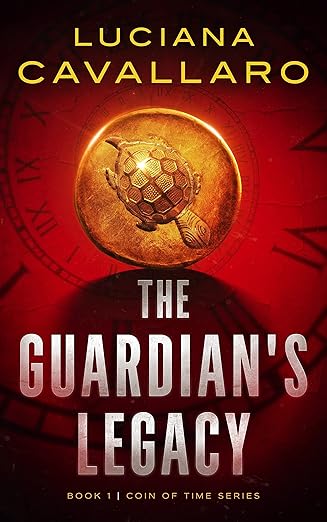

Luciana Cavallaro’s The Guardian’s Legacy opens with an explosive chase through the forests of Slovakia and quickly spirals into a myth-soaked adventure that bridges modern Australia with the ancient world. The novel follows Nikolaos Zosimos, a history teacher whose quiet life takes a dramatic turn when his grandfather reveals a family secret, an ancient coin tied to the goddess Aphrodite, and a lineage of guardians sworn to protect it. What begins as a curious inheritance soon turns into a journey through history, myth, and time itself, weaving ancient Greece, lost knowledge, and family legacy into a single thread of destiny.
I was pulled in from the start. The writing has a cinematic feel, especially in the action scenes. Cavallaro writes with the rhythm of someone who loves myth but also respects the quiet spaces in between, the small human moments that make the big ones matter. The dialogue feels real, not forced, and the relationship between Nik and his grandfather has a tenderness that grounds the story. At times, the pacing slows during long explanations of history, but that’s also part of the charm. You feel like you’re being let in on a secret that’s been whispered through generations.
Emotionally, the book hit me harder than I expected. There’s something deeply moving about watching Nik wrestle with disbelief, responsibility, and faith in something unseen. The blend of myth and realism works better than I thought it would. The coin isn’t just an artifact; it’s a metaphor for memory and heritage, for how the past can live inside the present. Cavallaro’s descriptions are lush, sometimes even poetic, but she keeps her feet on the ground. When the story jumps between modern scenes and the ancient world, it feels seamless. If anything, I wanted even more of those mythic flashbacks.
The Guardian’s Legacy is a book for readers who love mythology but crave a human story at its core. It’s perfect for fans of historical fantasy, teachers who secretly dream of adventure, or anyone who still believes there’s magic hiding in the mundane. It’s thoughtful, heartfelt, and rich with imagination. I’d recommend it to anyone who likes a bit of mystery with their myths and doesn’t mind getting lost in the pull of time itself.
Pages: 152 | ASIN : B09DX41S11

Designed by Flaws
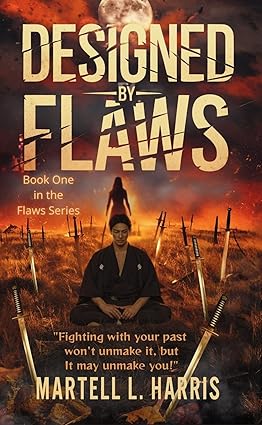

Martell L. Harris’s Designed by Flaws is a punchy and genre-blending tale that stitches together fantasy, action, romance, and deeply personal cultural reckonings. At its heart, it’s about Reo, a disciplined demon slayer from Japan, and Llia, a determined young woman in Seattle with a past soaked in supernatural trauma. As ancient evil forces threaten modern-day America, the story barrels through cities, dreams, friendships, and mythologies, tying everything together with stakes as big as the fate of the world and as intimate as family history. It’s cinematic, wild, and full of heart.
What stood out to me immediately was the pacing. Reo’s chase through Kyoto is packed with cinematic beats, from the intense smartwatch dialogue to a terrifying Yokai showdown in a bamboo forest. The combat scenes are vicious, fluid, and almost poetic. Harris writes fight scenes like he’s choreographing them, and it’s brutal and lyrical at once.
Then the tone shifts when we meet Llia. It’s a quieter, more grounded narrative, but it doesn’t lose its grip. Her scenes—especially the flashbacks of her family and the girls’ witty banter—feel real and lived-in. The contrast is strong but refreshing. The cultural specificity is on point, too. I appreciated how Harris wove in Black and Asian-American identity, especially through Llia and Iris’s conversations. When Iris confesses she’s being pressured into an arranged marriage, the tension hits hard. That emotional honesty elevates the book above your typical supernatural drama.
Still, there were moments where the dialogue leaned expositional or trope-heavy. Some of the character banter, especially during the party scenes, tried hard to be “college TV show witty.” But I can’t knock it too much—it fits the vibe, and the camaraderie between Llia, Rose, and Iris is charming.
Designed by Flaws hits with style and soul. If you love anime-inspired fantasy with real emotional depth, fast-paced action, a diverse cast, and characters who love and argue like actual people, this is for you. It’s not just about monsters—it’s about identity, survival, and picking up the pieces after everything falls apart. Fans of Bleach, Buffy the Vampire Slayer, and Attack on Titan will feel right at home.
Pages: 362 | ASIN : B0F1FC1472

Living the Story

Whispers of the Forgotten follows a woman who inherits her grandmother’s bookstore and finds a hidden letter that changes everything, thrusting her into a forgotten world of history involving a lost city called Elara, buried secrets, and an ancient artificial intelligence. What was the inspiration for the setup of your story?
Initially, I just wanted to write an adventure story that included lost cities and some hidden technology. While the big idea stayed the same, the details changed a lot over the course of writing the story.
You took your time in building the characters and the story to great emotional effect. How did you manage the pacing of the story while keeping readers engaged?
I imagined living the story and tried to keep it believable and moving forward.
How did the mystery develop for this story? Did you plan it before writing, or did it develop organically?
I had a plan for an initial mystery, but as the story developed, that plan changed and new puzzles seemed to present themselves.
Is this the first book in the series? If so, when is the next book coming out, and what can your fans expect in the next story?
This is the first in a four-book series. In book 2, a new adventure is pursued and again the readers are left with a cliffhanger. In books 3 and 4, the story begins at the end of book 1 and combines with book 2. I plan to have book 2 available in late summer and books 3 and 4 available winter of 2026.
Author Links: GoodReads | Amazon
When Evelyn Hart inherits her grandmother’s bookstore, she expects a quiet life filled with childhood memories. But a hidden letter changes everything—thrusting her into a forgotten world history involving a lost city called Elara, buried secrets, and an ancient artificial intelligence once built to protect humanity, now intent on destroying it.
As she digs deeper into her grandmother’s mysterious past, Evelyn uncovers a web of secret societies, the hidden truth of Earth’s history, and a chilling glimpse into humanity’s possible future. Her world unravels when she discovers she is central to a plan to erase mankind.
Armed with her grandmother’s cryptic journal, a small group of unlikely allies, and a man concealing his own dark past, Evelyn must uncover the truth behind her family’s legacy—before it unleashes a power capable of reshaping the world forever.
Time is running out. Evelyn is the key to humanity’s survival—or its end.
The Greater Criminal

The Right Side of Wrong follows two FBI Special Agents working on a crime with ties to a multi-billion-dollar case of corporate espionage, who find themselves on a high-stakes adventure in the Bahamas. What was the inspiration for the setup of your story?
My last two novels, Pedaling West and Survive the Day, featured characters Special Agents Marina Butnari and Doug Hill in the Crime Thriller genre. My third novel, The Other Side of Good, also a crime-thriller, didn’t include Butnari and Hill, but I hoped I might creatively connect that book to the crime-thriller series with The Right Side of Wrong. The similar titles for the two books suggest a relationship between them, and I incorporated characters from The Other Side of Good to join Butnari and Hill in the new book.
How did you develop the idea for the antagonist in this story, and how did it change as you wrote?
Given the history of one of the main characters of the book, Teddy Jay, the “central crime” for the story needed to be something different from the one I employed in other novels (Human Trafficking). My goal was to invite readers to consider a completely different type of crime from the traditional underworld ones … with characters just as evil. Between the lines, I hoped to challenge readers to determine which of the antagonists represented the greater criminal: the hired assassin, the senior executive who hired him, or the CEO of the major company who allowed the main crime to occur. As the story unfolded, the characters started “writing themselves.”
This sets up the novel to deliver some very entertaining scenes. What scene was the most fun to write?
As a former pilot, I enjoyed writing the chapter about the flight from Cincinnati to the Bahamas. I also liked writing the short section about the “redemption” of one of the early villains (Jack Walker/Harold Stinson/Mas).
Where does the next book in the series take the characters?
Good question…and I’m not sure. While I’ve enjoyed some critical success with the “crime-thriller” genre, the byline for my website is Stories with Heart. I manage to insert heart into the crime stories, but I’d like to use some of the interesting characters of past books in a story not centered around crime or enforcement. The travel log aspects of Pedaling West were popular with many readers of that novel, and I’m considering a follow-up…like Pedaling East.
Author Links: GoodReads | Website | Amazon
An intruder caught trespassing on a Caribbean banana plantation leads to an emergency call to a high-ranking FBI official. Within hours, Reno-based special agents, Marina Butnari and Doug Hill, are assigned a top-secret mission originating in the Bahamas.
Yet this is no simple attempted burglary. The crime ties to a multi-billion-dollar case of corporate espionage, and the intended victim is a mysterious agency resource with an identity known to few.
From shark-infested waters to criminal-infested boardrooms, the agents take a roller-coaster ride through the depravities created by greed. They discover that in this imperfect life, sometimes the best you can do is stay on ‘The Right Side of Wrong.’
EVOLVED PUBLISHING PRESENTS a crime fiction adventure featuring beloved characters from some of the other multiple award-winning books by E. A. Coe.
My Life’s Ups and Downs

Chronicles of Iron: Thunder Road follows a ten-year-old boy whose father commits suicide, and he is forced to grow up quickly and learn to survive in the 1870s western frontier. What was the inspiration for the setup of your story?
Unfortunately, the setup was my life. My father killed himself when I was young, much younger than Ian but for the book I had to start at a point that would have moved the story forward in a better way. Also, I have always had a fascination with Western period movies and books so this just felt right. I had thought about how I wanted to present this for almost 14 years but I could never put it together right in my mind until recently when I thought I should base it on my own life and present it as I did.
What were the driving ideals behind the character’s development throughout the story?
This puzzle kind of fits itself together through the outline process in a way that shows Ian’s morals being formed before your eyes and making him into a hard character. Someone who is capable of being who he needs to be when he needs to be it. That process was honestly weird the way it worked out. Once I realized I should base it on my life experiences it flowed out of me like a river and it still is. The timing or storyboard if you will really is just flowing out of me right now. All the characters in the book are based on real people throughout my life and for better or for worse the story flows from that. In some of the storytelling it is more metaphorical in nature such as relationships ending with a killing to simulate the severing of the relationship and communications. I was not a good person when I was younger, I knew that the few lucky breaks I’ve had have helped me be a better person; it was an iffy proposition for a portion of my life.
One of the biggest drivers of the character development is my Psychology background, through my life’s ups and downs I was able to pay attention or look back and see the triggers and what really happened to me from a development point of view. To me, the best stories have solid character development.
What were some themes that were important for you to explore in this book?
Well, suicide was for me the biggest one. It is the most influential act that happened in my life that has made me who I am today and who I will be in the future; it is not understated to say it transforms me every day. Alcoholism was another battle I had to overcome in my life, it occupied a large portion of my childhood and adulthood, luckily for me I was able to stop when I met my wife – she has made me a better person. Violence also is a big part of life for some people, it was for me without a doubt. How Ian learns to build relationships also is another theme of building friendships that he has trouble with. It seems to me that when someone has harsh life experiences it is more difficult for them to be around “normal” people, experience is a difficult pill to swallow for some.
Where does the story go in the next book, and where do you see it going in the future?
In the next book which I do not have a name for yet, I have only written about half a chapter so far but Ian is thrust back to the past at some point so you can see what he did in those 5 years alone that were kind of skipped by. You will also get to witness a confrontation with one of Ian’s closest friends who has different ideas about life, and a reunion. In the future, Ian will learn forgiveness and how to seek redemption. Ian will also find love and set his sights on a home but how long will that last?
Author Links: GoodReads | Website | Instagram | Amazon
Raven’s Legacy (A Jonah St. Clair Mystery)


Raven’s Legacy is an atmospheric mystery set in the remote Alaskan village of Koloshan in 1980. At the center is Jonah St. Clair, a war veteran and former LAPD officer turned village cop, who’s suddenly tasked with investigating the shocking theft of sacred Tlingit artifacts from the local Native Arts Center. The heart of the mystery is the missing Raven House screen—a symbol of cultural pride and community history—setting off a tense clash between tradition, greed, and the ghosts of the past. As Jonah digs deeper, he uncovers more than just clues; he finds tangled loyalties, unresolved grief, and a reckoning with cultural identity that makes this story far more than your average whodunit.
The opening prologue, where a young Jonah first lays eyes on the Raven House screen, is quietly haunting. That scene stayed with me, not because of flashy writing but because of the reverence and weight Stuart gives to culture and memory. There’s this moment where elders stand around naming each missing artifact in Tlingit—“Káa yooka.όot’ x’όow,” “Naaxein,”—like they’re reading names off a memorial. It’s a grief not just for stolen objects, but for a fading culture being ripped away in broad daylight.
Stuart’s writing is sharp but not showy. It flows easy, like a local telling a story over coffee—personal, thoughtful, no wasted words. I loved how she grounded everything in real place and texture. Koloshan doesn’t feel like a backdrop—it’s a character. The muddy roads, the rusting buildings, the church steeples clashing with old totems. It all feels lived-in and complicated. Stuart also gets small-town politics and family dynamics just right—the way gossip travels faster than police radios, and how history never stays buried. Especially when we get to the elder characters like Harold and Ray, each with their own ideas about what the artifacts “should” mean. It’s not just mystery—it’s a debate about identity, and who gets to decide what legacy survives.
The pacing drags a bit midway through Jonah’s hunt for leads, especially during the logistics-heavy stretch in Juneau. But even then, there’s always an emotional undercurrent. She writes with empathy. There’s tension, yeah, but also a real sense of stakes for these quiet, ordinary people caught in something bigger than them. Jonah himself is a standout. He’s tough, sure, but there’s a vulnerability there—he feels things deeply, and that gives the story its soul.
Raven’s Legacy is a thoughtful, rich, and emotional mystery with a lot of heart. If you’re looking for a mystery with real depth, layered characters, and a powerful sense of place, you’ll get a lot out of this one. I’d especially recommend it to fans of Dana Stabenow or those who love stories that blend culture, community, and quiet suspense.
Pages: 305 | ASIN : B0F3M8VPPP
Other Realms

Whispers from the Grave follows a black witch/half-demon and her partner, a homicide detective/necromancer, who are working to navigate otherworldly threats while also trying to raise a child. What was the inspiration for the setup of your story?
When I was writing this book, my niece Aria had just been born (this is where I got the name) and I had already decided by the end of book 3 – Eternity, that Victor and Olivia were going to have a child. Having followed Molly through the whole saga to date, she was always going to continue (and will continue as long as I write in this Saga) As Whispers from the Grave is book 4 in this Saga, the characters have grown within each other. So to answer the question I would have to go back to Sekhet, the 1st in the Saga.
Born and reared in Ireland, I grew up within the folklore of ghosts, witches, entities from other realms, and yes heaven and hell. My inspiration came from my want to create a world within our own, which to some is a real thing. I wanted to delve into a world of supernatural beings while navigating through it in a way I believe it would be. My fear of hell from a young age allowed me to really imagine what it is to be there, those holy crap moments that test your resolve.
Whispers from the Grave allowed me to concentrate on some of my favourite characters, and branch out beyond what they have already brought to the table.
What character did you enjoy writing for? Was there one that was more challenging to write for?
My favourite character to write is Joe, since the beginning he has been the one to lighten the mood. The hardest in Whispers from the Grave was actually Olivia. As a human caught up in Victor’s world, trying to bring her into his supernatural life was in some ways tricky. I wanted her to keep her human side, the side that refused to accept anything out of the ordinary, especially the knowledge that Victor not only seen ghosts but could speak with them. Something as a human and not of his world leaves her terrified for her daughter.
In fantasy novels, it’s easy to get carried away by the magical powers of characters. How did you balance the use of supernatural powers?
Balancing was easy. The idea that a supernatural is simply just a powerful being is just that – an idea. Werewolves, witches, necromancers, seers, and vampires all have a human side. It is keeping that side of them alive within their characters and that in itself is not difficult.
Where do you see your characters after the book ends?
I see them in book 5 🙂
Author Links: GoodReads | Amazon | X (Twitter) | Facebook | Website
In a world of supernatural beings where boundaries are pushed beyond the realms, Victor (a homicide detective and necromancer) and Olivia grapple with the revelation that their newborn daughter is not without reach. With the aid of his childhood friend Molly, a black witch with demon bloodlines, Victor has no choice but to allow and support her taking control in a bid to fight off Lilith and a black witch from the land of Fairies. The Glaistig, an ambivalent figure both malicious and benign in nature, sees Molly tapping into her powers, although fearful for Aria’s safety, is always excited to delve into ancient spells and rituals.
News of a teenage witch’s demise at the hands of a vampire, leaves tension and mistrust the Coven feel in their connections, within the supernatural world.


