Blog Archives
What Happens to the Soul?

The Ghost of the Sundance Kid and Other Stories is a unique blend of frontier history, spiritual inquiry, and personal narrative, each infused with moral lessons and philosophical questions about the soul, justice, and the afterlife. Where did the idea for this book come from, and how did it develop over time?
The idea came from an unexpected event. While visiting a tourist site, I stayed behind after the group moved on, and took photographs of the living quarters of the Hole in the Wall outlaw gang. To my surprise, a phantom face appeared in one of the photographs. I had already invented “Biblical Parapsychology,” so decided to provide an explanation for this latest phenomenon. I’m not a ghost hunter, I’m a Judeo-Christian minister, and that is why I weave explanations from the Bible into my work. These apparitions just appear on their own in my camera.
What were some themes that were important for you to explore in this book?
The main theme is to provide at least a partial answer to what happens to the soul when we die? Apparently heaven is not automatic, and some like this man remain earthbound. I would like people to ponder where it is they wish their soul to go when their physical body expires, as Shakespeare says, “come to dust.”
Did you find anything in your research of this story that surprised you?
I was surprised when pouring into extensive research into the life of Harry A. Longabaugh, the Sundance Kid. The more you look at his so called death in Bolivia, the more you realize it was a staged event. When evidence comes forward from several angles and sources, one can see the real picture forming.
What is the next book you’re working on, and when can readers expect it to be available?
The next book is forming, but I need knee surgery, am looking to improve my physical conditions first. Next book likely available in a year.
Author Links: Goodreads | Amazon
The Ghost of the Sundance Kid
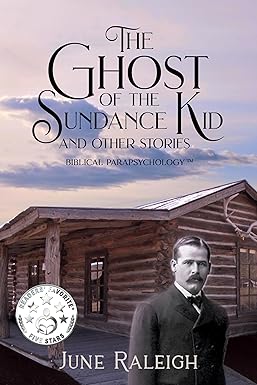

June Raleigh’s The Ghost of the Sundance Kid and Other Stories is a unique blend of frontier history, spiritual inquiry, and personal narrative. The book opens with the titular tale of the Sundance Kid’s ghost, sparked by a photograph the author says shows his apparition. What follows is a deep, often reverent dive into the life and legend of Harry Longabaugh, aka the Sundance Kid, as well as other real-life characters from the Wild West. Interspersed are thought-provoking spiritual reflections and biblical allusions. The latter half of the book includes additional paranormal-themed short stories that focus on modern settings, each infused with moral lessons and philosophical questions about the soul, justice, and the afterlife.
Reading this book was like taking a walk through an old ghost town with a guide who truly believes the past is still very much alive. I found Raleigh’s voice warm and intimate, and at times, disarmingly personal. She doesn’t hide behind scholarly distance; instead, she brings her own beliefs and experiences front and center. She made me feel like the Sundance Kid was more than a name in an old Pinkerton file—like he was someone still trying to be understood. The integration of biblical commentary alongside the outlaw lore gave the book an unusual but compelling heartbeat. It’s clear Raleigh sees history not just as facts, but as a spiritual echo.
The writing sways between storytelling, autobiography, and theology. There were moments when I wanted to dwell longer in the gritty details of the Old West, but the narrative would pivot sharply into spiritual reflection or social commentary. And while the ghost stories are touching and emotionally charged, they often read more like personal testimony than fiction or journalistic accounts. I admire the courage it takes to lay out one’s beliefs so plainly and connect the dots between past lives and present lessons.
This book left me reflective and oddly comforted. It’s for anyone who finds themselves wondering about the things we don’t see, the stories we forget, or the people history left behind. If you’re drawn to true crime, western history, ghost stories, or Christian spiritual writing, you’ll probably find something in here to chew on. It’s an honest and heartfelt work.
Pages: 80 | ASIN : B0BD9DTG9S

The Realm of Spirit

The Crying Tree and the Magic Rock is a captivating collection of true-life paranormal experiences interwoven with personal anecdotes and reflections. Why was this an important book for you to write?
I want readers to understand that we are constantly surrounded by and immersed in the realm of Spirit and that even in the most ordinary-seeming moments we may experience the sacred.
What is a common misconception you feel people have about paranormal events?
That anything paranormal is “of the Devil,” demonic, malevolent, or dangerous.
How has sharing your stories and experiences impacted or changed your life?
It’s made me aware of how many misconceptions there are in regard to the psychic and paranormal realm.
What is the next book that you are working on and when can your fans expect it to be out?
My next book is titled, “The Can Sack Ghost,” and is more nonfiction paranormal experiences, and fans can look for it in mid to late 2025.
Author Links: GoodReads | Website | Amazon
Enjoy the hair-raising supernatural event that happened to me when I was just a boy, running my paper route on my bicycle…in the dark; the magic rocks I’ve found over the years that wrote me messages on their surfaces; an incredible story of the Devil himself dancing with several women in a West Texas nightclub during Cinco de Mayo; guidance from the Other Side that enabled me to save the life of a young child; and…the bizarre story of a snake that saved me and my buddies from a beatdown!
And then, there’s those pesky UFOs! Read about my own up close and personal encounters with these strange craft and my subsequent observations that have led me to draw distinct conclusions about their behaviors. That’s just a smattering of the amazing true tales you’ll enjoy reading in my newest book, The Crying Tree and the Magic Rock.
I have three additional books available on Amazon for you to enjoy: Riding with Ghosts, Angels, and the Spirits of the Dead — A Knock in the Attic — 20 Ways to Increase Your Psychic Abilities
The Crying Tree and the Magic Rock


John Russell’s The Crying Tree and the Magic Rock is a captivating collection of true-life paranormal experiences interwoven with personal anecdotes and reflections. Russell takes readers on a journey through eerie encounters, from sentient trees to mystical rocks, blending a sense of wonder with profound themes about interconnectedness and respect for the natural and spiritual world.
Russell’s writing has a conversational tone that pulls you in, but at times, it feels almost too casual. The story about the titular “Crying Tree” stayed with me. Here, a half-dead magnolia tree with a face etched into its trunk becomes a symbol of neglect and care. Russell’s heartfelt interaction with the tree—and its eventual demise—was moving, especially as he detailed the “gifts” it left behind, like a canna and sunflower sprouting in its wake. Another standout moment is where a seemingly ordinary stone communicates with Russell, altering its weight, appearance, and even showcasing mystical symbols like his name. This chapter fascinated me but also raised questions. While Russell’s interpretations of these occurrences are earnest, the lack of critical exploration or skepticism may alienate readers who need more grounding. It’s undeniably entertaining, though, and his sincerity shines through every description. What truly kept me turning the pages were the unexpected doses of humor, as in “I Fried a Bus.” This anecdote about accidentally disabling a city bus with a burst of psychic energy was laugh-out-loud funny, showcasing Russell’s self-awareness and knack for finding humor in the bizarre.
The Crying Tree and the Magic Rock is ideal for those intrigued by the supernatural or anyone who enjoys deeply personal, reflective storytelling with a mystical edge. It’s not for skeptics looking for evidence or tight narratives. But if you’re open to wonder and a bit of the uncanny, this book feels like sitting down with a friend who has endless, bizarre, and heartfelt stories to share. It made me laugh, ponder, and—most importantly—believe a little more in the magic of the unseen.
Pages: 192 | ASIN : B0DK8MJ89N
A Surrender to Friendship

Someone Died in My House follows a man with a home inhabited by paranormal entities who has his balanced life torn apart while on a search for truth and justice. What was the inspiration for the setup of your story?
There is so much speculation about our mortal energy, as well as the power of real, genuine love sustaining itself, and whether or not both transcend this ‘earthly’ world. There have been countless, true stories of hauntings (my old ship-builder’s summer home in Nova Scotia was haunted by a friendly, residual spirit that I coaxed into walking towards the light, and it did.) The ‘bones’ of a house – its childhood, youth, adult life, and old age contain so many secrets that I couldn’t resist diving into a whole lot of research that in the end chilled me, made me laugh, and ultimately cry. I still cry when I think of the characters.
What were some of the emotional and moral guidelines you followed when developing your characters?
I wanted my characters in their desperation and failings to find kindness, compassion, and acceptance. All characters suffer and heal, but the way they heal is through a surrender to friendship, love, and self-belief. I treasure children more than anything; so, while in many stories children do suffer needlessly, I needed Annie not to be pushed into a life-threatening, dark place. There was enough suffering in my characters without dragging Annie into it. But I do want my readers to feel what the characters feel, and if possible, what I felt when writing it.
What intrigues you about the horror and paranormal genres that led you to write this book?
This is a great question. I tend to lean more toward mystery/thriller in soft S/F, but I would have to say I was more submerged in the initial murder (covered up) that reached out to Ben’s loss and creativity and sense of justice in order to discover the tragedy. I felt there might not have been a haunting if someone else had lived there. Rigo, the artist, knew Ben would be the one to listen and reunite him with Lexi. First and foremost to me was that this was a ‘love story’ wrapped up in everything else.
What is the next book you’re working on, and when can your fans expect it out?
I have final-drafted two works hopefully for release in 2024: When Bones Call Out (a mystery/thriller set in 2008 in Montreal) and KOVU (a chiller/soft SF set in 2023 near Toronto).
Author Links: Goodreads | Amazon
Graphic novelist, Ben Needham wakes up every day braced against something in his house, something that won’t leave. He works hard to create a near-perfect life for the three of them – himself, his daughter, Annie, and their dog, da Vinci. But when these disturbances blow out of control, Ben finds a team of forensic paranormalists who perform an autopsy on Ben’s house. Together they wade into its soulless history of murder and a cataclysmic haunting that redefines where life ends, and death begins. Ben surrenders what’s left of his fragile will to free his home from its terrifying anarchist and courageously opens a door he never knew existed, always asking himself what price he’d pay for truth, justice and unforgettable love.


