Blog Archives
My Embodiment Code I: The Cosmic Scribe


What happens when the life you’ve spent decades building begins to feel unfamiliar, and the questions you’ve carried since childhood suddenly demand your attention? In My Embodiment Code I, Lali A. Love takes readers on an extraordinary inward journey, exploring consciousness, identity, and the mysteries of human existence through the deeply personal lens of spiritual awakening. The first volume in her My Embodiment Code trilogy, this thought-provoking memoir follows Love’s search for meaning as she navigates childhood trauma, emotional exhaustion, grief, and a growing awareness of something she believes connects humanity to the greater cosmos. Her journey begins with questions many of us recognize: Who are we beneath the identities we’ve constructed? Why are we here? And how much of ourselves have we forgotten while trying to become who the world expects us to be? Love approaches these questions with vulnerability, curiosity, and an unmistakable sense of wonder, inviting readers into the experiences that have shaped her understanding of reality.
Love draws from quantum physics, neuroscience, Jungian psychology, sacred geometry, and ancient wisdom traditions, weaving these influences into what she calls her Harmonic Codex. Her reflections move between the intimate and the cosmic, examining everything from the body’s response to trauma to the possibilities of consciousness extending beyond our familiar understanding of space and time. Concepts such as quantum entanglement, black holes, holographic reality, and the Divine Architect become part of her personal vocabulary for exploring existence. These scientific and metaphysical connections are best appreciated as expressions of her lived experience and philosophical curiosity. Love’s richly layered prose gives the book an almost meditative rhythm, and her recurring imagery of light, geometry, frequency, and interconnectedness creates a distinctive atmosphere that carries throughout the narrative.
I think the memoir is especially impactful when Love brings these sweeping ideas back to the emotional realities of being human. Her reflections on childhood survival patterns, the longing to belong, and the ways grief settles into the body give the narrative its strongest emotional grounding. She writes with particular sensitivity about the difference between functioning in the world and genuinely feeling present within it. Her exploration of embodiment centers on learning to inhabit one’s own life with greater awareness, compassion, and emotional honesty. There’s something deeply relatable about her descriptions of carrying responsibilities, suppressing difficult feelings, and discovering how easily protective habits can become mistaken for personality. These passages offer readers a meaningful opportunity to consider their own relationships with fear, loss, self-worth, and healing. Love’s willingness to examine her inner world so closely gives even her most expansive spiritual reflections a personal foundation.
What makes My Embodiment Code I memorable is the sincerity of its exploration and the breadth of its vision. Love writes with the conviction of someone who has spent years searching for language to describe experiences that have profoundly changed her. Her lyrical style will particularly appeal to readers drawn to spiritual memoirs, contemplative philosophy, consciousness studies, and the intersection of personal transformation and metaphysical inquiry. The book asks for an engaged reader, someone willing to linger over its imagery, consider unfamiliar perspectives, and explore questions that resist easy answers. Through fourteen chapters, Love creates an intricate portrait of a woman learning to understand her life through an evolving relationship with consciousness, the natural world, and her own humanity. It’s an ambitious, intimate, and deeply reflective work that encourages readers to examine the extraordinary possibilities within ordinary existence. Lali A. Love turns the search for the universe’s deepest mysteries into something beautifully personal: the courage to come home to ourselves.
Pages: 298 | ASIN : B0HMFV2LBS

The Power of Caring: Who Cares, Why It Matters, and How Conscious Caring Creates a Fulfilling and Connected Life
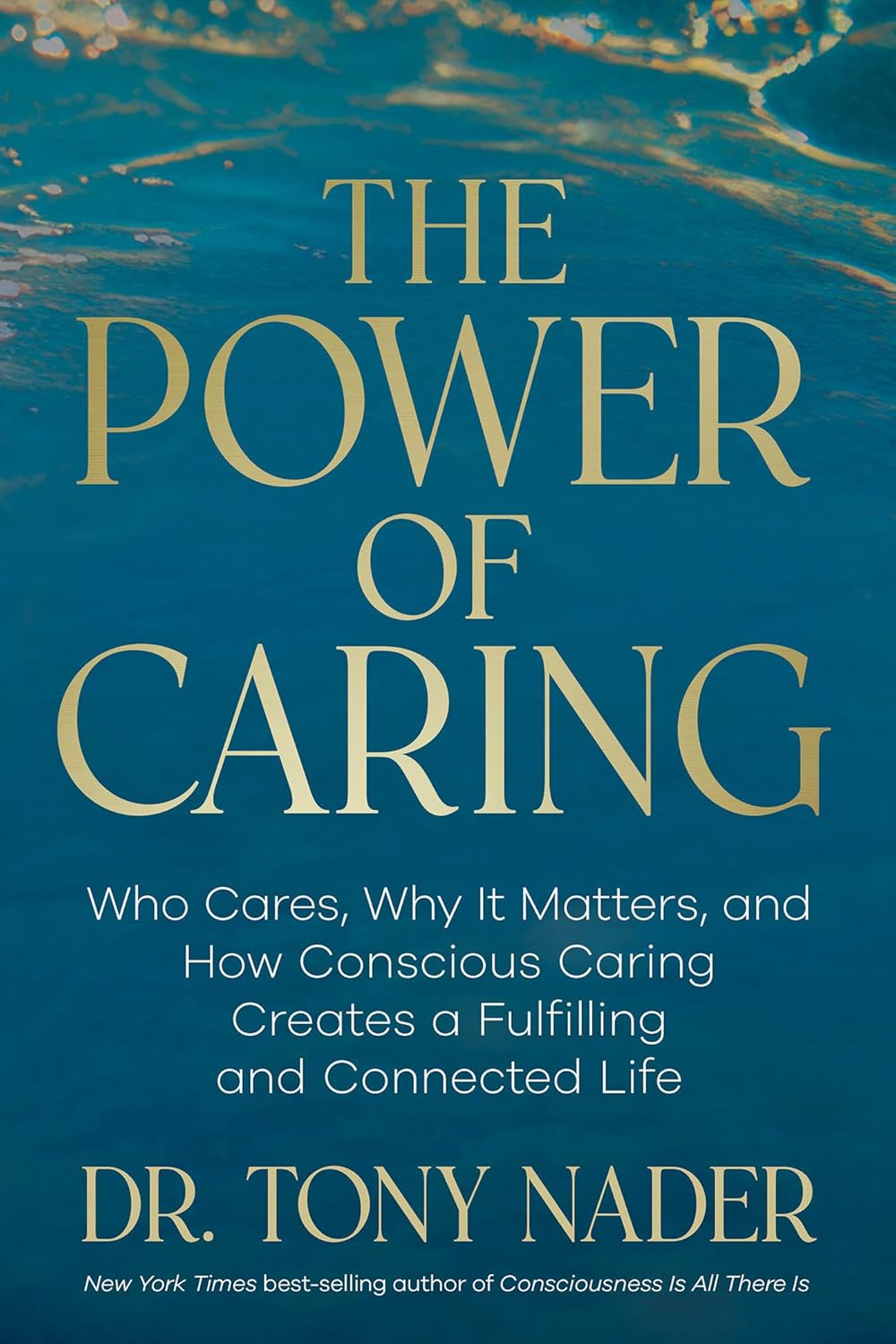
Dr. Tony Nader’s The Power of Caring is a thoughtful and wide-ranging look at why caring matters, how it shapes daily life, and how we can practice it without draining ourselves dry. The book begins with a simple question, “Who cares?” and turns it into a lens for looking at biology, philosophy, relationships, work, money, education, grief, technology, the planet, and spiritual life. Nader’s central idea is clear from early on: “This book does not ask you to care more. It asks you to care better.” That distinction gives the book its strongest practical footing.
What makes the book engaging is the way it treats caring as both deeply personal and much larger than the individual. Nader moves easily from hospital-room stories and family reflections to neuroscience, ethics, and the Consciousness Paradigm, his view that consciousness is the fundamental field beneath everything. That spiritual and philosophical framework gives the book its broad shape, but the chapters stay grounded through examples, reflection questions, quick resets, and takeaways. It feels designed to be used, not just read.
The book’s best sections are often the ones that deal with the tension between compassion and exhaustion. Nader understands that caring can become control, burnout, selective concern, or anxious overreach. Rather than pushing readers toward endless sacrifice, he keeps returning to steadiness, boundaries, renewal, and attention. His conversational style helps here. He’s not scolding the reader into being kinder. He’s inviting them to notice where their care is already going and whether it’s being spent wisely.
There’s also a strong sense of scale in the book. Caring for one person, tending the body, choosing meaningful work, responding to conflict, and thinking about future generations all become part of the same larger practice. Nader’s recurring image of ripples works well because it gives small acts real weight without making them feel grandiose. Near the end, his invitation becomes simple and memorable: “Care in your way. In your measure. With your rhythm.” That line captures the book’s softer wisdom.
The Power of Caring is ultimately a practical-spiritual guide to living with more conscious attention. It blends science, philosophy, meditation, and everyday ethics into a book that asks readers to take their influence seriously without carrying the whole world on their shoulders. Its message is steady and humane: caring is not a performance, a burden, or a personality trait reserved for unusually noble people. It’s a daily form of participation, one choice at a time.
Pages: 352 | ASIN : B0GWLT1MJR


