Blog Archives
The New Normal

Baby Brother-Itis follows a four-year-old girl who is convinced she’s come down with something called Baby Brother-Itis and spirals into a flurry of imagination, questioning what it is, whether it’s contagious, and how her world will change. What was the inspiration for the setup of your story?
Our children were my inspiration for Baby Brother-Itis. Our son was born early during my husband’s deployment with the U.S. Army. He was born with medical complications and required a lot of extra care. Our daughter never had to “compete” for our attention it was always hers alone. With a new baby in the house and only one parent caring for both children sadly, she was feeling the strain of our “new normal”.
What were some ideas that were important for you to share in this book?
I wrote this story 25 years ago; and put it in a filing cabinet. Periodically throughout the years I would pull it out and read it to our children. We moved 21 times in 23 years with the Army and a lot changed within our family dynamics during that time. Initially we only had 2 biological children when I wrote this; and adopted 3 more children years later. I wanted to incorporate all 5 of the children in the book. Each page is actually one of our children, with their unique characteristics.
What scene in the book did you have the most fun writing?
The scene I had the most fun writing was where sister says all the baby does is “eat and sleep all day”. Our son the “baby” is now 28 and when he came home from a deployment with the U.S. Army, he reverted back to the baby and once again “eat and sleep” all day. I also love the illustrations on that page; Tullip Studio did an amazing job with the illustrations.
I find a problem with well-written stories in that I always want there to be another book to keep the story going. Is there a second book planned?
The question keeps coming up about another book for this story. It definitely has given me something to think about. I’m excited to say, I have been working on another book not associated with Baby Brother-Itis and hopefully it will be available later this year.
Author Links: Website | Instagram | YouTube
As her overactive imagination runs wild, she starts feeling left out, confused, and even jealous. She overhears a conversation about her “mysterious” illness, sparking a journey of self-discovery. But despite the changes, she slowly warms up to her little brother, realizing that love isn’t divided—it grows.
Motivating and Empowering Kids

Jordyn’s A to Z Affirmation Book is a radiant and inspiring children’s book that transforms the alphabet into a journey of positivity and empowerment by introducing each letter with a meaningful affirmation to promote self-confidence, kindness, and inner strength. What was the inspiration for your story?
I wanted to have a book that motivated kids to dream big and to think big, my daughter suggested that I add an affirmation book to my series. She and I worked together on this project. I also added a new character to the series, Jordyn’s cousin named Jordan to this book. I wanted them to take turns motivating and empowering kids in their own way, and to let kids know there are no limits in what they can accomplish in their lives: whether it’s becoming a doctor, a professional athlete or running their own business one day. I wanted the story to build confidence, self-love, and resilience.
What were some educational aspects that were important for you to include in this children’s book?
First and foremost, this book encourages children to read and gives them the tools to know their self-worth. The book encourages kids to embrace their unique qualities, and to believe in themselves. All of my books encourage kids to read. That’s why I created my children’s book series to encourage children to read to have fun while doing so; while also empowering young minds to think big to dream big. The book is meant to be an educational tool for teachers, counselors, and parents to use daily to nurture a strong and positive mindset in their students and children. My inspiration was to inspire my young readers to dream and to keep dreaming, and for them to know that there are no limits in what they can achieve.
What scene in the book did you have the most fun writing?
The letters V and W, where Jordyn and her cousin are a princess and a prince. I definitely wanted to include that in this book. Children need to know they are valuable and worthy, and they need to hear it or read it daily. Self-love and developing inner strength can go a long way in life, and this book does that with each letter of the alphabet. Every letter introduces a positive affirmation.
Where does the next book in the series take the characters?
I’m still trying to figure out what’s next, whether I want to add more characters or what the next journey will be in the series. I’m sure it will be a wonderful and exciting storyline for my readers to enjoy.
Author Links: GoodReads | Amazon
Jordyn’s A to Z Affirmation Book encourages kids to embrace their unique qualities, celebrate diversity, and to believe in their dreams. This book is designed to foster a growth mindset and emotional well-being for children, while learning the letters of the alphabet with a positive affirmation and can be used daily as a tool for parents, teachers, and caregivers to nurture a strong and positive foundation in young hearts and minds. This book is meant to inspire, empower and motivate all kids. The book also includes several coloring pages to keep kids engaged.
The Adventures of Arya and Krishna Betta Fish : Desert Oasis
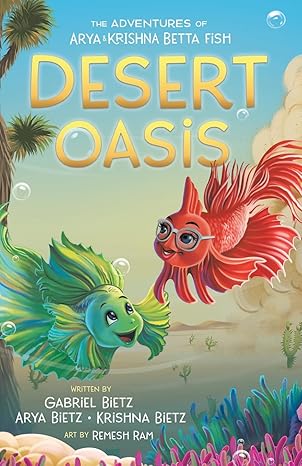

In The Adventures of Arya and Krishna Betta Fish: Desert Oasis, by Gabriel Bietz, readers are reunited with the charming betta fish siblings, Arya and Krishna, along with their parents, Gabe and Amita. Their journey continues alongside their human companions, Amer and Annie, as they navigate a series of unexpected events in the desert. This sequel brings a fresh and exciting perspective to the series, building upon the engaging narrative established in the first book.
The storyline is filled with humor and heartwarming moments, making it a standout in contemporary family adventure fiction. I was captivated by every twist in the plot, finding the blend of Arya and Krishna’s cleverness with Gabe’s humor and Amita’s wisdom particularly compelling. The development of Amer and Annie’s characters adds depth to the story, though I missed the more prominent roles of Blake and Sharktooth from the first book.
The encounter with Sam the Snake initially raised concerns for me, but the narrative remained engaging and lighthearted, filled with innocent fun. The inclusion of a scene featuring a young girl on an airplane adds a delightful touch, underscoring the story’s light-hearted nature.
The Adventures of Arya and Krishna Betta Fish: Desert Oasis, suitable for readers aged seven and up, delicately balances minimal fantasy violence and themes of mortality within its cozy and comforting narrative. It’s an ideal read for a relaxing winter evening by the fire, offering a blend of gentle action and humor. This engaging family adventure, perfect for those who appreciate a narrative with a sprinkle of whimsy, comes highly recommended and leaves me eagerly anticipating the next installment in the series.
Pages: 143 | ISBN : 978-1737795582

A Step in the Right Direction

Stormy Sailing follows a young boy and his father, on a journey with their refugee family, who get separated from the rest of the family and try to find a way to reunite with them. What was the inspiration for your story?
Even today, conflicts surround us, impacting people—families and children, too—in various ways. Some of us follow such events in the news. For others, social unrest and even war situations are part of their daily lives, forcing them to fight for survival.
It’s painful to witness world events that cause suffering, especially for children. They are innocent of the conflicts that displace families from their homes. Under inhumane conditions, little ones begin their lives without the security and joy that should be inherent to every child’s life. All means that could assist in this regard must be utilized.
There are influential individuals in society who possess the keys to important solutions, but we, the ordinary people, can affect them. We can also elevate the voices that might otherwise be silenced.
I feel like I’m an insignificant influencer, yet I strive to make these challenging situations visible through my children’s books. A storybook is a humble way to spread attitudes and feelings that, in turn, influence actions. It could be a step in the right direction.
What were some ideas that were important for you to share in this book?
The main themes of Stormy Sailing are the strength of close relationships and the significance of collaboration during challenging times. For family members, this is based on their love for one another and their readiness to make sacrifices for each other’s well-being.
The story’s overwhelming difficulties are portrayed through the eyes of the two main characters, a father and a son after their other relatives have already departed for the other side of the sea. Although the narrator describes the events from an outside perspective, the dialogues uncover the different perspectives of the adult and the child.
The father has his own role as an adult. He represents a parent who strives to ensure his child’s survival in every way possible. On the other hand, the child also has strength and refuses to give up. His sincerity and childlike optimism motivate the father to do his best from nearly impossible starting points.
For me, one of the most difficult parts of the story to write was when the father instructed his son to hold on to him as long as he was afloat. In other words, this means that the father tells his son to let go of him if necessary, in order to save himself. The father acts calmly, as a parent should behave to prevent the child from panicking. – In the most challenging situations, the greatest love also appears purest.
What is one thing that you hope the reader takes away from Stormy Sailing?
Earlier, I discussed the themes I consider most important in my story. If I were to highlight one more idea that could provide valuable support for the reader’s journey, it would be perseverance.
There are times in life when it seems like all means have been exhausted. It may appear that trying is no longer worthwhile. Even then, the Finnish saying “while there’s life, there’s hope” holds true. Although the outcome may not meet our expectations or may even be miserable, it feels better to have had the courage to make the attempt.
Even if our efforts were unsuccessful, we can at least be sure that nothing more could have been done. There is no blame or regret afterward. This relates to self-respect and confidence as well. Making the most of every opportunity strengthens us for the next time when that strength is needed.
What is the next book that you are working on and when will it be available?
I’m continuing my work on the Lyrics of Life Series, including Stormy Sailing. The second volume, illustrated by Spanish artist Catty Flores, has already been published and is titled Carried by Wings. The next two volumes in the series, The Hermit’s Hut and A Star Gazer are currently in progress, both illustrated by Nyamdorj Lkhaasuren from Mongolia.
My favorite songs inspire the books in my Lyrics of Life Series. Music is woven into my writing in various ways. Sometimes it plays in the background while I sit at my computer, immersed in a story. At other times, it creates moods that motivate me to explore new topics.
What has happened with this series is inspiring. I noticed that certain songs have played a significant role in my life at various times. Initially, they were on the radio when I was a child or teenager. Later, I rediscovered them as I sought the memories and emotions they evoked. Ultimately, they now serve as a source of inspiration for the children’s book series that has emerged.
In Stormy Sailing, waves from Rod Stewart’s “Sailing” were echoing in my mind. The song was written by Gavin Sutherland in 1972. In Carried by Wings, the winds of the Andes were blowing in my mind, and so was the Simon & Garfunkel song “El Cóndor Pasa” (“If I Could”). The original music was composed by Daniel Alomía Robles in 1913. These popular songs play in the background of the two latest episodes. I won’t reveal the other two until Nyamdorj Lkhaasuren and I have finished the books.
I have truly enjoyed writing the Lyrics of Life Series, and I hope the melodies resonate with the stories, even if they are not played out loud. Music has a wonderful effect and connects people everywhere, even when we do not realize it. Various forms of art inspire one another, and together, they influence human lives, including children’s lives.
Author Links: GoodReads | X (Twitter) | Facebook | Website | Amazon
Can a homemade ship, assembled from the wreck of a sailboat, last in a stormy sea? Will father and son survive the sea crossing and find the rest of the family?
The Power of Stories

Our Song, Our Voice follows a young golden crow as he embarks on a journey to save his grandmother and preserve his flock’s fading traditions, proving that courage, wisdom, and song can bridge generations. What was the inspiration for the setup of your story?
The main inspiration for this Our Song, Our Voice can be found in the UNESCO Indigenous Languages Decade (2022-2032). When I learned more about the topic on their website, the idea of approaching the issue through nature developed in my mind. After all, human cultures are directly connected to nature and the changes that occur within it. Just as indigenous peoples are affected by the changes caused by the modern world, the ecosystem, with its animals and plants, also undergoes a similar experience.
In my story, golden crows that once inhabited vast areas have become increasingly rare as wilderness areas shrink and diminish. Their customs and songs, which correspond to the cultures and languages of smaller groups of people, are also threatened.
I feel great sympathy for the languages of the people. Small language areas, in particular, are in danger when larger languages encroach upon them. The new unilateral development is gaining momentum from global communication, where a few languages dominate. It is inherently good that the people of the world understand each other as widely as possible and without linguistic barriers. Alongside such development, we should also strive to preserve the languages of smaller regions, peoples, and cultures. This is essential for individuals’ identity.
What role do you believe storytelling plays in preserving cultural traditions in the real world?
The power of stories is eternal. It has undoubtedly been utilized for as long as humans have been able to speak. Even in its simplest and most original form, it has been, after primitive basic skills, the most crucial tool for the survival of the human species and the development of culture. In addition to transmitting knowledge and skills, stories have conveyed all the human experiences and emotions that have fueled the progress of the human species, enabling complex forms of cooperation to arise.
The power and need for stories have not diminished as societies have evolved. They are used everywhere: in education, politics, and marketing; the list is endless. The immense power of storytelling can serve both good and bad purposes. At best, it continues to convey valuable information and emotion, forming the basis for human action. At worst, its messages are deliberately distorted, aimed at manipulating people to serve questionable goals and selfish interests.
In my children’s books, I explore and utilize the possibilities of storytelling for various essential purposes. I aim to convey information about today’s world, including history and traditions, to children in an appropriate manner. I believe this approach helps them gain a better understanding of society and function within it.
What were some themes that were important for you to explore in this book?
A central underlying theme in this storybook is the changes occurring in nature. The consequences of drastic economic projects for all living beings are often alarming and, at worst, irreversible. Increasing numbers of animal and plant species, as well as entire ecosystems and life forms, are under threat.
However, I believe that changes in nature should not be presented to children in an overly frightening or threatening way. My goal is to instill in them a respect for nature and a sense of responsibility for preserving it, rather than blaming them or projecting overwhelmingly disturbing images of danger.
I want to highlight the significance of cooperation and care between different generations as a vital foundation of humanity. By being deeply connected with people of various ages, we can pass down traditions and transfer knowledge to future generations as part of human interaction. The experiences of our predecessors pave the way for subsequent travelers on the paths of life.
My little protagonist’s name is “SISU,” a Finnish word that reflects an important theme in the story. It means determination, not giving up, and trying hard despite difficulties. It represents a stubborn strength that doesn’t make a big fuss about itself but acts regardless of obstacles. I thought it was a funny name for a little character, but it holds significant meaning and plays a crucial role in the national identity of people from my home country.
How did you develop the deep, heartfelt bond between Sisu and his grandmother, Una?
Relationships between members of different generations have always been meaningful to me. Important individuals older than me have greatly influenced my life.
To describe the special bond between Sisu and her grandmother in the story, I have drawn from moments and conversations I shared with my grandparents, who were part of my life for the longest time. Now, they are just a dear memory.
My grandfather, who lived in northern Finland, was an honest, old-fashioned man. He was skeptical of reforms that changed his world too much or too quickly. One detail in the story particularly relates to him: using tree resin for healing.
I have heard that my grandfather collected resin while walking in the forest and rolled it into a ball to take home. He would cut off pieces as needed and treat wounds or skin lesions with that gift from nature. Today, the disinfectant properties of resin are also recognized in medicine.
The story also reflects the peaceful togetherness I’ve experienced with my grandparents. They made time for me and shared many lessons that I still carry with me on my life journey.
Author Links: GoodReads | Website | Amazon
Sisu’s grandmother Una wants to teach him important lessons about life, including the crows’ traditional songs and language. The flock is among the last of their species, and Grandma worries their unique songs and customs will disappear forever.
Then little Sisu takes on a big task, a journey that is not only important to his grandmother but also to the future of all golden crows.”
Imagination Took Over

The Attic Door follows a little boy in a new bedroom that has a strange door where strange and scary sounds come from who works up the courage to investigate what is behind the door. What was the inspiration for your story?
The inspiration for The Attic Door came from my experience in second grade when I lived in Chicago, Illinois. My family moved into a new house, and my sister, brother, and I each got to choose our own bedrooms. Unfortunately, I picked the one with a large door that led into the attic. At first, I didn’t think much of it, but that quickly changed once night fell—especially during Chicago’s windy winters. The attic door would rattle and shake, and I began having nightmares. Eventually, my younger brother and I switched rooms, since the attic didn’t bother him at all. But as fate would have it, his old room—now mine—had a window that opened onto the roof. Of course, my imagination took over once again. I had to endure the rooftop window for another year until we finally moved!
What were some ideas that were important for you to share in this book?
I loved writing the story, and the completed illustrations made me love the picture book even more.
The art in this book is fantastic. What was the art collaboration process like with the illustrator David Barrow?
All communication went through the publisher. She shared the illustrations as David completed them, and I provided feedback. It was an easy process because David captured everything just as I had envisioned.
What is the next book that you are working on, and when will it be available?
I submit directly to publishers and currently have three stories out on submission. No takers so far, but I’m keeping my fingers crossed!
Author Links: GoodReads | Amazon
Scary noises are coming from the creepy attic door in Eduardo’s bedroom. His imagination goes wild!
When Eduardo (and his stuffed alligator) finally gather their courage to go investigate, is it a ghost? Or a monster? Or something unexpected?
Sisters and Mothers


Angry? That’s Okay! follows a group of seven animal friends on a camping trip who learn some important lessons on coping with the overwhelming feelings that result from frustration and disappointment. Where did the idea for this book come from?
As sisters and mothers with backgrounds in mental health and play-based education, our goal is to not only create space for children to feel their emotions but to give them tools that will help navigate life’s challenges. We wanted to address anger because it is an emotion everyone feels but not very many people understand how to navigate it. Our own children were the inspiration behind our characters, and we wanted this story to feel relatable to kids everywhere.
What is your collaboration process like? Do you have any routines in place for sharing ideas?
Living on separate continents brings a unique and oftentimes a little manic to our collaboration process. But thanks to technology, it is easier for us to keep track of said manic. We do mostly everything on our phones. We have a separate chat group that is just for book talk. And it helps that we are very much embedded in each other’s lives in the sense that we talk almost every day. So you hear of “power naps” but what we do are “power chats” wherein a small amount of time and competing with a 100 “look at this mums,” we share updates, thoughts, and action plans.
What do you hope young readers and their families take away from your story?
Anger often carries a heavy stigma—as if it’s a “bad” emotion. Because of that, many children (and even adults) aren’t equipped with the tools to handle it in a healthy way. We want our readers to understand that anger is a completely natural and normal emotion. The key isn’t to avoid it but to learn how to manage it in ways that are safe and constructive.
What is the next book that you are working on, and when will it be available?
We don’t have a specific title to announce just yet, but we do have a few exciting ideas in the works! Like our previous books, these upcoming stories will continue to focus on social-emotional learning and growth mindset themes. We’ve been releasing a new book each year since we began writing professionally, and as such readers can likely expect our 4th book sometime next year.
Author Links: GoodReads | Facebook | Website | Amazon
Through relatable scenarios, this book explores the different ways anger can look and feel. From clenched fists to racing hearts, young readers will learn to identify the physical signs of anger and discover simple, effective strategies to manage their emotions. Whether it’s deep breathing, body scans, or taking a break, each character in the story finds a method that works for them.
With vibrant illustrations and an encouraging message, Angry? That’s Okay! empowers children to understand that anger is a natural emotion-but learning how to handle it can make all the difference. Perfect for parents, teachers, and caregivers, this book is a valuable tool for fostering emotional awareness and resilience in young readers.
Small Life Lessons

The Curious Quest of Little Luna follows a fox who stumbles upon a mysterious treasure map in the woods, sending her on a whimsical journey filled with excitement, challenges, and meaningful moments. What was the inspiration for your story?
The inspiration for Little Luna came from watching my own children explore with such curiosity and wonder. I wanted to create a story that encouraged that same spirit of adventure—one that blends imagination with small life lessons. Luna’s journey is not just about finding treasure, but about what she learns along the way.
What were some educational aspects that were important for you to include in this children’s book?
One of my goals was to subtly introduce problem-solving, emotional resilience, and the value of curiosity. Luna faces challenges that require her to think, adapt, and sometimes lean on the help of others. These moments offer gentle reminders to young readers that it’s okay to make mistakes, ask questions, or feel uncertain—as long as you keep moving forward.
What scene in the book did you have the most fun writing?
Rather than one specific scene, what I enjoyed most was the process of introducing new characters as the story progressed. Each one added a unique energy and helped shape Luna’s journey in a meaningful way.
Is this the first book in the series? If so, when is the next book coming out, and what can your fans expect in the next story?
The Curious Quest of Little Luna is a standalone story and not part of a planned series. Luna’s journey wraps up in this book.
Author Links: Goodreads | X (Twitter) | Facebook | Website | Amazon
When Luna, a curious young fox, stumbles upon a mysterious treasure map, her quiet forest life transforms into the adventure of a lifetime. With bravery in her heart and a twinkle in her eye, she sets off to uncover the secrets of the map—but she won’t be journeying alone.
Joined by her wise owl friend Benny, the clever turtle Fin, and the fearless rabbit Tilly, Luna ventures through roaring rivers, tangled bramble paths, and the magical Starlight Glade. Together, they face challenges, solve mysteries, and discover that the greatest treasures aren’t glittering gold or sparkling gems—they’re the friendships, courage, and love found along the way.
What’s inside this heartwarming story?
A delightful tale of adventure, friendship, and bravery.
Stunning illustrations on every page that bring the magic of the forest to life.
Memorable characters who teach the power of kindness and teamwork.
Perfect for readers ages 5–10, families to enjoy together, or as a cherished bedtime story.
The Curious Quest of Little Luna is a timeless journey that inspires kids to embrace the magic of adventure and the beauty of connection. Whether read aloud or enjoyed independently, this book is destined to become a family favorite.
Discover the magic, wonder, and lessons that will stay with your little adventurer for a lifetime!



 LITERARY TITAN