Blog Archives
Navigation


Linda Neal Reising’s Navigation is a poetry collection that serves as a compass through personal memory, cultural history, and collective grief. Split into four parts, the book traverses everything from Native American identity to coming-of-age nostalgia to haunting reckonings with war and environmental collapse. At its core, this is a book about mapping trauma, tenderness, and survival in lyric form.
What really struck me was the way Reising’s poems blend elegance with grit. In “After Learning That a Woman and Her Baby Were Killed in the Bombing of a Ukrainian Maternity Hospital,” Reising writes of a cardinal’s remains as “feathers so pale a red they verge on pink,” a line that knocked the wind out of me. It’s delicate, yes, but brutal in its imagery. There’s no hiding from sorrow here. She doesn’t preach, she mourns. And in doing so, she lets you mourn too. That balance of beauty and ache shows up again in “Earth Day Lockdown,” where goats and jackals reclaim cities during COVID, as if nature’s revenge is not violent but theatrical. It’s weirdly funny and deeply sad.
I also loved the nostalgic, rough-edged sweetness of her childhood and youth recollections. “Dolly’s Debut” is a standout, so vivid, I felt like I was there in front of that new Zenith TV set, eating popcorn and watching Dolly Parton sparkle onto the screen for the first time. The mix of admiration and longing is infectious. Similarly, “Partial Eclipse” captures the awkward magic of being a seventh-grader with a shoebox solar viewer and a million questions you’re too young to answer. Her ability to make the small moments feel cosmic and vice versa is what gives the book so much punch.
Then there’s the raw nerve of her poems about generational trauma, especially those tied to her Cherokee heritage. “Education of a Sixth-Generation Cherokee Refugee” gutted me. Her grandmother didn’t pass down traditions, only superstitions and fear. That sense of loss, of something beautiful never even getting the chance to take root, hangs heavy. And in “Disappeared” and “The Poetry of Their Names,” Reising doesn’t flinch from the horrors of Native boarding schools and the epidemic of missing Indigenous women. These poems are like open wounds, necessary, unforgettable, hard to read, and harder to ignore.
Navigation is a powerful, heartfelt book for readers who love poetry that tells stories and stirs things up. It’s not airy or academic, but it’s grounded, lyrical, and bold. If you’ve ever felt lost, Reising might not hand you a map, but she’ll sit with you in the wilderness.
Pages: 90 | ISBN : 1639806903

Poetry for Peace

Poetry for Peace is a soulful collection of poems that gently nudges readers toward inner calm, healing, and reflection. Structured almost like a workbook, this book interweaves lyrical meditations on topics like prayer, loss, love, personal growth, and gratitude with prompts for reflection and aspiration. Through a sincere and spiritual lens, Dwyer explores how we can access peace by turning inward, embracing silence, remembering our dreams, and finding strength in grace and humility.
Reading this book felt like being invited to a quiet beach at sunrise. The writing isn’t flashy or complex—it’s earnest and heartfelt. There’s something relatable and inspiring in the simplicity of the language. Lines like “Let go, you have held the pain long enough” or “Believe in miracles, for you are one” sound almost like whispered advice from a trusted friend.
What I appreciated most is the raw vulnerability threaded through these pages. Dwyer doesn’t shy away from sorrow, confusion, or doubt, but he never lingers in darkness either. Each poem, no matter how steeped in struggle, circles back to hope. Some poems felt deeply spiritual—almost like prayers—and others were grounded in everyday beauty. I found myself unexpectedly moved by the pieces on aging, family, and the weight of forgiveness. And while not every poem landed for me, the heart behind them always did. There’s real compassion here. Real gentleness.
I’d recommend Poetry for Peace to anyone feeling emotionally overwhelmed, spiritually dry, or just in need of a quiet moment. It’s not a book to blaze through—it’s a companion to keep close by. Ideal for lovers of spiritual poetry, seekers of personal peace, and those who value affirmations and reflection. It won’t change your life in one sitting, but if you let it, it might open a door you didn’t know was closed.
Pages: 112 | ISBN : 1478793147
Analog Synthesis


Analog Synthesis is a rich and restless poetry collection by Christopher Fried that drifts through nostalgia, pop culture, and philosophical reflection. Split into two sections—“Retro Speculative” and “Iconoclasts”—the book reads like a time machine wired to a synthesizer. Fried channels memory, media, and meaning into formally composed verse, touching on everything from VHS tapes and video games to forgotten poets and outmoded ideologies. The poems pulse with synthwave energy, cinematic flair, and bittersweet homage to decades gone.
Reading this collection felt like walking through a dusty but beloved video rental store, every poem a cassette tape pulling you into another microcosm. Some poems hit like a sugar rush—immediate and nostalgic—while others unfold slowly, pushing you to sit with them. I was especially struck by Fried’s commitment to form. Sonnets, quatrains, and other metrical devices give the collection a tight rhythmic engine, but this isn’t stiff or academic; it’s playful, moody, and deeply personal. Sometimes his nostalgia is tender, then funny, then sad in the span of a stanza.
While I enjoyed this collection, I felt like the writing occasionally leans so heavily into references that it risks alienating readers less familiar with its touchstones. There were moments when the homage became a bit too insular, like a fan convention you enjoy but can’t quite join. Still, even in those moments, the emotional honesty kept me engaged. Fried doesn’t just celebrate the past, he interrogates it. The poems grieve the things we lose, laugh at the absurdity of what we remember, and hold up flickering screens to what endures. The voice is unique, sometimes jaded, sometimes ecstatic. It felt like a voice trying to make peace with both beauty and decline.
I’d recommend Analog Synthesis to readers who grew up blowing into NES cartridges, who still feel something when John Williams’ scores swell, or who find themselves haunted by the glow of an old TV set. It’s for lovers of formal poetry who don’t mind pop lyrics next to philosophy. This book made me smile, made me wince, and made me want to revisit old movies and old selves.
Pages: 85 | ASIN : B0F5MT7D8P
The Fusion of Faith and Nature

In Foundation Under My Feet, you share with readers your journey through life’s challenges and your own exploration of the Christian faith. Why was this an important collection for you to share?
This collection was important for me to share with readers because I wanted the reader to seek their journey of faith and to unlock the deep realization of its tremendous value. As a follower of Christ, the more I delve into what that means through nature, writing, prayer, theology, and worship, the more I comprehend its intrinsic value to the heart, mind, and soul. I have also found that there is a gap in published works of poetry regarding a more subtle emphasis on faith, specifically Christianity. Of course, there are a lot of wonderful published works regarding faith, but I wanted to create a book that touched on those themes without being overly grandiose about it. I love the fusion of faith and nature, and that many people connect faith to nature on a soul level.
How do you know when a poem is truly finished?
It is difficult to know when a poem is truly finished. You sift through each word, each stanza with a fine-toothed comb, playing with punctuation, meaning, and flow. One day you’re pleased, the next day you re-read your poem and add adjustments you did not consider before. I have found that once I have completed this process multiple times, it is only when I get a sense of creative peace when reading my poem that I can ultimately say it is finished.
What was the biggest challenge you faced in putting together this poetry collection?
The biggest challenge I faced in putting this poetry collection together was to force myself not to rush the process and to make sure I had a polished book that fit the vision I was after. My natural tendency is to be a “sprinter,” not a “marathon runner,” so I had to discipline myself throughout the process of writing and creating my book.
What is one thing you hope readers take away from your experiences?
My goal in writing Foundation Under My Feet is to give hope and inspiration through life’s great adventures, challenges, and faith. As I was in the process of creating my next book, this one came to my mind and demanded its creation. So here I am, writing to you, the reader. I hope you enjoy reading this book as much as I enjoyed its creation.
Author Links: GoodReads | Website

Literary Titan Book Award: Poetry

The Literary Titan Book Award recognizes poets who demonstrate exceptional artistry and proficiency and push the boundaries of language and expression. The recipients are poets who excel in their technical skills and evoke deep emotional responses, challenge thoughts, and illuminate new perspectives through their work. The award honors those who contribute to the literary landscape with their unique voices and powerful words.
Award Recipients

Visit the Literary Titan Book Awards page to see award information.
My Bee Soliloquy
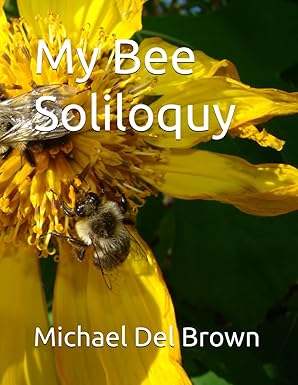
My Bee Soliloquy is a sprawling meditation on bees, both literal and metaphorical. The book dances between themes of nature, spirituality, philosophy, and even history, all framed within the fascinating world of bees. It’s a poetic and symbolic exploration of life itself, borrowing from science, mythology, and personal reflection. The structure is unconventional, feeling almost like a collection of musings rather than a traditional narrative. With chapter titles ranging from “Geometry” to “Bee Math” and even “Bloods and Crips,” it’s clear from the outset that this book refuses to fit into a neat little box.
What struck me first was the sheer ambition of the writing. It moves fluidly between subjects, often blending the mystical with the scientific. There were moments when I felt completely absorbed in the poetic flow, like in the chapter “The Bee in the Apokatastasis,” which seemed to weave together theological concepts with the natural order of hive life. At other times, there are sections that jumped abruptly between ideas. While this nonlinear style adds to the book’s unique voice, it also made some parts feel like an abstract puzzle. Still, there’s something hypnotic about the way the author treats bees, not just as creatures, but as symbols of deeper truths.
Some chapters, like “Bee Believes” and “Beeology-Theology,” delved into religious and philosophical reflections that were intriguing. On the other hand, sections like “Japanese Honey Bee” and “When There Are No More Bees” were more grounded and informative, bringing a refreshing clarity amidst the more abstract passages. There’s a lot of wisdom buried in the text, but the reader has to be willing to embrace the book’s unpredictable structure to fully appreciate it.
If you love books that blur the line between poetry, philosophy, and science—books that challenge you to think in new ways—this one is worth diving into.
Pages: 80 | ASIN : B0DX8KHQLD
Humor is an Incredible Tool

Five Minutes from a Meltdown is a cheeky, offbeat, ridiculously entertaining mashup of punchline poetry and snarky cartoon fun. What was the initial idea behind this collection, and how did that transform as you were writing the book?
I originally started writing comedic poems to provide some joy to my friends and family who subscribed to my Substack, and they were very kind in their responses. Some might say they were too kind, as their positive feedback resulted in me writing hundreds of these poems. Some were sillier than others, some more thoughtful, and many (hopefully) a combination. The poetry collection came together slowly, until I had a manuscript of 100 poems that I thought might be a nice compilation. As I wrestled with which to include and in what order, I started with the funniest, but then began to consider those that I felt had some more meaning or sincerity to them (something I’m not always as comfortable with). I tried to strike a balance as the book came together, to get readers not just to laugh, but think just a teeny bit too.
The cartoons in this book are as entertaining as the writing, elevating this collection from amusing to laugh-out-loud enjoyment. What was the art collaboration process like with the illustrator Mark Hill?
I originally sent over some potential illustrations that I myself drew to my publishers at Yorkshire Publishing. They looked at my sketches and responded with a gist of…”Great ideas! We’ll find someone else who can actually draw” (they said this more kindly and diplomatically). That was the right choice. I’m a writer, not an illustrator. When Mark came onboard, it became clear immediately that he was going to be the right fit. His illustrations were the exact style of playfulness and thoughtfulness I hoped for, and every idea he had for the illustrations was complementary and elevated the humor and meaning of the poems. The process couldn’t have been easier, and I’m so grateful to have had him as a collaborator!
How did you decide on the themes that run throughout your book?
All the themes of the book have come up in my life. From the goofiest and most unrealistic of thoughts about our world to the most serious and real mental illness I’ve dealt with, I have personal experience with every concept in the book. For the book, I tried to navigate each topic humorously, but also treat those that needed more care both intentionally and thoughtfully. My publisher helped me pare down the plethora of poems in the first manuscript to those that had a cohesive or comedic idea, or preferably both. With their help, I am happy to say that we found the 60 poems that were the best for this collection.
What is one thing that you hope readers take away from Five Minutes from a Meltdown?
I hope to inspire a little reflection on how silly our world truly is, and remind everyone that humor is an incredible tool to help us all connect and relieve stress. If I can get a few chuckles or make any reader think about a topic more deeply, or both, I’ll be thrilled. I hope the message comes across to look around, laugh, and smell the roses (and presumably sneeze; I have terrible hay fever).
Author Links: GoodReads | X | Facebook | Website
Get ready to laugh out loud with this collection of awkward encounters, groan-worthy puns, clever turns of phrase, and hilarious cartoons. Through David Meyer’s perspective, discover the goofiness in the everyday and the idiosyncrasies of life. This collection of quick-witted, quick reads can be devoured in a single sitting or at a poem-a-day quota (to keep the doctor away).
The book is a perfect gift for a friend who likes to laugh, an enemy who hates to laugh, or a family member who needs a laugh (and to pay you back that money they borrowed).
Put it on your coffee table to be lovingly stained with hors d’oeuvres and good memories, on your bedside table to ward off nightmares, or perhaps in your bathroom, as everyone loves reading a book that other people on the toilet have been touching for years.
However you read, this comedic poetry book is sure to please.
5 Minutes From a Meltdown: A Comedic Poetry Collection
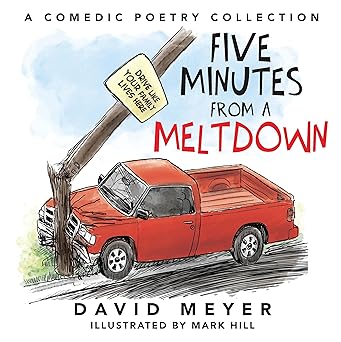
What do you get when a poet says they’re not really a poet, then proves they kind of are? You get Five Minutes from a Meltdown — a cheeky, offbeat, ridiculously entertaining mashup of punchline poetry and snarky cartoon fun. David Meyer isn’t trying to change your life. He’s trying to make you laugh out loud on a Tuesday afternoon. And he succeeds.
Right from the “this is not poetry” intro, Meyer sets the tone. No grand metaphors. No deep soul-searching. Just a parade of bite-sized poems, full of dad-joke energy, wry observations, and perfectly timed nonsense. The humor is sharp but not cruel, smart without being full of itself.
Each piece is like a mini comedy sketch. Some land like a classic stand-up punchline (“I’m the Next Great Supervillain” is a Teflon-coated jab at comic logic). Others are warm and weird, like the running gag of clueless parents and chaotic kids — see “Kids Like the Darndest Things” or the painfully real “My Biggest Fear, Ask My Exes”.
There’s a rhythm to the madness. Meyer plays with line breaks like a DJ dropping beats — awkward pauses, mid-sentence shifts, a lot of “wait, what?” moments that make the final line hit harder. The structure keeps you guessing, and that surprise is half the fun.
Now add in Mark Hill’s cartoons. They’re goofy in the best way — expressive, exaggerated, and full of that Sunday-paper charm. Each one is like a punchline’s wingman, jumping in with a wink and a smirk to make sure you get the joke. It’s not just poetry with pictures — it’s a tag team of absurdity.
This isn’t a book for your English lit professor. It’s for anyone who loves a good laugh, a clever pun, or needs a mental break from the world being on fire. Lighthearted, self-aware, and just the right amount of unhinged — Five Minutes from a Meltdown is like comedy comfort food. You’ll flip through it in a flash. You’ll quote it at brunch. You might even leave it on your coffee table, hoping guests pick it up and laugh.
Pages: 96 | ASIN : B0DK5P76RH



 LITERARY TITAN