Blog Archives
Intention and Action
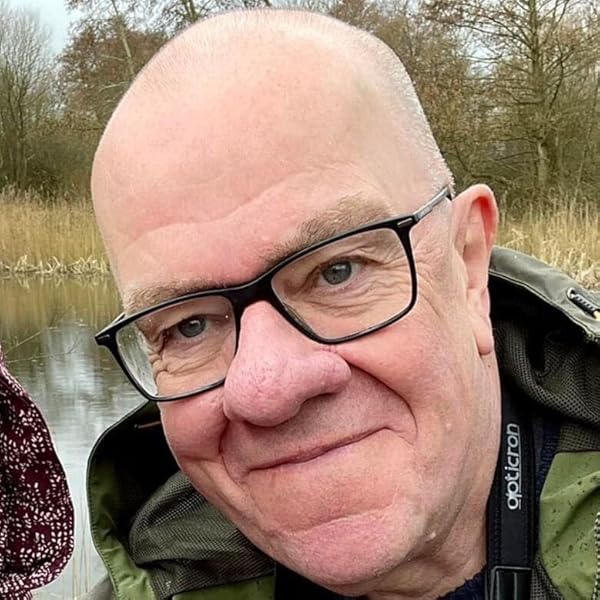
Where The Winds Blow follows the rise of Path Finder, a grassroots movement born from grief and idealism, while powerful governments, criminal networks, and ordinary people collide around it. What was the inspiration for the original and fascinating idea at the center of the book?
The inspiration for Path Finder came during the COVID crisis, while I was cleaning out my garage for the third time in a week. I suddenly imagined finding the UK’s prime minister hiding in there – someone who’d simply decided he couldn’t cope any more. That image stuck, and I started writing, using it as a focal point.
It led to a simple but unsettling thought: for all their bombast and posturing, governments have only limited control over what actually happens within their own borders. The responses to the 2008 crash, COVID, and countless regional crises revealed not grand strategists, but leaders who were overwhelmed, reactive, and often out of their depth.
Lies, distraction, and obfuscation disguise their weakness and uncertainty – skills that modern power structures have perfected. Meanwhile, real influence increasingly sits with billionaires, technocrats, and the vague, unaccountable entity we call “the markets,” all of whom operate with little responsibility to the societies they shape.
Across much of the world, there’s a simmering resentment paired with helplessness – a frustration that’s often misdirected toward convenient scapegoats rather than those truly responsible. What feels missing is a spark: something that turns anger and despair into constructive action rooted in honesty, humanity, and hope.
I don’t pretend to know how that spark might happen in real life, although I believe it will. In the Path Finder series, I’ve created a world only inches removed from our own, where readers can enjoy the humour and drama in the story, recognise familiar institutions and personalities, and perhaps imagine a different future – for themselves as much as for society as a whole.
History is full of ordinary people doing extraordinary things, often accidentally or without understanding where their choices might lead. This series begins with one man deciding he’s had enough of pretending to be something he isn’t and disappearing. Three books in, even I’m not entirely sure where that decision will ultimately take him or Path Finder. I just know it’ll be fun finding out!
What are some things that you find interesting about the human condition that you think make for great fiction?
What fascinates me most about the human condition is the gap between who we think we are and how we actually behave when things stop going to plan. We like to believe we’re rational, principled, and in control, but pressure, fear, love, grief, and ambition have a habit of knocking those ideas sideways. That gap – between intention and action, certainty and doubt – is where great fiction lives.
I’m also interested in how ordinary people respond when they’re swept up in events far bigger than themselves. Most of us don’t set out to change the world, break systems, or become symbols of anything. We’re just trying to get through the day, protect the people we care about, and make sense of the noise. Yet history shows that it’s often these accidental participants – people acting from love, stubbornness, guilt, or hope – who trigger the biggest consequences. That tension between small, human decisions and vast, unpredictable outcomes runs through the Path Finder series.
Finally, there’s the absurdity of it all. Humans are capable of extraordinary kindness, bravery, and resilience, but we’re also unwittingly brilliant at self-delusion, tribalism, and panic. Put those traits under stress – mix them with power, money, ideology, or blind faith – and you get situations that are by turns terrifying, ridiculous, and darkly funny. Satire lets me explore those contradictions honestly, without pretending we’re either heroes or villains. We’re usually just flawed, emotional creatures doing our best… sometimes making an almighty mess of it… occasionally doing something amazing.
What is one thing that you hope readers take away from Where The Winds Blow?
More than anything, I hope readers come away feeling that the time they spent with Where The Winds Blow was time well spent. I want them to have been entertained – laughing at the absurdity, caught up in the momentum, and maybe a little breathless at times – but also quietly validated in the way they see the world.
If there’s a deeper takeaway, it’s the reassurance that confusion, doubt, and frustration aren’t personal failings; they’re rational responses to a chaotic system. The characters in the book don’t have grand plans or neat answers – most of them are muddling through, reacting, improvising, and occasionally getting things spectacularly wrong. And yet, meaning still emerges from those imperfect choices.
I also hope the book leaves readers with a sense that individual actions matter, even when they seem small, accidental, or misdirected. Change doesn’t always come from heroes or leaders; it often starts with ordinary people deciding to stop pretending, to care a little more honestly, or to take one step they didn’t think they were capable of taking.
If readers finish the book feeling entertained, understood, and perhaps a little more open to the idea that hope can exist without certainty, then I’ve done my job.
I hope the series continues in other books. If so, where will the story take readers?
The series will continue. As for where the story will take the reader, who knows?! I’m currently writing shorter pieces for my Path Finder newsletter subscribers that fill in some of the character back stories. One of those pieces became a major plot line in Where The Winds Blow, and I have no doubt that one or two of my current works in progress will do the same in the fourth novel.
Author Links: GoodReads | Threads | Facebook | Website | Amazon
The Path Finder movement has gone global. Millions of followers. Endless headlines. Oceans of cash.
Only one tiny snag: the founders still have no idea what the movement actually is. Now the powerful want answers – and they’ll do anything to keep control.
Meanwhile, an ex-soldier from Afghanistan crosses continents and the Mexico-US border, desperate to reach his family before the authorities catch him or local vigilantes do even worse.
Elsewhere, Simon and Pippa Pope are chasing storms, blissfully unaware that their late wedding gift could unleash consequences for humanity, the planet, and a whisky-soaked Scotsman on a collision course with destiny.
Fast, funny, and ferociously sharp, Where The Winds Blow skewers the powerful and the absurd in equal measure.
It’s the third and wildest instalment in The Path Finder Series, following Paths Not Yet Taken and Good for the Soul. Each offers satire with bite, stories with heart, and storms of every kind.
Where The Winds Blow


Where The Winds Blow blends political satire, global intrigue, and adrenaline-soaked storm chasing into a single, fast-moving narrative. The book follows the rise of Path Finder, a grassroots movement born from grief and idealism, while powerful governments, criminal networks, and ordinary people collide around it. At the same time, the story weaves in a parallel thread of storm chasers barreling across Texas, where tempests both real and emotional hit with little warning. The plot swings from Irish funerals to boathouse diplomacy to desert border tensions, always nudged forward by colorful characters who often stumble into history by accident.
Reading it, I found myself laughing at moments I didn’t expect to laugh at and bracing during scenes that came out of nowhere, like the chaotic barbecue rescue early on or the tense debates inside the gilded halls of Peace Castle. The writing has a kind of cheeky confidence. The author slips from humor to sincerity in seconds, and somehow it works. I liked how the “science guides” at the castle go from bickering like rivals to forming a unified plan after being nudged by drinks, blunt truth, and a locked door. Those small human quirks make the big themes feel grounded. And the storm chasing chapters surprised me. The imagery of dirt clouds swallowing the vans and lightning cracking overhead felt alive. Moments like Simon dragging a stubborn tourist away from his dramatic self-sacrifice scene stuck with me because they were messy and relatable and oddly sweet.
The book plays with many threads. I enjoyed each storyline on its own, but sometimes the pace jumped so fast that I had to remind myself where we were and who was scheming or storm chasing or hiding from cartel lookouts. The Path Finder political satire is sharp and funny, especially scenes in Washington where we watch powerful people try to bend the movement to their will. The storm chasing plot, though, has this raw emotional pulse that could carry a book by itself. When the two worlds finally echo each other thematically, it lands.
I closed the book feeling satisfied. Where The Winds Blow is a good pick for readers who like stories with heart and humor mixed into real-world chaos, who enjoy political send-ups, or who don’t mind a chase through a thunderstorm or a bureaucratic maze. It’s lively. It’s warm. It’s playful. And it’s perfect for anyone who wants a story that reminds them that even the biggest changes in the world often start with a handful of imperfect people trying to do the right thing.
Pages: 313 | ASIN : B0G1KKJLYR

Washington Post Is Switching Off Lights


Piotr Bardzik’s Washington Post Is Switching Off Lights is a strange, witty, and razor-sharp collection of aphorisms that reads like a cocktail of philosophy, satire, and self-therapy. It’s not a novel, not quite poetry either, but something in between, an endless stream of short, punchy reflections on politics, ego, human nature, and absurdity. The book feels like flipping through the diary of a man who sees the world too clearly to take it seriously. From politics to death to dopamine, Bardzik fires off truths and contradictions at lightning speed. You don’t read this book to follow a story. You read it to be jolted awake.
I’ll be honest, reading this felt like watching fireworks. Every line bursts for a second, then vanishes, leaving an echo. Some aphorisms are funny and wickedly sharp, others hit hard because they’re too true to laugh at. The writing is stripped bare, almost surgical, but it carries an undercurrent of despair and amusement that feels very human. I loved that it didn’t try to be lofty. It’s smart but never pretentious, bitter but never cynical. There’s something deeply personal here, too. Bardzik pokes at himself as much as he pokes at everyone else, which makes it feel authentic and weirdly comforting.
Still, it’s not a book you can swallow in one go. The tone swings from irony to sadness to hilarity in a heartbeat, and that constant shifting keeps you on your toes. There are a lot of ideas in this book. Yet that’s part of its charm. It’s a modern kind of chaos, crafted into small, perfect fragments. The language crackles with energy, and the humor often cuts deep enough to sting. It made me laugh, then wince, then think, and that’s not something I can say about many books lately.
I’d recommend this to anyone who loves wordplay, irony, and truth disguised as jokes. It’s perfect for readers who enjoy thinkers like Wilde, Cioran, or Vonnegut, but want something more contemporary and raw. It’s one of those rare reads that makes you want to put it down every few pages just to let the thought sink in, and maybe laugh at how much it hits home.
Pages: 59 | ASIN : B0FSYG8G8C
The World of Extremism
So You Want to Be an Extremist is a satirical guide that traces the origins and evolution of conspiracy theories from ancient Rome to modern-day social media. Why was this an important book for you to write?
I think people know bits and pieces, but there wasn’t a full picture of extremism in one place. I wanted to create a single piece of content that anyone could pick up and easily learn about the world of extremism, from its humble origins to a major part of society today. And also laugh a bit at the horrors they learn along the way because it is a dark, scary place. Whether we like it or not, these people, these products, these movements are affecting all of us in some fashion.
Did you learn anything during your research that surprised you?
How truly ubiquitous this level of extremism and conspiracy thinking has become, particularly among the younger generation. Twenty years ago it was your crazy uncle sending emails. A decade ago it was older people falling for Facebook memes, believing anything that was written online. Now, it is a younger, seemingly displaced generation, who are very tech-savvy, failing at even baseline critical thinking on many topics.
Why was it important for you to take the satirical approach with this book?
For me, satire has always been a way to convey certain ideas and vices as laughable, but also reprehensible. I have a penchant for poking fun at the horrible people that take advantage of others: dictators, oligarchs, and now, extremists. I like to strike a balance between comedy and learning, and I do think they can complement each other. So, I wanted to give the audience that same balance. Plus, they don’t have to read a 400-page academic paper to learn about this stuff. I suffer for them.
What is one thing you hope readers take away from So You Want to Be an Extremist?
Extremism isn’t fringe anymore! It has been normalized to the point that it is a part of everyday media, politics, religion, business, and society. This isn’t going away anytime soon. These ideas and movements are only becoming more prevalent and worse, more accepted.
Author Links: GoodReads | Facebook | Website | Amazon
With Extremism, explanations can be simple – and exciting. You’re not a “loser.” Nope, It’s just an international cabal of lizard people holding you back from greatness.
In this satirical leadership guide for oven-ready radicals and greedy grifters, uncover a mind-blowing myriad of crazy conspiracies, insane ideologies, and meet the fabulous fanatics who promote them.
Join former government lackey turned humorist, C.T. Jackson as he takes you from the quiet corners of sanity to the far fringes of social implosion, as you learn to reach your full radical potential.
So You Want To Be An Extremist? Well, This Book Is For You! (And The Voices In Your Head.)
Bad Boys, Bad Boys: What Does A Lawyer Do?!
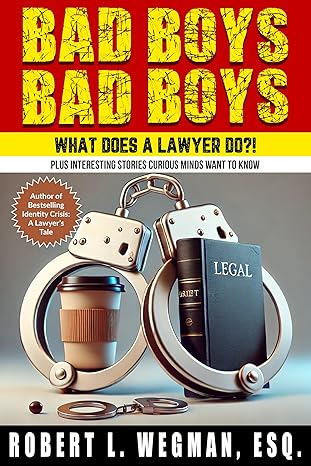
Wegman’s Bad Boys Bad Boys is part courtroom confessional, part social satire, and part philosophical musing—seasoned heavily with gallows humor and a splash of heartfelt introspection. The book is split into two sections: the first filled with hilarious, bizarre, and occasionally touching anecdotes from his long career as a criminal defense attorney; the second a freewheeling mix of commentary on language, politics, and modern culture. If you’ve ever wondered what it’s like to defend the indefensible—or you just want a brutally honest glimpse into the absurdity of both the justice system and humanity itself—this book delivers.
What hit me right away was Wegman’s comedic timing. The man knows how to tell a story. In Happy Birthday To Me (Chapter 2), he recounts with surgical precision how a single moment of inattentiveness during voir dire turned into a masterclass in foot-in-mouth lawyering. When he chirped, “Oh, September 2nd—what a great day. That’s my birthday,” right after a grieving widow said her husband died that day, I cringed so hard I nearly dropped my Kindle. That scene is a perfect example of what Wegman does best: turn his own blunders, and his clients’ downright legendary stupidity—into vivid, laugh-out-loud tales that reveal deeper truths about how fragile the line is between ordinary life and legal chaos.
But it’s not all jokes. Some stories really get under your skin. In It Wasn’t Me (Chapter 3), Wegman walks through a court-martial rape case where the accused was found guilty but sentenced to only 90 days. That paradox—the brutal charge against the surprisingly lenient sentence—throws a wrench into everything we assume about guilt, truth, and justice. Wegman doesn’t moralize; he lays out the tension and lets you sit with it. His reflection on how credibility, not truth, is often what wins in court made me pause and stare at the wall for a bit. I’ve felt that same frustration in my own work. Court isn’t about justice; it’s about persuasion. His honesty about that, and about how easy it is to get swept up in your own client’s story (Davey and Gravy Train, Chapter 5), made me feel like I was having a late-night drink with a colleague who’s been in the trenches.
If you’re looking for legal theory or a polished ABA how-to, this ain’t that. But if you’ve got any experience in the justice system, especially defense work, you’ll find yourself nodding, laughing, maybe wincing a bit. This book is perfect for law students who need a reality check, burned-out attorneys who need a laugh, or just anyone with a dark sense of humor and an interest in courtroom drama. Wegman’s style is unfiltered but never mean-spirited. He’s that rare kind of lawyer who can take the darkest parts of the job and still find a human (and often hilarious) angle.
Pages: 221 | ASIN : B0DZ7Y3RCX

Making Vespuccia Great Again
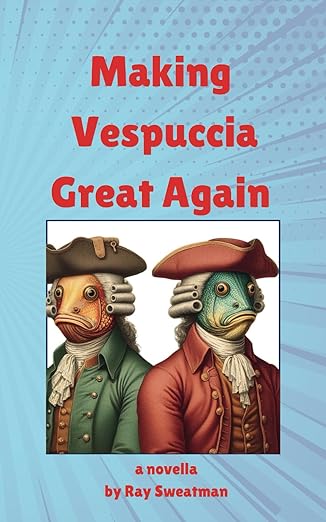
Ray Sweatman’s Making Vespuccia Great Again is a sharp, fearless, and at times laugh-out-loud political satire that imagines a dystopian America rebranded as “Vespuccia.” Set in a twisted mirror of our current socio-political climate, the novella follows the rise (again) of President O.J.C. McDonald, a grotesque caricature of a certain orange-hued reality TV personality. Through absurd characters, biting dialogue, and a surreal plot that includes everything from sentient fish Founding Fathers to LGBTQ revolutionaries called “The Pronouns,” Sweatman delivers a fiery send-up of authoritarianism, fake news, and cultural division in America.
From the very first chapter, Sweatman goes full throttle, skewering the January 6th insurrection with the same kind of commentary you’d expect from The Onion if it took acid and watched Idiocracy on repeat. The fake news anchors Donna Dumay and Don Drapery narrating the Capitol attack like a sports event? Genius. “Oh my, this is better than Getflix!” Donna chirps as democracy crumbles. I was equal parts horrified and laughing out loud. Sweatman walks that tightrope masterfully, never letting the humor soften the blow of the real critique.
One of my favorite arcs was Reverend Swindlemore and his daughter-turned-nonbinary-hacktivist Bucky (aka They/Them). The Reverend is a grotesque blend of fire-and-brimstone televangelists with just the right dose of unhinged righteousness. His hell-obsessed sermons feel ripped from real-life absurdities, and when Bucky forms a rebel group of queer hackers, I was all in. It’s outrageous, it’s camp, but there’s heart. You get the sense that Sweatman deeply respects those fighting for justice, even while cranking the satire up to eleven.
And then there’s the Founding Fathers. Literal fish-people who rise from the sea, transform into Jefferson and Hamilton, and get swept into a costume shop where they breakdance to Rick James’ “Super Freak.” It sounds insane because it is, but somehow it works. These absurd moments don’t just entertain, they hammer home Sweatman’s larger point: when truth dies, history becomes theater, and we’re all stuck on stage, flailing. Watching Jefferson defend his slave-owning past while Hamilton snarks and George Washington threatens to shoot him with a shotgun? That’s satire doing its job, shining light through the madness.
Making Vespuccia Great Again isn’t for everyone. It’s blunt, crude at times, politically fiery, and proudly liberal. But if you’re the kind of reader who enjoys Dr. Strangelove, South Park, or Vonnegut on a rampage, you’ll eat this up. Making Vespuccia Great Again is for the disillusioned, the politically exhausted, the angry, and the hopeful. It’s for anyone who still believes words have power, humor can cut deep, and that fighting back might look a little ridiculous but is still necessary. I laughed, I cringed, I shook my head. And I’d read it again in a heartbeat.
Pages: 252 | ASIN : B0DY4T96PV
Circumstances and Opportunity
In Paths Not Yet Taken, a middle-aged warehouse worker hiding a secret life of his own discovers someone unexpected in his garage. What inspired the setup of your story?
Paths Not Yet Taken was a slow burner. Covid caused many things including – way down the list – yours truly deciding to write a novel. The question was, what to write?
It was during the first lockdown and my fourth weekly tidy-up of the garage (anything to get out of the house). I opened the side door and stepped into the already immaculate space and thought: What if I’d opened the door and somebody was already in here? A few moments into sweeping the already pristine floor: What if it was the prime minister? Then, seconds later: What if it was the prime minister having a nervous breakdown? I grabbed my laptop and started writing.
A couple of years, two or three vaccinations, and just eighteen thousand words later, I gave up.
There was no point. The poor decision-making, the corruption, the sheer stupidity, and the arrogance of those in power superseded any crazy satirical notion I had planned for the novel. The UK government was beating me at my own game, without even realising it.
I wanted to write a book that exposed the weakness at the heart of power, but there had to be something positive at the end at least and I couldn’t find anything to be positive about. Instead, I played golf, read books, and walked the dogs. I gave myself time, and that gave me hope.
Generally speaking and despite their tiresome frequent examples of stupidity, arrogance, and greed, politicians don’t set off with a dream of destroying the economy, tearing apart the fabric of the nation, or jeopardising lives and futures.
At all levels of society, life gets in the way of what we hope to do and where we plan to be. Circumstances and opportunity can be way beyond our control. Seemingly innocuous decisions we make can result in significant unforeseen consequences (good and bad).
Some may well be content with the hand dealt to them. Others less so. Whatever the case, we each have a choice – to accept our norm or to change it; to stay on the current path, or to choose another.
That became the focus of the novel. I fired up the laptop once more. The plot changed dramatically; the characters not so much – although more were introduced. The result, I hope, is something dramatic, humorous in places, and ultimately uplifting.
My book is meant to entertain, amuse, and to give people something to think about. Hopefully, their own reflections will give them a better sense of the meaning and purpose in their own lives. Whether they choose a different path; decide to change nothing, but are more content with their lot in life; or simply finish the novel with a smile on their face – then the book’s job is done.
What were some themes that were important for you to explore in this book?
Paths Not Yet Taken is a breezy satire about life and the individual’s place within it.
We live in an age where it is very easy to become enraged, to overreact, to abdicate responsibility, and to be apathetic. Much of that is down to the media and our exposure to the internet. While the latter has a great deal of value, it makes it easy to have a lazy opinion about something on the basis of very little evidence or fact. It also dilutes our responses to events by turning raging anger and a desire to take action into the sharing of a meme or pressing a Like button.
We need to make time to take a step back, to communicate better with each other, and to consider each others’ perspectives rather than rushing to superficial, ill-informed judgments.
Sounds great, but if we are to change the status quo, we need to look at ourselves first. I wanted to explore our ability to do that through the action of one man who, the reader may think, would be the last person on earth to require such a change in direction – and the implications of that action on individuals and on society as a whole.
I also wanted to touch on the perception of power and to show how fragile that concept is, how dependent we all are on events and decisions outside the control of ourselves or those we rely on to make huge decisions on our behalf.
At all levels of society, life gets in the way of what we hope to do and where we plan to be. Circumstances can be way beyond our control. Seemingly innocuous decisions we make can result in big unforeseen consequences further down the line – good and bad.
Some may well be content with the hand dealt to them. Others less so. Whatever the case, we each have a choice – to accept our norm or to change it; to stay on the current path, or to choose another.
I found this novel to be a cutting piece of satire. What is one thing that you hope readers take away from your novel?
It certainly has some points to make! By the end of the story, I’d like readers to recognise there can be two or more sides to every story and to realise that your life is not set in stone. You have the power to change or not to change it and to influence the lives of those around you and even further afield by doing so. Maybe the change needed is simply to better appreciate what you already have. Whatever it is, it starts with you.
What is the next book that you’re working on, and when can your fans expect it?
I’m currently writing a second novel, which is a sequel to this one and involves some of the same characters on a short trip to a small town in Ireland. I’m having fun with the plot as I go along and have no idea how it will end – much the same as when writing Paths Not Yet Taken! This should be published by the first quarter of 2025.
I’m also working on outlines and ideas for a third and a possible fourth book, where other characters from Paths Not Yet Taken will reappear and play prominent roles.
Author Links: GoodReads | X (Twitter) | Facebook | Website | Amazon
A breezy satire that offers hope to us all… eventually.
In a Midlands food warehouse, a Government visit goes badly wrong. The prime minister vanishes without trace before he’s had the chance to wave his German sausage at the gathered media. The consequent nationwide search creates massive issues for government, the security services, a local police force, and for a keyboard terrorist who finds the missing man.
Chaos ensues involving drink, dogs, guns and golf. And that’s just at one small end-of-terrace house. Elsewhere, a van explodes, a prospective leader loses it before he’s even started leading, and an assassination attempt goes badly wrong. Twice.
Ultimately, one man’s spur-of-the-moment decision is the catalyst for others to reflect on their own lives and to consider decisive actions of their own.
Just try not to think about the sausage.
Paths Not Yet Taken

Paths Not Yet Taken, by Philip Rennett, is an exhilarating and witty novel that captivates readers from the first page to the last. Set over five tumultuous days in late summer, the story masterfully intertwines crises, action, and emotional drama with a dry, observational wit that makes for an incredibly enjoyable read.
The narrative centers on Simon Pope, a middle-aged Midlands warehouse worker who discovers someone very unexpected in his garage. During a press visit to the warehouse where Pope works, the Prime Minister suddenly vanishes, throwing the entire UK into chaos. As the security services and police launch a frantic search for the missing PM, the government scrambles to maintain its composure and manage the situation. Simon Pope harbors a secret life, spending his evenings on the dark web platform @TheTrth, where he voices his disdain for the political establishment, particularly the now-missing Prime Minister.
Paths Not Yet Taken is a thoroughly entertaining read. Rennett skillfully makes both the Prime Minister, who confides in Pope his desire to return to a normal life, and Pope, who has a surprisingly dark past, immensely likable characters. The author reserves his critique for the bureaucrats running the government, extracting comedy gold from their antics. This is especially evident when these bureaucrats attempt to scapegoat Pope, adding a realistic and humorous twist to the story.
The novel is a true page-turner with tight pacing, witty writing, and a perfect balance of action and drama. It is genuinely funny without being mean-spirited, offering a refreshing change of pace in today’s often cynical political landscape. Paths Not Yet Taken has real heart and comes highly recommended for anyone looking for a smart, engaging, and humorous read.
Pages: 335 | ASIN : B0D1GMJZ4M



 LITERARY TITAN