Blog Archives
Crossfire


Crossfire follows Moirin Garrett, a high-powered executive juggling corporate pressure, family expectations, and the uneasy beginnings of an environmental partnership that forces her into the political, personal, and ethical “crossfire” she’s spent a career avoiding. From the first chapters, the story grounds us in her world of boardrooms, complicated family brunches, and the shimmering social circles where everyone wants something from her. As the plot widens, the book becomes a layered look at ambition, reinvention, and the messy overlaps between public responsibility and private longing.
Reading this in first person, I found myself rooting for Moirin even when she frustrated me. She’s sharp, driven, polished on the outside, and quietly unraveling beneath the surface. The writing makes room for that contradiction. The scenes move with a steady rhythm, sometimes clipped and tense, sometimes opening up into softer, more reflective moments that show how lonely success can feel. I liked how Herman lets small details do the emotional lifting: the staleness of office coffee, the weight of a family legacy, the flicker of discomfort when Moirin realizes she’s being sized up not just as an executive but as a woman in a room full of men with agendas.
What stood out most was the author’s choice to frame the story’s tension around both career stakes and personal awakening. The environmental study storyline sets up a believable moral tangle, especially as shady players circle around Moirin’s work. At the same time, the book gives her space to question what she actually wants beyond the next professional milestone. Moments with her friends feel warm and real, and her slow steps toward vulnerability make the corporate drama feel more human, not just high-stakes business maneuvering. The writing stays simple, grounded, and clear, letting the emotional beats land without theatrics.
The book feels like a story about a woman stepping out of a life she mastered and into one she’s still learning how to want. It’s women’s fiction with corporate intrigue woven in, built for readers who enjoy character-driven arcs, workplace complexity, and the slow burn of personal transformation. If you like stories about strong women navigating reinvention in midlife, or if you enjoy fiction set at the intersection of power, family, and identity, Crossfire will hit the mark.
Pages: 365 | ASIN : B0FTDX5MML

Fulfilling Relationships

Moving Maggie follows a sixty-year-old woman going through a divorce, losing her job, and having to move all at once, who tries to build a new life in a new town and rediscover herself. What was the inspiration for the setup of your story?
I’ve been doing a lot of book signings since Reinventing Rita, my first Midlife Moxie novel, came out in 2023, and I have had the most fascinating conversations with women 50 and older. They tell me about their lives—the good parts and the bad—and the challenges they have had to overcome. So I’m sure that some of the characters in Moving Maggie came out of those interactions.
As for the inciting event, well, while I have never had to move from my home, I have had relationships end unexpectedly and career choices that didn’t quite go the way I anticipated. That meant I had to discard the idea I had formed of what the next 10 or 20 years were going to look like and come up with a new vision and goal.
Being a planner and a bit of a control freak like Maggie, those early stages of transition and reinvention weren’t very much fun! But looking back, I see that it all turned out for the best and gave me an opportunity to develop new skills and strengths—just like Maggie.
Maggie is a fascinating character with a lot of depth. What scene was the most interesting to write for that character?
I think it was Chapter 26, when Maggie and the teenage girl, Janna, have a verbal altercation. Until that point, the two of them had a good relationship, which, given Maggie’s childless state, was unusual for her. But when Janna expressed her frustration after the hospital refused to consider her as a kidney donor for her brother, Maggie responded in “hospital administrator speak.” That generated an angry retort from the young girl that surprised and dismayed Maggie, who had prided herself on knowing how to handle problems in the work environment.
Maggie’s sense of guilt that she had failed to give the right response made her think of other times in her past when she didn’t recognize what the other person needed from her but was instead “all business.” It’s one of the times in the story when she begins to understand that she had to develop a sense of empathy if she wanted to have fulfilling relationships with other people.
What were some themes that were important for you to explore in this book?
Always central to the Midlife Moxie novel series is the idea that we are stronger than we think and that we can handle the changes that come unexpectedly—regardless of our age or perhaps, because of our age, and the wisdom and experience we have gained through the years. And also, that reinvention is not something to be avoided or rejected but is instead a positive activity that can open new doors.
A theme specific to this book is the willingness to be vulnerable and take risks, personally and professionally. As Maggie gradually opened her heart to those around her, she saw that her self-protectiveness had isolated her in the past and resulted in a lonely existence. By allowing herself to care about those she met, even at the risk of being hurt or rejected, she realized her life was becoming much more fulfilling.
And when she found herself taking on responsibilities at her new job (that itself came with no small learning curve), she recognized that making mistakes is part of the process and there is no shame in doing something wrong the first time, if subsequently she did it right.
A second theme is the importance of learning from past missteps and bad choices. Maggie was very driven when it came to her life, and her primary commitment was to her career and professional future. While initially it worked out to her benefit, her tendency to ignore warning signs that developed over time, both at work and at home, ultimately resulted in the end of her marriage and the loss of her job. Now she not only had to create a new future but also make time in her life for other people and experiences without repeating those same errors in judgment and negative tendencies.
I hope the series continues in other books. If so, where will the story take readers?
Because each novel in the Midlife Moxie novel series is a standalone, I will have to leave it to the reader’s imagination to envision what happens next to Maggie and the rest of the Eden community!
However, Maggie’s boss, Sheila Jones, also appears in With Any Luck—one of the stories that’s part of my short story collection, The Language of Love, which was also released in 2025. Sheila handled the sale of a home in Eden to Amy, a newcomer to the town, and, in true Sheila fashion, provides more than just a real estate service.
I hadn’t originally planned for that to happen, but as I was writing that short story, I needed to have someone who would arrange the house sale. I liked the character of Sheila from Moving Maggie so much that I couldn’t help making her part of it!
Author Links: GoodReads | X (Twitter) | Facebook | Instagram | TikTok | Focus on Fiction | The Writer’s Place | One on One | Make A Change | Website | Podcast | Bluesky | Pinterest | Threads | Medium | Substack | YouTube | Books by Nancy Christie | Amazon
The year Maggie Cartwright turned 60, she is hit with a triple whammy of unpleasant and definitely unwanted events: the loss of her job, the ending of her marriage, and the need to find a new place to live. The impact of all these undesirable occurrences is that the woman once known as “Move-Ahead Maggie” has lost her moxie and can’t figure out where she can go or what she can do with the rest of her life.
Maggie’s move to a small rural community sparks a series of unexpected opportunities and new friendships, and she realizes that making a life change can bring unexpected benefits. But as she begins to reclaim her “Move-Ahead Maggie” identity, can she let go of her career-driven focus to take advantage of them?
MOVING MAGGIE is a double winner in the 2025 Firebird Book Awards Competition: Summer Beach Read and Women’s Fiction categories!
This Time

This Time is a story that weaves together love, loss, and redemption in the small town of Tartan Springs, West Virginia. At its heart, it follows Ty Harrell, a Marine pilot, and Siena “Seeney” Tyson, a woman rebuilding her life after a messy divorce and betrayal. The story opens with their ten-year high school reunion, where old sparks rekindle and dormant feelings stir. Around them, the novel paints a vivid picture of small-town America, filled with complex relationships, community politics, and quiet battles for dignity and forgiveness. Beneath the romance lies a thread of corruption, environmental tension, and moral choice, giving the book more depth than a typical love story.
Coe’s writing is full of detail, almost cinematic, and that made it easy to slip into the world he built. I could smell the rain in the hills, hear the small-town chatter, and feel the awkward warmth between Ty and Siena as they stumbled through old emotions. Sometimes the dialogue felt a little too polished, but the emotional truth beneath it rang clear. I liked that the characters were flawed, real people who made mistakes and carried scars. Siena, especially, stood out, resilient, sharp, and unwilling to let the past define her. Ty’s decency and quiet loyalty balanced her strength perfectly.
What really got to me, though, was how the story handled forgiveness. It wasn’t wrapped in a neat bow. The pain from betrayal lingered, and love didn’t erase it. Coe didn’t shy away from showing the ugliness of pride, or the way people cling to control when their lives are falling apart. Yet, somehow, through the grit and sorrow, the book stayed hopeful. The scenes about military service, small-town politics, and even environmental issues added layers that gave it substance without slowing the pace too much.
I’d recommend This Time to readers who enjoy heartfelt fiction with real emotional weight. It’s perfect for anyone who loves stories about second chances, especially those set against the backdrop of small-town life where everyone knows your secrets. It’s not just a romance, it’s about rebuilding, forgiving, and learning when to fight and when to let go. This book pulled me in, and when I turned the last page, I just sat there for a minute, thinking about how some things are worth risking again.
Pages: 348 | ASIN : B0FST7LVL2

Ultimate Sin

Ultimum Judicium: The Last Judgment follows a prophet living in a civilization that has fallen who has been chosen by God to lead the survivors on an odyssey to a place of redemption while battling his own inner demons. What was the inspiration for the setup of your story?
The current state of the world is the basis for what prompted me to explore a future doomsday scenario in my novel—a warning, maybe? There is more anger and disagreement than I’ve ever before seen or read, leading to fighting and rioting that could ultimately lead to the end of civilization—or so it did in my book.
Ultimum Judicium is a novel exploring the classic concept of good versus evil. Growing up as a Roman Catholic, and that being the largest formal religion in the world, I adopted that Christian perspective for this book. The basis for most end-of-world stories seems to be rooted in themes of good vs evil, focusing on exorcism and demonic possession governed by Catholicism. The priest I created was ordained by God, the good, and is tempted by Satan, the evil. Here, I gave him a weakness in his attraction and passion for women—an ultimate sin for a priest. The story follows the Christian Bible’s Revelation. It is the journey to Armageddon—the last battle between good and evil.
I find the world you created in this novel is haunting and full of possibilities, with both light and dark elements. Where did the inspiration for the setting come from, and how did it change as you were writing?
The future I invented occurred 200 years after all governments of the world had fallen. A reader must try to envision exactly what a world would be like after so many years without laws or any civilization whatsoever. It would likely be a horror show. We can realize this with certainty after reading about the hairline fractures of civilization called wars that history has documented so clearly. In all wars, we saw the extreme brutality of humanity.
Once I committed to embracing that reality—one of extreme brutality—I found I had created a very different place. So, I contrasted the wickedness of such viciousness with love and kindness. Hence, I gave birth to three loving romances to counteract the savagery. Also, most of the characters within the stronghold, including the Manhig, or Leader, are good and caring people, except for the few bad ones.
What were some themes that were important for you to explore in this book?
My book, Ultimum Judicium: The Last Judgment, explored good vs evil in a broken world. However, it also shows the resilience of men and women in such times. As with war, it shows humanity’s ability to overcome and survive. And ultimately, love will defeat hatred.
Where do you see your characters after the book ends?
At the end of this book, the characters judged as good went to a place some theologians refer to as the Millennial Kingdom of Saints from the book of Revelation. The evil went to be with Satan, locked in the pits of Hell for the same millennium period.
At the last minute, before this book went to publication, I removed the Aftermath written for the book. It thoroughly explained the actual places each character went and what they planned to give closure to the story.
Author Links: GoodReads | Amazon
Since the dawn of humanity, people had always survived. Cultures fell, but new ones continually emerged and thrived. Humans fought wars, but they kept rebuilding after the destruction. That pattern changed in the future—everything did.
There were predictions and warnings—both spoken and written—but no one paid attention to them. As the ominous signs grew, still, no one obeyed. The unrighteous one kept everyone from seeing what was coming, even though it was obvious; he cast veils over their eyes. Not long after the final recorded year of 2040 AD, humanity faced a worldwide economic disaster of catastrophic proportions following years of street riots. Over time, human moral transgressions led to the collapse of societies worldwide. Countries turned against each other as the world became a wicked and ungodly place. More than two centuries after the last civilization fell, people lost the ability to speak—their capacity to verbalize had ended years earlier. Our future became our past—one marked by brutality and barbarism.
Guided by angels, a prophet chosen by God leads His remaining followers on an odyssey to a place of redemption. Anointed as Manhig, or Leader, he and his armies of male and female warriors are the only hope of preserving some form of civilization, where everyone must obey the laws or be forever banished into the now-wild wastelands of the countryside, overrun with destructive intruders.
Attracted to a feisty woman he cannot have and tempted by the young and beautiful, captivating yet sharp-witted and brilliant General Helen, the manhig wrestles with his inner demons—his inability to resist the lures of Satan regarding women. If he succumbs, the way of life he spent years cultivating will unfold—all will be lost.
The manhig leads his warriors and people from one temporary stronghold to another for defense in an otherwise shattered world—a place now dominated by hordes of unhuman beings: evil cannibalistic beasts, demons, and other mutations—created centuries earlier by the science of that long-ago era. Now living in a surreal culture, while following strange laws, customs, rituals, and practices, and speaking a vernacular of the future, the manhig commands his warriors while battling these creatures alongside many evil humans: thieves, wicked gangs, slave traders, and other nefarious characters who roam the wilderness as the followers journey toward a confrontation between good and evil—the last battle before God’s judgment.
The strongholds—an attempt by the manhig to provide some form of civilization to battle-weary warriors—taverns and bars for his followers to eat, drink, and socialize. They are also a haven of temptation from the evil one. Adultery—forbidden by law by the leader—manifests within those walls of protection as the end draws near.
Sketches from the Periphery

Michael Patrick Summers’s debut novel, Sketches From the Periphery, stands as a remarkable achievement in historical storytelling. It illuminates the human narratives behind world conflicts, offering a gripping and thought-provoking exploration of the Darfur conflict in Sudan. For anyone fascinated by history, this novel provides a poignant and empathetic window into the lives of those impacted by one of the 21st century’s most complex crises.
The story centers on Alexander Barr, a young American contractor working with the African Union’s peacekeeping mission in Darfur in 2006. Through Alex’s eyes, readers navigate the brutal realities of a war-torn region. The narrative delves into existential themes, grappling with the enduring legacies of colonialism and the often violent dynamics of human history.
Alongside Alex’s journey is the parallel tale of Tariq, a battle-hardened operative of the Darfur liberation movement, whose life has been indelibly shaped by conflict. Although their paths do not directly converge, the interwoven stories depict life on the margins of civilization, where idealism and survival clash in a haunting dance. Adding richness to the narrative is Cassandra, a fiercely independent European journalist whose presence brings a fresh dynamic to Alex’s search for meaning. Her depth and resilience make her a standout character. Summers deftly blends historical fiction with profound philosophical reflection, creating a layered and immersive experience.
The novel not only exposes the raw truths of the Darfur conflict but also challenges readers to confront broader questions about humanity’s capacity for both destruction and creation. The richly developed characters, each grappling with moral complexity, bring the story’s themes to life in vivid and unforgettable ways.
Sketches From the Periphery is an evocative and introspective work, appealing to history enthusiasts, fans of philosophical literature, and readers drawn to stories of resilience and moral struggle. Even for those who may not typically choose books about war, this novel offers an unparalleled journey into the depths of human conflict and the search for meaning amidst chaos. It’s a profound, moving, and deeply worthwhile read.
Pages: 197 | ASIN : B0DL6S7VHX
Flawed Characters

London Skies centers around a woman haunted by the memories of a lost love and her own experiences as a wartime nurse. What was the inspiration for the setup of your story?
I first had the idea for the story of a WWII nurse in 2004, and briefly wrote something, before shelving it. It was sparked by a documentary about ‘the Guinea Pig Club’ – the group of pilots badly burned, and then experimented, on with pioneering plastic surgery and facial reconstruction at East Grinstead. Coincidentally, I then found out that my mum spent six weeks in that very hospital after a near-fatal car crash in the 1960s, where she had many broken bones, including to her face.
I had more ideas about Charlotte over time, and just thought she’d be a good person to build connected stories around.
I grew up adjacent to Heathrow Airport as my dad worked there for nearly 30 years, and I never really thought about the town where we lived until I was much older and had left.
I then had the idea that Charlotte could connect the stories initially via a scene at what was then called London Airport, in 1956, as the story moves forward but also with her looking back on the war.
Which character in the novel do you feel you relate to more and why?
I wrote it so that I can relate to all the characters in some ways, and have empathy for their plight, even if they may be the opposite of how I am, or how I think about things.
Some are closer to my actual experiences, but I don’t tend to turn my life into fiction. So, being a newly divorced dad 20 years ago who couldn’t have access to his young son was something I could relate to, despite having part-time access as a father in a more amicable way, but where it obviously left me appreciating what it must feel like to be cut off completely.
I also find it interesting how a character like Monty splits opinion based on the feedback so far, but I feel a lot of sympathy for his plight.
I try to balance as many things as possible in a novel, so there are three-dimensional, flawed characters, but also interesting descriptions, a sense of place, and sufficient plot and intrigue. It takes time to do that in a way that works.
What are some things that you find interesting about the human condition that you think make for great fiction?
I always liked seeing the world through someone else’s eyes and experiencing things I never would in my life, through the different books I grew up reading.
We can step into someone else’s shoes, even their skin, and try to think about how we’d react if in the same situation. The act of reading puts all the imagery in their own mind, and that’s powerful.
I like flawed characters, but I don’t like the idea of character arcs, or that everyone must learn a lesson. “No hugging, no learning” was the Seinfeld mantra, and I like that. But I also like at least some hugging and some learning. Because in real life, some people learn, and some don’t.
I make zero effort to conform to what’s popular, proven, or marketable, as ultimately, I’m writing the best book I can, that only I can write. I had an agent in the past, but the shoe-horning of a story into something more commercial was too distressing. The BBC showed interest, but again, it wasn’t quite right. It’s why I went indie, as I didn’t want to compromise to the point where I lost belief in what the story was about.
I’d love to find readers, but readers who want to read the kind of books I write, as I don’t want to waste anyone’s time!
What is the next book that you are working on, and when will it be available?
I have the research done for another book, including a visit to a key location and acquiring dozens of books and documentaries, but it takes me about ten years, on and off, with all the other writing I have to do for a living, as well as being only partially functional due to having suffered with M.E. since 1999, and now I’m going blind in one eye. But I still have the other eye.
I respect how Donna Tartt works, taking time to get it right, except she sells a lot more books and wins a lot more awards than I do!
Author Links: GoodReads | Amazon
Dotted around the terminal, a handful of strangers whose lives will be forever linked by the tragedy that rolls in with the snowstorm, and the decades each spends attempting to unravel its remarkable connections and mysteries.
From wartime Piccadilly Circus to a remote Icelandic shoreline as Eyjafjallajökull erupts in 2010, London Skies is a sweeping story of family secrets, lost loves, and unravelling the past.
London Skies
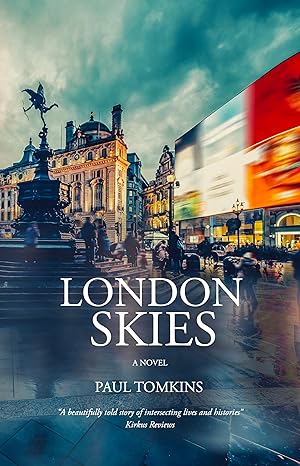
Paul Tomkins’ London Skies is a beautifully crafted tribute to the unsung heroes of the sky—both the aviation industry and the soldiers who served during World War II. This novel is more than just a story; it’s an immersive experience. Tomkins’ vivid descriptions and evocative prose transport readers to another time, allowing them to step into the post-war world of 1956, where humanity’s resilience and interconnectedness take center stage.
Set primarily at the newly built London Airport, the novel weaves together the lives of its characters through seemingly unrelated stories, all bound by aviation as the common thread. At its heart is a deeply introspective protagonist who visits the airport daily, haunted by memories of her wartime experiences as a nurse and the loss of her lover. Charlotte’s reflections on the bustling lives around her and her poignant musings on grief and resilience offer profound insight into the psychological toll of war. Her observations of strangers’ fleeting interactions reveal universal truths about connection, healing, and the small ways we find meaning in life. The narrative takes a dramatic turn during a snowstorm in 1956 when a tragic incident forces a group of strangers to confront their vulnerabilities and share their stories. Families, couples, and individuals recount their journeys, their lives often subtly intersecting in ways only the reader can fully appreciate. From moments of heartbreak to flashes of humor and romance, their tales reflect the rollercoaster of human emotions and how our paths often cross in unexpected and profound ways. The story builds to a heartwarming conclusion, reminding us of the invisible threads that bind us all.
London Skies captures the essence of post-war humanity with grace and depth. It’s a novel for those who love historical fiction and relish stories that explore the intricacies of human relationships. Tomkins deftly balances personal, relatable moments with larger reflections on loss, love, and resilience, creating a narrative that resonates long after the final page. This is a moving testament to the endurance of the human spirit and the moments of connection that keep us moving forward.
Pages: 438 | ASIN : B0CX22HWSX
Oblivion Black

Oblivion Black, by Christa Wojciechowski, is a gritty, darkly compelling story of addiction, trauma, and the quest for redemption. It follows Ona Price, an art school dropout navigating the brutal realities of heroin addiction and the emotional spiral it causes. Set in the seedy underbelly of New York City and later in the rural calm of her aunt’s bed-and-breakfast, Ona’s journey is one of self-destruction, survival, and the long, painful process of trying to reclaim her life.
The book weaves vivid descriptions of withdrawal and heroin highs with Ona’s inner turmoil, delving into themes of love, obsession, and despair. What struck me first about this book was the raw, unapologetic portrayal of addiction. Wojciechowski doesn’t sugarcoat the experience. In fact, she plunges you straight into the darkness of it. The vivid, almost cinematic scenes made me feel like I was right there with her, suffocating under the weight of her choices.
The writing hits hard and fast, often as disorienting as the life Ona is living. I found myself both repulsed and captivated by her self-destruction, wanting to reach through the pages and shake her awake. Wojciechowski’s ability to depict inner conflict is stunning. Ona’s thoughts are chaotic yet painfully introspective, such as when she reflects on her artistic ambitions and how her addiction has derailed them. The way the narrative delves into Ona’s psyche made me both pity and admire her. Her contradictions make her feel incredibly real—she’s someone who knows she’s broken, but she can’t quite summon the strength to pull herself together.
The book’s pacing takes on a slower, more reflective tone in the middle. This shift allows the reader to truly immerse in the painstaking nature of the healing process, capturing the realistic ebb and flow of emotions. The portrayal of Ona’s daily struggle creates a sense of authenticity, highlighting the repetitive yet essential small victories and setbacks of recovery. And just when the routine starts to feel too settled, Wojciechowski injects powerful moments of raw emotion that reignite the intensity and keep the reader deeply engaged.
Oblivion Black is not for the faint of heart. It’s a gritty, disturbing, and often uncomfortable read, but it’s also beautifully crafted, with characters that linger long after the last page. I’d recommend this book to anyone who enjoys psychological fiction that doesn’t shy away from dark, complex themes. It’s perfect for readers who appreciate stories that explore the depths of human suffering and the possibility of redemption, even when the odds seem insurmountable.
Pages: 387 | ASIN : B09YWKRLG6


