Blog Archives
Lila’s Dance: A Tale of Two Journeys


David Ghilardi’s Lila’s Dance is a historical novel set at the end of the seventeenth century, when religious persecution, colonial expansion, and the Atlantic slave trade shaped lives across continents. Its narrator, Sebastian, enters the Carthusian order as a boy and matures into a monk at the Grand Chartreuse. His discovery of a secret letter attributed to St. Bruno places his growing belief in spiritual oneness at odds with Church doctrine. Dispatched to St. Kitts, Sebastian encounters Lila, the educated daughter of a Huguenot mother and a Catholic scholar executed for teaching Indian philosophy. Their relationship develops through silent evenings on a veranda, where a mission of conversion gradually becomes an exchange of memories, ideas, and affection.
The novel’s two journeys are both geographical and inward. Sebastian travels from Brabant to the French Alps and then across the Atlantic, while his contemplative practice carries him beyond the boundaries of his religious identity. Lila’s path begins in Pondichéry, continues through Paris and the Caribbean, and is shaped by her father’s study of the Yoga Vasistha. Their experiences converge around the book’s central question: whether reality is fixed or created through consciousness. Mrs. Eliot, the Kalinago healer whose presence moves between the historical and visionary worlds, gives this idea its most concise expression. When Sebastian asks her to remove the cage confining him, she replies, “I can’t do that, for there is no cage.” The line captures the novel’s view of liberation as a change in awareness.
Ghilardi builds the story from carefully researched accounts of Carthusian life, Huguenot persecution, maritime travel, plantation society, slavery, and the destruction of the Kalinago population. These details give the novel considerable historical scope. The prose is strongest when physical surroundings carry spiritual meaning: wooden wheels echoing through a monastery, an Andalusian stallion emerging from the Caribbean, music dissolving into silence, and sunsets becoming thresholds between states of being. Lila’s observation that “Sunset is a moment between the inhale and exhale that is timeless” exemplifies the novel’s talent for joining sensory imagery with metaphysical reflection.
The ending recasts Sebastian and Lila’s romance as one possibility within a larger field of consciousness. This conclusion gives the title its full significance: the dance is the creative movement through which love, grief, history, and imagined futures coexist. Lila’s Dance is an ambitious meditation on spiritual freedom presented through historical adventure, philosophical inquiry, and a tender relationship between two people learning to direct their own lives. Its lasting interest lies in the way it treats imagination not as a retreat from reality, but as one of the forces from which reality is made. I recommend Lila’s Dance to readers who appreciate historical adventure, philosophical inquiry, spiritual themes, and thought-provoking explorations of love, imagination, and personal freedom.
Pages: 213 | ASIN : B0H8WJYZQW

Complex Relationships

The Sawmillers Daughter follows a woman from her childhood in a Depression-era timber settlement through marriage, motherhood, bereavement, and the creation of a sawmilling legacy. What was the inspiration for the setup of your story?
I have family that has been generational Sawmillers, the setting of the Eastern Dorrigo Plateau is a real location and once was a thriving community, and that’s where I drew my inspiration for my story. I also listened to people’s stories about what life was like back in the day in those locations, so I guess the history of the place also inspired me.
Maggie’s relationship with her mother, Dotty, is one of the novel’s most emotionally complex threads. Was it important to you that readers understand Dotty without necessarily forgiving her?
Absolutely, I believe that with all complex relationships, it might be easy to forgive, but it’s important to never forget, but it was also important to me that Maggie’s life wasn’t defined by her mother or their relationship and that she could forge her own path without that determent.
The novel moves across several decades at a brisk pace. What challenges did you face in balancing the sweep of history with the intimate moments of Maggie’s personal life?
I guess, like everyone’s life, the older you get, the faster life goes as we get so busy with work, children, family life, that it passes by so quickly. I also wanted to be able to show significant historical events that create a timeline, but also life milestones that become significant in a person’s life. For example, I can still remember the day Princess Diana died, I remember where I was and what I was doing, and to me, even that is a historical event.
If Maggie could meet the young girl she was at the beginning of the novel, what do you think she would tell her?
Never give up on your dreams and to always believe in yourself, and that she is stronger than she thinks.
Author Links: GoodReads | Website | Amazon
As the Great Depression and World War shaped her world, Mags transformed ambition into action, mastering the Canadian saw and dreaming of building her own timber enterprise. Along the way, she confronted bitter rivalries, devastating losses, and family secrets that threatened everything she had worked for.
The Sawmillers Daughter is a sweeping saga of grit, loyalty, and determination. It tells the story of a woman who carved a place for herself in a man’s world, built a lasting legacy in Australia’s timber industry, and ensured that her family—and their mill—would endure for generations to come.
The Sawmillers Daughter


The Sawmillers Daughter, by Sarah Smith, is an Australian historical novel that follows Margaret “Maggie” McClement from her childhood in a Depression-era timber settlement through marriage, motherhood, bereavement, and the creation of a sawmilling legacy. Raised by a cold, volatile mother and a taciturn but devoted father, Maggie learns early to depend upon her own nerve and ingenuity. Her fascination with the timber trade eventually becomes more than an inheritance: it is the means by which she builds a life with James Dorkins, survives personal losses, and establishes a family enterprise capable of outliving them both.
I found Maggie most convincing when she was at work. Her affinity for saws, logs, machinery, and the rough choreography of the mill gives the novel its particular grain. Smith doesn’t treat the timber industry as picturesque scenery; she presents it as dangerous, communal, economically precarious, and deeply entwined with identity. The historical sweep, from the Great Depression and World War II to mechanization, railway closures, and changing forestry practices, also gives the story heft. The chronology moves briskly over major events, but that directness suits Maggie’s practical temperament. She’s not inclined to embroider her suffering, and the bluntness of her narration often makes it land harder.
The most affecting element for me was Maggie’s complicated reckoning with her mother. Dotty’s cruelty leaves welts that success cannot entirely erase, yet the novel resists turning her into a simple monster. Later revelations expose damage, thwarted ambition, and remorse without demanding that Maggie grant easy absolution. I appreciated that moral abrasion. The tender counterweights – Maggie’s bond with Old Natty, her father’s quiet faith in her, and James’s steadfast partnership – keep the book from becoming unremittingly bleak. Their affection is expressed less through declarations than through labor, loyalty, and the ordinary act of staying, which gives the relationships a sturdy, unvarnished warmth.
This Australian historical fiction and multigenerational family saga will appeal to readers interested in women’s fiction, rural history, family legacies, and stories about determined women entering male-dominated industries. Its broad historical canvas and knotty family relationships may remind readers of Colleen McCullough’s The Thorn Birds, though Smith trades pastoral grandeur for the resinous, clamorous world of the sawmill. The Sawmillers Daughter is a rugged story of inheritance and self-invention, proving that a life shaped by hardship need not remain defined by it.
Pages: 156 | ASIN : B0GX38ST4T
Weighing a Miracle

Weighing a Miracle retells the raising of Lazarus from John 11, but it does so from the ground level rather than the halo. Author Steven Nimocks centers the story on Caleb, a merchant whose life is built on weights, ledgers, contracts, and whatever can be proved, then sets that temperament against Lazarus, Mary, Martha, and the gathering rumor of Jesus moving through Bethany. The result is a biblical novel that begins in commerce, friendship, and illness, then tightens into death, waiting, and the unbearable strain between measurable reality and divine interruption.
I admired that the book does not treat faith as a decorative glow laid over the narrative. It treats faith as friction. Caleb is not a cardboard skeptic; he is a wounded, disciplined man whose need for order feels earned, even poignant. That gives the book its real voltage. Again and again, Nimocks returns to the language of scales, seals, balances, and records, and instead of becoming repetitive, that imagery acquires moral density. I felt the novel’s emotional pressure not in its largest miracle, but in its quieter humiliations: the way grief narrows a room, the way practicality can become both mercy and armor, the way a friend’s hope can irritate you precisely because you fear it may be true.
The prose has a clean biblical-historical surface, but underneath that surface is a distinctly modern psychological intelligence. Nimocks writes with tactile specificity, the dust of the Jericho road, the heft of bronze weights, the smell of sickness, the faint trace of burial myrrh, and those details keep the book from floating away into pious mist. I would not call it flashy prose, and that is to its credit. It’s steady, exact, and occasionally luminous. The novel’s seriousness can make it feel over-deliberate in places; it advances by moral accumulation rather than narrative speed. But even there, the patience suits the subject. This is a book about a man learning that his categories are too small for what is happening in front of him.
I would recommend this to readers of biblical fiction, Christian historical fiction, faith-based literary fiction, and Scripture-centered retellings, especially those who prefer interior conflict over spectacle. Readers who appreciate authors like Francine Rivers, or who responded to the scriptural intimacy of The Chosen, will probably find this book congenial, though Nimocks feels quieter, sterner, and more merchant-eyed in his sensibility. For readers who want reverence without blandness, and devotion without soft focus, this is a strong fit. Weighing a Miracle is a novel about resurrection, but even more, it’s a novel about what happens when a man’s scales can no longer hold the truth.
Pages: 147 | ASIN : B0DLWXN7C4
Racial Freedom

Heat of Paris follows a 26-year-old white man and a 24-year-old Negro woman who cross paths, pulling them into a world of art, politics, race, class, love, and self-reinvention. What first drew you to 1951 Paris as the setting for this story?
My parents were refugees from WW2. My father was in a leftist anti-Hitler group in Germany before the war and was wanted by the Gestapo. He fled Germany for Belgium in 1936 and met my Jewish mother. When war broke out, he was imprisoned by the Belgian/French as an enemy alien and sent to an internment camp in Southern France. He eventually escaped from the camp and rendezvoused with my mother. On the run and evading capture (my father to a forced labor camp and my mother to Anschutz extermination camp), they fled to neutral Spain and with the help of Jewish organizations embarked on one of the last ships leaving Europe in 1942. Hearing the stories of their life and escape from Europe defined the view of my parents as a child. When I was sixty years old, I found out that my father, deceased at that time, had left a daughter in Germany. I tracked her down and wrote a book – My Sister: A Journey to Myself.
Helping my parents send food parcels to her and her family in communist East Berlin to help them survive near starvation defined my childhood. I knew I had to write about that period. And Paris, the city my wife and I loved and visited repeatedly after the war, became the setting for the novel I wanted to write. Paris had not yet experienced the post war prosperity and was a melting pot of ideas about the post-WW2 world and how it would be organized. Self-determination, sexual freedom, and identity were the themes I wanted to explore.
How does being out of America reshape Christie’s and Franz’s understanding of themselves?
Christie was an intelligent, ambitious Black woman seeking to escape the confines of her family and community. For her masters thesis, she chose a summer in Paris to research the French writer George Sand as her entry into the larger white world. Freed from the restrictions of her Harlem community, she was able to initiate new relationships previously considered unimaginable.
Franz was not a newcomer to Paris and France. For him, as a former soldier, it represented the reliving of his wartime trauma and loss of his best friend. But the moment he saw Christie disembark from the ship, his world changed. If he had seen her in New York, it would have been the mere adoration of a beautiful Black woman. But the racial freedom of Paris allowed this adoration to express itself into a meaningful relationship.
What were some themes that were important for you to explore in the book?
Race, Culture, and Identity. From my own experience of being married to a Black woman for 58 years, I reached into my own feelings to uncover how I was able to transcend the racial boundaries during the period when I met my wife. For Christie, who lived a generation before mine, it was an enormous jump into the unknown. She never thought of herself as a romantic, but more realistically as an ambitious Black woman striving to be somebody. In Paris, the first time, she experienced the power of love, and she had to process this power against the rules of her upbringing in a segregated society. She loved her family, church, community, friends, and life in Harlem. That life was incompatible with her love for Franz.
Franz’s view on race was different. Living as a white man, yet cognizant of his Negro ancestry, he was seeking absolution for the lie he was living. Yet, he could not confess his Negritude to Christie, wanting her instead to love him as the white man he perceived himself to be. He knew his marriage to Christie would ostracize him from his community and force him to live in a Black neighborhood. He wanted Christie to make the same sacrifice and not fall back on the fact that he looked white but was really black. In those days, one drop of black blood defined your blackness.
Where do you see your characters after the book ends?
Heat of Paris is the first book in a trilogy. The saga of Christie and Franz continues in Ring of Deception to be published in several months and finally in Sugar Hill to be published early next year. Their saga brings Franz back to Paris, then colonial Algeria and the Mohican reservation in Wisconsin, and Christie to her childhood in segregated Mississippi. Through it all, they are separated, yet together, and must each undergo an unveiling of who they are and then a rebirth to allow their love to flourish.
Author Links: GoodReads | Amazon
The Path of Saints and Sinners
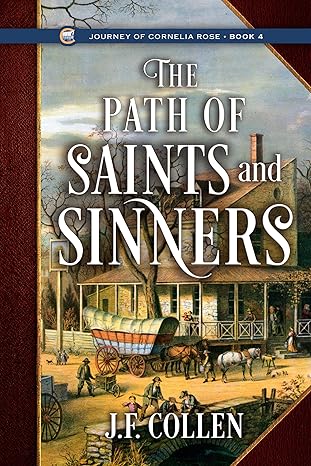
The Path of Saints and Sinners is the fourth book in J.F. Collen’s Journey of Cornelia Rose series, and it carries Cornelia “Nellie” Rose Wright into the stark and complicated world of Utah Territory in the mid-1800s. The story picks up with Nellie, her husband Obadiah, and their daughters after the grueling journey westward. They arrive in Great Salt Lake City, hoping for rest, stability, and a sense of community, only to find tension, hostility, and political turmoil instead. The book blends the trials of pioneer life with the undercurrents of faith, loyalty, and the uneasy intersection between the United States government and the Mormon settlers.
I felt pulled right into Nellie’s restless heart from the start. She is exhausted and homesick, yet her sharp wit and stubborn courage refuse to give way. The dialogue brims with energy, and the little details like dusty wagon wheels, harsh light, and the smell of mold on corn husks make the setting feel immediate and alive. At times, I found myself irritated with Obadiah’s insistence on pressing forward in the face of obvious danger, but then that frustration softened because it mirrored Nellie’s own. The writing does not shy away from messy conflict. It lingers in the gaps between what is said and what is felt, and I admired that.
The book meanders through conversations and stretches of description that sometimes slow the tension. Yet, even when I grew restless, I found myself laughing at Nellie’s sharp asides or touched by the innocence of her daughters. There is an honesty in the way Collen portrays family life, messy and tender all at once, and that honesty kept me invested.
I realized this book is less about resolution and more about survival. Nellie’s world is uncertain, and her doubts echo across the pages in a way that felt strangely modern to me. I would recommend The Path of Saints and Sinners to readers who enjoy historical fiction rooted in strong female voices, especially those who like their history layered with personal struggle and the grit of daily life.
Pages: 504 | ASIN : B0FHPXS955
Inside Their Restricted Worlds

Night Hawks follows the lives of small-town drifters, dreamers, and the disillusioned who are all looking for something more, be that a fresh start, an escape, or just some understanding. What was the inspiration for the setup of your story?
The inspiration came to me from Edward Hopper’s famous 1942 painting Nighthawks. I always admired that painting and how it reveals a late-night café frequented by lonely souls. That’s what I always saw in it, anyway. The painting sparked an idea for a first chapter titled “The Last Train to Chicago,” which as a story, won a fiction contest award from The Vincent Brothers Review.
That first chapter ended with Hank appearing to lose his longtime server, Lois, and so I decided to write another chapter exploring where Lois went and what happened and once I felt it was becoming a book, I needed a couple more good characters to drop into the fishbowl already inhabited by Hank and Lois, and I put the four of them on constant collision courses.
Was there anything from your own life that you put into the characters in your novel?
I don’t think so. Both Hank and Tyler are military veterans and I’m not. I don’t believe any of the four main characters are based on anyone I know now or from the past. For each of the four characters, I first established their names, and from the names I got a starting point for building them into people. I worked, too, off their occupations: Hank as a diner owner and cook, Lois as a veteran server, Clara as a young server still living at home, and Tyler, a jittery veteran just home from Afghanistan.
So, when I started putting flesh on each one, I began with knowing their name and job and my imagination assembled them, and then with each new chapter, I learned more about them and how they would react. For me, writing is a daily process of discovery like it is for readers. I don’t do character arcs before I start writing. I want the daily surprise that comes day as I know the characters better and hear their voice and understand their desires and conflicts.
What were some themes that were important for you to explore in this book?
Family is perhaps the most important – and obvious – theme in Night Hawks. But not the usual concept of family. The four people in the book whose paths and lives are so intertwined, don’t really have traditional families anymore and so their journeys require them to bond and become their own little family. There are lots of people whose lives have become small and desperate, and they look to the people inside their restricted worlds to be family members.
Perhaps enduring and persevering are themes, too. Hank, Lois, Tyler, and Clara must all maintain hope for something better. They don’t have a lot to work with but must keep fighting to have satisfactory lives.
What is the next book that you are working on and when can your fans expect it to be out?
I am nearly done writing the draft of a novel titled The Gatsby Lover. It has a connection to The Great Gatsby, but I’ll keep that close to the vest for now. After I let it sit a few days and then make revisions, it goes over to my longtime personal editor, Carol Burbank, for her always useful reactions. Fingers crossed it finds a good publisher!
Author Links: GoodReads | Facebook | Amazon
Hank Spencer knows what goes on in his diner. He knows which days are best for business and whether the Blue Plate special is selling, and he makes note of the customers who come to drink and make small talk with his servers.
Lois is a hardworking waitress pushing fifty who hasn’t forgotten her big city dreams. When opportunity presents itself, she boards the train for Chicago, despite the risks and her boss’s attempts to warn her.
Working all the double shifts in the world won’t take care of Clara’s problem. She’s young, single, and knocked up. She feels trapped—at the diner, living with her god-fearing parents, and in the gossipy town full of watchful eyes.
Tyler is adjusting to civilian life after a stint in the army. At Hank’s Diner, he finds camaraderie and comfort, and sometimes, he can drown out visions of war over a plate of potatoes and meatloaf, and several, ice-cold beers.
These lonely souls converge under the fluorescent glow of the eatery, late at night and during long days, as the train speeds through, blaring its horn and signaling an alternate path. NIGHT HAWKS is a tender novella with a touch of noir about finding family in unlikely places, living through losses, and the connections that keep us showing up for another shift.
The London Cheque

Allen Longstreet’s The London Cheque delivers a haunting debut horror tale set in the picturesque yet ominous 1960s Scottish village of Catrine. The disappearance of four boys, including 12-year-old Arun Khan, sets off a chilling chain of events that intertwines the lives of Aniqa, a mother driven by relentless determination, and Margaret Brown, a jaded policewoman seeking redemption. As Aniqa begins to suspect Albert Reid, a local benefactor with a shadowy presence, the story spirals into a gripping tale of resilience, redemption, and the horrifying truths hidden within the seemingly serene community.
Suspense drips from every page, showcasing Longstreet’s skill in crafting an unsettling atmosphere. The visceral image of “the man with no skin” lingers long after it’s introduced, a testament to the author’s ability to create vivid, terrifying moments. Aniqa’s journey is especially gripping. Her pain, resilience, and fierce maternal instincts ground the story in raw emotion, while Margaret’s parallel struggle adds layers of complexity, showing how two very different women are united by their pursuit of justice and truth. Albert Reid, the antagonist, stands out as a truly unforgettable character. Longstreet crafts him with grotesque precision, but he isn’t a caricature of evil. Instead, Reid’s humanity peeks through the horror, making him as tragic as he is terrifying. This depth elevates the narrative beyond a simple battle of good versus evil, delving into the complexities of human darkness and redemption. The balance of horror and humanity keeps the story gripping and emotionally resonant.
The Scottish dialect, though challenging at first, adds authenticity to the setting, pulling readers further into the world of Catrine. Longstreet’s descriptions of eerie landscapes and the harrowing events that unfold feel cinematic, painting vivid pictures of terror and tension. The book almost begs for a screen adaptation, with its evocative imagery and powerful character arcs. While some scenes are undeniably disturbing, they serve a purpose, highlighting the stakes and the cost of the characters’ choices. Longstreet doesn’t exploit violence for shock value but uses it to underscore the weight of trauma and resilience. By the time the plot reaches its shocking twist, every harrowing moment feels earned, leaving an indelible mark on the reader.
The London Cheque is a chilling, emotionally charged novel that lingers long after the final page. It explores themes of loss, survival, and the enduring bonds of family with unflinching honesty. Longstreet’s debut is nothing short of remarkable, and I eagerly anticipate what he brings us next. For fans of horror with depth and heart, this is a must-read.
Pages: 579 | ASIN : B0CTHK2H57


