Blog Archives
Once-Mighty Civilization

Daughters of the Empire follows two women as they navigate through political intrigue, family secrets, and timeless battles as they search for truth and a way to save their world. What was the inspiration for the setup of your story?
There were several sources of inspiration, but two stand out: The Rise and Fall of the Great Powers, by Paul Kennedy, and The Legend of the Galactic Heroes, by Yoshiki Tanaka. I wanted to craft a story that blends Kennedy’s concept of the cyclical rise and decline of empires with a more human-centered narrative. While Tanaka’s work is brilliant in exploring the merits of autocracy versus democracy, it often lacks the intimate human dimension. I also felt that modern storytelling rarely gives us strong, complex female leads like Major Kira Nerys or Susan Ivanova. Too often, Hollywood substitutes depth for superficial “girl boss” tropes. My goal was to create flawed yet deeply relatable characters—Deanna, Valerica, Lucilla, and Miyu—whose choices you may not always agree with, but whose motivations you can understand.
I find the world you created in this novel brimming with possibilities. Where did the inspiration for the setting come from, and how did it change as you were writing?
The myth of Atlantis and Homer’s Iliad were my primary inspirations. I was fascinated by the idea of a once-mighty civilization—the Palladian Star Empire—suddenly collapsing, leaving the protagonists to pick up the pieces. The second half of the book draws heavily from the Iliad, exploring how war reshapes not only the world but the heroes themselves. One chapter of history closes, and a new one begins. Gaia emerges scarred yet transformed, and the four main characters realize that survival alone is not enough—the empire must evolve if it is to flourish.
What were some themes that were important for you to explore in this book?
Personal freedom is one of the core themes. I wanted to subvert the “chosen one” trope, but in a way different from Dune. Deanna, Valerica, Lucilla, and Miyu understand that their choices have consequences. They don’t blindly follow prophecies or orders—they seize leadership and make the best decisions they can in the moment, even when those choices haunt them later. Unlike Paul Atreides, Lucilla reforms the empire without invoking any divine mandate, and Deanna joins her not as a rebel but as a realist. Frank Herbert once said that all rebels are closeted aristocrats—a fair point—but Deanna is something else entirely: pragmatic and grounded.
The second major theme is transhumanism: what truly makes us human? Is it our memories, our personality, our capacity to love? Through genetic memory, cybernetic augmentation, and the tension between evolution and identity, the book asks whether humanity is defined by biology or by the choices we make.
I find a problem in well-written stories, in that I always want there to be another book to keep the story going. Is there a second book planned?
As you said, the story is intentionally left open-ended, which creates many possibilities for what comes next. So yes—a sequel is definitely a possibility. I already have ideas about where the characters and the empire could go from here, but I want to make sure any continuation feels as meaningful and ambitious as the first book.
Author Links: GoodReads | X (Twitter) | Facebook | Instagram | Amazon
Admiral Valerica Crassus, a veteran of countless battles, faces her greatest challenge yet—not from an enemy fleet, but from the haunting questions of right and wrong as she commands her forces in the final stage of the Draco Sector conquest.
On the verdant planet of Dorset II, Deanna Lancaster’s tranquil existence as a wine merchant is shattered by a sudden raid, thrusting her into a web of cosmic schemes. As she delves into her family’s enigmatic past, Deanna discovers truths that could alter the course of her life, and the galaxy, forever.
Daughters of the Empire is a tale of courage, camaraderie, and the unyielding quest for truth. Join Valerica and Deanna as they navigate through political intrigue, family secrets, and timeless battles over a galactic chessboard between light and darkness. This richly illustrated space opera—including 22 original artworks and two detailed maps—will take you on an epic journey where the legacy of the past will define the destiny of the future.
The Last Defense: The Fight for Epsilon
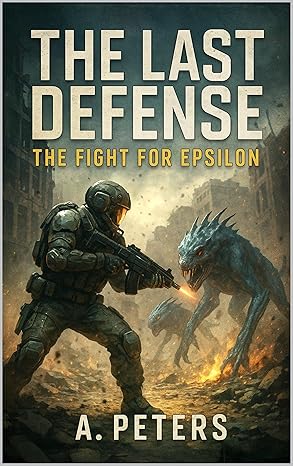

The Last Defense drops us straight into a brutal, crumbling world where Earth’s last hope rests in the hands of worn-out soldiers trying to fend off an overwhelming alien invasion. Major Jonas Cross, our gritty and deeply human lead, fights not just for survival but for family, memory, and something that feels a lot like hope. The story unfolds across the wreckage of Epsilon City, blending desperate last stands, gut-wrenching rescues, and shaky alliances into a tense, high-stakes battle for humanity’s future.
Right from the first chapter, A. Peters pulled me in with raw, vivid imagery. The opening scene where Jonas is crouched behind a slab of concrete, breathing smoke and fear, while Nightfangs hunt the ruins, slammed the urgency into my chest like a hammer. I loved how Peters didn’t waste time with long setups; you’re thrown straight into the fire. When Jonas reflects on his late wife Anna while hiding from monsters, it doesn’t feel forced or preachy. It feels real, like the kind of memory that guts you when you least need it. Peters has a knack for giving action scenes an emotional spine, and that’s a rare trick.
There were moments, though, where the pacing buckled a little under all the world-building. For instance, the section in the starport had so much tactical briefing that it almost felt like I was reading mission notes instead of a novel. I wanted to get back to Jonas, Ethan, and Selina fighting their way through the city ruins. That said, when the story veers into darker territory, like the prisoner experiments Jonas stumbles upon in the factories, it hits like a punch to the throat. That part genuinely made my skin crawl, and that’s a good thing.
What really stuck with me was the relationship between Jonas and Ethan. Their bond isn’t syrupy or melodramatic; it’s stubborn and bruised and heartbreakingly real. When Jonas risks everything to find his captured brother, dragging himself and a whole squad through hell, it made every firefight and every narrow escape count for more. And the moment Jonas finally finds Ethan, broken but alive, was pure gold. Peters writes brotherhood the way it feels: messy, guilt-ridden, and absolutely necessary.
The Last Defense is a grim, relentless ride, but it’s also filled with tiny flickers of hope that feel all the more precious because they’re so hard-won. I’d recommend it to anyone who loves gritty sci-fi war stories that don’t skimp on heart. Readers who appreciate the intense, character-driven science fiction of The Expanse or Halo: Fall of Reach will find much to admire here. Prepare for a gripping experience that demands both attention and emotional investment until the very last page.
Pages: 169 | ASIN : B0DY386H36

The Challenges of Our Times

Aquila Rising follows a Martian-born young man whose colony is attacked and his father is executed before his eyes, leading him to seek a way to get revenge while being forced into the army that destroyed his life. What was the inspiration for the setup of your story?
I was watching an old History Channel series on The American Revolution and a world started to grow in my head as I watched. I liked the power dynamics between the American militias and the British army that was considered the most powerful army in the world at the time. The British were also seen as the oppressors and it’s an infamous story of humanity’s struggle for freedom.
I’ve always thought that using our history as inspiration for a story will help make it feel more real, so I took the inspiration and built a new world around it. A space opera felt like a fitting setting for my story!
I find the world you created in this novel brimming with possibilities. Where did the inspiration for the setting come from, and how did it change as you were writing?
There’s a lot of tension and discussion right now regarding wealth inequality and corporate power. I wanted my space opera to be relevant to our times and challenges, so I started brainstorming ways that I could incorporate the world I had created with the challenges of our times.
As I built out the story, more and more possibilities sprung up and the size and power of Draconis grew. As I wrote, their leader took on more evil, but I tried to make the employees seem like good, normal people, stuck within their grasp.
What were some themes that were important for you to explore in this book?
I really wanted to explore some social themes in this book, the big one for me was corporate power and corporate greed. We’re living in a time where certain companies have incredible amounts of power and they use their influence to alter humanity’s course in the world, most often, not for the betterment of the average person.
A gripping adventure through space provides an engaging platform for readers to explore some of these themes and the ambiguity of some of the moral decisions hopefully leaves readers thinking long after they set down the book.
Can you tell us where the book goes and where we’ll see the characters in the next book?
Lewis and Nels continue their quest for freedom with The Aquila Front. They’ve become accidental heroes of the rebellion and given it credibility. Inspired by their actions, more people within Aquila start following suit and wage a hidden war against Draconis.
Draconis becomes more and more desperate as they feel threatened for the first time, they become hyper-focused on finding Lewis, convinced that capturing him will end the war. Their singular focus leaves them vulnerable and The Aquila Front takes their chances in their biggest open act of war yet.
Author Links: GoodReads | Amazon
Conscripted by a ruthless space mining corporation, Lewis rose through their ranks, becoming a weapon in their iron grip. But a chance encounter with a childhood friend ignited a rebellion within him.
Joining the Aquila Front, an insurgent movement fighting for freedom, Lewis uses his insider knowledge to launch devastating strikes against Draconis. But as the war escalates, he must confront the ghosts of his past, and find the man he was meant to be.
“Aquila Rising” is a pulse-pounding space opera that will leave you breathless. Buckle up for thrilling battles, daring escapes, and a hero who must choose between duty and defiance.
For fans of Hard Science Fiction books like James S.A. Corey’s The Expanse and Andy Weir’s The Martian, this is a must-read.
Don’t just read about it! Experience it. Click “Add to Cart” and join the rebellion against corporate greed today!
Aquila Rising

Allen Ansel’s Aquila Rising throws readers headfirst into a vividly realized future, where humanity’s reach extends deep into space, but old conflicts still fester. Set in 2198, the novel envisions a solar system carved up by political factions and corporate empires, teetering on the edge of war. Mars, Luna, Jupiter’s moons—each settlement is a chess piece in a game controlled by the United Nations, BRICS, and two powerful space-mining corporations, Draconis and Dongfeng. In the middle of this struggle stands Lewis, a Martian-born young man whose life takes an unexpected turn when his colony is attacked and his father is executed before his eyes. Forced into the ranks of the very organization that destroyed his home, Lewis finds himself navigating the rigid hierarchy of the Draconis Navy while struggling with his own burning desire for revenge. The book blends political intrigue, space combat, and personal vendettas into a gripping narrative that never slows down.
I loved the world building in this novel. Ansel doesn’t just tell us about Mars, he makes us feel it. The opening chapter, where Lewis gazes over the Martian landscape, grounds the reader in a setting that feels both foreign and lived-in. The detail Ansel packs into his depictions of space stations, asteroid mining operations, and the brutal realities of life in space makes the universe feel real. Even small details, like how the Draconis Navy’s green uniforms reflect their Earth-bound arrogance, add layers of depth to the world. That said, at times, the lore can feel overwhelming. There are moments where the narrative pauses to explain the political dynamics or technological advancements, which, while fascinating, can slow the pacing in spots.
Where Aquila Rising really shines is in its characters, especially Lewis. His transformation from a defiant Martian kid into a conflicted officer in the Draconis Navy is both painful and compelling. The scene where he watches his father’s execution is gut-wrenching—his helplessness, his rage, his heartbreak—it all feels raw and real. Later, as he struggles to fit into the rigid structure of the Navy, his resentment simmers beneath the surface, threatening to boil over at any moment. The supporting cast is hit-or-miss. Nels, Lewis’s childhood friend, provides an emotional anchor, but some of the naval officers, particularly Captain Abernathy, come across as archetypal rather than fully fleshed-out. Still, the dynamic between Lewis and his crewmates, particularly the sharp-tongued Pascal, keeps the dialogue engaging and adds much-needed levity.
The action sequences are thrilling, whether it’s a chaotic space battle or a tense political standoff. The attack on New Draco, where Fox 88s rain destruction from above, is pulse-pounding, and the moment Lewis realizes his father is about to be executed is one of the book’s most emotionally charged passages. Later, when Lewis takes his first command on the aging attack frigate DarkWind, the tension shifts to survival and strategy. The battle sequences are immersive, with Ansel balancing technical precision with cinematic flair. But the book isn’t just about explosions and dogfights—it’s about control, oppression, and the choices people make under extreme circumstances. Ansel doesn’t paint Draconis as outright villains, nor does he make the rebellion purely righteous. Instead, he leaves room for moral ambiguity, making the reader question who’s really fighting for justice.
If you love space operas with political intrigue, character-driven drama, and adrenaline-fueled action, Aquila Rising is an easy recommendation. It’s got the gritty realism of The Expanse and the high-stakes tension of Battlestar Galactica, but with a style that’s distinctly its own.
Pages: 335 | ASIN : B0DWKWCHJV
Cold Blooded
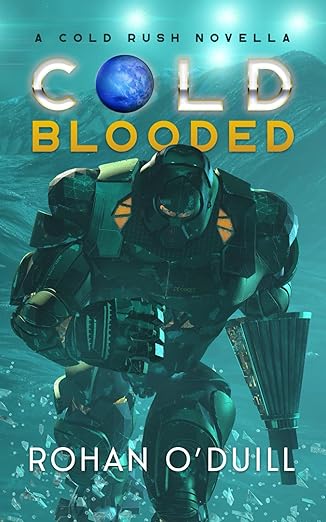

Cold Blooded by Rohan O’Duill transports readers to a vividly imagined future where corporate powers dominate the solar system, wielding unparalleled influence. At the heart of this dynamic setting is Mint, a skilled yet detached marine mech pilot. Once content as an instructor, she is thrust back into action, navigating the chaos of the “Cold Rushes.” Her journey takes an unexpected turn when she reunites with her former colleague, Bjorn—now a pirate—and his spirited daughter, Frida. Unexpectedly, Mint finds herself as Frida’s reluctant guardian, forcing her to balance survival, loyalty to her friend, and her obligations to her corporate overlords.
What sets Cold Blooded apart is its remarkable ability to function both as a prequel and as a self-contained narrative. Striking a delicate balance, the story seamlessly establishes a foundation for the larger series while delivering a complete and compelling tale in its own right. Far from feeling like a mere setup, the book captivates with dynamic characters, unpredictable plot twists, and gripping conflicts. O’Duill’s storytelling ensures that Cold Blooded stands firmly on its own, an achievement worthy of high praise. Equally impressive is the depth and intricacy of the book’s science fiction elements. The richly detailed futuristic worlds, advanced technologies, and innovative equipment are described with a precision that immerses the reader. Every aspect of this universe feels meticulously crafted, reflecting the author’s dedication to thoughtful world-building. The result is a setting that feels authentic and alive, adding a tangible sense of realism to the narrative.
Cold Blooded by Rohan O’Duill offers a thrilling blend of fast-paced action and intricate science fiction, making it an ideal pick for fans of the genre. Whether you’re new to O’Duill’s work or already familiar with his universe, this novel delivers an engaging and satisfying experience. Highly recommended for readers who crave immersive storytelling and high-stakes adventure.
Pages: 304 | ASIN : B0D9TY1V5N
The Quantum Effect -Snakes in the House

Nicklois Leonard’s The Quantum Effect-Snakes in the House delves into a speculative narrative surrounding the origins of the COVID-19 virus. In this thought-provoking novel, Leonard weaves a complex tale of time travel, secretive alliances between global organizations like the FDA, the WHO, and major pharmaceutical companies, and the supposed role of the Chinese Ministry of Health. This gripping narrative, rooted in science fiction, brings to light the intricate webs of power and influence that govern our world.
Central to the story is the depiction of the scientists at a Wuhan lab, who find themselves entangled in moral dilemmas, torn between their professional duties and personal ethics. Leonard skillfully portrays the plight of these individuals, notably Dr. Phen, as they navigate a landscape riddled with government pressure and the threat to their loved ones. Leonard’s prowess in blending speculative theories about the pandemic with elements of science fiction creates a cohesive and captivating narrative. He strikes a delicate balance, ensuring the scientific details complement rather than overshadow the human experiences at the heart of the story. This approach allows readers to engage with both the technical intricacies and the emotional depth of the characters’ journeys. While the dialogue in the novel occasionally veers towards a more structured style, it’s an interesting choice that sets it apart. The conversations, though at times methodical, are reflective of the author’s unique voice, presenting a distinctive approach to character interaction that some readers may find refreshing.
The Quantum Effect is a riveting exploration of speculative events linked to the pandemic, wrapped in a science fiction veneer. It will particularly resonate with fans of thrillers and conspiracy fiction, leaving an open path for a potential sequel.
Pages: 252 | ASIN : B0DDF6DRQS
fúath slugair
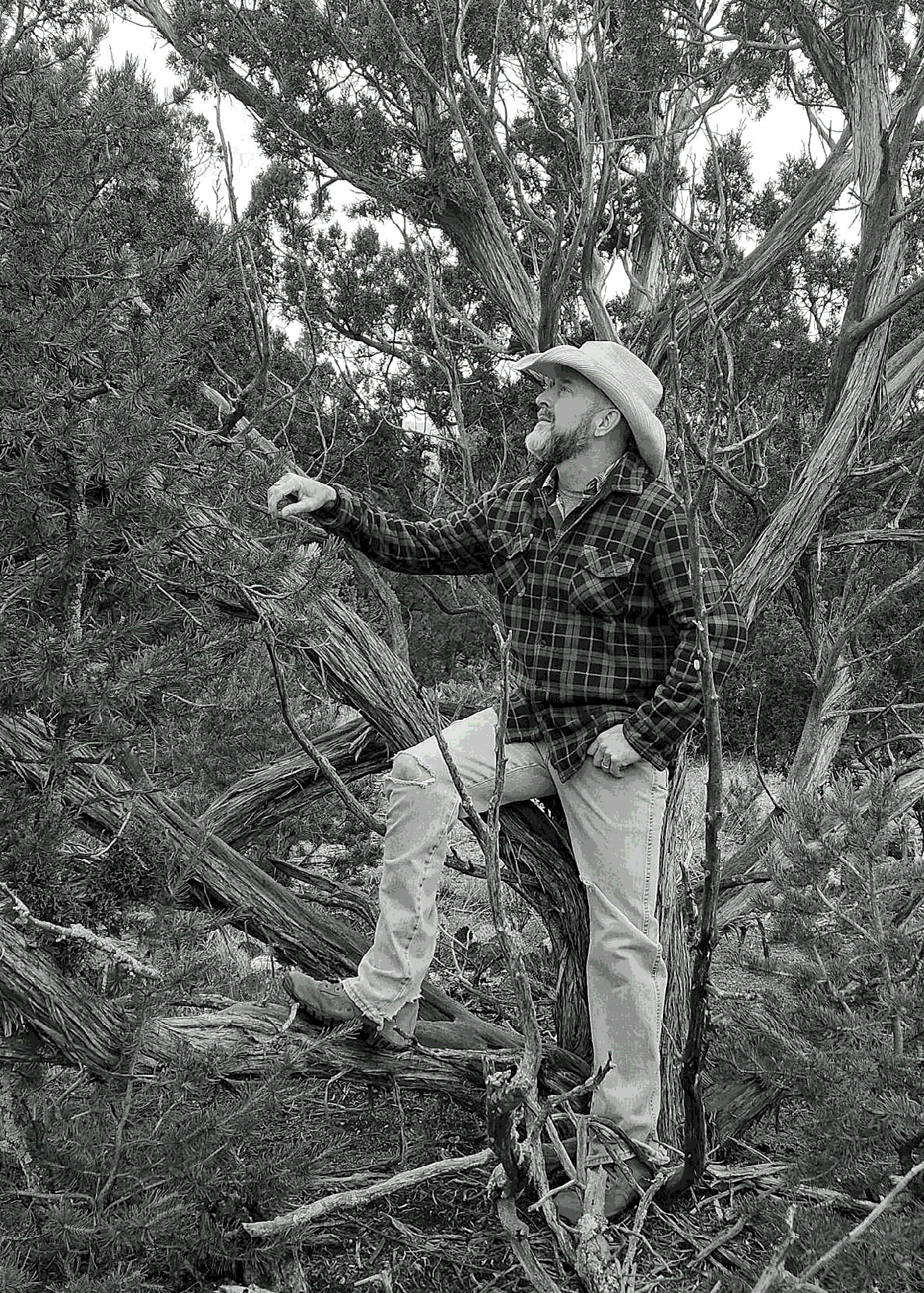
Fractured State follows a man entrusted with safeguarding a community of Druids who must navigate a perilous world where reality, mythology, and technology intersect and face relentless threats to survival. What was the inspiration for the original and fascinating idea at the center of the book?
Great question. Fractured State occurs within the world of The Blighted Earth, where humankind is both the planet’s dominant species and ‘the blight.’ Thus, the level of frustration and even disdain for humanity which bleeds through in the narrative leads the reader to question the narrator’s origin and species—High Sentient? Likely, an elemental or Guardian Spirit. For the series, the downstream story arcs were fleshed out first, and I had to map primary story arcs back to Book One to set the stage and create the conditions for what was going to happen later. I needed a great character who captured our species’ duality—flawed and yet possessing great potential; an aspect of the human condition which so vexes the High Sentients. As a combat veteran myself, I am intimately familiar with the challenges and struggles facing many of our military veterans, and as an obscure, religious minority, Druidry presented a likely target for discrimination while also possessing strong ties to nature. Finally, I needed an effective counter to Chaos’s shadow campaign to weaponize human emotion, which spawned the concept of the fúath slugair or ‘Hate-eater’—hence, Arden was born!
I find the world you created in this novel brimming with possibilities. Where did the inspiration for the setting come from and how did it change as you were writing?
To “set the table” for the Blighted Earth series, I needed the right set of conditions for Chaos to exploit in His relentless pursuit to initiate the Great Cascade and bring about the Discordant on Earth. The makings of environmental catastrophe (extended drought, wildfires, natural habitat erosion, human over-settlement, etc.) have been present and worsening for some time, with climate change driving more destructive weather extremes. Additionally, the novel was written during the trials and tribulations we all endured during the COVID pandemic and the unfortunate events in the aftermath of the 2020 Presidential election. When coupled with all the emerging threats, conflicts, and uncertainty which have emerged in last few years, as well as their corresponding negative effects on our collective state of mind and emotions, the real world itself provided all the drama and necessary ingredients for ruinous potential at continental scale. The final step was to inject the enduring struggle of otherworldly entities and supernatural beings into volatile mix—and “voila”—this author had everything he needed to create the “fractured state.” As far as changes during the writing process, extraordinarily little changed in the overall setting in the United States, but local places, encounters, and characters within Arden’s story arc changed as his supernatural powers and the overall impact he was to have in the series gained greater fidelity. These factors then shaped more ‘tactical’ aspects of the novel, such as finding the right settings and locations within the state of Texas.
What were some themes that were important for you to explore in this book?
I explore several themes in Fractured State, and to me, some of the more important ones are:
- Human belief systems and the huge impacts they have had on the environment and biodiversity of our world: How would things be different if we all adopted the Lakota philosophy of “we are all relatives?” We are the planet’s dominant species, but that does not place us ‘above’ other living things; non-human species are not just resources to be exploited. Humankind’s role obligates us to serve as the Earth’s stewards for the benefit of all life. Taking this concept another huge step further, how would our approach to life and living change if we were all children of a sentient planet?
- The adverse impacts of our technology: Human innovation and the ability to “make tools” to enhance our abilities and our lives has always been a strength, but it also has the negative corollary effects of extending the reach, influence, and power of bad actors. I would go as far as to say that, in many ways, technology is contributing to our “devolution” as a species.
- The rise of incivility in our civilization: The human attributes which enabled our meteoric rise to the top of the food chain—cooperation, communication, community—are being rent apart by divisiveness, corruption, and dishonesty within society. It is like a contagious disease which is fundamentally changing us for the worse and causing us to turn our backs on the things that made us “great.”
- Storytelling, one of humanity’s other great attributes, is also being co-opted to insidious ends: This is nothing new in our relatively short history as a species, but the line between exaggeration and lie has gone from blurred to practically nonexistent. Worse, the power of lies proliferated by influential people has been exponentially magnified by our own technologies.
- The process of radicalization and the rising threat of ‘homegrown’ violent extremists to our American democracy: In a world where life resources are becoming ever more limited and contested, while the gap between the “haves” and “have-nots” continues to grow, the numbers of disenfranchised citizens continue to grow. They are the target population for radicalization, and everything previously mentioned amplifies the ability of extreme actors to make more converts more quickly … and they do not even have to be in the same room, or state, or even in our country!
When will book two be available? Can you give us an idea of where that book will take readers?
Great news: Blighted Earth fans can expect to see Long Leg from the Blight Earth sometime next year. I am pretty far along in knitting together and refining the manuscript from the initial draft. In fact, I actually have the rough drafts completed for the next three books in what is currently planned to be a nine-book series. In terms of Book Two expectations: expect the unexpected! Another story arc begins with a new cast of characters who will have to accept the baton and carry the gripping narrative forward in the Natural Order’s struggle against Chaos and his minions. Where will Book Two take place? Hint: pay careful attention to Parim’s words towards the end of the Fractured State epilogue. Lastly, though it is hard to pick favorites, Book Two is one of the stories I really want to share with the world!
Author Links: GoodReads | Instagram | Website | Book Review
His objective: initiate the Great Cascade and bring about the Discordant on Earth. His target: North America, where the Chaotic flashpoint within human civilization has occurred…in Texas?
The eternal struggle between order and chaos is an inescapable condition of the universe. Caught in the middle is the delicate balance necessary for life to exist and prosper in our world. On Earth, the opposing sides in this timeless conflict are Earth Mother’s Natural Order and Chaos’s Force Corrupted-the En’Troop-EE. The Great Cascade is underway, and with the High Sentients of the Natural Order reduced and in disarray, there may be no stopping Chaos this time.
In Fractured State by R.M. Tembreull, the reality of existence on Earth is reinterpreted, where all living things are seen as the children of a sentient planet. Our immortal souls are gifts from Earth Mother, and all living beings progress through many lives within the Hierarchy of Sentience. If our world could feel, would this change how you perceive our world?
Fractured State

Fractured State by R.M. Tembreull is a riveting fusion of mythology and dystopia, set in a future America where Texas has seceded and fallen under extremist control. The protagonist, Arden, a distinguished veteran, is tasked with safeguarding a community of Druids known as Hearthstone Grove. Branded as religious deviants by the new Texas republic, Arden and his community must navigate a perilous world where reality, mythology, and technology intersect, facing relentless threats to their survival.
Tembreull’s writing is a tapestry of vivid imagery and intricate world-building. From the very first chapter, the reader is plunged into a narrative that oscillates between the human and the supernatural, the real and the mythic. The prologue, “Purgatorium,” sets the tone with its exploration of a metaphysical state that restricts spiritual growth, offering a powerful metaphor for the constraints facing the characters and, by extension, humanity. Tembreull’s ability to weave together such high-concept ideas with grounded, relatable human experiences is one of the novel’s standout features. One of the novel’s strengths lies in its character development. The characters, both human and otherworldly, are well-crafted and multi-dimensional. The Sentient Winds and Elementals, like Nilch’i and Parim, are not just forces of nature but entities with personal vendettas and deep emotional landscapes. The human characters, such as Kieran McBride, embody the struggles and resilience of those living on the margins of society. This duality is best exemplified in the interactions between the elemental beings and their human counterparts, which are fraught with tension and profound moments of insight. The narrative is rich with lore and exposition, which, while fascinating, can occasionally overwhelm the reader. The detailed descriptions of the universe’s creation and the Inani’s home world, Calisphaer, are particularly dense. While these sections add depth to the story, they also slow down the pacing. Readers who enjoy meticulously crafted worlds will appreciate this attention to detail, but those looking for a more straightforward narrative might find it challenging.
Fractured State is a compelling read for those who enjoy deep, intricate world-building and complex characters. Tembreull’s narrative is both a cautionary tale and an epic fantasy, blending real-world issues with mythic elements to create a story that is as entertaining as it is thought-provoking. This book is highly recommended for fans of speculative fiction and those who appreciate a richly detailed universe that challenges the reader to think critically about the world around them.
Pages: 299 | ASIN : B0D7LRZN75



 LITERARY TITAN