Blog Archives
Gravitational Anomalies

Cold Earth follows a deep-space commander and a far-future doctor whose memoirs collide when a black hole mission sends one crew 50,000 years ahead, where they become accidental saviors of a war-torn Earth. What inspired the idea of linking a deep-space mission with humanity’s world in 50,000 A.D.?
I have always been a big fan of science fiction involving space travel. The idea about linking a deep space mission commander and a far-future doctor came to me during a lunch break at work, after I recalled watching a science channel video about the black holes in deep space. These powerful gravitational anomalies are so powerful that even light cannot escape their gravitational pull. The science program also explained that time would drastically slow down when a spaceship gets close to the black hole, even if it will not cross the Event Horizon, which would be fatal for the ship and the crew, because there will be no escape. I thought, why not make a near-future spaceship experience the same phenomenon and accidentally travel forward in time? And thus, the idea for the Cold Earth novel was born. The rest of the setup involved the character design and the list of events in the story.
Why did you choose to tell the story through alternating memoir-like timelines?
This is a very good question. By choosing to tell the story through alternating timelines, I wanted to tell the readers about the two very different worlds: the world of a science expedition commander, Martin Hall, of the year 2248 A.D., and the far future scientist, Dr. Antares Lang, of the year 50,000 A.D. The world of Martin Hall, in many ways, is similar to our own. He is a professional astronaut, a family man, a husband, and a father. He lives in a time where humanity has finally developed the means to bend space and time, thus ensuring faster-than-light travel without violating the fundamental laws of physics. In comparison, Dr. Antares Lang lives in the distant future, on planet Earth gripped in the period of a New Ice Age. Like Martin Hall, Antares is a former soldier who has a family but lives deep underground in one of the high-tech exotic cities where humans hide from the elements and battle rogue and highly evolved ancient cybernetic organisms on the surface.
How did you approach balancing scientific explanation with character-driven storytelling?
Before I began writing this novel, I wanted to make it grounded in a solid science of astrophysics without boring the reader with technical details. My idea was to present the scientific facts, and present them to the readers in an entertaining as well as educational manner. There is a genre called hard science fiction, where the exact science of today is applied in a very academic manner and woven into the story. I also wanted this novel to be character-driven, where each protagonist is given his or her voice that makes them unique. As for the black hole Gaila BH-1, which becomes the cause of the ship’s accidental travel into the very distant future, such an active celestial object does exist in the constellation of Snake Catcher, and although formidable, it poses no danger to us, being more than one thousand light years away.
Which part of the far-future Earth was the most exciting or challenging to build?
I am not a futurologist, but just like the highly educated people of science and people who are very familiar with human social dynamics, I tried to imagine the far distant future of humanity, where the situation is hard but far from hopeless. Just like we, in our own time, try to handle our own problems of political instability, environmental pollution in the name of profit, unrestrained corporate greed, corruption, and economic uncertainty, I thought that the world fifty thousand years from now would seem radically different from our own in languages, traditions, customs, and technology. I was excited to build the subterranean world, where the return to the deep caves was a temporary measure, and the struggle of men against a new race of intelligent, hostile machines that have evolved from ancient military robots, is presented in a realistic manner, but without many action scenes that readers might have expected. Cold Earth is a tale of evolutionary philosophy, as well as a high adventure beyond time and space.
Author Links: GoodReads | Amazon
The Structure of Society

Tyrants of Gravity follows the people of Earth who have survived the first alien attack and are now preparing for future attacks, while trying to survive the aftermath of the first war. Is this story more about survival—or about what survives?
The first book in the series, Gravity of Sol-3, is more about what or who survives. The alien sentinels sought to prevent humans from acquiring black hole energy technology that could threaten the dominant galactic worlds. The aliens also tried to prevent the evolution of man’s telepathic communication, deploying eugenic attacks to exterminate neurodiverse members of the population. If the aliens could have blocked these two elements of human civilization — one technological, the other biological — then humankind would survive but stagnate.
The aliens, Tyrants of Gravity, return in the second book to eradicate the human threat now that Earth has obtained both capabilities. Humans use black hole energy to power spacecraft, and human telepathy establishes contact with alien life. The alien antagonists plan to strike our world with relativistic kinetic energy weapons—releasing more destructive energy than a million nuclear weapons. In Tyrants of Gravity, the stakes are the survival of the human race.
Your battle planning and tech feel tactile and grounded. What research or frameworks shaped that realism?
This aspect of the stories came easily to me, as I have a background in science and engineering and have designed military weapon guidance systems and commercial computing systems. I used my experience with those systems, the teams of developers, and with government and military organizations. I also ensured the story’s events obey the laws of physics as closely as possible: I have a spreadsheet titled, Physics, for each story, and this is just as important as my detailed outlines of story structure and character arcs. The realism introduces natural constraints and obstacles that the characters must overcome.
The alien forces are not just antagonists—they react, adapt, and escalate. How did you approach their psychology?
The aliens rely on machine intelligence, MI, to operate their spaceships and their society. I extrapolated beyond our current AI technology to imagine systems that threaten their organic creators. The alien life forms, the organics, still manage to exert diminishing influence over the alien MI. I gave the MI characteristics of human political organizations, along with many of the weaknesses and faults humans exhibit today. The aliens must grapple with MI and organic conflicts as they pursue the greater objective of suppressing and destroying the human threat. The alien organics and MIs are flawed characters.
As a sequel, this book expands both scale and theme. How do you see the larger arc unfolding?
The first two books of the series focus on Earth and the first contacts with alien antagonists. These books are close together in time and result in the breakout survival and advancement of the human race, making Earth’s inhabitants viable contenders in the galaxy. The worldbuilding of the first two books was a straightforward extrapolation of present-day Earth. Future books will explore how humans exploit their new capabilities to travel to the stars and interact with the alien species that first watched over and then assaulted Earth. Human neurodivergence and telepathy progress and dramatically affect the structure of society.
I have two works in progress that transit across space and time and feature significantly more worldbuilding for the alien settings, cultures, and technologies of Luyten-B and Proxima-B. Humans travel to the home world of the Luyten, Cap, to find the captain’s world subjugated by Centauri masters. Human military and diplomatic missions journey to the Centauri fleet station on Proxima-B to confront the alien civilizations from a position of strength, but grapple with the unintended consequences of their missile and cyberattacks on the Centauris.
Author Links: GoodReads | BlueSky | Website | Amazon
Humans mount a frantic defense.
The aliens launch planet killers.
Earth’s civilization and billions of human lives are at stake.
Two autistic boys, Robby and Luca, search for their lost parent–lost in the dystopia created by the alien attacks. The rogue alien officer, Cap, is thrilled by the boys’ emerging telepathy mutation and helps them in their quest.
Scott Anderson, Robby’s physicist brother, joins the Space Force weapons development team to defend against the approaching alien fleet. But man’s technology, which harnesses the energy of primordial black holes, is primitive compared to the Centauri fleet’s weapons.
Metaphysical Talents

Legacy of Valor follows Major Liam O’Connor as he leads a fractured alliance into a brutal campaign on a hostile moon—while navigating family, loyalty, and a mysterious Dreamscape power. What was the inspiration for the setup of your story?
Earth’s recent history contains many memorable battles and warriors to draw inspiration from. The Civil War’s Gettysburg and the Battle of the Ia Drang Valley in Vietnam inspire much of Legacy of Valor. At the Battle of Gettysburg, during the defense of Little Round Top, Colonel Joshua Lawrence Chamberlain and his regiment were on the extreme left of the Union line with orders to hold at all costs. He used the terrain to his advantage, ultimately driving the Confederates back. As Chamberlain did to win the battle (and possibly the war), Major Liam O’Connor does in Legacy of Valor, using the ground topography to win the Battle of Treespo; outnumbered, he held his position until reinforcements arrived.
Another battle on Earth that took place 100 years later was in the Ia Drang Valley of Vietnam. Lt. Colonel Harold (Hal) Moore faced a numerically superior North Vietnamese force. He coordinated his troops to use the artillery on the ground along with air power to hold their position. Using these same battle tactics, Major O’Connor channeled the spirits of Chamberlain and Moore by remaining outwardly calm in the face of overwhelming odds and thinking quickly. He employed the terrain, artillery, and air power, along with orbital forces, to keep his warriors alive.
In this second novel of the series, Legacy of Valor, the triplets are still children who grew up hearing stories of their father’s exploits. Liam now leads Etursci’s Special Operations Company and is attached to the New Terran Marine Corps’ Third Division to retake the moon called Treespo, orbiting the planet Beta Proximus IV, from Marshal Kergan’s Rebel forces. “No plan survives its first encounter with the enemy,” is an old Marine saying. Minutes after landing on the hostile surface of Treespo, treachery decapitates the division, leaving Liam the senior combat officer. Deception has stripped the Third Division of its support. As forces scramble to assist both sides, Liam must keep the warriors under his command alive.
For personal inspiration, there are science fiction books that use psionics like ESP (Extra Sensory Perception), though I put my unique twist on it. Few Military Science Fiction books explore a person’s consciousness being used outside the body, which is called “Dreamwalking.” While Dreamwalking, a person often has to fight enemy Dreamwalkers. I also drew inspiration from video games such as Halo, in particular with weapons and tactics in space combat.
The Dreamscape adds a unique layer to the story. What narrative challenges came with blending physical and metaphysical combat?
I explore the military use of Extra Sensory Perception (ESP) powers. For such metaphysical talents to be convincing, I must clearly explain the ESP abilities and their associated costs. To do this, I show that the protagonist does not have an overwhelming advantage, or the reader won’t believe they could lose in a battle.
Belief is critical in the Dreamscape. If a person doesn’t believe he or she can do something in the Dreamscape, such as fly or walk through something, they will not be able to do it. Conversely, when someone is attacked in the Dreamscape, weapons directed at them don’t really exist. Therefore, the victim can only be harmed if they believe the weapon can harm them. This makes the ability to disbelieve an important defense against someone’s attack. However, believing and disbelieving require years of training to discipline one’s mind. As Jarek (an expert at Dreamwalking in Dreamscape Warriors Series) said, “the slightest doubt could kill you.”
While moving around, one’s own subconscious uses very little energy, communicating over a great distance or moving outside the body uses energy more rapidly. When a person is exhausted, the Dreamscape seems filled with fog to the point that they might not be able to find their way back to their body.
Related to Dreamwalking is the ability to “Step Out of Time.” This technique enables a warrior to slow the time around him without it affecting him. In battle, they can move very rapidly, giving them a distinct advantage over their enemy for a limited time. However, like Dreamwalking, it uses energy, and a person can be dragged back into regular time once they become tired.
Are there more stories planned in this Dreamscape Universe?
In my books, I explore family dynamics, especially during times of crisis and separation. The triplets and their brother play a major role in the third novel, Promise of Mercy. Aisling, Bayvin, and especially Deirdre, needed to be their father’s daughters. The girls returned home after advanced training in the Finnian Shock Forces. They’ve inherited their father’s marksmanship, his leadership skills, and his ESP powers. However, they aren’t clones of each other. Deirdre is their best shot, and leadership comes naturally to her. Aisling is an explosives expert and pilot. Bayvin specializes in electronic warfare and excels in military intelligence. Their brother is still in his teens but is already a skilled pilot. We also meet Marissa, a former Rebel war criminal who must confront her past once her daughter, Gayla, is born. Marissa goes against Kergan to befriend Liam and return him to his family.
In the fourth book, Addiction of Power, Liam is older. His daughters are now middle-aged. His son, Aidan, is a veteran fighter pilot. The daughter that Liam and his wife Celinia conceived in Promise of Mercy, Tetia, is in her teens and planning to follow her mother’s path as a priestess and healer. The theme of family carries over. Aidan agrees to deliver information to Finnian Intelligence while on a trip with his Great Aunt Máire and sister Tetia when Kergan attacks their ship. After escaping, Marissa and her daughter Gayla, whom the audience meets in Promise of Mercy befriend Aidan and his family. This starts a journey to end a 700-year interstellar civil war. Factions on both sides of the conflict must wrestle with the implications of peace: an end to the bloodshed versus losing power. It also plants the seeds for threats from beyond the Milky Way.
While I was writing the Dreamscape Warriors Series, I realized my central characters had interesting personal life adventures—and I wanted to write about them. These can be major emergencies that only last a matter of minutes, or everyday surprises that take us down unexpected roads. They make up the backstories of each person’s life. This realization started me writing the Sci-Fi Short Book Series based on the characters in the Dreamscape Warriors Novels.
The first short book in the series, Way of Forgiveness, highlights the main character, Liam O’Connor, between the first and second volumes. Liam is not sitting idle between the novels. Things happen in his life that are not covered in the full-length novel, but make a good story in this short book. Here, I focus on Liam’s journey to understand the nature of forgiveness as he struggles through and learns from his archenemy, Licinious.
In the next short book, Evolution of Leadership, Deirdre (one of Liam’s triplet daughters) goes from being a scamp who always leads her siblings to mischief into a military leader. As she goes through her advanced trooper training, Deirdre learns to make responsible decisions when others’ lives are on the line.
Author Links: GoodReads | Website | Kurt’s Frontier | Facebook | Price of Vengeance | LinkedIn | X (Twitter) | Amazon


Once-Mighty Civilization

Daughters of the Empire follows two women as they navigate through political intrigue, family secrets, and timeless battles as they search for truth and a way to save their world. What was the inspiration for the setup of your story?
There were several sources of inspiration, but two stand out: The Rise and Fall of the Great Powers, by Paul Kennedy, and The Legend of the Galactic Heroes, by Yoshiki Tanaka. I wanted to craft a story that blends Kennedy’s concept of the cyclical rise and decline of empires with a more human-centered narrative. While Tanaka’s work is brilliant in exploring the merits of autocracy versus democracy, it often lacks the intimate human dimension. I also felt that modern storytelling rarely gives us strong, complex female leads like Major Kira Nerys or Susan Ivanova. Too often, Hollywood substitutes depth for superficial “girl boss” tropes. My goal was to create flawed yet deeply relatable characters—Deanna, Valerica, Lucilla, and Miyu—whose choices you may not always agree with, but whose motivations you can understand.
I find the world you created in this novel brimming with possibilities. Where did the inspiration for the setting come from, and how did it change as you were writing?
The myth of Atlantis and Homer’s Iliad were my primary inspirations. I was fascinated by the idea of a once-mighty civilization—the Palladian Star Empire—suddenly collapsing, leaving the protagonists to pick up the pieces. The second half of the book draws heavily from the Iliad, exploring how war reshapes not only the world but the heroes themselves. One chapter of history closes, and a new one begins. Gaia emerges scarred yet transformed, and the four main characters realize that survival alone is not enough—the empire must evolve if it is to flourish.
What were some themes that were important for you to explore in this book?
Personal freedom is one of the core themes. I wanted to subvert the “chosen one” trope, but in a way different from Dune. Deanna, Valerica, Lucilla, and Miyu understand that their choices have consequences. They don’t blindly follow prophecies or orders—they seize leadership and make the best decisions they can in the moment, even when those choices haunt them later. Unlike Paul Atreides, Lucilla reforms the empire without invoking any divine mandate, and Deanna joins her not as a rebel but as a realist. Frank Herbert once said that all rebels are closeted aristocrats—a fair point—but Deanna is something else entirely: pragmatic and grounded.
The second major theme is transhumanism: what truly makes us human? Is it our memories, our personality, our capacity to love? Through genetic memory, cybernetic augmentation, and the tension between evolution and identity, the book asks whether humanity is defined by biology or by the choices we make.
I find a problem in well-written stories, in that I always want there to be another book to keep the story going. Is there a second book planned?
As you said, the story is intentionally left open-ended, which creates many possibilities for what comes next. So yes—a sequel is definitely a possibility. I already have ideas about where the characters and the empire could go from here, but I want to make sure any continuation feels as meaningful and ambitious as the first book.
Author Links: GoodReads | X (Twitter) | Facebook | Instagram | Amazon
Admiral Valerica Crassus, a veteran of countless battles, faces her greatest challenge yet—not from an enemy fleet, but from the haunting questions of right and wrong as she commands her forces in the final stage of the Draco Sector conquest.
On the verdant planet of Dorset II, Deanna Lancaster’s tranquil existence as a wine merchant is shattered by a sudden raid, thrusting her into a web of cosmic schemes. As she delves into her family’s enigmatic past, Deanna discovers truths that could alter the course of her life, and the galaxy, forever.
Daughters of the Empire is a tale of courage, camaraderie, and the unyielding quest for truth. Join Valerica and Deanna as they navigate through political intrigue, family secrets, and timeless battles over a galactic chessboard between light and darkness. This richly illustrated space opera—including 22 original artworks and two detailed maps—will take you on an epic journey where the legacy of the past will define the destiny of the future.
The Last Defense: The Fight for Epsilon
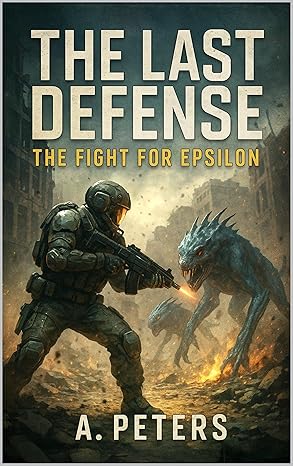

The Last Defense drops us straight into a brutal, crumbling world where Earth’s last hope rests in the hands of worn-out soldiers trying to fend off an overwhelming alien invasion. Major Jonas Cross, our gritty and deeply human lead, fights not just for survival but for family, memory, and something that feels a lot like hope. The story unfolds across the wreckage of Epsilon City, blending desperate last stands, gut-wrenching rescues, and shaky alliances into a tense, high-stakes battle for humanity’s future.
Right from the first chapter, A. Peters pulled me in with raw, vivid imagery. The opening scene where Jonas is crouched behind a slab of concrete, breathing smoke and fear, while Nightfangs hunt the ruins, slammed the urgency into my chest like a hammer. I loved how Peters didn’t waste time with long setups; you’re thrown straight into the fire. When Jonas reflects on his late wife Anna while hiding from monsters, it doesn’t feel forced or preachy. It feels real, like the kind of memory that guts you when you least need it. Peters has a knack for giving action scenes an emotional spine, and that’s a rare trick.
There were moments, though, where the pacing buckled a little under all the world-building. For instance, the section in the starport had so much tactical briefing that it almost felt like I was reading mission notes instead of a novel. I wanted to get back to Jonas, Ethan, and Selina fighting their way through the city ruins. That said, when the story veers into darker territory, like the prisoner experiments Jonas stumbles upon in the factories, it hits like a punch to the throat. That part genuinely made my skin crawl, and that’s a good thing.
What really stuck with me was the relationship between Jonas and Ethan. Their bond isn’t syrupy or melodramatic; it’s stubborn and bruised and heartbreakingly real. When Jonas risks everything to find his captured brother, dragging himself and a whole squad through hell, it made every firefight and every narrow escape count for more. And the moment Jonas finally finds Ethan, broken but alive, was pure gold. Peters writes brotherhood the way it feels: messy, guilt-ridden, and absolutely necessary.
The Last Defense is a grim, relentless ride, but it’s also filled with tiny flickers of hope that feel all the more precious because they’re so hard-won. I’d recommend it to anyone who loves gritty sci-fi war stories that don’t skimp on heart. Readers who appreciate the intense, character-driven science fiction of The Expanse or Halo: Fall of Reach will find much to admire here. Prepare for a gripping experience that demands both attention and emotional investment until the very last page.
Pages: 169 | ASIN : B0DY386H36
The Challenges of Our Times

Aquila Rising follows a Martian-born young man whose colony is attacked and his father is executed before his eyes, leading him to seek a way to get revenge while being forced into the army that destroyed his life. What was the inspiration for the setup of your story?
I was watching an old History Channel series on The American Revolution and a world started to grow in my head as I watched. I liked the power dynamics between the American militias and the British army that was considered the most powerful army in the world at the time. The British were also seen as the oppressors and it’s an infamous story of humanity’s struggle for freedom.
I’ve always thought that using our history as inspiration for a story will help make it feel more real, so I took the inspiration and built a new world around it. A space opera felt like a fitting setting for my story!
I find the world you created in this novel brimming with possibilities. Where did the inspiration for the setting come from, and how did it change as you were writing?
There’s a lot of tension and discussion right now regarding wealth inequality and corporate power. I wanted my space opera to be relevant to our times and challenges, so I started brainstorming ways that I could incorporate the world I had created with the challenges of our times.
As I built out the story, more and more possibilities sprung up and the size and power of Draconis grew. As I wrote, their leader took on more evil, but I tried to make the employees seem like good, normal people, stuck within their grasp.
What were some themes that were important for you to explore in this book?
I really wanted to explore some social themes in this book, the big one for me was corporate power and corporate greed. We’re living in a time where certain companies have incredible amounts of power and they use their influence to alter humanity’s course in the world, most often, not for the betterment of the average person.
A gripping adventure through space provides an engaging platform for readers to explore some of these themes and the ambiguity of some of the moral decisions hopefully leaves readers thinking long after they set down the book.
Can you tell us where the book goes and where we’ll see the characters in the next book?
Lewis and Nels continue their quest for freedom with The Aquila Front. They’ve become accidental heroes of the rebellion and given it credibility. Inspired by their actions, more people within Aquila start following suit and wage a hidden war against Draconis.
Draconis becomes more and more desperate as they feel threatened for the first time, they become hyper-focused on finding Lewis, convinced that capturing him will end the war. Their singular focus leaves them vulnerable and The Aquila Front takes their chances in their biggest open act of war yet.
Author Links: GoodReads | Amazon
Conscripted by a ruthless space mining corporation, Lewis rose through their ranks, becoming a weapon in their iron grip. But a chance encounter with a childhood friend ignited a rebellion within him.
Joining the Aquila Front, an insurgent movement fighting for freedom, Lewis uses his insider knowledge to launch devastating strikes against Draconis. But as the war escalates, he must confront the ghosts of his past, and find the man he was meant to be.
“Aquila Rising” is a pulse-pounding space opera that will leave you breathless. Buckle up for thrilling battles, daring escapes, and a hero who must choose between duty and defiance.
For fans of Hard Science Fiction books like James S.A. Corey’s The Expanse and Andy Weir’s The Martian, this is a must-read.
Don’t just read about it! Experience it. Click “Add to Cart” and join the rebellion against corporate greed today!
Aquila Rising

Allen Ansel’s Aquila Rising throws readers headfirst into a vividly realized future, where humanity’s reach extends deep into space, but old conflicts still fester. Set in 2198, the novel envisions a solar system carved up by political factions and corporate empires, teetering on the edge of war. Mars, Luna, Jupiter’s moons—each settlement is a chess piece in a game controlled by the United Nations, BRICS, and two powerful space-mining corporations, Draconis and Dongfeng. In the middle of this struggle stands Lewis, a Martian-born young man whose life takes an unexpected turn when his colony is attacked and his father is executed before his eyes. Forced into the ranks of the very organization that destroyed his home, Lewis finds himself navigating the rigid hierarchy of the Draconis Navy while struggling with his own burning desire for revenge. The book blends political intrigue, space combat, and personal vendettas into a gripping narrative that never slows down.
I loved the world building in this novel. Ansel doesn’t just tell us about Mars, he makes us feel it. The opening chapter, where Lewis gazes over the Martian landscape, grounds the reader in a setting that feels both foreign and lived-in. The detail Ansel packs into his depictions of space stations, asteroid mining operations, and the brutal realities of life in space makes the universe feel real. Even small details, like how the Draconis Navy’s green uniforms reflect their Earth-bound arrogance, add layers of depth to the world. That said, at times, the lore can feel overwhelming. There are moments where the narrative pauses to explain the political dynamics or technological advancements, which, while fascinating, can slow the pacing in spots.
Where Aquila Rising really shines is in its characters, especially Lewis. His transformation from a defiant Martian kid into a conflicted officer in the Draconis Navy is both painful and compelling. The scene where he watches his father’s execution is gut-wrenching—his helplessness, his rage, his heartbreak—it all feels raw and real. Later, as he struggles to fit into the rigid structure of the Navy, his resentment simmers beneath the surface, threatening to boil over at any moment. The supporting cast is hit-or-miss. Nels, Lewis’s childhood friend, provides an emotional anchor, but some of the naval officers, particularly Captain Abernathy, come across as archetypal rather than fully fleshed-out. Still, the dynamic between Lewis and his crewmates, particularly the sharp-tongued Pascal, keeps the dialogue engaging and adds much-needed levity.
The action sequences are thrilling, whether it’s a chaotic space battle or a tense political standoff. The attack on New Draco, where Fox 88s rain destruction from above, is pulse-pounding, and the moment Lewis realizes his father is about to be executed is one of the book’s most emotionally charged passages. Later, when Lewis takes his first command on the aging attack frigate DarkWind, the tension shifts to survival and strategy. The battle sequences are immersive, with Ansel balancing technical precision with cinematic flair. But the book isn’t just about explosions and dogfights—it’s about control, oppression, and the choices people make under extreme circumstances. Ansel doesn’t paint Draconis as outright villains, nor does he make the rebellion purely righteous. Instead, he leaves room for moral ambiguity, making the reader question who’s really fighting for justice.
If you love space operas with political intrigue, character-driven drama, and adrenaline-fueled action, Aquila Rising is an easy recommendation. It’s got the gritty realism of The Expanse and the high-stakes tension of Battlestar Galactica, but with a style that’s distinctly its own.
Pages: 335 | ASIN : B0DWKWCHJV
Cold Blooded
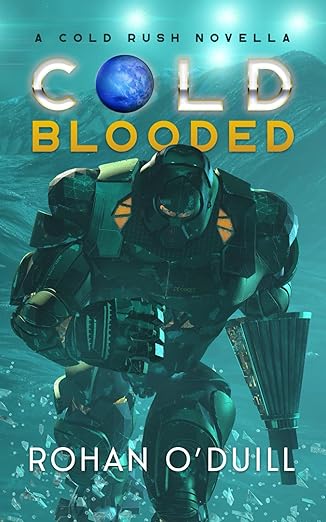

Cold Blooded by Rohan O’Duill transports readers to a vividly imagined future where corporate powers dominate the solar system, wielding unparalleled influence. At the heart of this dynamic setting is Mint, a skilled yet detached marine mech pilot. Once content as an instructor, she is thrust back into action, navigating the chaos of the “Cold Rushes.” Her journey takes an unexpected turn when she reunites with her former colleague, Bjorn—now a pirate—and his spirited daughter, Frida. Unexpectedly, Mint finds herself as Frida’s reluctant guardian, forcing her to balance survival, loyalty to her friend, and her obligations to her corporate overlords.
What sets Cold Blooded apart is its remarkable ability to function both as a prequel and as a self-contained narrative. Striking a delicate balance, the story seamlessly establishes a foundation for the larger series while delivering a complete and compelling tale in its own right. Far from feeling like a mere setup, the book captivates with dynamic characters, unpredictable plot twists, and gripping conflicts. O’Duill’s storytelling ensures that Cold Blooded stands firmly on its own, an achievement worthy of high praise. Equally impressive is the depth and intricacy of the book’s science fiction elements. The richly detailed futuristic worlds, advanced technologies, and innovative equipment are described with a precision that immerses the reader. Every aspect of this universe feels meticulously crafted, reflecting the author’s dedication to thoughtful world-building. The result is a setting that feels authentic and alive, adding a tangible sense of realism to the narrative.
Cold Blooded by Rohan O’Duill offers a thrilling blend of fast-paced action and intricate science fiction, making it an ideal pick for fans of the genre. Whether you’re new to O’Duill’s work or already familiar with his universe, this novel delivers an engaging and satisfying experience. Highly recommended for readers who crave immersive storytelling and high-stakes adventure.
Pages: 304 | ASIN : B0D9TY1V5N


