Blog Archives
The Spiral Can Be Reversed

The Path from Hell to Heaven is a philosophical and psychological map of the ego, tracing how people spiral downward into “Hell” through fear, shame, and denial, and upward toward “Heaven” through trust, openness, and renewal. Why was this an important book for you to write?
Because ego explains nearly every human collapse and ascent, yet most people never receive a practical map for it. I wanted to translate psychological chaos—fear, shame, denial—into a recognizable model anyone could use, the same way we map complex systems in software or business architecture. This book is that missing human blueprint: a self-debugging framework that moves readers forward instead of leaving them looping in abstraction.
How did you come up with the concept of the two-sided spiral of the ego and develop this into a process that readers can implement into their own lives to find clarity and understanding of themselves?
I analyzed patterns before individuals. Ego contracts or expands; there’s no true neutral. Avoiding truth descends, openness creates lift. The spiral metaphor stuck because it captures momentum and acceleration.
To make it implementable, I structured it as an RPM self-awareness loop:
- R – Recognize the ego state you’re operating in
- P – Pause the automatic reaction loop
- M – Move with intentional correction or openness
It’s diagnostic and reversible, giving readers a clear exit path whether they’re descending or rebuilding upward.
I found the ideas presented in your book relatable and appreciated the actionable steps that readers can take to find their own clarity. What were some ideas that were important for you to share in this book?
The concepts that mattered most to me were:
- Ego itself isn’t the problem → closed ego is
- Narcissism is often unprocessed fear wearing armor
- Pain isn’t identity, it’s a turning point
- Ambition without self-awareness becomes self-sabotage
- Recognition of the loop always comes before the escape
And above all—I wanted a book that doesn’t just sound smart, but gets applied and changes outcomes.
What is one thing that you hope readers take away from The Path from Hell to Heaven?
That their ego has directions, and so do they. If they feel stuck, defensive, ashamed, or overwhelmed—it’s a state, not a life sentence. The spiral can always be reversed, rebooted, and climbed. The only real trap is believing the descent is normal and permanent.
This book is a Map of the Ego’s Double Spiral — a journey every individual, family, and society travels between Hell (closed ego) and Heaven (open ego).
Through vivid metaphors and grounded psychological insight, LANOU unveils how pain becomes protection, how protection turns to illusion, and how awakening begins when trust cracks the shell.
You’ll see yourself, groups, and even nations in these patterns:
The wound that starts the descent.
The mask that hides pain through control.
The collapse that breaks illusion.
The trust that starts renewal.
The open ego that frees love and truth.
Structured as a fractal spiral, the book reveals six repeating steps across all scales — from individuals to groups to the world itself. It blends the clarity of psychology with the simplicity of spiritual truth: hell is repetition; heaven is renewal.
Once you see the map, you cannot unsee it.
The Path from Hell to Heaven: The 2 Sided Spiral of the Ego
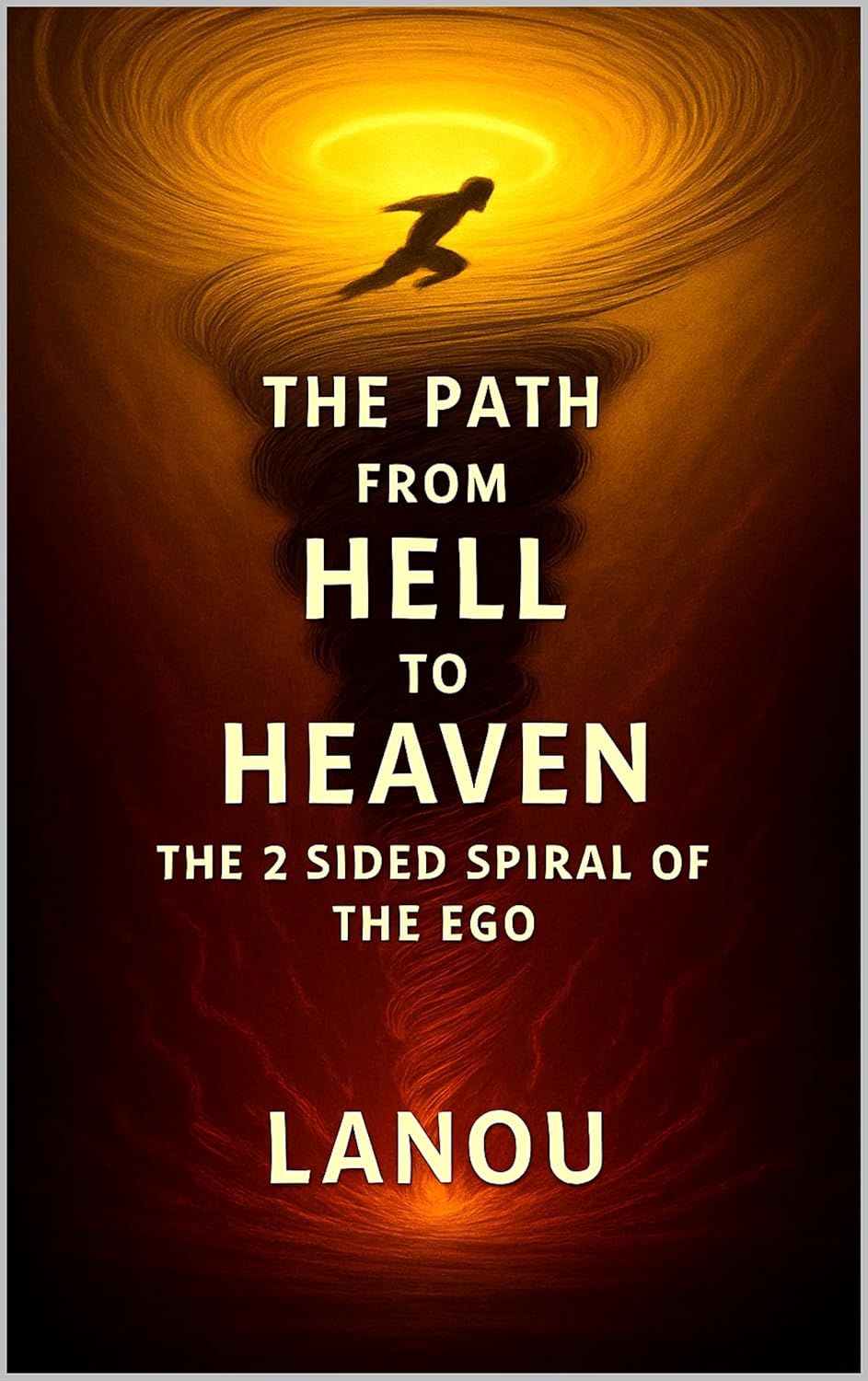

This book is a philosophical and psychological map of the ego, tracing how individuals, groups, and societies spiral downward into “Hell” through fear, shame, and denial, and how they rise toward “Heaven” through trust, openness, and renewal. It’s written like a guide for self-awareness, where the ego’s descent, wound, shell, mask, illusion, collapse, and denial are mirrored by its ascent through trust, openness, adulthood, mastery, and renewal. Each section builds on the last, connecting personal trauma to collective dysfunction and, finally, to global healing. The language is clear and rhythmic, sometimes poetic, and the structure moves like a spiral itself, repeating ideas but deepening them each time.
I liked how direct this book is and how it pointed to familiar pain without drowning in theory. The writing style blends psychology and spirituality without turning preachy. I could feel the author’s intention: to wake readers up, not to comfort them. Sometimes the simplicity of the prose makes it cut deeper than expected. It’s not a book that flatters, it exposes. At points, it felt like being called out and held at the same time. The “spiral” metaphor worked for me; it explained so much of what people repeat in life, from personal self-sabotage to entire societies collapsing under pride and denial.
The book’s tone is confident, almost absolute, which can feel heavy when you’re already raw. The ideas are strong, but their repetition across individual, group, and world scales sometimes blurs the freshness. Yet even then, I found myself underlining lines, rereading them, and thinking of people I know who live both spirals at once. The message that Heaven and Hell are not destinations but daily states of ego, sticks.
I’d recommend The Path from Hell to Heaven to people who crave clarity more than comfort. It’s for readers who think deeply about healing, leadership, and the way our inner wounds ripple into culture and politics. Therapists, activists, or anyone burned out on shallow self-help would probably find it bracing. It doesn’t tell you what to do; it shows you what you’re already doing. And if you’re willing to face that, it can be liberating.
Pages: 151 | ASIN : B0FT5HM9RS




 LITERARY TITAN