Blog Archives
Healing Technology

The Trident Code follows a former Navy SEAL who discovers a cryptic trident symbol linked to his team’s past and uncovers a secret society and a buried mission that may unleash an ancient terror from the deep. How does this book set up the SEAL Cypher Series?
The first book introduces the idea of a possibly marine rogue commander who believes their old mission unleashed a divine curse. The commander happened to have been John Klade’s old commander when he was in the Navy. A particular mission in Yemen went sideways, or so it seemed to Klade and his colleagues, and the thought was that his commander, Elias Cross, had died. But he found “religion”, thinking he had a purpose after surviving, and he set himself up aboard a ship, The Leviathan, as his headquarters, and started to track the team that had been associated with the mission. They would either be part of his “religion” or pay the debt in their bloodline. With the help of Yale symbologist Annabelle Johansson, Klade unravels the truth behind the symbol — a secret society older than any modern army, one that believes the sea itself demands sacrifice. As the tide rises and the killings close in, Klade must face the one enemy he never expected — the ghost of his own past. “The Deep remembers.”
This sets the stage for book two, The Phoenix Protocol, where there is an escalation of the apparent mythical symbology. The Order of the Phoenix Tide — has risen, believing fire can “purify what the Deep cannot.”
Klade himself is recruited by MI6 black unit, based on his success in neutralizing the previous Trident-Serpent artifact.
The Order of the Phoenix Tide is using a new weapon, a resonance-based bioenergy project called The Phoenix Protocol, originally conceived by the Navy as a disaster-response technology and technically derived from Dr. Henrick Johansson’s (Annabelle’s father) original research that focused on consciousness mapping for medical applications – helping coma patients, treating neurological disorders, preserving cognitive function during invasive brain surgeries. Klade and Annabelle discovered that the Order had militarized it, transforming a healing technology into a weapon.”
What makes John Klade different from typical military thriller heroes?
John Klade is vulnerable, rather than invincible. He knows his limits, is not rogue or vigilante, and pretty much law-abiding. He holds a steady job after leaving the service, unlike most military thriller heroes who tend to be more nomadic (like Jack Reacher) or ones not having a sense of purpose outside the service.
Is the story about secrets, loyalty, or something else?
The Trident Code is about espionage, secrets, and mythical suspense, and there is also an element of loyalty involved in the story as well.
Can you tell us a little about where the story goes in book two and when the novel will be available?
Yes. Book two (The Phoenix Protocol) occurs a year after The Leviathan. Klade has gone off the grid. When a terrorist bombing in Athens leaves behind a phoenix symbol intertwined with the trident, Klade realizes the Brotherhood isn’t gone — it’s evolved.
Annabelle, now lecturing in Rome, is recruited by an EU counterterror unit to decode the symbol. She learns that a new sect — The Order of the Phoenix Tide — has risen, believing fire can “purify what the Deep cannot.” Their weapon? A resonance-based bioenergy project called The Phoenix Protocol, originally conceived by the Navy as a disaster-response technology, and now turned into a weaponized resurrection experiment. Klade and Annabelle reunite as reluctant allies when they uncover that the Phoenix Tide’s leader, Dr. Isaac Kerrigan, was Elias Cross’s scientific advisor — and the man who resurrected the relic’s energy signature.
If Book One (The Trident Code) is like The Da Vinci Code and Jack Reacher, Book Two (The Phoenix Protocol) is like Jason Bourne!
All 4 books in the series (The Trident Code > The Phoenix Protocol > The Crossmind Transcendence > The Reaper’s Debt) are all available now.
Author Links: GoodReads | X (Twitter) | Facebook | Instagram | Website | Amazon
With the help of Yale symbologist Annabelle Johansson, he unravels the truth behind the symbol — a secret society older than any modern army, one that believes the sea itself demands sacrifice.
As the tide rises and the killings close in, Klade must face the one enemy he never expected — the ghost of his own past.
The Deep remembers.
The Trident Code
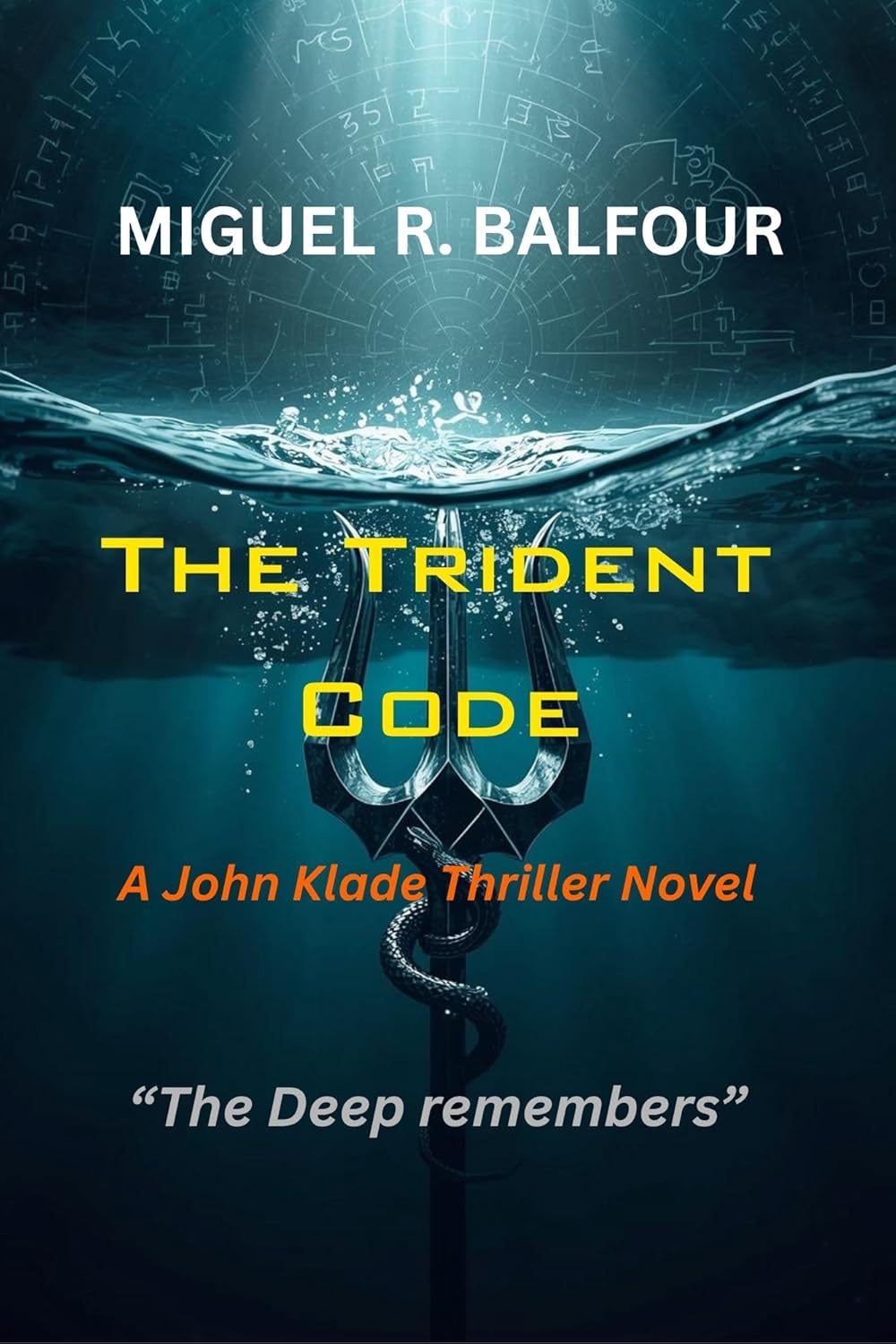

Miguel R. Balfour’s The Trident Code is a military conspiracy thriller (with a definite dark, myth-tinged edge) that kicks off the SEAL Cypher Series. It follows John Klade, a former SEAL turned private investigator, whose routine surveillance work in Los Angeles gets interrupted by a strange trident-and-serpent symbol that keeps showing up like a fingerprint you cannot wash off. When a former teammate is murdered and the same mark appears at the scene, Klade is pulled into a widening hunt that stretches from the streets to old operations, coded messages, and finally toward a looming offshore threat tied to something called “Leviathan.”
The opening chapters have that noir-ish, boots-on-asphalt feel, with details that land in a very physical way, like the city is sticky on your skin and every alley has a memory. Klade reads as competent without being invincible, and I liked that he’s not written as a walking slogan. He’s wary, tired, methodical. The story also knows how to escalate without rushing: a chalk mark becomes a pattern, the pattern becomes a warning, then suddenly it is personal in the worst possible way.
Balfour also makes an interesting author choice by blending modern special-ops paranoia with something older and stranger. Once Annabelle Johansson enters the story and the symbol starts pointing to maritime myths and long-buried operations, the book widens from “who’s stalking the team?” to “what did they wake up?” I was going back and forth on that shift, in a good way. Part of me wanted the clean logic of a pure spy thriller. Another part of me enjoyed the unease, because it fits the book’s central idea: some secrets are not just classified, they feel hungry. And when the plot pushes out onto the water and toward the Brotherhood’s ship, the Leviathan, the tension turns claustrophobic in a new setting. Steel decks, ritual vibes, and the sense that the ocean itself is keeping score.
By the end, I felt like I’d read the opening movement of a larger series story rather than a neatly tied bow, and I mean that as a heads-up more than a complaint. The last stretch leans into momentum and dread, and the closing image of heading into open water, with hope showing up like a fragile, stubborn light, really worked for me. I’d recommend The Trident Code most to readers who like fast, cinematic thrillers with military DNA, team history, and a conspiracy that turns almost mythic at the edges. If you’re happiest when a book feels like a cross between a covert-ops chase and a shadowy cult mystery, this one is written for you.
Pages: 386 | ASIN : B0G1L3JDYN



