Blog Archives
Sense of Foreboding

Along the Trail follows a young woman traveling westward with her family in search of new beginnings on the Oregon Trail, who learns about resilience, love, and the freedom and cost of such a dangerous journey. What was the inspiration for the setup of your story?
I grew up in Kansas City, MO, which is about 20 minutes from the town of Independence, where the Westward Trails began. It was a point of interest for me, starting all the way back in elementary school. I found everything about it fascinating: the adventure of it all, the beauty of the wilderness, and the extreme grit and hope that the people of that time had to possess in order to even begin. But I also wanted to make sure to highlight the drudgery, the discomforts, and the dangers that they faced along the way. I didn’t want it to be overly romanticized, as that would downplay the magnitude of the obstacles that the travelers faced, which was the opposite of what I hoped to do during the story.
Winnie is a charismatic character that readers get to watch figure out who she is and what path she wants to follow. Were you able to achieve everything you wanted with her character in the novel?
I doubt any author can ever say they achieved everything they wanted with a character, haha. Well-developed characters often seem to move through their story on their own, and it’s all the writer can do to keep up with them! But honestly, I wanted Winnie to be representative of her time and her circumstances. That said, she had to be open-minded enough to recognize that some of her initial reactions to things she encountered during their journey were not justified reactions – rather, that some of them came as a result of fear and not from her own experience. I do think that she’s a relatable character, and even an admirable one. Not everyone will so readily admit to being wrong as she does. Not everyone chooses personal growth, but Winnie does.
What were some themes that were important for you to explore in this book?
I think one of the biggest themes for me was that the setting (thousands of miles of wilderness) was often the protagonist, but also sometimes acted as the antagonist. Such an environment was brutal and beautiful. Stunning, and stifling. It had to flow and change along the way, and at other times, remain so similar and vast as to seem unconquerable, like the travelers were barely making progress at all. It was important to me that the setting inspire both a sense of wonder and a sense of foreboding.
Another theme that I hope comes across is that of resilience, enduring hope, and personal growth. The characters experience some grueling physical challenges, and also some tough mental ones – things with the potential to break anyone’s spirit. But instead of turning on one another, or even turning back, they come together to form a community and rely on each other in times of need. I didn’t want my characters to be stealing from one another, or harming each other – I wanted them to represent the best of humanity, to help rather than harm, wherever possible. Perhaps that’s a bit naive, but there’s enough doom and gloom in the world these days; I chose to highlight human resilience and hope rather than focus primarily on division.
That’s not to say there aren’t some nuanced perceptions that the characters have to overcome to achieve personal growth, because that’s one of Winnie’s main character arcs. But she gets through it because she has the introspective honesty and open-minded nature to acknowledge a prejudice in her world, analyze the validity of it through what she experiences (rather than what she’s told by others), and come out the other side with her own opinion. And I hope that journey shines through for readers.
Will this novel be the start of a series, or are you working on a different story?
I’m seriously considering writing a sequel and making it a duology. There is a lot left to explore with the Hayes family once they reach their destination, and also a lot that I’d like to expand on with Mae and some of the other strong secondary characters.
Even though their journey ended once the overland travelers chose a spot to settle, their hardships did not. It was grueling work to build a homestead, to make it through winter in an unfamiliar territory. There’s a lot to discover there that I think would make for a great second novel.
Author Links: GoodReads | Instagram | Facebook | Website | Amazon
Threatened by storms, wild animals, and outlaws, Winnie must rely on the bonds she’s made and all she’s learned in order for them to make it to Oregon alive. She also must decide if she is ready to risk forming an attachment to Hal, the cowhand who has a knack for showing up just when help is needed, or whether she will emulate Mae, the free-spirited daughter of their trail guide.
The Path of Saints and Sinners
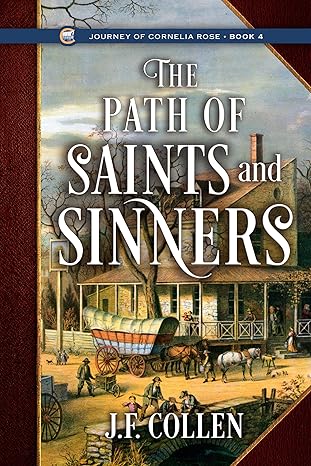

The Path of Saints and Sinners is the fourth book in J.F. Collen’s Journey of Cornelia Rose series, and it carries Cornelia “Nellie” Rose Wright into the stark and complicated world of Utah Territory in the mid-1800s. The story picks up with Nellie, her husband Obadiah, and their daughters after the grueling journey westward. They arrive in Great Salt Lake City, hoping for rest, stability, and a sense of community, only to find tension, hostility, and political turmoil instead. The book blends the trials of pioneer life with the undercurrents of faith, loyalty, and the uneasy intersection between the United States government and the Mormon settlers.
I felt pulled right into Nellie’s restless heart from the start. She is exhausted and homesick, yet her sharp wit and stubborn courage refuse to give way. The dialogue brims with energy, and the little details like dusty wagon wheels, harsh light, and the smell of mold on corn husks make the setting feel immediate and alive. At times, I found myself irritated with Obadiah’s insistence on pressing forward in the face of obvious danger, but then that frustration softened because it mirrored Nellie’s own. The writing does not shy away from messy conflict. It lingers in the gaps between what is said and what is felt, and I admired that.
The book meanders through conversations and stretches of description that sometimes slow the tension. Yet, even when I grew restless, I found myself laughing at Nellie’s sharp asides or touched by the innocence of her daughters. There is an honesty in the way Collen portrays family life, messy and tender all at once, and that honesty kept me invested.
I realized this book is less about resolution and more about survival. Nellie’s world is uncertain, and her doubts echo across the pages in a way that felt strangely modern to me. I would recommend The Path of Saints and Sinners to readers who enjoy historical fiction rooted in strong female voices, especially those who like their history layered with personal struggle and the grit of daily life.
Pages: 504 | ASIN : B0FHPXS955

Storytelling and Healing

Scarlet Birthright follows a young DJ in Trinidad who falls in love with a dancer who becomes pregnant and flees to America, leaving his daughter with a lifetime of questions and longing. What was the inspiration for the setup of your story?
Scarlet Birthright is deeply personal—it’s autobiographical fiction born from my own experience. I was the love child of teenage parents, and my father left Trinidad when I was just a few months old. I grew up with my loving grandparents in Trinidad and Tobago while my father lived in America with his other family. This novella became my way of weaving together fact and fiction to explore that story, and ultimately, it helped me process and resolve the trauma of growing up with an absentee father. Writing this title was both an act of storytelling and a form of healing.
Were you able to achieve everything you wanted with the characters in the novel?
Mostly, yes. Since Scarlet Birthright unfolds through multiple perspectives, I felt I gave proper depth to the father, daughter, grandparents, and mother—each voice felt authentic and complete. However, I do wish I’d spent more time developing the stepmother’s character. Her story felt unfinished to me, which is why I ended up writing a separate short story dedicated entirely to her perspective. Sometimes characters demand more space than we initially give them.
What were some themes that were important for you to explore in this book?
The central theme became letting go of anger—a gift I didn’t realize I needed when I began writing. Through the process, I also explored the idea that perhaps we all do the best we can in any given moment. We’re imperfect humans making imperfect choices, often with limited information or emotional resources. There’s something both humbling and liberating about accepting that complexity in ourselves and others.
What is the next book that you’re working on, and when can your fans expect it out?
I’m working on “The Other Side of Love and Desire,” which will be the fullest exploration of themes that first emerged in my short story collection, Scarlet Yearnings: Stories of Love and Desire. It’s my way of diving deeper into those emotional territories that readers responded to most strongly. The book is scheduled for publication at the end of 2025 and will be available on Amazon, Barnes & Noble, and from all major book retailers.
Author Links: GoodReads | Website
🔥 A Life-Altering Spark: Witness the impulsive choice that sets Joromi on a collision course with family, identity, and legacy—its aftershocks echoing across decades.
🌴 Vivid Caribbean Setting: Immerse yourself in the lush beauty and folklore of Trinidad, where family legacies run deep as the island’s roots.
💔 Generations of Heartache: Follow Trisha’s poignant struggle to find her place—and finally confront the father she never knew.
✨ Ancestral Magic: Spirits, legends, and cultural traditions weave through every page, reminding us how the past guides our future.
💪 A Story of Hope & Redemption: Watch as one family’s destiny unfolds across decades and oceans, revealing the power of forgiveness and second chances.
Buy now to immerse yourself in a novel where passion transcends distance, heartbreak challenges fate, and one family’s destiny unfolds across oceans and decades.
Read less
Scarlet Birthright: What They Left Behind


Scarlet Birthright is a raw, emotional novella about love, abandonment, regret, and redemption. Set between Trinidad and New York from the late 1960s to the early 1990s, it tells the story of Joromi, a young DJ whose summer romance leads to heartbreak, a hidden daughter, and lifelong consequences. Across shifting seasons and continents, James stitches together the lives of Joromi, Margaret, Trisha, and their families, weaving a tale about choices that echo through generations. It’s messy, real, and haunting in the best way.
One thing that hit me right off the bat was how vivid and alive the writing is. The first chapter, where Joromi meets her at the party, practically sizzled off the page. James doesn’t just tell you that he’s struck dumb; you feel the sweat, the frangipani scent, the pounding heart when the mystery girl with the Afro walks in. That attention to atmosphere is a real strength. It dragged me into the heat of Trinidad’s dry season without mercy. At times, the language was almost overwhelmingly rich, dense, and luxuriant, like indulging in a second slice of chocolate cake despite already being full, but ultimately, it remained deeply satisfying.
Emotionally, this book gutted me. Joromi’s slow-motion car crash of choices, breaking things off, lying to himself, chasing an American dream while abandoning his roots, felt so human it was painful. The scene where he learns about the death of Trisha’s mother broke me. He crumples onto the kitchen floor, and even though he deserves the gut punch, you can’t help but ache for him. James captures grief and guilt in a way that’s too real. It’s messy and selfish and confused, just like real people. That said, there were moments when I wanted to shake Joromi until his teeth rattled. I mean, come on, man, your daughter’s right there!
What stood out even more was the women. Margaret, in particular, was complicated and, frankly, sometimes pretty hard to like. But that’s what made her fascinating. When she tells Joromi, “Just don’t bring her into this house,” after learning about Trisha, my stomach twisted. I hated her. I understood her. James doesn’t try to make any woman a saint or a villain. They’re just…human, battered by life and culture and their own fears. It’s messy in a way that polished, sanitized novels rarely dare to be.
Scarlet Birthright is a story for anyone who knows that love isn’t always enough, that choices leave scars, and that healing takes more than just time; it takes courage. I’d especially recommend it to readers who like intergenerational family dramas, emotionally complex characters, and writing so lush it feels like stepping into another world. Bring tissues, and maybe a little grace for the characters you’ll love and hate all at once.
Pages: 179 | ASIN : B0DYYXKV5F

The Need to Take Risks

In Harm’s Way follows a Colonial sea captain returning home after a year-long voyage only to have his ship confiscated by the British Royal Navy and find more tragedy at home who outfits his own private ship-of-war to seek out enemy merchant ships to oppose their tyranny. What was the inspiration for the setup of your story?
The inspiration was the many times I came home myself from six-month deployments aboard Navy ships. I then coupled it with the history of the Norfolk area, where I was at the time stationed. It was always heartwarming to see the new fathers meeting their children for the first time, and heart-wrenching to occasionally see a young sailor coming home after the death of a close relative. I knew I wanted to write a historically accurate novel set during the Revolution, and it was natural to begin it with a homecoming that turned sorrowful. It sets the mood for the story. The Revolution was not clean, it was not easy, nor was it a fight between “good” and “bad” guys.
What are some things that you find interesting about the human condition that you think make for great fiction?
The struggle each of us has to rise above the events that shape our current circumstances. We can either sink under the weight of what’s happened or happening, or adapt and change. But we must choose; even deciding to do nothing is a choice. Every day, folks around us choose to rise above. Even if they fail, they try and often try again. We should honor that.
What were some themes that were important for you to explore in this book?
Loss, and dealing with it, and the need to take risks in life. Playing it safe is rarely, if ever, successful. Finally, that in every conflict, a person must choose a side, based on their values and principles. Neutrality only works for Switzerland, and only because they can defend themselves.
Where does the story go in the next book, and where do you see it going in the future?
Jonas will return to sea in the next book, this time accompanied by his son, and with vengeance in his heart. But he’ll find that revenge is an insufficient reason to fight, and obtaining it is both unsatisfying and damaging. In the third book, he will again return to the fight, this time with a commission in the Continental Navy.
Author Links: GoodReads | X (Twitter) | Facebook | Website | Amazon
Colonial sea captain Jonas Hawke returns home to Norfolk after a year-long voyage only to have his ship and its valuable cargoseized by the British Royal Navy. As the royal governor further tightens the noose on trade, Jonas is thrust into the chaos of a growing rebellion. Desperate to support his family, he sets out to find work. When he is denied a commission with the newly formed Continental Navy, he outfits his own vessel as a private ship-of-war and voyages to the Caribbean in search of enemy merchant ships he can capture and friends he can trust.
But dangers multiply on the unforgiving sea. The Royal Navy reacts mercilessly to the threat posed by privateers like Jonas. How will Jonas fare now that he has boldly defied the king of Britain to preserve his family? And what will happen to his loved ones while he is away, engulfed in a war to oppose tyranny in the name of freedom?
In Harm’s Way
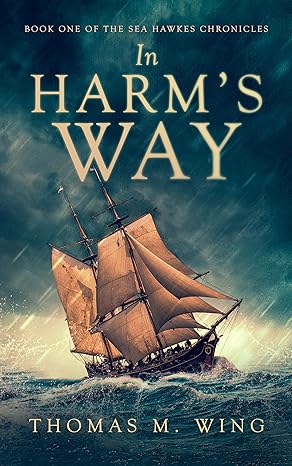
Thomas M. Wing’s In Harm’s Way is a gripping historical novel set during the American Revolution, centering on Captain Jonas Hawke, a privateer navigating the turbulent waters of war and personal loss. When his ship, the Elizabeth, is seized by the British Royal Navy under dubious pretenses, he and his crew are thrust into a battle not just for their freedom but for justice. As Hawke returns home to Norfolk, he finds not only a changed political landscape but also devastating personal tragedy. Wing blends historical accuracy with compelling storytelling, making the reader feel the weight of revolution on ordinary men.
What struck me most was Wing’s ability to bring history to life through vivid and authentic detail. His background as a retired Naval officer shines in the way he captures the rhythm of ship life—sails creaking, the smell of tar and hemp, and the ever-present danger on the high seas. The opening scene, where British forces storm a printing press to suppress rebellious voices, is tense and sets the tone for the book’s theme of resistance against oppression. He delivers a story that feels raw and real, making the reader feel every injustice and triumph.
Jonas Hawke is a protagonist who carries the novel with quiet strength and deep emotion. His return home to find that his infant twins have died is a gut punch that lingers. Wing makes us feel the grief through Mary, Hawke’s wife, whose simmering resentment toward his long absences cuts deep. Their exchange—her quiet fury, his helpless sorrow—was one of the most emotionally impactful moments in the book. The revolution is personal, fracturing families and reshaping lives. Hawke’s struggles reflect the larger battle for independence, making his journey all the more compelling.
The pacing of the novel balances naval battles with quieter moments of introspection. The scenes aboard the Otter, where Hawke and his men are treated as criminals rather than citizens, are particularly enraging. The arrogance of the British officers, especially Captain Squire, is infuriating yet believable, reinforcing the stark divide between colonists and their so-called rulers. The way Wing builds tension, especially during the naval confrontations, had me holding my breath. The book immerses you in history, making the reader experience the frustration, fear, and determination of those who fought against British rule. At times, the historical details, while fascinating, slow the pacing just a bit, especially for readers less familiar with naval terminology or Revolutionary War politics.
In Harm’s Way is an outstanding read for anyone who enjoys historical fiction, particularly those fascinated by naval warfare and the Revolutionary War. Fans of Patrick O’Brian’s Master and Commander series or Bernard Cornwell’s Revolutionary War books will find much to love here. Wing’s storytelling is rich, emotional, and historically grounded, making this book both educational and deeply engaging.
ASIN : B0F1W6GTC4
Consequences of Choice

A Tuft of Thistledown follows a white man and a Cherokee woman in the early 1800s who grew up together as their mothers were like sisters, and now as adults are rivals each fighting for different things. What was the inspiration for the setup of your story?
I dreamt it all many years ago but forgot how it ended. It wasn’t until a few years later that I remembered the ending thanks to a very special horse and a horse whisperer from Scotland, UK.
There was a lot of time spent crafting the character traits in this novel. What was the most important factor for you to get right in your characters?
I wanted to not insult/portray badly/misrepresent the Cherokee and Africans of those times along with everyone else who lived there first.
What were some themes that were important for you to explore in this book?
I guess, thinking about it, there could be a few really; when to trust, the sometimes never-ending consequences of choice, the pain of a love or a life that can’t be had, and what the terrible want of always more can make people do.
Our hard-wired will to survive is also a theme, unless like one of the characters, too much has been seen or happened, then that will can spill away.
But for me, one of the major themes is the absolute need to sometimes go with what all you feel inside, no matter what others say.
What is one thing that people point out after reading your book that surprises you?
I think the one biggest thing that surprises me is when some people say they think about it after they have finished reading it.
Author Links: GoodReads | Amazon
In the early 1800s, a time when people in parts of the world did things that their souls wouldn’t want them to, John Lucas Jnr. and Horse Song, the children of two women raised as sisters in England, find themselves caught up in the brutal western expansion of America; a place where for some to live and survive was all in the undying consequences of choice.
Later, in 1839, after being officially tasked to clear all Cherokee still living in hiding east of the Mississippi, John Lucas Jnr. finds Horse Song, the woman whose hands he once wanted to hold forever. Torn by their shared past and love that couldn’t be had, Horse Song and the Cherokee she is hiding with are forced into deciding that when it comes to duty, land, and the right way to be, can John Lucas Jnr. be trusted or not.
Dread Tribunal of Last Resort

Decker Brown is a man with clear aspirations. Born in Virginia and educated in Boston, he envisions a future rooted in business success, family life, and societal contribution. But history has other plans. As the Civil War looms, the idyllic life he hopes to build with Paula Crane, the woman he loves, comes under threat. While Decker clings to the ideals of the Republic, Paula recoils at the idea of countrymen warring against one another. Together, they must confront a stark question: can their love and shared dreams endure the upheaval of a nation in turmoil?
In Dread Tribunal of Last Resort, Brian Kaufman crafts a sweeping work of historical fiction that captures both the years leading to the Civil War and its turbulent aftermath. Readers familiar with works like Cold Mountain or Gone with the Wind will find echoes of those classics here. The narrative centers on Decker and Paula, two privileged young individuals who find their lives upended as war reshapes everything they once took for granted.
Kaufman’s novel stands out not only for its meticulous attention to historical events but also for the humanity he breathes into his characters. Through their eyes, readers experience pivotal moments like the Richmond Bread Riot and the Battle of Shiloh. Interwoven with these personal struggles are encounters with towering historical figures such as Robert E. Lee and Abraham Lincoln, grounding the narrative firmly in its historical context.
What truly sets this novel apart is its emotional resonance. Kaufman delves deeply into the inner lives of Decker and Paula, portraying their struggles with a poignancy that is both heartrending and authentic. Their longing for a peaceful life is starkly juxtaposed with the relentless challenges of war, making their losses all the more intense. Kaufman’s commitment to historical accuracy amplifies the weight of these moments, while his vivid, unflinching prose captures the grim realities of a conflict that forever altered the fabric of the nation.
Dread Tribunal of Last Resort is more than a historical novel—it’s a story of love, resilience, and the enduring human spirit amidst the chaos of history. Kaufman’s masterful blend of compelling characters and rich historical detail ensures this book will linger in the minds of readers long after they turn the final page.
Pages: 354 | ASIN : B0CXYJ62Y1


