Blog Archives
The Secretary


Deborah Lawrenson’s The Secretary is a richly layered spy novel set against the bleak yet fascinating backdrop of Cold War Moscow in the late 1950s. The story centers around Lois Vale, a British woman sent under deep cover to the British embassy in Moscow. By all outward appearances, she is a secretary, but beneath the surface lies a complex and dangerous mission to uncover a possible traitor within the embassy. Through diary entries, vivid scenes, and psychological depth, Lawrenson paints a tense world where truth is elusive, betrayal is always near, and even the most personal thoughts can become weapons.
From the very first page, I was pulled in. The writing has a graceful rhythm. It’s elegant without being flowery, sharp without being cruel. Lawrenson manages to say so much with so little. I found myself re-reading lines not because they were hard to follow, but because they hit a nerve. Her descriptions of Moscow are like watching a black-and-white film—gritty, cold, and oddly beautiful. What really stuck with me, though, was the emotional weight. Lois isn’t a James Bond figure. She’s real. She’s scared. She second-guesses herself. And I believed her every step of the way.
The book builds slowly, piece by piece. The tension comes from little things like a locked drawer, a look held too long, a diary that might be read. At times, I wanted more plot, more fireworks, but I came to appreciate the quiet dread more than the expected explosions. The sense of being watched, of being alone in a room full of people—it’s handled so well it gave me chills. There’s also a feminist undertone I didn’t expect. Lois is underestimated, even dismissed, but she holds more power than most of the men around her. That felt deeply satisfying.
I’d recommend The Secretary to anyone who loves Cold War fiction, but especially to readers who enjoy slower, more introspective spy stories. This isn’t an action-packed thriller. It’s a character study wrapped in espionage. If you liked Tinker, Tailor, Soldier, Spy but wished it had more emotional depth, or if you ever wondered what it would be like to spy without backup, this is your book. I closed it feeling both chilled and strangely moved.
Pages: 305 | ASIN : B0DSWG8J3C

The Last Defense: The Fight for Epsilon
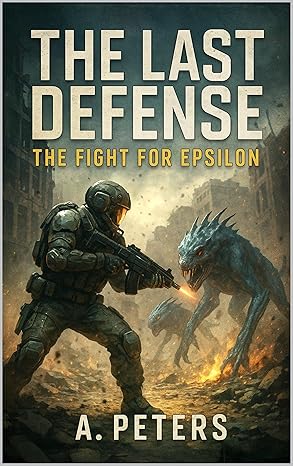
The Last Defense drops us straight into a brutal, crumbling world where Earth’s last hope rests in the hands of worn-out soldiers trying to fend off an overwhelming alien invasion. Major Jonas Cross, our gritty and deeply human lead, fights not just for survival but for family, memory, and something that feels a lot like hope. The story unfolds across the wreckage of Epsilon City, blending desperate last stands, gut-wrenching rescues, and shaky alliances into a tense, high-stakes battle for humanity’s future.
Right from the first chapter, A. Peters pulled me in with raw, vivid imagery. The opening scene where Jonas is crouched behind a slab of concrete, breathing smoke and fear, while Nightfangs hunt the ruins, slammed the urgency into my chest like a hammer. I loved how Peters didn’t waste time with long setups; you’re thrown straight into the fire. When Jonas reflects on his late wife Anna while hiding from monsters, it doesn’t feel forced or preachy. It feels real, like the kind of memory that guts you when you least need it. Peters has a knack for giving action scenes an emotional spine, and that’s a rare trick.
There were moments, though, where the pacing buckled a little under all the world-building. For instance, the section in the starport had so much tactical briefing that it almost felt like I was reading mission notes instead of a novel. I wanted to get back to Jonas, Ethan, and Selina fighting their way through the city ruins. That said, when the story veers into darker territory, like the prisoner experiments Jonas stumbles upon in the factories, it hits like a punch to the throat. That part genuinely made my skin crawl, and that’s a good thing.
What really stuck with me was the relationship between Jonas and Ethan. Their bond isn’t syrupy or melodramatic; it’s stubborn and bruised and heartbreakingly real. When Jonas risks everything to find his captured brother, dragging himself and a whole squad through hell, it made every firefight and every narrow escape count for more. And the moment Jonas finally finds Ethan, broken but alive, was pure gold. Peters writes brotherhood the way it feels: messy, guilt-ridden, and absolutely necessary.
The Last Defense is a grim, relentless ride, but it’s also filled with tiny flickers of hope that feel all the more precious because they’re so hard-won. I’d recommend it to anyone who loves gritty sci-fi war stories that don’t skimp on heart. Readers who appreciate the intense, character-driven science fiction of The Expanse or Halo: Fall of Reach will find much to admire here. Prepare for a gripping experience that demands both attention and emotional investment until the very last page.
Pages: 169 | ASIN : B0DY386H36

The Last Rival: A time of our Choosing

Kyle Palmer’s The Last Rival: A Time of Our Choosing is a gripping and intellectually compelling novel set in the turbulent aftermath of World War II. At its heart are Jim Bolden and Lew Weinman, covert operatives navigating the shadowy world of intelligence. Their mission is perilous, their existence unacknowledged by any government, and their enemy a hidden remnant of the Nazi regime seeks to seize power and reshape history in its own sinister image.
Palmer’s prose is sharp and evocative, balancing high-stakes action with moments of profound introspection. Suspense builds with relentless intensity, yet the novel’s true strength lies in its exploration of moral ambiguity. Themes of sacrifice, redemption, and the battle between duty and conscience weave seamlessly into the narrative, elevating it beyond a conventional spy thriller. The action grips, but it is the philosophical depth that lingers, prompting readers to ponder the complexities of right and wrong when allegiances shift and ideals collide.
Far from mere instruments of espionage, the characters emerge as deeply human figures wrestling with personal demons and ethical dilemmas. Their struggles, whether to seek vengeance or embrace forgiveness, add a rich emotional undercurrent that resonates beyond the confines of their mission. As they confront impossible choices, their internal battles become as compelling as the external threats they face.
For those who appreciate historical fiction infused with intellectual depth, The Last Rival delivers an immersive and thought-provoking experience. Palmer masterfully blends real-world history with speculative intrigue, crafting a novel that feels both immediate and timeless. Though the pacing slows at times to allow for introspective moments, the payoff is well worth it. This is more than a thriller; it is a journey into the heart of human conflict, both on the battlefield and within the soul.
Pages: 500 | ASIN : B0DM6H5TD8

Finding Rosie

Finding Rosie by W.B. Edwards takes us on a meandering journey through the mind of Paul Sutton, a young man fresh out of high school, trying to navigate his way through post-Vietnam War America. It’s a coming-of-age tale, laced with the tensions of escaping the draft, surfing along the Californian coast, and the bittersweet relationships he builds. The narrative ebbs and flows through different timelines, from carefree teenage escapades in Baja to a more mature struggle with love, memory, and a haunting past in the Philippines. The book uses surfing as a powerful metaphor for Paul’s emotional highs and lows while exploring the nostalgia and confusion of youth in a world shaped by war.
At times, Edwards paints scenes so vividly that I felt the warmth of the sun on my face or the cold sting of the Pacific water. His descriptions of California in the late ’60s and early ’70s brim with life, like the exhilarating, carefree drive Paul takes with Don Frank, his surfboard strapped to the roof, heading to Ocean Beach for one last adventure. Edwards captures the carefree, almost reckless spirit of youth beautifully, and the surfing sequences are thrilling, almost cinematic. But there are moments where the pacing stalls and the plot feels as aimless as Paul’s inner journey. I found myself yearning for a tighter narrative, especially in the chapters set in the present, where Paul’s struggle with direction often drags.
Edwards’ exploration of the theme of friendship struck an emotional chord. Paul’s bond with Don Frank is as deep as the ocean they surf together, a poignant connection forged through shared adventures and near-death experiences, like their harrowing escapade in Baja. Their dynamic feels authentic; the dialogue is peppered with humor, the slang of their time, and an unspoken understanding that goes beyond words. Yet, Paul’s relationships with women, particularly Mary and Rosie, are more complicated. There’s a raw vulnerability in how Paul reflects on his time in the Philippines, his guilt, and the sense of loss he feels in the wake of his fractured relationship with Mary. The titular character, Rosie, feels like a specter of lost innocence and an unresolved past that continues to haunt him. There’s a repetitive quality to Paul’s musings about his mistakes and his constant yearning for escape, which becomes tiresome. I felt trapped in his cycle of guilt and indecision, much like Paul himself. The conversations with Mary are emotionally charged yet ultimately feel stagnant, never quite resolving the tension. Mary’s poignant declaration about growing apart and moving on is one of the book’s more affecting moments. It’s delivered gracefully, and I empathized with her, even when Paul seemed determined to remain adrift. These moments of emotional honesty are where Edwards’ writing shines.
Finding Rosie is for readers who enjoy a slow, introspective read, one that dives deep into the psyche of a character trying to find meaning in a world that doesn’t make sense. It’s a melancholic, sun-soaked story, ideal for those who love novels about the Californian surf culture, the post-war generation’s disillusionment, or tales that don’t offer easy resolutions. While the book could have benefited from a brisker pace, it does succeed in capturing the essence of a restless soul. In the end, Edwards reminds us that some memories are impossible to out surf.
Pages: 178 | ASIN : B0773ZMGCH
Between the Clouds and the River
Between the Clouds and the River by Dave Mason transports readers into a richly layered narrative set against the backdrop of World War II. This historical fiction follows Bernhardt, a captured German soldier detained in a U.S. prison camp, and Frank Gardner, an aging Canadian living a solitary life. Mason skillfully weaves together two timelines: Bernhardt’s tumultuous youth as a soldier, detailing his service in North Africa, imprisonment, and escape in the United States, and his present life as an adult facing the remnants of a difficult past. In Frank’s story, he wrestles with lingering scars and connects with a troubled young boy from a dysfunctional family. Through Frank’s journey, Mason delves into themes of redemption, love, loss, and the notion of family—whether born or chosen—highlighting the enduring power of human connection to heal emotional wounds.
The strength of this novel lies in its exceptionally crafted characters. Frank and Joseph’s stories stand out with a depth and warmth that make them memorable and relatable. Mason’s introspective style lets us into the minds and hearts of his characters, creating a powerful emotional bridge between them and the reader. This narrative choice not only deepens readers’ empathy but also brings a universal relevance to their journeys. The characters feel real, fully fleshed out, and distinct, drawing readers into their complex, personal struggles. That said, Mason occasionally obscures the storyline with subtle hints that can make it challenging to follow. At times, I found myself needing to re-read sections to piece together certain moments, which broke the story’s flow. While this understated approach succeeds in building suspense during key moments, it occasionally risks losing readers in the process. Despite these occasional ambiguities, Between the Clouds and the River is a compelling and thought-provoking novel.
Between the Clouds and the River is a beautifully crafted tale of resilience, identity, and the transformative power of human connection. Dave Mason’s nuanced storytelling and deeply developed characters bring to life a narrative that resonates long after the final page. I recommend this book to those who enjoy historical fiction with complex characters and themes, as well as readers looking for a story that thoughtfully explores redemption and the meaning of family.
Pages: 383 | ASIN : B0DGQGSGKZ
2024: Attack on America


2024 Attack on America is an action-packed techno-thriller that dives into the world of cyber warfare, government secrets, and espionage. The plot follows Gabriel Brinkerhoff as he navigates a crisis involving hackers, leaked intelligence, and global cyber threats. Throughout the story, Gabriel interacts with world leaders, military officials, and even supercomputers as he works to unravel a conspiracy threatening national security. The novel uses real-world technology and touches on themes of privacy, governmental overreach, and the ethical dilemmas inherent in national defense.
One of the strengths of Sasha Zarustin’s book is its almost breathless momentum. Zarustin keeps the reader engaged with frequent plot twists and a sense of urgency that rarely lets up. For example, Gabriel’s race against time to expose hackers using VPN breaches and the manipulation of social media algorithms keeps the tension high. The dialogue is sharp and feels authentic, whether in the Oval Office or among tech moguls.
The novel also leans into a particular masculine bravado, which feels over-the-top at times, but some readers may appreciate these more intimate asides in an otherwise gripping thriller. On the other hand, Zarustin does a great job portraying the intricacies of modern technology and its potential for manipulation. His exploration of social media as a tool for mind control, as explained by the character Demiurge is fascinating and chilling. The book’s detailed analysis of cyber-attacks and the vulnerability of infrastructure makes the story feel real even when the characters venture into somewhat implausible heroics. Gabriel’s reflections on cyber warfare and the ethical consequences of whistleblowing add depth to an otherwise action-driven story.
The co-plot dives more into Gabriel’s personal life, his emotional struggles and often raw interpersonal relationships. This aspect of the story contrasts sharply with the techno-thriller elements and gives the novel an introspective and existential layer. These scenes, which are marked by frank dialogue, everyday tensions and moments of self-reflection, evoke a Bukowski-esque tone as they explore masculinity, disillusionment, and the messiness of life in a more grounded way.
2024 Attack on America is a fast-paced read that will appeal to fans of political thrillers and anyone looking for a good cyber warfare story. Its action-packed narrative offers a compelling look at the dark side of technology and the fragile balance between national security and privacy.
Pages: 296 | ASIN : B0D5Z2H9GS
I Had a Story to Tell

What Not to Forgive follows ordinary people struggling with the harsh realities of life and trying to do the right thing, even when it is hard and complicated. What was the initial idea behind this story, and how did that transform as you were writing the novel?
As a boy, I was a hero worshipper of my six uncles and father who served in WWII. I had hopes of serving in the military too. In college ROTC, I was recognized for my academic achievement and leadership potential. But a pretty dramatic neurological condition got in the way of my military dreams. On Veteran’s Day in 2018, I was inspired to write this book after watching a young Army veteran who served in Afghanistan sprint two hundred meters on his prosthetic running blade at my gym. I was disabled by my “neurodiversity” and he by serving our country. He was inspiring because what he had sacrificed did not hold him back.
I experienced some mystical force that morning that compelled me to talk with this man. What was his story? Would he be willing to share it? I’ve learned over time that many veterans don’t want to talk about their time in war. I was lucky this man did. We bonded immediately and he agreed to be interviewed at my home. During our first interview, he described in vivid detail the events that led up to him stepping on a landmine in Afghanistan. I found no anger or resentment in his voice … only the pride of serving his country. There came a part in the interview that he wanted me to know … that in Afghan there is no word for forgiveness. Yet, he had forgiven the terrorists for what happened to him. I immediately knew I had a story to tell.
It is often said that writing is more cathartic for the author than the reader. It was true for me because I had discovered that writing What Not To Forgive was a way to pay my respect to those who served, while not being able to do so myself. What I learned was that forgiveness, far from being easy, is complicated. I believe it is the highest form of love we can aspire to.
Your characters’ emotional depth stands out and allows readers to connect with their journeys. What ideas were important for you to personify in your characters?
I wanted my characters to be relatable, ordinary people who show humility and be able to examine their flaws. Each character had choices to make. Sometimes they struggled and faced the consequences of their actions. Throughout the book, I wrote with disarming honesty. This, I believe, contributed to each character’s emotional depth.
What were some themes that were important for you to explore in this book?
The theme of forgiveness was foremost because it is complex. Forgiveness doesn’t mean just saying the words as many think. Forgiveness is an active, conscious act to let go of bitterness and resentment. Sometimes people think they have forgiven but they forgive the wrong way. They carry the grievance with them forever, though they think they let it go. What Not To Forgive is a work of fiction, but of course, it’s autobiographical too, in the ways that novels often are, by the people we have known and cared about, and cities and towns where we’ve lived our lives.
I suffer from a neurodivergent condition, similar in some ways to my character Frank Oglesby in What Not To Forgive. Though not life-threatening, I have experienced, over the course of a lifetime, the burden of exclusivity that comes from a socially awkward, sometimes embarrassing condition. I wanted to show, by way of Frank, that people who don’t understand can be scared and make false judgments. Seek to understand before being understood is one of Stephen Covey’s habits of highly effective people.
With Tekla, I wanted to explore how a young woman, who “had it all,” sought not to waste her gift of languages. She chose to keep up the family tradition of serving in the military. What price would she have to pay? There were safer ways she could have served her country. But she didn’t.
In her words, “she doesn’t suffer from PTSD but is bothered by it.” The blast from the landmine blew off one leg below the knee. She has scars she cannot feel while others are embedded in her soul. She is prone to look back on her “last normal day.” PTSD has her experiencing panic attacks and attachment issues. I wanted her to be challenged in her own path to forgiveness. Along that path I had a desire for her to experience love, a feeling she thought was buried in her past.
Friendship among characters is portrayed with not just honesty but also with loyalty.
What is the next book that you are working on, and when can your fans expect it to be out?
That is a good question. It took four years to write my first book, a memoir, Montana Epiphany. The next six years were devoted to writing What Not To Forgive. Launching a new book into the world has taken time away from writing. That doesn’t mean I haven’t been thinking about my next book. What I’m mulling over is a book of short stories, about Montanans and the tough, dangerous work some do. I would write again using Montana as a canvas and focus on occupations that are unique to Montana … a smokejumper … a Butte miner or a helicopter pilot who flies rescue missions into the Montana backcountry. Four years is a reasonable timeline before I’d likely publish another book. There is always a chance that one spark of the right inspiration could lead to another novel.
Author Links: GoodReads | Website | Amazon
Modern Naval Warfare Novel

Against All Enemies follows a Naval Commander whose crew is cut off from leadership after a devastating attack on the US. What inspired the setup of your story?
I wrote the first draft between Feb. and Nov. of 2016. Tensions were fairly high with China, again. I worked at the Navy lab where the Prologue is set and often lunched at the cafeteria that features. One day in late 2015, I wondered what it would look like if a cruise missile attack streamed in from the sea. That gave me the opening. A few months later, I listened to the various debates and positions taken by presidential candidates across the spectrum. I took what I felt were the least well-considered positions vis a vis our relationships with China, Russia, and NATO, and combined them all into my president. He was not patterned after any one candidate. I’d always wanted to write a modern naval warfare novel, and the rest of the characters were born as amalgamations of officers and enlisted I served with through my 32-year career. Though I must admit, my Seventh Fleet commander, Vice Admiral Simpson, was influenced by David Weber’s Honor Harrington character! The Russia-NATO war came as a natural consequence of a break with NATO. I am not prescient by any stretch of the imagination, but I did have to make some changes and edits over the next five years. It also required a full year and a half to get the manuscript through the Navy Operational Security review process.
Newly appointed Commander Bill Wilkins is a fascinating character who is thrown into a complex situation. What scene was the most interesting to write for that character?
There were several, but the scene that sprung fully developed without any conscious thought was when he is reporting in with Rear Admiral Gupta at the end, just before Bill and Nicholas are ordered home. The possibility that Bill would reject an augment to his crew after suffering such losses definitely didn’t come from me! Bill had his own ideas by this point, and he made it clear he didn’t need any help. The real-life USS Franklin analogy is much more nuanced than portrayed here, but Bill was clear about why he wanted his crew to take Nicholas home themselves. The second most interesting, and difficult, scene to write with him was the one (SPOILER!) in which his Navigator dies. I didn’t want her to die, but the story needed it, and it led to the theme, which hadn’t yet revealed itself to me: risk and the need to embrace it.
I felt that the action scenes were expertly crafted. I find that this is an area that can be overdone in novels. How did you approach this subject to make sure it flowed evenly?
I have a wonderful editor, Laura Taylor, who runs a Read and Critique workshop at the Southern California Writers Conference. She’d seen several of the action sequences and encouraged me to keep writing them short and to the point. She doesn’t believe in overdone action scenes, either! I avoided them because I’ve experienced combat at sea myself and want to be true to the way it plays out. Especially today with supersonic missiles, but even as far back as World War II (particularly during the Guadalcanal campaign), sea combat moves quickly. If I were to have characters over-reacting, or inject unnecessary drama, I’m no longer being authentic. Authenticity is very important to me. I want Navy veterans to read this and say, “Yep, that’s how it was.” People do their jobs amidst chaos. There’s no time to let anything else in, even if the ship is taking hits. That was true 249 years ago and has proven true again as recently as last month in the Red Sea.
Will there be a follow-up novel to this story? If so, what aspects of the story will the next book cover?
I’ve been asked that quite a bit. When I finished this book, I didn’t have any plans for these characters, and I will definitely never try writing a story too close related to real-world events again! That said, I’ve played with some possible future scenarios, perhaps where Bill is now a Destroyer Squadron commander. Iran and Korea are obvious possibilities for adversaries, but again, I am leery of writing anything that might be overcome by events by the time it comes to print. I think China is done for this generation, based on where I’ve left it, and I don’t want to stretch the bounds of reasonable to create another conflict with them just to get the characters back into another book. I’m working on a trilogy set during the American Revolution right now, and a World War II novel loosely based on my father’s and two of my uncles’ service. But I’m not ruling out Bill’s eventual return. I wish Barrister were alive, as I think she’d be an interesting character for a future story, but alas, it’s not to be.
Author Links: GoodReads | Website | Amazon
When the People’s Republic of China unleashes a devastating attack on the United States, newly appointed Navy Commander Bill Wilkins and his crew are suddenly alone, deep in the enemy’s backyard, and unable to communicate with naval or national leadership.
At home in Washington, the president is detached from reality. Survivors of his cabinet contend with military leadership for control, some to save the nation they serve, others in pursuit of personal power.As America becomes alienated from her allies, Russia begins a campaign that creates heightened fears of nuclear annihilation.
Bill must navigate a political minefield to find friends among China’s neighbors while undertaking a role that demands he take unimaginable risks and wrestle with the question, What losses are acceptable in order to win?


