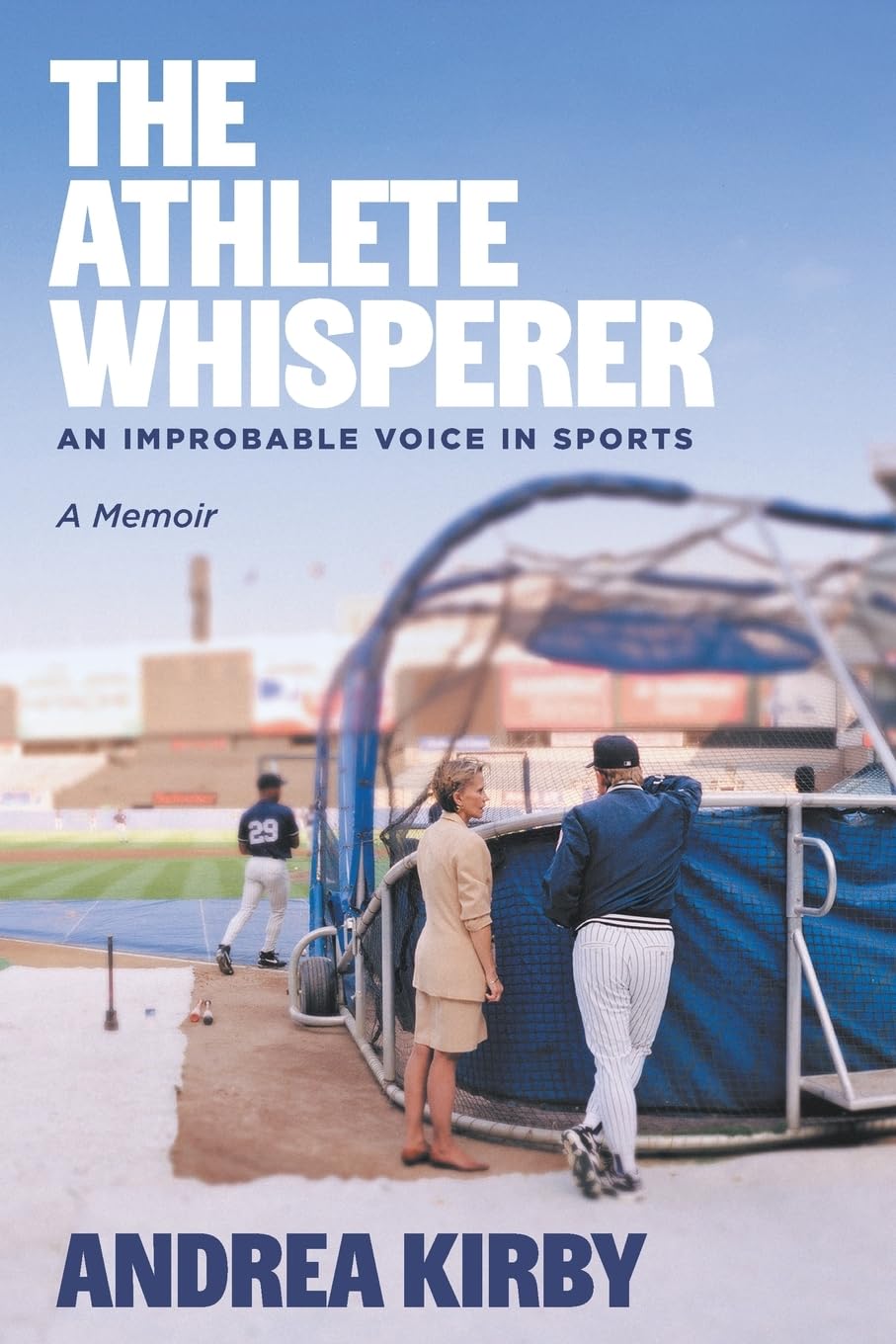
The Athlete Whisperer is a vivid and unfiltered memoir that shares how you became the first woman in sports broadcasting, the discrimination and harassment, the hard-won successes, and the future you helped shape for women. Why was this an important book for you to write?
To uncover how I feel now about what I experienced and denied at the time.
What was the most challenging part of writing your memoir, and what was the most rewarding?The heartbreaking, personal stories were challenging to retell.
The most rewarding has been the connection with readers who see themselves in my story, and feel reconciled.
What advice do you have for other women who are fighting against gender discrimination in their own fields?
Read this book. The examples I faced will prepare you well. Find mentors and friends to support you.
What do you hope is one thing readers take away from your story?
Most people are good. Find mentors. Respect yourself. Keep boundaries. Do what you love, and do it so well people can’t take their eyes off you! Pay it forward.
Andrea Kirby was not a former athlete and had no ties to television. Still, in 1971, this single mom talked her way onto a small television station as a sportscaster. A rare female in the all-male culture of her beloved sports, she was harassed and discriminated against, but she wasn’t deterred.
Kirby excelled at her first break and then moved to a bigger market in sports-rich Baltimore. Male colleagues said she didn’t belong, but fans loved her, teams respected her, and networks noticed her. In 1977, ABC Sports hired Andrea Kirby as its first full-time female announcer. Hosting the College Football Scoreboard and traveling the world for Wide World of Sports was her hard-fought dream come true.
Heartbreakingly, the dream ended. Kirby’s survival became another great adventure. Then, a chance interview with a famous basketball player changed everything, inspiring an idea so original that it appeared as a question in the board game Trivial Pursuit.
A rare, entertaining, and uplifting story, The Athlete Whisperer will inspire any reader with an improbable dream.
Andrea Kirby’s The Athlete Whisperer is a vivid and unfiltered memoir that pulls back the curtain on what it means to be a woman breaking barriers in sports broadcasting. From her early days as one of the first female sportscasters in the 1970s to her later years coaching athletes and media talent, Kirby tells her story with grit, humor, and honesty. The book weaves through decades of change in television and sports, balancing personal struggle with professional triumph. It’s not just about a career, it’s about identity, perseverance, and the raw nerve it takes to keep moving when no one wants you there.
What I liked most about Kirby’s writing is how straightforward it feels. She doesn’t write like someone trying to impress you. She writes like someone who’s lived through hell, laughed about it, and decided to share the punchlines. Her voice is confident, yet not polished to perfection, which makes it genuine. The stories are fast-moving, full of sharp details, and often tinged with pain that sneaks up on you between the victories. I felt her frustration when men dismissed her, her thrill when she nailed a broadcast, and her heartache when life hit harder than any newsroom drama.
At times, I found myself pausing not because the writing was heavy, but because it was relatable. Kirby doesn’t whitewash the sexism, the exhaustion, or the loneliness. She’s not asking for pity, though. She’s showing how resilience can look messy and stubborn and still be beautiful. The people she met, famous names from ESPN, ABC Sports, and the field, come alive through her lens, but it’s her own story that lingers. There’s a rough-edged warmth in the way she talks about the athletes she coached and the young broadcasters she helped find their footing. I could almost hear her voice, no-nonsense, but kind.
By the end, I felt like I’d sat across from someone who’d lived several lives in one. The Athlete Whisperer isn’t just for sports fans. It’s for anyone who’s ever felt underestimated or out of place but went ahead and did the thing anyway. If you like memoirs that feel like conversation, that mix heart with humor and truth with tenderness, this one’s worth your time.
Mother’s Ruin is a brutally honest and heartbreaking memoir that shares with readers your tumultuous childhood and early adulthood life as you coped with the effects of your mother’s alcoholism and emotional instability. Why was this an important book for you to write?
Definitely for my own healing and for that of those facing similar circumstances. My mother’s addiction and untimely passing have long since overshadowed me, and I needed to share my story to achieve full emotional freedom from this.
Despite what the stigma may have you believe, addiction is a trauma-response and never a choice. Nobody wakes up one morning and decides to pick up a bottle of alcohol or similar, and this was something that I was desperate to convey through my writing.
How did you decide what to include and leave out in your memoir?
This was something that I struggled with: the fine line between oversharing and undersharing. I wanted my writing to be rich and emotive, but to also not read like a personal diary, and I hope that I have achieved this.
I do believe that having already outlined my second memoir at the time also helped in choosing what to include (alongside endless rounds of editing, of course!).
What was the most challenging part of writing your memoir, and what was the most rewarding?
The flashbacks and the fear of being perceived were equally challenging. Long-suppressed memories were suddenly boiling to the surface, and not only did I have to address and write about these, but I also had to learn to do so in a safe, controlled and healthy manner, without reverting to previous toxic coping mechanisms.
Though my mum may not have been my protector, I have spent my life believing that I should be hers. With this in mind, I was worried that people would believe that I was villainising her in some way, when this could not be further from the truth.
That said, Mum may well have been poorly, but this is no justification for her actions, and I am tired of living a life enshrouded in secrets and lies to protect a collective.
The most rewarding aspect has definitely been the feedback that I have received. Though it pains me to know how many people can relate to my story, I am also proud of and thankful for those who have reached out to me whilst on their own healing journeys.
What do you hope is one thing readers take away from your story?
That healing from trauma may be painful, messy, and never linear, but it is always possible.
Raw, hard-hitting, but, ultimately, a true memoir of survival.
Raised fatherless on a ’90s poverty-stricken council estate, in the East Midlands, Belle details the struggles faced as she shared the role of young carer with her older brother, and the difficult transitional period as their relationship changed from brother and sister to child and caregiver, following court-approved legal guardianship.
MOTHER’S RUIN is an honest account of the devastating long-term impact of a mother’s addiction, dangerous actions and untimely death, just before her daughter’s eleventh birthday.
In Unconverted, you share with readers the surprising journey that resulted from your unexpected marriage to an Episcopal priest. Why was this an important book for you to write?
This was an important book for me to write because, beginning around the time I started going to church every Sunday with my children, I was thunderstruck by the feeling that my life had changed enormously, and in a way that I hadn’t fully anticipated before marriage. I realized that falling in love with a particular person, who was on a particular trajectory, set in motion a whole chain of events that brought me into unfamiliar territory: The Church, really, Any Church. I needed to figure out who I really was: how much I could shift around inside myself to accept some degree of religion, even as a bystander; how much my well-being depended upon my staying the secular person I had always been. Sitting in a pew, time after time, watching my husband up front performing his duties, I became fascinated with both the covenant and the daily reality of marriage – what it asks of us, how it enables us to grow and sometimes to merge with another person, how much room it allows for maintaining individuality.
I appreciated the candid nature with which you told your story. What was the hardest thing for you to write about?
Since this is a book about our marriage, I had to be careful throughout with any scenes depicting my husband’s actions or words; I needed his buy-in, his memories of these particular scenes, for accuracy. It was important to me that, overall, he comes across as the very decent and loving person that he is. And I couldn’t make the mistake of assuming I knew what his feelings were in particular moments, either – only what I observed (unless he wanted me to know). Probably the hardest parts of the book to write were the episodes when I stand apart, in some way, from engaging in the full experience of a church service. Specifically, the section when I remain in the pew at communion time, watching my kids go up for the wine and wafer, feeling a kind of necessary isolation; also Chapter 36 — “At the Consecration,” because that event was so celebratory in nature, with many people looking at me, I knew that my internal anxiety pegged me as someone swimming against the tide. And yet, that feeling was precisely what made the scene worth depicting in a book. It was in my Memoir Incubator class at Grub Street that I got the idea to begin this chapter with a childhood memory of lying in a field, seeing the crows circling; I’m proud of the honesty in this writing.
What is one misconception you believe many people have regarding mixed-faith marriages?
Mixed-faith marriages have become increasingly common over the past 50 years or so, part of the cultural landscape that most of us accept as normal. And yet, people continue to gather data on these unions, trying to discern how much impact this particular kind of difference makes over time, in the life of a couple, especially when it comes to divorce rates. From my perspective, a common misperception that is still prevalent is probably that couples spend a whole lot of time wrangling over matters of faith, trying to come to agreement about their individual beliefs. In the case of my marriage, we had probing conversations on the topic through our courtship, owing to the fact that we each knew we were falling in love and so needed to bring it all out into the open: the fact that he was devoting his life to serving the Church, while I wasn’t even sure what I believed! My willingness to have our children be brought up Episcopalian meant that we didn’t need to disagree about a key element in how they were raised, or what holidays we celebrated, etc. Over time, while we continued to explore our diverging beliefs (many being already in synch) we discovered that the key challenges we faced in maintaining daily harmony had more to do with how we were each “built” – his introversion and need for quiet, my extroversion and need for connection – than any specific doctrines we embraced. How well we managed a long drive to Nova Scotia together, for instance, wasn’t determined by anybody’s faith tradition, or lack thereof.
What is one thing you hope readers take away from your experiences?
As they finish Unconverted, I hope readers will take away a sense of tenderness about what’s involved in living out any long-term commitment between two people, especially one in which a fundamental difference is baked right into the relationship. I also hope that they’ll consider how such a difference can actually enrich a union, rather than threaten it, with each person being able to see and respect and learn from “another way” followed by a beloved without fully adopting that other way. Perhaps many readers will have had some kind of a similar experience – when they’ve felt the need to retain their own true nature, stay loyal to their roots, while also making space for someone else’s next to them – and therefore they will take away encouragement that the effort is worth the challenge. In addition, I hope readers might reflect upon how falling for and staying with another person always takes some degree of courage as well as vulnerability; you are taking a risk, putting yourself on the line, opening yourself up to many potential kinds of changes. So long as you don’t give up a sense of your own integrity, your heart can grow in surprising ways.
As soon as Polly and Rob meet, there is electricity between them, despite the fact that Rob is a devout Divinity student and Polly does not practice a religion. When they fall in love, she begins to wonder if their union can survive their theological differences. Over time, they build a multilayered life of family and community, and Polly manages to create a comfortable space as a clergy wife. In lyrical prose that is reflective, candid, and warm, this is the story of how an extroverted agnostic remained true to herself through three decades of marriage, three children, and four relocations. As Polly’s husband rose through the ranks to become an Episcopal bishop, she stayed steadfast in her love of literature, sports, nature, and her family, while deepening her understanding of herself, her husband, and marriage itself.
Belle Mills’ Mother’s Ruin is a brutally honest and heartbreaking memoir that follows the author’s tumultuous childhood and early adulthood as she copes with the effects of her mother’s alcoholism and emotional instability. Written in raw and intimate prose, the book is both a confession and a cry for connection. It tracks Belle’s experiences growing up in a working-class British town, surrounded by love yet starved of the nurturing and stability she craved. Her account weaves together personal memories, therapy sessions, and vivid reflections on trauma, mental illness, and the weight of abandonment, all told through the lens of someone fighting to make sense of her own pain.
Reading this book shook me. It left me feeling like I’d sat beside Belle through each moment, watching her as a child search for her mother’s approval, as a teenager drowning under the pressure of school and self-worth, and later as a young woman walking the tightrope between survival and collapse. The writing is emotionally dense but easy to follow. Belle doesn’t use fancy words to impress; she tells it like it is. And that’s where the strength lies. Her vulnerability is disarming. I found myself rooting for her, crying with her, and getting angry on her behalf. The structure bounces between timelines at times, but it only makes her struggle feel more lived-in. You feel how trauma isn’t linear. It loops and claws and resurfaces when you least expect it.
What struck me most was how well Belle captures the duality of love and pain, especially the love for a parent who keeps letting you down. The parts about her mother are some of the hardest to read because they’re not one-note. Belle doesn’t just paint her as a villain. She mourns the person her mother used to be and the one she might have been. It’s complicated and messy, and that makes it feel so real. I also appreciated how much Belle lets us into her head. The way she describes dissociation, panic attacks, and suicidal ideation is visceral and chilling. She doesn’t shy away from the darkness. But there’s also beauty in her resilience. Her relationship with her brother, her dogs, and even with strangers who show her small kindnesses, all of it reminds you that survival isn’t always dramatic. Sometimes it’s just continuing.
Mother’s Ruin is for anyone who’s grown up with a parent who couldn’t parent. For anyone who’s carried too much, too young. For survivors of trauma who don’t have tidy endings but still keep going. I wouldn’t recommend this book to someone looking for light reading or an uplifting memoir. But if you want to read something brave, human, and painfully relatable, then this one is worth every page.
Such a Pretty Picture is a devastating and intimate memoir that tells your story of a childhood marked by trauma, silence, and survival. Why was this an important book for you to write?
Like many memoir writers, I started the book with the intention of turning my personal trauma into art, but over time my intention has evolved. I want to use this book to create awareness about the issue of childhood sexual abuse and to give hope to other survivors. I believe that by telling my story I am sending a message to other survivors–letting them know it is okay for them to tell their stories too.
What were some ideas that were important for you to share in this book?
That childhood sexual abuse can occur in any family, no matter how “pretty” things look from the outside.
That love can exist even in the wake of the most profound betrayal.
That childhood sexual abuse or any abuse can have deleterious effects long after the abuse has stopped but that with therapy and support it is possible to heal; find the north star that resides in each of us.
What was the most challenging part of writing your memoir and what was the most rewarding?
My relationship with mother was complicated one of the most challenging parts of writing the book was allowing myself to write honestly about her abuse and her complicity. That secret was almost harder to reveal than the incest.
The most rewarding has come more recently, as part of my publicity I have shared the ARC on Net Galley, Goodreads as well as with Rape Treatment Providers, the comment I hear most often is that memoir will give hope to other survivors. I can’t wait to get the first email or direct message from someone who the book helped.
What do you hope is one thing readers take away from your story?
That even in childhood marked by trauma, growth, healing, and forgiveness are possible.
For readers of I’m Glad My Mom Died by Jennette McCurdy and The Glass Castle by Jeanette Walls, a candid and heart-wrenching memoir about child abuse, family secrets, and the healing that begins once the truth is revealed and the past is confronted.
Andrea is four and a half the first time her father, David, gives her a bath. Although she is young, she knows there is something strange about the way he is touching her. When her mother, Marlene, walks in to check on them, she howls and crumples to the floor—and when she opens her eyes, she is blind. Marlene’s hysterical blindness lasts for weeks, but her willful blindness lasts decades. The abuse continues, and Andrea spends a childhood living with a secret she can’t tell and a shame she is too afraid to name.
Despite it, she survives. She builds a life and tells herself she is fine. But at age thirty-three, an unwanted grope on a New York City subway triggers her past. Suddenly unable to remember how to forget, Andrea is forced to confront her past—and finally begin to heal.
This brave debut offers honest insight into a survivor’s journey. Readers will feel Andrea’s pain, her fear, and her shame—yet they will also feel her hope. And like Andrea, they will come to understand an important truth: though healing is complicated, it is possible to find joy and even grace in the wake of the most profound betrayals.
Terror at the Sound of a Whistle is the memoir of a successful career woman who attains all she dreamt of only to realize she may have lost the only thing of worth. You tell your story with novel-like quality; what inspired you to share your story and tell it in this fashion?
I have, as near as possible, a photographic memory. I remember not just incidents from the past but whole conversations and details of where and when. I suppose for most people, it is a strange phenomenon. I draw upon it for my writing, whether non-fiction or fiction. When I started writing Terror, it came back. I heard Jimmy’s voice and mine. I felt the fear. Saw the beauty. I had known great love during that time. I wrote as if I were there once again. I was in my mind and heart.
What were some ideas that were important for you to share in this book?
I started writing this book when I was a law major in college. My father and I had many discussions about the illegal supper club and gambling casino that he and his business partner ran in our huge Victorian home when I was growing up. Dad had become obsessed with how national and local politicians and those with money and power often decided our country and legal issues. When the club operated, gambling casinos were illegal, and bars had to close at midnight. The city had a vice department that raided places like ours, but if you ran a clean operation like my parents and Jimmy’s, you paid under-the-table money, graft, and were given a free pass. Our parents were notified ahead of time when there would be a raid. They emptied most of the money from the cash registers and stuck it in the cushions of our rocking chairs. Then came the fake raid. It affected our lives immensely. I wanted the injustice brought out in the book. I knew what happened then so long ago was as relevant as what is happening today. If not more so… Everything old is new.
How did you balance the need, to be honest and authentic with the need to protect your privacy and that of others in your memoir?
I waited until our parents had passed away, and all those of us left would not be hurt. We knew. We understood. Years before, I had tried to make it into fiction by adding a phony character at the beginning and end. My agent at Curtis Brown LTD, Clyde Taylor, loved it as the true story it was without the made-up character. Clyde was also my mentor, and he was working on marketing a novel I had written when he died unexpectedly. At the time, I was getting very ill with a malady called Trigeminal neuralgia, and the devastating loss of Clyde’s demise and my illness proved too much to start seeking a new agent. I put away all my work but never stopped writing. Now, I have short stories coming out by Running Wild Press. Also, two novels will be released in the near future.
How has writing your memoir impacted or changed your life?
My writing brought to life my desire to give credence to the impact our early lives have upon us as humans. I believed my experiences had elements everyone faces, and I could help others. Our feelings and emotions of those early experiences impress upon us images of all we experienced when we were small, as though we were little sponges. It is said you can’t go home again. I say, you never leave.
A successful career woman, at a juncture in her life, has finally attained the beautiful lifestyle, the security, all she had ever dreamt of during her trauma laden upbringing— only to realize she may have lost the only thing of worth. Fear, drama, trust, grief— and eventually, understanding and redemption dominate this novel-like memoir.
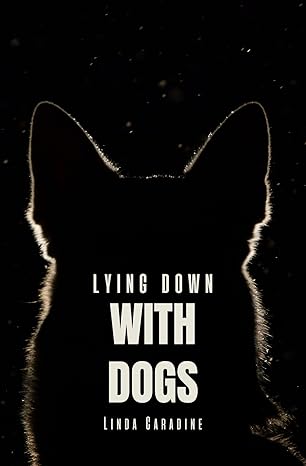
Lying Down with Dogs is a collection of deeply moving and beautifully crafted personal essays that serve as an inspiring beacon for anyone standing at the crossroads of life, hesitant to take the plunge toward an unconventional dream. The author, shaped by a childhood devoid of affection as the daughter of a German war bride in the 1950s, weaves vivid flashbacks of trauma and resilience. Yet, she is quick to clarify: while her life experiences inform the narrative, this is not a memoir in the traditional sense. Instead, it is a heartfelt tribute to the animals that shaped her journey and a testament to their transformative, healing power.
The narrative unfolds as a poignant, non-linear exploration of her adventures. The author recounts rescuing pregnant dogs in desperate need of care, kittens abandoned at construction sites, and even pigs—all while battling her own inner turmoil. She juggled the demands of caring for her aging parents and raising her daughter, all while building her animal rescue organization from the ground up. Through it all, her unwavering determination shines, driven by her love for the creatures she saved. Her stories of “foster failures” brim with warmth and humor. In one particularly memorable account, she likens a paraplegic Chihuahua to Scarlet O’Hara from Gone with the Wind, using the dog’s indomitable spirit as a lens through which to view resilience. These moments are both tender and vivid, drawing the reader into her world with startling intimacy. Grief and loss also permeate the pages. The deaths of three close friends to cancer could have easily overwhelmed her. Instead, she channeled that sorrow into her rescue efforts, finding solace and purpose in her work. The animals, it seems, saved her just as much as she saved them. Despite addressing weighty themes, childhood trauma, grief, and personal struggle the author employs dry humor and a light-hearted tone. Her deliberate avoidance of melodrama keeps the focus on the animals and their stories, making the narrative both accessible and deeply impactful. This restraint lends the book its emotional power, allowing readers to connect with the experiences without feeling overwhelmed.
Lying Down with Dogs contains tales of resilience and hope that inspire readers to see the world through a more compassionate lens, cultivating a deeper appreciation not only for animals but for the richness of life itself. This book is far more than a collection of essays; it is a celebration of the human-animal bond, a testament to perseverance, and an ode to the healing power of love and compassion.









 LITERARY TITAN