Blog Archives
Be Authentic

In Heart’s Dzyer, you share some of the most intimate aspects of your relationship with your boyfriend via letters exchanged during his time in prison. Why was this an important book for you to write?
This was an important book to write because his family was grieving, and I wanted to give them something about him that they may not have known.
I appreciated the candid nature with which you share your experiences. What was the most difficult thing for you to write about?
Even though I was candid and I wrote about difficult things, I did black out some private things that I didn’t think were appropriate to be shared with everyone.
What advice would you give someone who is considering sharing their own memoir?
I would advise that person to be authentic. I kept his spelling inaccuracies because, as someone with dyslexia, it would have been inauthentic to portray him as a perfect speller.
Did you learn anything about yourself in the course of putting Heart’s Dzyer together?
I don’t know if learning is the first thing that comes to mind. If anything, my experience dredged up a lot of emotions. Some days were harder than others. Sometimes I had to take a break because I needed to process emotions. So I guess I learned that I needed to give myself time to process, and I had to be compassionate toward myself as well.
Author Links: GoodReads | Facebook | Website | Amazon
Heart’s Dzyer


Heart’s Dzyer is a memoir built from more than 193 letters exchanged between author Woo-Ae Yi and her former boyfriend Snail between 2011 and 2015, then transcribed after his death in 2023. What begins as a prison pen-pal reconnection between two people who knew each other in middle school slowly opens into something stranger, riskier, and more intimate: a record of affection under surveillance, of art made in confinement, of addiction, depression, longing, manipulation, tenderness, and the way a person’s voice can outlive the body that carried it. The book moves through requests for photo enlargements and tattoo sketches, coded financial favors, flirtation, emotional collapse, private jokes, fox-and-hound imagery, and eventually the ache of loss, all while insisting on the rawness of the original letters rather than smoothing them into a cleaner memoir.
I was surprised by how alive Snail feels on the page, and how uneasy that aliveness can be. He can be lyrical one moment and coercive the next, self-deprecating and charming in the same breath. A line about a “6×9 labyrinth” gives way to instructions for mailing hidden cash; a meditation on loneliness turns into delight over stickers, cartoons, dubstep, or a glowing light box. That instability is the book’s power. Yi doesn’t sanitize him into a noble tragic figure, and I respected that. She lets the contradictions stand. I found that deeply moving, because love here isn’t sentimental at all. It’s full of care, fascination, danger, rescue fantasies, and blurred boundaries. The emotional truth comes precisely from the fact that the book refuses to turn this correspondence into something tidier than it was.
As writing, the book is rough in ways that are sometimes frustrating and often essential. The preserved misspellings, abrupt tonal swings, and sheer accumulation of letters can make the reading experience challenging. But that feels earned. Prison correspondence should not read like a polished novel. It should snag. It should circle. It should sometimes feel like being trapped in somebody else’s head. I also admired the way art keeps breaking through the prose. The requests to enlarge drawings, the graffiti pieces, the tattoo designs, the “Gentle” image caged in chain-link logic, even the odd tenderness of The Fox and the Hound references all give the relationship a visual pulse. The book’s ideas about identity, loneliness, performance, and survival aren’t laid out as arguments, but they accumulate by pressure. By the end, I felt I’d spent time not just with a doomed romance, but with a record of how people improvise meaning when freedom, time, and dignity have all been damaged.
I found Heart’s Dzyer messy, haunting, intimate, and brave. I finished it feeling tender toward both the love it preserves and the pain it refuses to disguise. This is a book I’d recommend to readers who are drawn to epistolary memoirs, prison writing, complicated love stories, and books that leave the seams showing, because those seams are the whole point.
Pages: 574 | ASIN : B0GKY4MF85

Very Much into Romance

Red Thread of Fate follows a woman who discovers the ups and downs of having a relationship with an older man. What was the inspiration for the setup to your story?
This book is partially autobiographical and based on my own life experiences.
Zarah is an intriguing character. What were some driving ideals behind her character’s development?
Zarah is based on myself, and I was very much into romance at the time.
What were some themes that were important for you to explore in this book?
The themes are more psychological in nature. I wanted to have the themes of codependency, narcissism, and commitment phobia. They’re not usually fictional themes, but it’s something that happens the real world.
What is the next book that you are working on and when will it be available?
I’m actually working on screenplays right now, including the screenplay for Red Thread of Fate, in which I will make the main character a Vietnamese adoptee. Movies take a longer time to make than books and can take up to five years to make. Another screenplay I’m working on is a TV episode pilot about a national nonbinary support group. It’ll be comparable to Pose but focused on the nonbinary trans experience rather than on the binary trans experience and more diversity with Asian and Latinx characters as well as Black and white characters. I don’t know yet if it will be on Netflix or elsewhere.
Author Links: GoodReads | Twitter | Facebook | Website
A Vietnam War veteran and a half-Korean/half-Black adoptee meet in Indiana and, ironically, they take a liking to each other.
They are not just ships passing each other in the sea of life; they actually hook-up despite doubts that the relationship will work. The feelings between them are intense, making each day, each week, each month more intense than the last. But they become separated by distance. And more doubts emerge as to the longevity of the relationship.
The question: How long can they last in their own little world until they start to see the world around them?
Red Thread of Fate
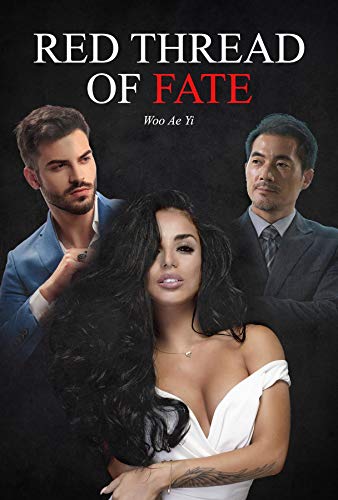
The Red Thread of Fate by Woo Ae Yi is a fiction story following a half-Black half-Korean woman named Zarah, who was adopted by a white father. She is a victim of emotional abuse but can’t seem to break away from her white boyfriend, Perez (aka Threat). When she gets a new job, she meets a man forty years older than her. But despite their age difference, she feels drawn to Yue Lao, a Chinese man who fought in the Vietnam War. After she finally ends her four year relationship with Perez, she moves away from Indiana to another State. But she remains in contact with both men. Will she ever be able to cut ties with the people who are connected to her by the red thread of fate?
Red Thread of Fate has an intriguing concept, and it was interesting to see how the author wove it into this story, which is intended as a cautionary tale. So much of our future is affected by things that happen to us in our past, and it is hard to overcome this without allowing ourselves to be pulled back in by previous self-destructive patterns. Despite the darker elements of the story, there were some humorous moments, which I enjoyed. I also liked that there were poems interspersed throughout the story. I enjoyed reading them, and they helped to provide additional insights into the characters and events.
While I thought this was a compelling and emotionally-charged novel, I thought the writing was hard to follow at times because, in the beginning, the book didn’t follow chronological order and included flashbacks that didn’t seem relevant to the chapter. Things seemed to be a string of random incidents rather than a story with a strong central plot with a smooth flow.
Author Woo Ae Yi has given readers a provocative romance novel that provides thought-provoking commentary on relationships and how they change and affect us. Red Thread of Fate is an intriguing romance novel with an alluring character and some emotionally resonant moments.
Pages: 171 | ASIN: B092M9QMWP

Woo Ae Yi – Author Interview

Profiles of KAD Relations with the Black Community helps readers understand how KAD can be a bridge in the Black Lives Matter movement. Why was this an important book for you to write?
I wrote the answer to that within the book itself, but essentially I didn’t feel that there was anything like it in existence, and I thought there should be.
What were some ideas that were important for you to convey in this book?
The role that Korean adoptees play in anti-racism.
What is a common misconception you feel people have about Korean adoptees (KAD)?
That they’re “not Asian enough.”
What is one thing you hope readers take away from your book?
The importance of practicing anti-racism and the importance of getting adoption-based and/or race-based trauma included in the DSM V.
Author Links: Website | Facebook | GoodReads
This book is divided into three parts: profiles, background history, and a how-to. Korean adoptee, Yi Woo Ae, also added a call to action. She first points out how the relationship between Blacks and Korean adoptees is better than what we see in the media, if it’s in the media at all. The author advocates for the inclusion of adoption-based and race-based trauma into the Diagnostic and Statistical Manual of Mental Disorders (DSM). She shares the importance of acknowledging that trauma, as defined in the DSM, is not currently all-inclusive. Whether we believe we chose our present life or not, we are the bridge between worlds. As a Korean adoptee (or Asian adoptee), we can support the Black Lives Matter movement.