Blog Archives
Why You Felt Crazy


Why You Felt Crazy is a compassionate and steady-handed guide to understanding gaslighting, trauma bonding, leaving an emotionally unsafe relationship, and learning how to live inside your own mind again afterward. Author Quinn Morgan writes from the middle of the experience rather than from some polished, faraway place of total recovery, and that choice gives the book its pulse. The book moves from the first quiet signs of self-erasure, like softening a simple “Where are you?” into something safer, toward the brutal confusion of leaving, going back, wanting to go back, and eventually rebuilding self-trust one small, almost tender decision at a time.
What I appreciated most was how deeply the book delves into the emotional weather of abuse without flattening it into slogans. Morgan doesn’t pretend that leaving is clean or that clarity stays lit once it arrives. The scene at her sister’s house, when a harmless request to make cookies triggers panic about mess, scrutiny, and being watched, stayed with me because it captures something many books only describe clinically. The harm has followed her into safety. It’s in the body, in the reflex to explain, in the way ordinary life suddenly feels booby-trapped. I found that devastating, but also strangely relieving. The book gives language to experiences that are often too slippery to hold, especially the ache of missing someone you know hurt you. Morgan’s insistence that grief isn’t proof you made the wrong choice feels emotionally precise and hard-won.
The writing is intimate and rhythmic. Morgan has a gift for returning to a phrase until it feels less like repetition and more like a hand on your shoulder. At its best, the prose is luminous in a quiet way, especially when she writes about the nervous system seeking closeness from the very person who creates the fear, or about safety feeling unfamiliar before it feels peaceful. The structure can feel soothing in its pattern, with each chapter turning toward reassurance in a similar cadence. This isn’t a book trying to impress the reader with complexity. It’s trying to keep someone company at 2 a.m., when logic has gone thin, and the urge to go back feels enormous. As a result, its repetition often feels intentional.
I came away feeling that the book’s strongest idea is also its most humane one: people don’t stay because they’re foolish. They stay because the good moments were real, because the beginning mattered, and because the cycle trains the body to confuse relief with love. That framing is powerful, and Morgan handles it with care. The practical sections on safety planning, the day of leaving, and the first thirty days are grounded without turning cold, while the later chapters on self-trust and learning what safe feels like give the book a softer landing. Why You Felt Crazy is tender, clear, and painfully recognizable in the best sense. I’d recommend it to readers who are questioning an emotionally manipulative relationship, recovering from one, or trying to understand why someone they love can’t simply walk away.
Pages: 170 | ASIN : B0GGYFWCJD

Psychic-Spiritual Abuse

In Silent Talking, you explain how you were drawn into a world of psychological manipulation and abuse and how you were ultimately able to free yourself. What inspired you to share your experiences with others?
Well, I actually feel like a literary titan—having the courage to expose my story and bring my unheard of life out of the darkness and into the light. It has been a monumentally traumatic but healing journey, my soul has seemed to deem necessary! Every sentence was painful to bring onto the page. But the urge to do so prevailed. It was so overwhelming to face that in 2024, I published it in 32 pages and couldn’t iterate further. A year or so later, I began to flow more easily and filled in more details that were paining me inside to come out. I felt more healed and more able to emotionally observe from the outside and tell more, and revised and republished it in the 76-page edition it is today. It’s straight to the point and scopes the heart of 30 years. Unbelievable as I have faced—my trauma took my life—my entire adult life to face and overcome and return from. Exhausted now—I feel driven to make up for lost time, but realize that my life has become my story, and the time for both career and family with children has sadly passed me by. I’m finding more peace with that as my memoir takes flight and begins to validate my life—not what I wished to live—but what I did live instead. To further answer your question, the motivation to share came as an urge from my soul—a deep need to convey after bottling it in for 10 years, once I returned to the world.
I appreciate the candid nature with which you tell your story. Were there parts of your story that were especially difficult to put into words?
Yes, when I expanded the length of the book, much more was brought to the surface. Going into more nuanced detail about the brutality I faced in the presence of a single individual and remembering the experiences as if it were the very day, was soul-shaking. Talking more about their personality was especially traumatizing because I was drilled to keep their privacy. Keeping their privacy, I realized, was burying me alive. My first 32 pages quickly skimmed over these details and focused more on the kundalini channeling aspects versus the abuse that led me into that state.
Expressing took an actual additional year and nine months to be calm and strong enough to sit down again and expand on the narrative of my story. Albeit daunting—it was necessary to face for my personal healing, and I believe for the reader to have a whole understanding—especially as a life learning experience.
The memoir involves experiences you describe as supernatural or involving channeling. How do you interpret those experiences today?
Every individual has inherent psychic and extrasensory abilities, as all beings are one with the universe. Some people’s lie dormant their entire lives, some people know them young, and others seek to develop them later on in life. My memoir is about the experience of being forced to awaken your spiritual abilities through the experience of extreme psychological and physical hardship—where a ‘kundalini’ event manifests itself—opening your third eye. This involuntary ‘opening’ subsequently leads to the loss of one’s natural spiritual protection from ‘the other side’—I believe we are all born with.
There are many accounts of people being called to channeling or serving entities, as mentioned in my memoir. It is always presented in biographical and autobiographical nonfiction, where the channeler gives over their body as a vessel for the entities to take over and give health or spiritual messages to a client or to the world. No one discusses how the individual channeler lost their agency to these entities, and if it was truly their will. Everyone automatically accepts that that was a ‘good’ thing. But was that really the case? Because my experience with third eye openings and entity entrance into your body was not positive, it breaks open and sheds light on that that might not really be the case. This I now feel as my duty to convey.
When entities embody you, you feel obligated to serve them. I am working to strengthen and stand up for the rights of people who channeling has befallen, as Asian Shamans that are born into families for generations, that are forced to serve Deities through them and give readings to clients. Even if they are highly regarded and earn plus sums of money to give readings and perform rites—many shaman’s stories include the threat to parents from ‘the other side’ that their children will die young and must serve and become a shaman to live (the new South Korean reality TV series ‘Battle of Fate’ – can be watched on Hulu with English subtitles). Since my experience had no public virtue and I was literally frozen in my own body, I feel compelled to present my story and the awareness of an individual’s rights to agency inside their own body. I very carefully tread now to stay grounded, and it has caused me to isolate myself as much as possible. I am hyper-awakened and aware and gaining more insight daily.
What do you hope readers take away from your story?
I hope to enlighten readers to a new truth—an underlying theme between personal abuse leading to supernatural abuse. And that my emotional step-by-step account can relay a world of hidden undertow that all can benefit from being made aware of. I know no one has ever heard of psychic-spiritual abuse, and I am firsthand the testimony!
Author Links: GoodReads | Website | Amazon
Honesty and Compassion

In The First Call Was Mine, you share the abuse of your childhood, the hardships of your adolescence, including suicidal despair, and the long road to healing. Why was this an important book for you to write?
For a long time, my story lived quietly inside of me. I carried the memories, the fear, and the resilience without ever fully putting words to them. Writing The First Call Was Mine became a way of reclaiming that story, not just as something that happened to me, but as something that shaped who I became.
Growing up in instability and abuse can make you feel invisible, as if your experiences don’t matter or your voice isn’t worth hearing. Writing this book was my way of pushing back against that silence. It was important for me to tell the truth about what it looks like to survive a chaotic childhood and still build a life defined by purpose.
I also wrote this book for others who have lived through similar experiences. Trauma can convince people that they are alone or broken beyond repair. If someone reads my story and realizes that survival, healing, and even joy are still possible, then sharing my story was worth it.
How did you approach writing about childhood experiences that were both formative and painful?
I approached it with a balance of honesty and compassion for my younger self. When you revisit painful memories, it’s easy to relive them through the lens of pain or anger. Instead, I tried to write those moments with the understanding I have now as an adult.
That meant allowing the experiences to be truthful without letting them become the entire definition of the story. The book isn’t just about trauma; it’s about resilience, growth, and the complicated ways we survive difficult circumstances.
At times, writing those chapters was emotionally heavy, but it was also surprisingly healing. Putting the experiences into words allowed me to process them differently and see the strength that existed in moments where I once only saw survival.
You draw a powerful connection between childhood survival and your work in EMS—when did you first recognize that link?
For a long time, I didn’t consciously recognize the connection. I just knew I was drawn to emergency services, the chaos of it all, and helping people in their most vulnerable moments. It felt natural to step into chaos and try to make things better.
Over time, I began to realize that my childhood had quietly prepared me for that kind of work. Growing up in an unpredictable environment teaches you how to read situations quickly, stay calm under pressure, and protect others even when you’re still trying to protect yourself.
EMS gave me a way to transform those survival instincts into something meaningful. Instead of chaos defining me, I was able to use the skills I learned from surviving it to help people in their most critical moments. In many ways, the career that grew from that path became part of my healing.
What is one thing you hope readers take away from your experiences?
I hope readers understand that the circumstances we come from do not have to determine the limits of our lives. They don’t have to define us.
Many people grow up believing that their past defines them, that trauma, hardship, or instability will always control their future. My story is proof that those experiences can become something different. They can shape strength, compassion, and purpose.
Healing doesn’t happen overnight, and it doesn’t erase what happened. But it does allow you to build a life that isn’t ruled by those experiences. If readers walk away believing that change, growth, and healing are possible, even after the hardest beginnings, then the book has done what I hoped it would.
Author Links: GoodReads | Website | Amazon
The First Call Was Mine is a raw and unflinching memoir about growing up in chaos and choosing a different future. With honesty and dark humor, Kayla traces her path from a traumatic upbringing to a career in emergency services, where she found purpose in running toward the very crises she once lived inside.
Becoming a firefighter and paramedic did not erase the past but it gave her the tools to face it. Through demanding calls, hard-earned resilience, and moments of unexpected grace, she begins to understand how survival can transform into strength. The book explores themes of foster care, trauma, identity, and healing, while examining how service, discipline, and community can help rebuild a life once shaped by loss.
This memoir does not offer easy answers or tidy resolutions. Instead, it tells the truth about what it means to carry trauma forward and still choose to show up, again and again. It is a story for anyone who has lived through adversity, questioned where they belong, or wondered whether it’s possible to break cycles that feel inescapable.
The First Call Was Mine is a testament to resilience, chosen family, and the quiet courage it takes to keep going, even when the past is loud.
The First Call Was Mine

The First Call Was Mine is a memoir about growing up inside relentless instability and then, somehow, building a life devoted to helping other people survive their own worst moments. Author Kay Blake traces a childhood marked by abuse, neglect, foster care, abandonment, and the aching responsibility of trying to protect her little brother, then follows that thread into adolescence, EMS work, paramedic school, chronic illness, sexual violence, suicidal despair, and the long, uneven work of healing. What stayed with me most was the book’s central idea that her instinct to respond to emergencies did not begin in uniform but in childhood, barefoot in the snow, wrapping her mother’s bleeding hand, or in the smaller, piercing moments that never quite leave, like a boy handing her his coat at school, or the locket her foster parents gave her when she was sent back into chaos.
I admired that Blake never writes like she’s polishing pain into something noble. She writes like someone who has stared at it for a very long time and decided, finally, not to lie about its texture. There’s a rough honesty to the prose that I found deeply affecting. At its best, it has a plainspoken force that lands harder than ornament would. She has a sharp instinct for the image that says everything. Christmas gifts arriving in black trash bags, Kid Rock becoming the soundtrack of dread, sleeping in a car that is both freedom and shelter, signing a dead friend’s guitar while half-thinking he’d be furious about the marker on the finish, these moments give the memoir its pulse. I also appreciated the dark humor braided through the book. It proves she survived it with her wit intact. That tonal balance is hard to manage, but here it often feels earned.
I also found the book compelling because of the ideas beneath the story, especially its refusal to romanticize resilience. Blake understands that being “strong” is often just what adults call a child who had no safe alternative. That insight runs quietly through the memoir and gives it moral weight. I was especially moved by the later sections, where the book shifts from survival into a harsher, more adult recognition that trauma doesn’t politely stay in the past. It follows her into love, into work, into her own body, into the institutional failures that greet her even after she does everything right. The chapter in which she reports being assaulted and is met with skepticism and procedural coldness is infuriating in exactly the way it should be. And the scene in the garage, when she nearly ends her life and then reaches, however shakily, for one stubborn reason to remain, has the kind of emotional nakedness that made me put the book down for a minute and think. Even when I wanted a little more compression or shaping in places, I never doubted the heart behind the pages.
The First Call Was Mine is painful, brave, and very human. Blake makes room for grief, rage, tenderness, absurdity, loyalty, and the slow dignity of choosing to keep going. I’d recommend it to readers of memoir who can handle heavy material and want something emotionally direct, especially people interested in foster care narratives, trauma and recovery, or the hidden personal histories carried by first responders. It’s a hard book in many places, but it has real warmth in it, and by the last page, I felt I had been spoken to by a person, not a performance.
Pages: 272 | ASIN : B0G5B3Z7J1
SILENT TALKING My Kundalini Nightmare: My Memoir of Being Supernaturally Forced to Service: Channeling Entities in an Occult Sex Cult

Sometimes, even after a person escapes a horrific ordeal, silence still hangs over what happened. That silence can shape identity as surely as the experience itself. Speaking out may offer a path back to agency. Fear often stands in the way. Yet people are resilient. When conviction finally rises, a voice can return. This is one of those stories. And it feels, unmistakably, like a case where truth is stranger than fiction.
Silent Talking, My Kundalini Nightmare: My Memoir of Being Supernaturally Forced to Service: Channeling Entities in an Occult Sex Cult by Adria Chalfin is a chilling first-person memoir. Brief in length but striking in impact, it recounts formative experiences from the author’s life that unfolded several decades ago.
Chalfin describes beginning her adult life as a sexual being and finding that experience deeply unfulfilling. That dissatisfaction led her into the orbit of a captivating woman she met in Los Angeles in 1984. An aspiring filmmaker and writer, this woman was drawn to practices that can best be described as sexually sadistic. Chalfin became involved with her and, at first, believed she was discovering a deeper dimension of her own sexuality. The relationship seemed to promise insight, intensity, and understanding.
The opening sections of the memoir contain vivid, unsettling descriptions not only of the physical acts Chalfin was compelled to endure, but also of the psychological manipulation that surrounded them. Under the influence of a woman she believed to be her friend, Chalfin came to think she was channeling entities that overtook her body and left her trapped in a state of paralysis.
As the memoir progresses, it explains how she ultimately freed herself. Because the account is told firsthand, the experience feels immediate and deeply harrowing. What emerges is more than a story of suffering. It is a compelling portrait of how the search for selfhood can veer into dangerous territory and become profoundly toxic. At the same time, it stands as a cautionary tale and a testament to the extraordinary endurance of the human spirit.
Silent Talking is both disturbing and compelling, not simply because of the experiences it recounts, but because of the courage it takes to recount them at all. Chalfin’s memoir offers a haunting look at manipulation, vulnerability, and survival, while also underscoring the strength required to reclaim one’s voice after profound trauma. It leaves the reader unsettled, reflective, and keenly aware of how easily the search for meaning and connection can be twisted into something deeply destructive. As a personal testimony and a warning, the book is powerful, sobering, and difficult to forget.
Pages: 76 | ASIN : B0CTLQMRL9
Being Broken: Tales and Essays of Survival and Death from Narcissistic Parental Abuse
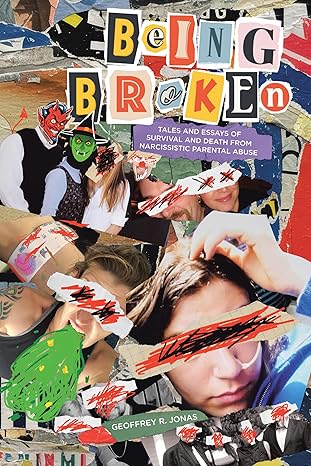
Being Broken, by Geoffrey R. Jonas, is a brutally honest memoir about trauma, addiction, and survival. It follows Jonas through a childhood steeped in neglect and narcissistic abuse, into years of substance dependence, and finally toward healing and self-understanding. He recounts the deaths of his sister, father, and mother, all in a single year, and how those losses forced him to face the damage that shaped his life. The book mixes memoir with insight–part psychology, part confession, and all heart.
Right from the start, Jonas pulls no punches. In the foreword, he admits, “I am spewing my head out onto these pages,” and that’s exactly how it reads, raw, direct, and strangely freeing. The prologue on narcissistic parental abuse hooked me. He doesn’t just define the concept; he exposes how it poisoned his family dynamic and left scars that followed him into adulthood. The mix of personal detail and clinical explanation makes it both heartbreaking and fascinating.
What I love most about this book is its honesty. Jonas never paints himself as a victim. He admits to his own part in the chaos, lying, manipulating, and self-destructing. There’s something refreshing about how he refuses to hide the ugly parts. When he writes about his sister’s overdose or his parents’ emotional absence, he doesn’t look for pity. He looks for truth. The section “Fault vs. Responsibility and Blame” really stuck with me. His idea that “it’s not their fault, but they are responsible” reframes forgiveness in a way that feels mature and real.
Jonas’ writing hits hard because it’s unfiltered but thoughtful. The poem “Broken,” written for his sister, might be the emotional heart of the book. It’s tender and painful, a mix of love, guilt, and memory. And by the end, when he says, “Here I am. A survivor,” it doesn’t sound like a line from a movie. It feels earned.
Being Broken isn’t a light read, but it’s a powerful one. It’s for people who’ve faced trauma, addiction, or toxic family systems, and for anyone curious about how self-awareness can lead to recovery. Jonas writes like a man who’s been through hell and decided to document the landscape. It’s dark, hopeful, and deeply human.
Pages: 274 | ASIN : B0DZPGY1BZ
Unbroken: A Survivor’s Journey After Sexual Assault

Lesley Goth’s UNBROKEN is a raw, honest, and deeply personal guide for survivors of sexual assault, told through a blend of professional expertise and lived experience. Each chapter addresses tough, often unspoken questions survivors carry. Questions about guilt, bodily autonomy, trust, pleasure, and healing. Goth uses stories, affirmations, and exercises to help readers reconnect with themselves and shed the shame and self-blame they’ve carried. With her compassionate tone and direct guidance, she offers a clear path through the fog of trauma toward hope and recovery.
Goth doesn’t just write like a psychologist; she writes like someone shining a light for those climbing out of their emotional trenches. Her language is simple and heartfelt, never preachy or clinical, which makes it feel like sitting with a wise, loving friend. What hit hardest for me were the sections that dealt with feeling complicit. “What if I liked it?” and “What if I gave consent?” They break open the myths we often use to silence ourselves. She tackles these grey zones without judgment, which is rare and brave and necessary. The real-life stories she includes aren’t sanitized, and that’s what makes them powerful.
I also appreciated the practicality of the book. Goth doesn’t leave the reader with just emotions and theory; she gives you tools. Exercises, guided imagery, breathing techniques, and even journaling prompts–all doable. I tried some of them while reading and was surprised by how quickly they brought up things I hadn’t realized I’d buried. She encourages you to move at your own pace, and that permission alone feels like healing. The tone of the whole book is soft but firm. She doesn’t coddle, but she always has your back. I found myself highlighting entire paragraphs and whispering, “yes,” more than once.
This is not an easy book to read, but that’s the point. It’s for survivors who are ready to stop pretending and start facing the pain, confusion, and sometimes even twisted memories of their trauma. It’s for people who’ve felt lost in therapy, or who haven’t yet found the words for what happened. It’s also a guide for those supporting survivors, partners, friends, and family who want to understand without intruding. UNBROKEN would be especially helpful for anyone navigating the messy aftermath of assault while still trying to function in everyday life.
Pages: 134 | ASIN : B0CZYBCRMC
THE MINDSET OF AN OUTLIER

The Mindset of an Outlier is an intense and personal guide to inner transformation. In it, Karamokoh B. Wurie blends spiritual reflection, personal struggle, and motivational fire to offer a roadmap for reinventing your life. The book moves from philosophical musings about reality and consciousness to brutally honest advice on how to confront addiction, self-doubt, and trauma. Wurie argues that life is an illusion shaped by your thoughts, and that by shifting your mindset, you can shift your entire existence. Part spiritual manual, part no-nonsense coaching, it’s written in a voice that feels both raw and uplifting.
I was drawn to the book’s bold, no-filter tone. Wurie talks about suicidal thoughts, toxic leadership, childhood pain, and the feeling of being spiritually lost, but does so with purpose. His voice is fierce but warm. He challenges you without patronizing. Some parts felt like a sermon, others like a late-night heart-to-heart. What I appreciated most is how he fused spiritual language with everyday pain, making big ideas like “consciousness” or “parallel realities” feel accessible. His core message is about reclaiming your life from the inside out, and that’s something that resonates, regardless of belief system.
At times, some ideas were revisited, and a few concepts could have been clearer with more structure or explanation. I also found myself occasionally wanting a few more real-life examples or outside perspectives to help ground the insights being shared. But then again, this book isn’t about data or citations, it’s a battle cry from someone who’s clearly lived through a lot and wants to help others do the same. Wurie’s emotional honesty makes up for any lack of polish. His rawness is his strength.
The Mindset of an Outlier is for anyone who’s tired of being stuck, who’s questioning the story they’ve been telling themselves, or who simply needs someone to say, “You’re not broken. You’re just not done yet.” This isn’t a book for skeptics or cynics looking for clean formulas, it’s for the searchers, the strugglers, and the spiritually hungry.
Pages: 134 | ASIN : B0FJL6WYCJ


