Blog Archives
Survival of the Fittest

In Adventures of a Looney Scot, you share your childhood experiences in Glasgow and trace your life through class, landscape, and national identity through a comedic lens. What made you decide to tell your life story?
I am no ‘spring chicken’, hence I need to speak up now for my children’s sake, or forever hold my tongue. Note that Adventures of a Looney Scot follows the first part of our hero’s life (see video link) as described in Book 1 of the Quantum Leap Forward trilogy that sets the scene for Ewan MacLeod’s leap from Scotland to Hong Kong. (see Facebook). This is soon to be followed by Book 2 Epicentre: Hong Kong (Edition 2) when that city state experiences the shock of The Big One; then finally Book 3 The Making of Punta – our resort in the Philippines that presents the development of The Most Sustainable and Liveable Resort in the Philippines (see Punta Riviera Resort and also Facebook).
How did you decide what to include from such a wide-ranging life without losing that sense of spontaneity?
As described above, each stage is presented as a book in the trilogy. My life has, in fact, been discontinuous and very much shaped by movements from growing up in Scotland, then moving to Hong Kong, life and death in Hong Kong; then moving to the Philippines; each being very much moulded by the three women in my life who have kept us in shape, given us strong direction, and helped us keep our own and our families’ heads above water. When all else fails – exercise your sirtuin genes and – keep breathing! Ach well, that’s life!
Your family life is depicted with both chaos and loyalty. How do you see those dynamics now, looking back?
Keeping our heads above water includes that from tsunamis and flooding, for example, from two super typhoons in the latter part of 2025 and a 4-6m high tidal surge wave that smacked into our resort Punta Riviera Resort at Bolinao, Pangasinan. The stories throughout this trilogy are partly about picking ourselves up after each disaster and learning from them. Filipinos have specific words for this recovery, namely Kapwas or Bayanihan, where everyone gets up after a disaster, helps everyone else near them to do the same by seeing themselves in others, then all move forward in the same direction. In the West, we follow the philosophy of ‘Survival of the Fittest,’ which is a very weak alternative and not how civilizations have survived natural disasters over centuries. When Matt Gandi was asked by a reporter after visiting Churchill’s cabinet in London: ‘So what do you think about British Civilization?’ he is reported to have replied: ‘Oh, that would be nice.’
If readers take one thing from your story, what do you hope it is?
Readers may appreciate that in Scotland, our Ancient Ancestors from a previous civilization left us precious ancient cultural secrets that helped us keep the Roman Empire out by forcing them to build Hadrian’s Wall, the English wall-bangers at bay for many years, and this helped us maintain our unique national identity. This led to our unusual DNA and our use of intuition, invention, and creativity during and after the Age of Enlightenment and Industrialization. However, whilst these are important issues, my pride in being a Scot and maintaining a healthy sense of humour are the key ingredients in this soup.
Author Links: GoodReads | Amazon
Adventures of a Looney Scot


Adventures of a Looney Scot is a memoir, but it doesn’t read like a careful march through dates and milestones. It reads like someone sitting across from you, pint in hand, telling you how a rough Glasgow childhood, a fierce family life, and an obsession with the outdoors slowly shaped him into a geologist with a taste for risk, argument, and reinvention. The book’s subtitle, From a Glasgow Urban Warrior to a Professional Geologist, turns out to be the clearest description of what it’s doing: tracing a life through class, landscape, work, and national identity, while keeping one foot in comedy the whole time.
What gives the book its real personality is the voice. McFeat-Smith writes in a way that’s unruly, funny, self-mocking, and deeply attached to Scottish speech and rhythm. A scene about midges lands because the punchline arrives with perfect local bluntness: “If the tourists knew about Scottish midges, they wouldnie come here tae enjoy themselves.” That line captures the book’s whole method. It doesn’t just describe Scotland. It performs Scotland as the author knows it: hard, absurd, affectionate, and never polished to the point of losing its bite.
The middle stretch is where the memoir really finds its shape. The childhood material has real grit, but the outdoor episodes turn that grit into momentum. Canoeing on Loch Lomond, hiking, cycling, close calls, family arguments, and reckless confidence all build the sense that this is a book about being formed by physical experience as much as by education. The book understands that a life story can be told through danger, embarrassment, and stubborn survival just as well as through achievement.
What I found most interesting is how the book gradually expands. It starts as a personal story, then grows into a broader portrait of Scottish culture, marriage, professional identity, food, ancestry, and politics. Jeanie isn’t treated as a side note but as part of the author’s development, and the later chapters move from memoir into a kind of argumentative cultural scrapbook, with sections on Scottish breakfast, self-determination, inventions, and odd laws. That shift makes the book feel true to its own ambitions. This isn’t just a record of one man’s youth. It’s a book that wants to place that youth inside a bigger Scottish story.
Adventures of a Looney Scot is a boisterous, big-hearted memoir about how a particular kind of Scottish boyhood becomes a professional life without ever quite losing its appetite for chaos. It’s at its best when memory, place, and voice are all firing at once, and even when it sprawls, the sprawl feels connected to the author’s personality. What stayed with me wasn’t just the sequence of events, but the sense of a mind trying to understand itself through weather, family, class, work, and country. That’s a rich mix, and the book leans into it with conviction.
Pages: 252 | ASIN : B0GVVPJ9KZ

The Strange Tools of Human Communication: The Voice, the Pen, and the Lyre

Ruth Finnegan’s The Strange Tools of Human Communication is a wide-ranging and often unexpectedly intimate meditation on how human beings make meaning through more than language alone. Moving from the voice to writing, music, gesture, number, colour, and finally the hand itself, Finnegan argues that communication is not a single channel but a dense, historical, bodily weave. What stayed with me most was the book’s refusal to let speech monopolize the story of human expressiveness. The chapters on Limba storytelling in Sierra Leone, on pictographic systems and cave art, on music’s possible origins, and on those half-conscious forms of signifying that live in numbers and colours all feed into one large claim: we are tool-making communicators, and our tools are stranger, older, and more various than modern habits of thought usually allow.
What I admired most was the book’s atmosphere of intelligent wonder. Finnegan writes like a scholar who still feels genuine astonishment at her subject, and that astonishment is contagious. I was especially taken by the pages on voice, where she moves from the physical instrument of the larynx to the felt power of hearing poetry aloud, and then into her vivid account of Limba oral performance, with its repetitions, pauses, chorus responses, and the sly drama of “the clever cat.” Those sections have real life in them. They don’t just describe communication, they seem to perform its vitality. I also liked the book’s impatience with easy hierarchies. Her defense of pictograms and non-alphabetic systems, and her skepticism toward grand claims that writing alone transformed humanity, give the argument a welcome steadiness.
At the same time, I found the book more persuasive in its concrete chapters than in its more speculative ones, and that imbalance is part of what makes it feel human rather than mechanically “complete.” When Finnegan is close to lived example, to oral artistry, to scripts and inscriptions, to music as a social and emotional practice, I felt entirely in her hands. When she moves into swarming, unconscious intercommunication, or the more mystical reaches of shared consciousness, I was intrigued. Still, even there, I never felt she was being careless. What she offers is less a hard thesis than a roaming, seasoned intelligence thinking aloud across disciplines. The book has the texture of a learned person laying out a lifetime’s thinking, with all the warmth, digression, and oddity that implies.
I found this a stimulating book that enlarges the reader’s sense of what communication is and where it lives. I finished it feeling more alert to sound, script, gesture, ritual, and the patient labor of the hand. I’d recommend it most strongly to readers of anthropology, linguistics, music, oral tradition, and cultural history, and also to anyone who likes scholarship with personality still beating inside it. This is a thoughtful book for curious readers who don’t mind following an original mind down winding paths.
Pages: 257 | ASIN : B0CXVJB1G3

I Was Just Sitting There Eating A Salad…


I Was Just Sitting There Eating a Salad… is a loose, comic tapestry rather than a traditional story collection with hard walls between pieces. The book keeps circling back to Green City and its recurring cast, especially Edward Loomis, the salad-eating private detective whose disastrous encounters become a running joke, while other stories widen the town into something stranger and more affectionate. One minute, the book is leaning into broad farce with names like Randolph and Imogene Scary and a whole town rattled by an “alien” misunderstanding, and the next it opens into more ambitious comic sci-fi through Jerald Cross, Sarah Smart, Greg Lieberman, and the wormhole device that turns a small West Virginia town into the center of increasingly absurd adventures. What finally holds it together is the sense that Green City is its own comic universe, one where gossip, coincidence, pulp plotting, and homemade science all somehow belong in the same weather.
The opening salad story is such a good example of the collection’s method because it commits completely to repetition, timing, and escalation until Edward’s laugh becomes practically mythic. I also found myself genuinely charmed by the way the stories start cross-pollinating. “Wormhole” could have felt like it came from a different book, but instead, it deepens the world, giving the collection a stronger spine than I expected. The courtroom frame, the teenage inventiveness, and the uneasy moral turn after the Nevada chase give that story real momentum, and later pieces gain extra pleasure because they’re no longer isolated gags. By the time the book gets to ghosts, pranks, and military suspicion, it’s working with a whole local mythology, and I admired how casually it builds that mythology without ever sounding solemn about it.
Author Victor Coltey’s prose has a talky, easy-going looseness that can be funny, especially when a narrator is half deadpan and half delighted by his own nonsense, but it can keep pushing after the laugh has landed. Some of the character descriptions and comic premises are intentionally outrageous, though for me they worked. There were stretches where I felt the book’s affection for eccentricity and caricature was warm and knowing. The author’s note helped confirm what the stories themselves suggest, which is that the book is openly trying to mix humor, sci-fi, and what Coltey calls “a little idiocy,” and I think that self-awareness is important because it frames the collection less as polished satire than as a homemade comic world built out of tall tales, genre love, and an authentic voice.
This book is rough-edged, but also lively, distinctive, and cohesive. Its best stories have the pleasure of hearing a practiced raconteur keep a straight face while the town around him slips further into absurdity, and its larger appeal is the way it treats small-town life as a stage big enough for wormholes, ghosts, Sasquatch, and very bad lunches. I’d recommend it to readers who enjoy offbeat regional humor, linked story collections, and comic speculative fiction that feels homemade rather than slick. It’s the kind of book for someone who likes their fiction odd, chatty, and full of personality.
Pages: 203 | ASIN : B0GG7TV3TG
A Society Divided By Technology
Christine Z. Miller Author Interview
Tools, Totems, and Totalities is a striking and expansive critique of modern technology and its pervasive role in shaping culture, institutions, and identities. Why was this an important book for you to write?
To bring together a society that has been divided by technology.
What is a common misconception you feel people have about how technologies impact culture and individuals’ identities?
We feel that we are the masters of the technology, when in fact we are enslaved by it.
What were some ideas that were important for you to share in this book?
First, that “technology” is not a human universal, but rather is a specific creation of the industrial revolution, and second that “technology,” like industrialization generally, has its pluses and minuses.
What is one thing that you hope readers take away from Tools, Totems, and Totalities?
That we collectively should be thinking about a world beyond technology, a world in which human connections and conviviality are more important than the tools we use.
Author links: GoodReads | Website
Tools, Totems, and Totalities: The Modern Construction of Hegemonic Technology, the 2024th Edition

Tools, Totems, and Totalities is a striking and expansive critique of modern technology and its pervasive role in shaping culture, institutions, and identities. Allen Batteau and Christine Z. Miller craft an ethnographic and philosophical journey through the social ecosystems technology inhabits, evolves within, and often dominates. Rather than viewing technology as a neutral tool, the authors challenge us to see it as a deeply embedded hegemonic force—one that organizes power, redefines human interaction, and reshapes meaning in the modern world. The book blends anthropology, design theory, engineering insight, and cultural criticism to show how tools become totems, and how both can culminate in totalizing systems of control.
What grabbed me right away was the authors’ raw honesty in grappling with our blind trust in “progress.” The opening chapter sets the tone, arguing that our imagination of technology—our deep faith in it—is more fantasy than fact. We treat smartphones, space probes, and electric grids as if they magically better our lives, when in truth, many of these devices mask deeper social problems or even create them. The idea that technology acts as a form of modern magic, filling the spiritual and communal voids of contemporary life really resonated with me. We reach for the newest device like it’s a talisman against chaos, and in doing so, we lose sight of the human behind the machine. That sense of disillusionment is something I’ve felt before, but the book gave me the language and history to make sense of it.
But it’s not all doom and gloom. I found myself surprisingly moved by Chapter 6, where the authors introduce “convivial technology.” Here, they offer a hopeful, even beautiful vision of tools designed to enhance human relationships and community life, not just productivity. It was a breath of fresh air. They celebrate thinkers like Ivan Illich and Victor Papanek, who envisioned technology that’s adaptable, human-centered, and a little slower. Their critique of modern design culture—its obsession with speed, efficiency, and control—felt deeply personal. As someone who’s worked in tech, it made me pause. Maybe the point of innovation isn’t always to push forward, but to step back and ask, “Who is this really serving?”
Tools, Totems, and Totalities is a mirror held up to our techno-utopian fantasies. It doesn’t offer easy answers, but it does offer clarity. The writing is at times dense but always thoughtful, weaving scholarly insight with a conversational rhythm that kept me engaged. The authors don’t pretend to speak with a single voice—they embrace their differences, and it works. The book doesn’t preach. It pokes, it nudges, and sometimes it throws cold water on our comfort zones. But I appreciated that. I finished the final chapter with a weird mix of dread and inspiration. I wanted to change something. Or at least think differently.
This book is for people who aren’t satisfied with buzzwords. If you’re curious about the social and cultural consequences of technology—and especially if you’ve ever felt unsettled by your own reliance on it—this book will challenge and reward you. Scholars, designers, engineers, sociologists, and everyday readers who are just plain tired of the hype will find something meaningful here.
Pages: 231 | ISBN : 9819787076
Kids Being Kids

Better Be Home When the Streetlights Come On: Remembering the Summer of 1963 follows three eleven-year-old boys as they spend their summer going on adventures and making memories. There was a lot of time spent crafting the character traits in this novel. What was the most important factor for you to get right in your characters?
The three main characters and most of the supporting cast are loosely based on my childhood friends. Brain, the Jewish kid, was the smartest among us and Chief an African American kid was simply our friend – we didn’t care about race. The important traits are just ”kids being kids” and navigating the challenges and landscape of 1963.
What were some themes that were important for you to explore in this book?
I wanted to give the reader a sense of what it was like growing up in Braddock 1963. Beginning with a macro view of Braddock as a steel town shaped by Andrew Carnegie, steel-making technologies, and the environmental advantages of proximity to the Monongahela River and the rich coal seams. Next, I focused in closer on the neighborhood, stores, and the culture of the times. From then on through the rest of the book I follow the major events of their summer vacation. Another theme is the challenges of aging with the older versions of the friends as they reflect on the childhood memories.
What is the next book that you are working on, and when will it be available?
I am going to go in a completely different direction and write a non-fiction book. I had the honor and privilege to serve in Chief Information Security Officer (CISO) roles in several iconic organizations including but not limited to the Naval Nuclear Program, US House of Representatives, American Red Cross (from 9-11 to Hurricane Katrina), and AMTRAK. Over 40 years of experience, I will write about the evolution of the CISO vocation in the context of meteoric advancements in technology and the means to protect the organization against internal and external threats. As to when it will be available, TBD.
Author links: GoodReads | Facebook
Better Be Home When The Streetlights Come On
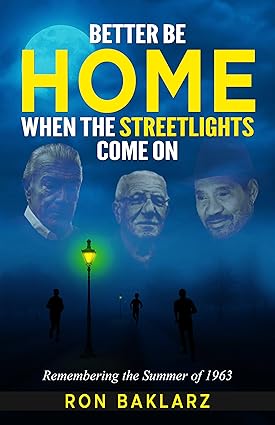
Better Be Home When the Streetlights Come On: Remembering the Summer of 1963 by Ron Baklarz provides an evocative journey into the lives of Jack and his teenage companions during the vibrant era of the 1960s. This narrative, which can best be described as a fictional biography, is rooted in the lively exploits of these young lads, all set against the backdrop of Braddock, Pennsylvania, following their academic year at St. Brendan Catholic School.
Caught in the tumultuous throes of adolescence, Jack, along with his inseparable friends Brain and Chief, grapple with their increasing curiosity. Whether it’s dodging the intimidating Buster or embarking on secret escapades their parents should remain oblivious to, their summer is nothing short of eventful. From spirited accounts of their Catholic school experiences to their eager anticipations of the Boy Scout camp, their tales encompass the universal thrills of teenage years – the intrigue surrounding girls, firearms, fireworks, and camping adventures.
Baklarz does an admirable job of immersing readers in the 1960s, interweaving the narrative with cultural and historical references pertinent to the era. Vivid episodes, such as a delightful picnic escapade with their mothers or a daring attempt at firearm smuggling, consistently engage the reader.
While the novel’s focus remains sharply on 1963, there are moments when I feel the pacing feels slightly rushed, making it a tad challenging to trace the connectivity between certain events. I think a deeper dive into the perspectives of the supporting cast would have further enriched the tapestry of this story. While the extensive detailing of historical events is informative, its relevance to the central narrative occasionally feels overstated.
Better Be Home When the Streetlights Come On promises a delightful read for those with an affinity for tales that blur the lines between fact and fiction and who relish a trip down memory lane.
Pages: 225 | ASIN : B0CG7KF43V


