Category Archives: Five Stars
American Tiger
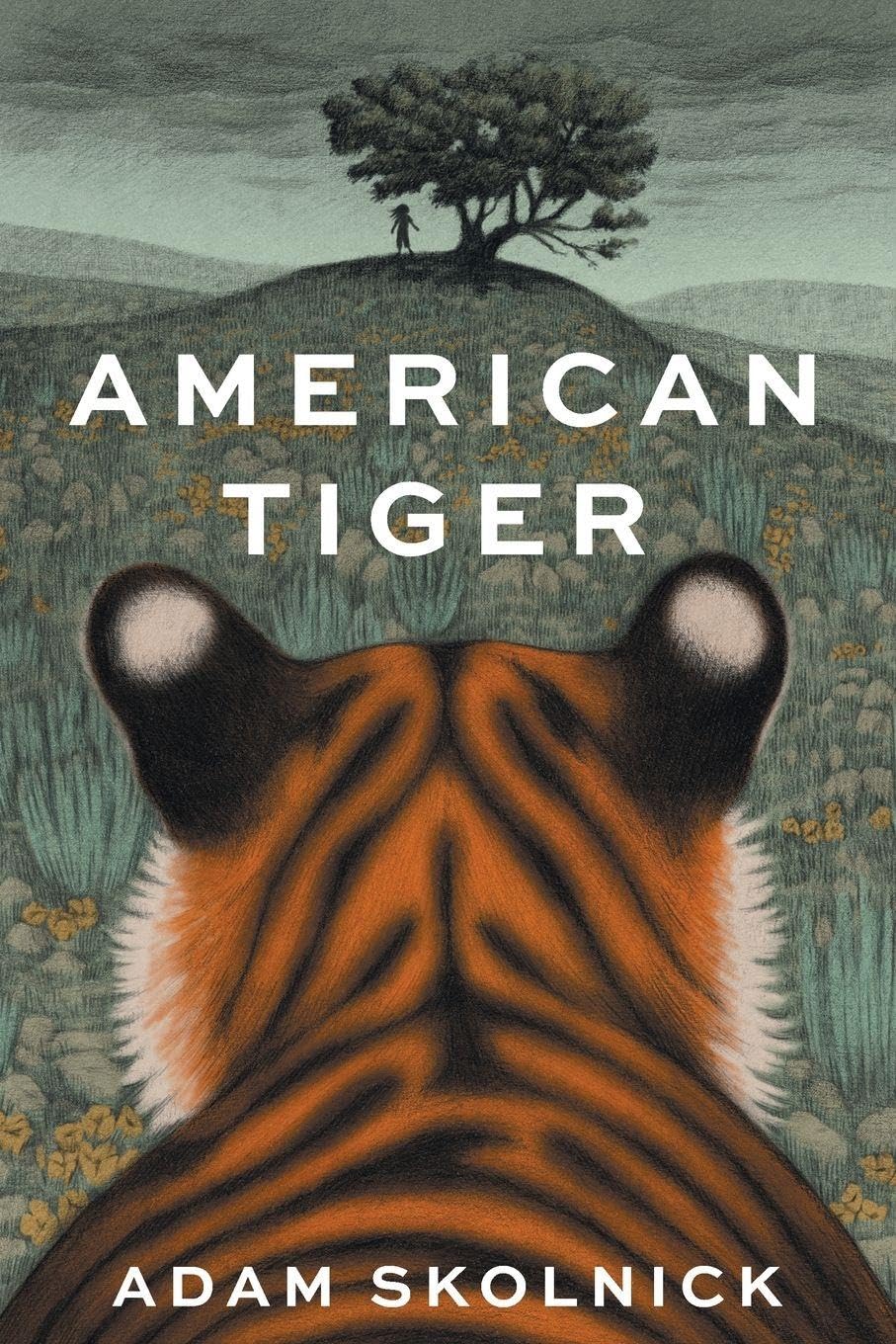

American Tiger follows nine-year-old Bell Tern, a sharp and wildly imaginative kid who becomes the first person in quiet Alisaw Valley to spot a tiger wandering near a Target loading dock. No one believes her, not even her father Jay, a game warden who knows there should be no tigers in Ventura County. As more strange sightings ripple across the valley, the story blends tension, family struggle, and ecological wonder. The tiger becomes a spark that exposes fear, disbelief, and a father and daughter’s effort to bridge the widening gap between their inner worlds. The opening chapters paint Bell’s devotion to drawing and documenting wildlife, her loneliness at school, and Jay’s steady but fraying attempts to raise her while holding the wild at bay.
This book pulled me in fast. I felt a kind of fond ache watching Bell try to prove what she saw. Her imagination is so alive that you can’t help rooting for her, even when it gets her labeled as a liar. The writing hits a sweet spot. It’s warm, direct, and paced in a way that made me forget I was reading. I liked how the author paints the valley around them. The details are simple but vivid. The land feels baked into the bones of the characters. I also noticed how naturally humor and sadness sit together in the scenes. One minute I was smiling at Bell’s oddball survival kit in her backpack. The next I felt a sharp little twist in my chest as the bus full of kids turns on her when she reports the tiger.
I also found myself moved by the relationship between Bell and Jay. Their dynamic is messy in a relatable way that I appreciated. Jay tries so hard to be steady and rational, but he’s worn down. The moment he gets a report of “a striped tail” under a pepper tree, something shifts in him, and I felt it. The writing lets him be flawed without judgment, and that made me care even more. The stakes get bigger as the search spreads. Experts arrive, each with their own trauma or agenda, and everything grows more tangled. I liked that the book never leans into cheap danger. Instead, it digs into fear, memory, loss, and what wildness means in a world that keeps shrinking.
The story touched that soft place where wonder and grief live side by side. I kept thinking about how a giant animal roaming the suburbs could expose so much about the humans who live there. The book surprised me. The writing has heart. It’s clear and calm on the surface, but there’s a current running underneath it that pulled me along.
I’d recommend American Tiger to readers who enjoy character-driven stories with a strong sense of place. It’s great for people who love literary fiction that carries a hint of adventure and for anyone drawn to stories about family, nature, and the things we try to believe in. It would also hit home for readers who like books told through the eyes of kids who see the world in ways adults forget.
Pages: 326 | ASIN : B0FTGLN6X2

Blessings Abound: Awaken to the Gifts at Hand

Blessings Abound is a short and sweet guide designed to help us spot the good things in life. Katherine Scherer and Eileen Bodoh wrote this book to help readers wake up to the gifts they already have. The authors break the content down into three main buckets. These are blessings we receive. There are blessings we ignore. And there are blessings wearing masks. The pages are packed with quotes from famous folks like Rumi and Abraham Lincoln. It explores how nature and music and friendship make life rich. The main goal is to shift your mindset from complaining to appreciating. It acts as a roadmap to peace and wonder.
I honestly felt a wave of calm washing over me while reading this. It is not trying to be a hard textbook. It feels like a warm hug. I really liked the way they used so many quotes. It felt like a greatest hits album of wisdom. Sometimes self-help books try too hard. They use big words to sound smart. This one keeps it real. It is simple. That is its superpower. The section on nature really resonated with me. I felt lighter after finishing it. It pushes you to use your heart more than your head.
The authors talk about blessings in disguise. This part made me think. It is hard to see the good when things go wrong. But they make a solid point. They mention people like Edison, who failed but kept going. That was inspiring. I also noticed the book gets pretty spiritual near the end. It talks about God and the Bible. They included Native American prayers, too. It felt like they wanted to welcome everyone. The focus on gratitude as a tool to fix a bad attitude is smart.
I think this book is a solid pick for anyone feeling a bit burnt out. If you need a mental reset. It works well as a coffee table book. You can pick it up and read a page or two. It does not demand a lot of your time. It just asks for an open heart. I would gift this to a friend going through a rough patch. It reminds you that the world is actually pretty cool if you look closely. Give it a shot if you want to smile more. It is a quick read with a long-lasting impact.
Pages: 58 | ASIN : B0FBSTLR27
The Living Bridge
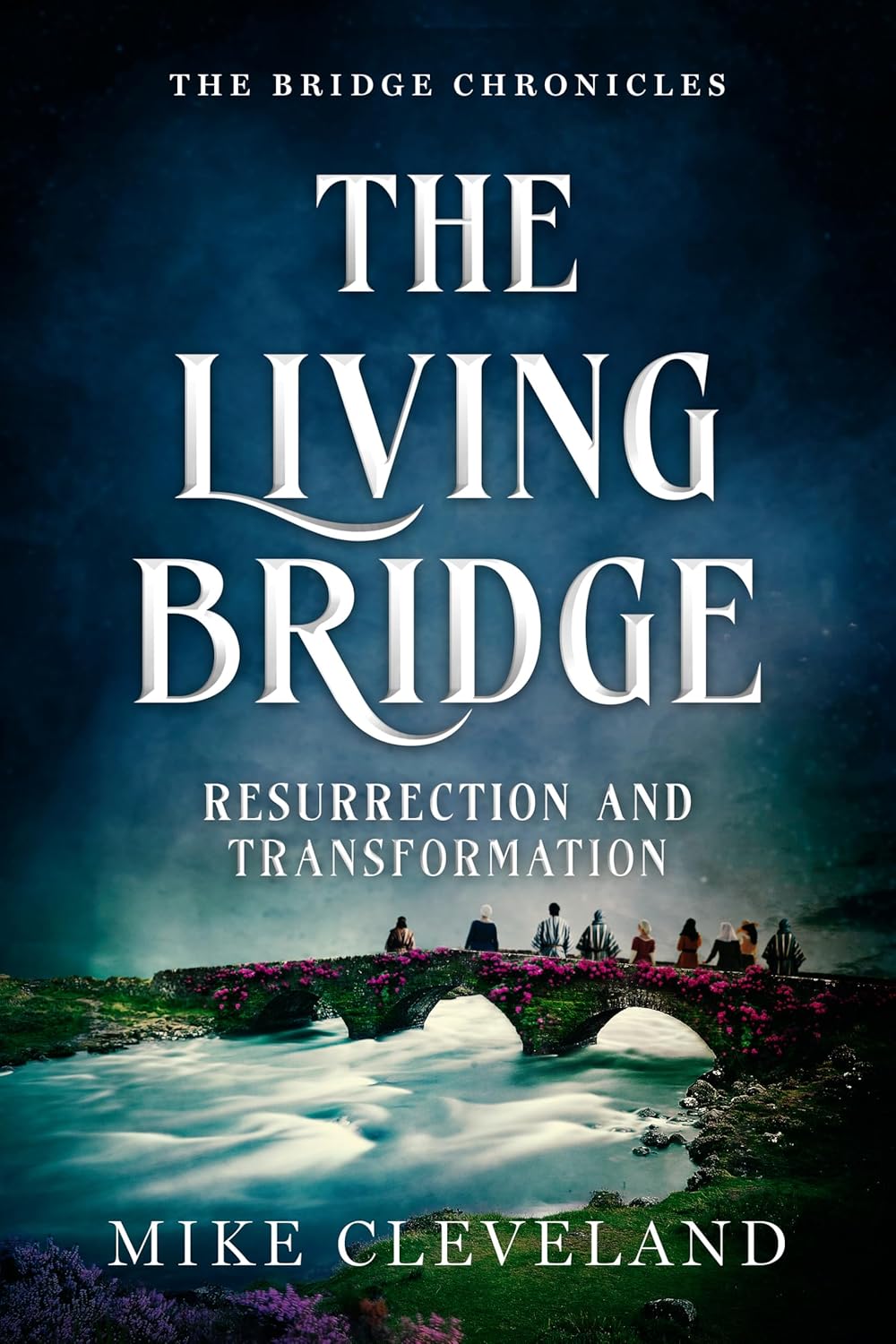
The Living Bridge is a work of Christian allegorical fiction that weaves together the stories of five broken people whose lives intersect in the shadow of a shattered bridge between Eastlight and Westshore. The book follows Mary, Lydia, Matthias, Cleopus, and Tamar as each carries grief, guilt, or despair to the riverbank where everything once fell apart. Their stories unfold in three movements that chart their journey from damage to darkness to eventual restoration, all centering on the arrival of a mysterious teacher named Geshriel, whose presence begins to mend what the earthquake destroyed. The opening chapters set the tone well, especially Mary’s torment under “Legion” and her stunning moment of deliverance, and Lydia’s aching exile from her family across the broken river.
As I read, I found myself reacting less to the plot mechanics and more to how the author frames suffering. Cleveland writes with a kind of steady compassion, letting each character’s pain breathe before offering any hint of resolution. Mary’s chapter in particular struck me. Her inner world felt raw and believable, and the moment her mind finally quiets when Geshriel calls her “beloved” is one of the more affecting scenes in the book. The prose is simple, almost plain at times, but it works because the emotional beats land without being dressed up. It felt like sitting with someone who has been wounded for so long they’ve forgotten anything else is possible. The author doesn’t shy away from darkness, but he also doesn’t exploit it. Instead, he uses it to build a kind of slow, patient hope.
There were moments when I paused, not because the story demanded it but because something in the writing touched on familiar human questions. Lydia’s longing for her daughters across an uncrossable river is written with a tenderness that feels lived-in rather than symbolic. Matthias’s crushing guilt over the collapse he caused, and the way he interprets every failure as further proof of his curse, could have felt melodramatic, but it didn’t. His scenes carried the weight of someone who can’t imagine forgiveness applying to them anymore. Cleveland seems most comfortable when exploring how shame isolates people, how grief reshapes their days, and how mercy begins as a voice they aren’t even sure they heard correctly. Sometimes the metaphors are quiet, sometimes they shine brighter, but they always feel in service of the characters rather than the other way around.
The book’s message is clear without being heavy-handed. The “living bridge” isn’t just a rebuilt structure but a person, a sacrifice, and a way back home. This won’t surprise readers familiar with the genre, but it still lands because the characters’ journeys make the message earned rather than assumed. If you enjoy faith-centered fiction, particularly stories that blend biblical echo with imaginative narrative, this book will likely resonate. Readers who appreciate character-driven arcs of healing and gentle spiritual allegory will find plenty here to sit with. And for anyone who has ever felt stuck on the wrong shore of their own life, the book offers a quiet reminder that bridges can be rebuilt, even when you’ve forgotten how to hope.
Pages: 227 | ASIN : B0FX5WS62Y
New Harmony: A Mother’s Story of Love and Loss
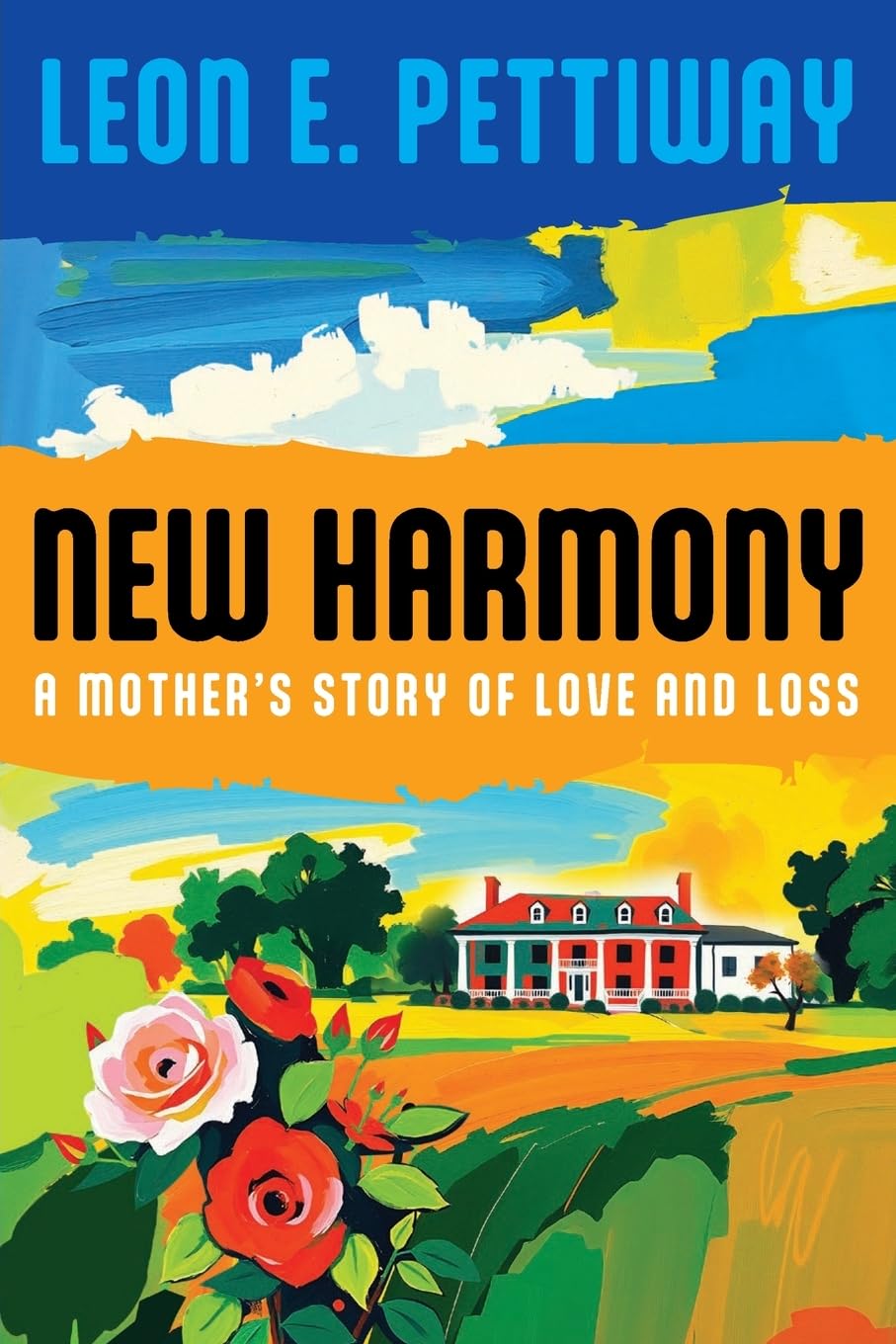
New Harmony opens with a grieving mother, Margaret Butler, recounting the gut punch of losing her teenage son to racist violence in 1949. The story reaches backward through her memories as she traces the long chain of choices, injustices, and quiet heartbreaks that shaped not only her life but the world that destroyed her boy. The novel moves between Margaret’s childhood on a South Carolina plantation, her uneasy ties to the white Demmings family, and the sorrow-filled road toward the truth behind her son’s death. It is a story made of memory, pain, stubborn hope, and the weight of generations.
I was pulled straight in by Margaret’s voice. The writing has this rhythm that feels lived in. Soft at times, sharp at others, always honest. The author doesn’t dress anything up. He lets Margaret speak in her own cadences, and I loved how that drew me closer to her world. I could feel the heat of the fields, the hush of the church during the funeral, the tightness in her chest when the pastor’s words sliced open her grief. The scenes in the Big House hit me hardest. They’re full of beauty on the surface and danger right underneath, and the writing captures that quiet tension so well.
Certain moments were very emotional and thought-provoking. The way Margaret watches the small signs of how power works. The way she tries to shield her children, even though she knows she can’t keep the world off them. The book doesn’t rush. It sits with the hard parts. And the ideas about how small acts, good or bad, weave themselves into a life stayed with me. The whole story feels like someone laying out a quilt square by square. Every piece matters.
By the end, I felt a mix of sadness and admiration. Sadness for everything this family carries and admiration for the strength that keeps rising up through the story. I would recommend this book to readers who want a powerful character voice, who like stories rooted in the South, and who don’t mind being pulled into heavy truths. It’s especially good for anyone who values fiction that feels real enough to leave a mark.
Pages: 374 | ASIN: B0G348J1KP
Mosswood Apothecary

Mosswood Apothecary is a cozy fantasy novel that follows Rowan Mosswood, a gentle, anxious botanical alchemist who accidentally grows invasive fungi during exams and packs dirt in his suitcase because it helps him think. After barely securing his graduation, he’s sent north to Frostfern Valley to study the region’s dwindling magic. What he finds there isn’t just a research assignment. It’s a quiet mountain town with withering crops, a long-abandoned greenhouse, a warm carpenter named Jimson, and a community that slowly becomes his home. The book blends slice-of-life pacing, soft magic, queer romance, and small-town healing, ending with Rowan opening his own apothecary and saying yes to a wooden ring carved from the oldest tree in the forest. It’s all very tender and very intentional.
The writing is simple in the best way: unhurried, a little vulnerable, and often funny without trying too hard. The worldbuilding leans more cozy than epic, even though the setting includes universities, automatons, and intricate alchemical sigils. What grounded me most were the sensory details that weren’t flashy: dirt under Rowan’s nails, windows iced in delicate patterns, the smell of elderflower tea hanging from the rafters.
I also loved how the story lets Rowan be soft. In so much fantasy, magic is about power or destiny, but here it feels like craft, patience, and care. Rowan’s magic grows wilder and more unpredictable the farther north he goes, and instead of turning that into a high-stakes threat, the author uses it to show how Rowan is changing, too. The romance builds the same way. Jimson isn’t swoony in a scripted sense; he’s solid, warm, and fully part of the town’s rhythm. Their relationship grows like something planted, slow at first, then steady, then suddenly blooming so clearly that by the time the Winter Festival proposal arrives, it just feels right. Even the townsfolk, with their worn-down farms and quiet pride, become part of Rowan’s chosen family, which gives the whole book the emotional softness of queer cozy fantasy at its best.
Mosswood Apothecary feels like TJ Klune’s The House in the Cerulean Sea crossed with the gentle, craft-centered magic of Travis Baldree’s Legends & Lattes, delivering a story that’s just as warm, queer, and quietly transformative. If you enjoy cozy fantasy, queer romance, or stories where magic supports character growth rather than overshadowing it, this book will be completely your vibe. It’s especially lovely if you like narratives about chosen family, rural communities, and soft magic that feels more herbal than explosive.
Pages: 392 | ASIN : B0FH5L8X2F
Sousanna: The Lost Daughter

In the aftermath of World War II, the world was in a state of flux. Countries devastated by the war faced the daunting task of rebuilding while their citizens grappled with profound changes in their lives. Greece, in particular, was further battered by the onslaught of a Civil War, compounding the struggle for survival. Amidst this backdrop of turmoil and rebuilding, America emerged as a symbol of hope and prosperity, an idyllic destination promising a life free from hunger and deprivation.
Sousanna: The Lost Daughter delves into this historical context, narrating the poignant tale of a young girl named Sousanna, caught in the crosscurrents of hope and despair. The memoir unfolds with Sousanna’s father, driven by a blend of hope and desperation, making the heart-wrenching decision to send his youngest daughter to America. This decision, born out of a belief in temporary separation, spirals into years of longing and heartache for Sousanna and her family back in Greece. The narrative poignantly captures the family’s clinging to the hope of Sousanna’s well-being, juxtaposed with her struggle to maintain her identity in a foreign land brimming with abundance.
Set between the 1950s and 1970s, the novel offers a compelling exploration of the complexities surrounding international adoptions, particularly from economically challenged countries. It insightfully presents the perspectives of the biological family, the adoptive family, and most crucially, the child at the heart of these life-altering decisions. The book sheds light on the controversial practices that led to the adoption of thousands of Greek children by American families, often under dubious circumstances.
Sousanna: The Lost Daughter, by Sousanna Stratmann, is a thought-provoking and relevant exploration of themes that resonate as much today as they did in the mid-20th century. The narrative is a testament to the enduring human spirit and the quest for identity in the face of overwhelming odds. This book is highly recommended for its insightful portrayal of a little-known chapter of history and its moving reflection on the human experience.
Pages: 272 | ASIN : B07JKBN66Y
Book 3 – Alexander Fleming’s Penicillin Promise: Dr. K’s Portal Through Time
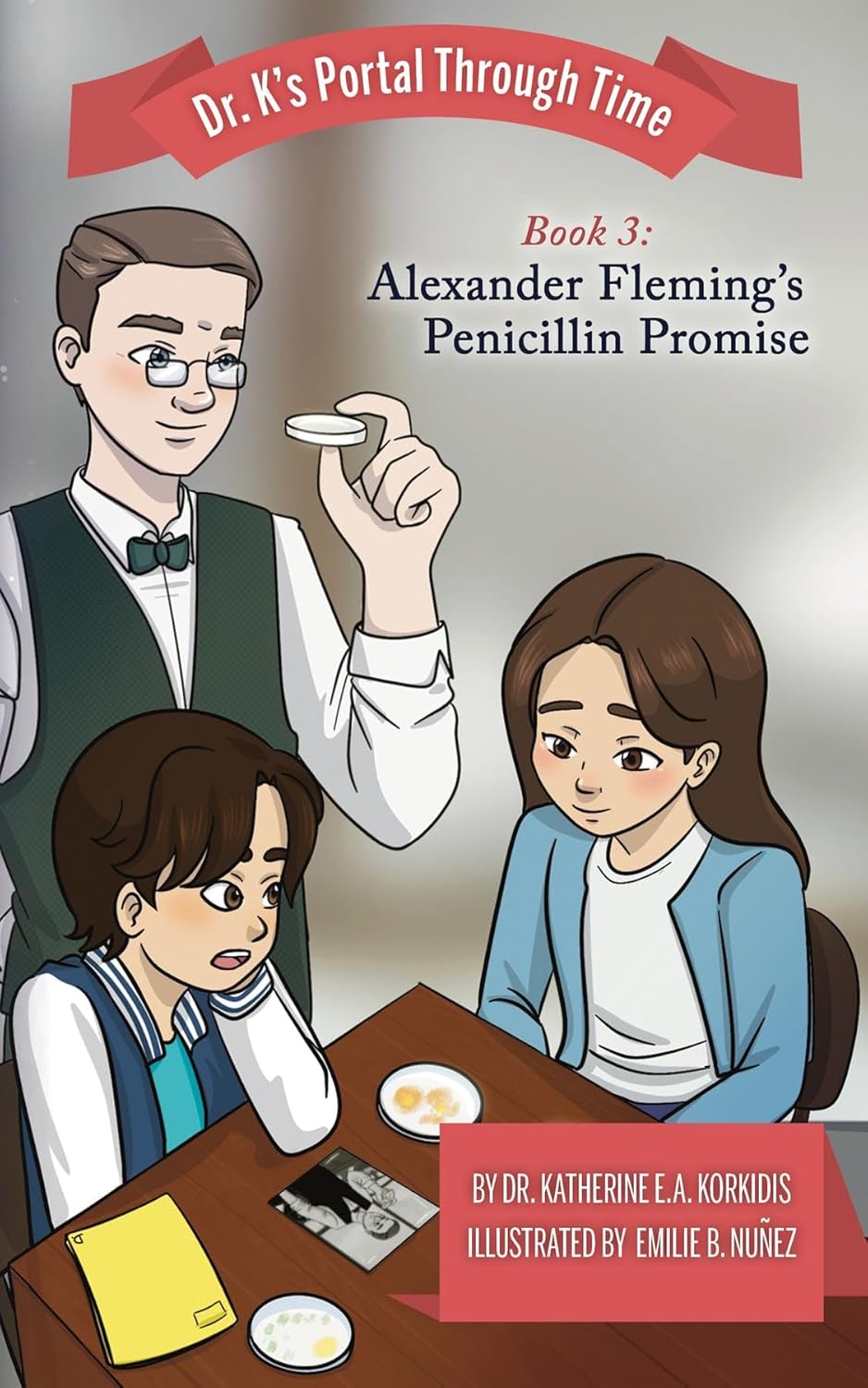
Alexander Fleming’s Penicillin Promise drops you right into a bright, curious world where two kids tumble through time to witness one of the biggest medical discoveries in history. The story walks through Fleming’s accident with that famous mold, the slow uncovering of penicillin’s power, and the uphill climb to prove it mattered. What starts as a small, strange spot on a Petri dish grows into something world-changing, and the book turns that whole scientific moment into a warm adventure full of wonder. It blends history with imagination in a way that feels playful and still hits the big lessons.
I had a great time with this children’s book. The writing feels cozy and easy to fall into, like someone telling you a good story over hot chocolate. I loved how it never talks down to kids. Instead, it hands them big ideas wrapped in clear moments that feel alive. The scenes with Fleming in his messy lab made me grin because they show how discoveries are often born from accidents and curiosity. The tone bounces between gentle humor, quiet awe, and those sweet little emotional beats between Jennifer, Daniel, and Dr. K. I kept finding myself smiling when the “mold juice” nickname came up.
There was also something surprisingly moving about watching these kids witness history. Seeing Fleming’s doubts, his patience, and his strange mix of order and chaos gave the journey real heart. The book does this neat thing where it makes science feel adventurous without turning it into something cold or technical. The moments with early patients hit me hardest, especially when Fleming realizes penicillin works, but there simply is not enough of it yet. The artwork throughout the book has a polished, anime-influenced aesthetic that creates a warm and approachable atmosphere. The character designs are the standout element, characterized by clean linework and expressive faces, like in a graphic novel.
I would recommend this children’s chapter book to curious kids, teachers, parents, and any adult who wants a warm and hopeful reminder that small discoveries can grow into life-changing things. If you enjoy stories that mix history with heart, or if you just want something that lights up your sense of wonder, this one is a perfect fit.
Pages: 113 | ASIN : B0FSTF3PDJ
Mask of Romulus

Mask of Romulus follows a sweeping story that stretches from Rome to India and ties together power, ambition, prophecy, and the fragile nature of empire. The book opens by painting a world connected by trade and restless ideas. It introduces Augustus at the height of his influence and an India fractured by competing kingdoms. Into this tense landscape steps Kamala, an oracle whose visions push her toward a journey that crosses four thousand miles and collides with the political storms of the Roman world. The novel layers real history with imagined personal struggles, giving the reader a sense that huge movements of empire hinge on private choices, secrets, and fate.
As I moved through the early chapters, I felt pulled in by how personal the book tries to make epic history. The scenes from Octavius’ childhood surprised me. They feel raw and grounded, almost gritty at times, and they made him more human than the distant marble figure we tend to imagine. The writing jumps between action and reflection, sometimes with sharp contrast, and that rhythm kept me alert. The prose feels almost cinematic, especially the storm at sea and the tension around Caesar’s final days. The book has a clear emotional heartbeat. It cares about loneliness, loyalty, power, and the cost of ambition. Those themes.
What really stuck with me was how confidently the author shifts between worlds. Rome feels vivid with its politics, temples, mentors, conflicts, and restless ambition. India feels just as alive in its spiritual tension and shifting kingdom lines. Even though the story reaches far beyond any one character, the author still gives each major figure enough emotion and doubt to make their choices feel real. I especially appreciated how the book doesn’t treat history like a static backdrop. It treats it as something alive and dangerous. The writing style itself is clean but emotional. Sometimes the dialogue leans formal, but I never felt pushed out of the story. Instead, it gave me the sense that these people carried the weight of their worlds in every sentence.
I feel like Mask of Romulus is a great fit for readers who love historical fiction but want more than dates and battles. It’s for people who like character-driven stories, who enjoy seeing famous figures stripped of their myth and shown as vulnerable, ambitious, or afraid. It’s also perfect for anyone who enjoys ancient-world political drama or a good cross-cultural adventure. I’d recommend it to readers who want something immersive, thoughtful, and full of heart.
Pages: 300 | ASIN : B0G26Z32D4



 LITERARY TITAN