Blog Archives
Beyond the Lies


In Beyond the Lies, author Kimberli Edmonds blends memoir, reflective self-help, and guided practice to explore how inherited shame, damaging relationships, financial fear, and self-imposed limits can become mistaken for identity. Her central argument is that lasting transformation doesn’t come from motivational language alone, but from gathering concrete evidence that an old belief is no longer true. She traces that process through deeply personal experiences: discovering the documentation that helped her recognize the manipulation within her marriage, announcing her decision to divorce while physically trembling, returning to school after repeatedly dropping out, learning to speak with authority in executive meetings, and entering a women’s prison to lead worship despite her fear. Each chapter moves from story to interpretation to practical reflection, gradually widening the book’s focus from individual survival to professional growth, financial possibility, community, and service.
What affected me most was Edmonds’s refusal to make courage look clean. Her strongest scenes preserve the body’s resistance to change: the hand gripping a doorway, the long nights spent turning a dining table into a financial “war room,” the woman sitting in a college parking lot while every old failure argues that she should leave. These moments give emotional credibility to her insistence that action often precedes confidence. I was especially moved by her image of washing a plate without shrinking after deciding to leave her marriage. It’s such a modest gesture, yet it captures the book’s deepest insight: freedom often enters quietly, first as a nervous system discovering that it no longer has to obey. Edmonds writes with directness and considerable tenderness toward the selves she once judged. Her language can be emphatic, but that usually feels purposeful, as though she’s trying to speak over years of internal accusation with something steadier and more humane.
I also admired the book’s distinction between guilt and shame, and between accountability and lifelong self-punishment. Edmonds doesn’t excuse harm. Her account of publicly wounding someone she loved, then delaying an apology because shame made repair harder, is candid and morally serious. At the same time, she argues persuasively that a damaging act cannot be allowed to become a permanent name. That idea gains force when she describes the incarcerated women she initially viewed through fear, particularly Keesha, whose guarded presence dissolves into vulnerability during worship. The encounter exposes Edmonds’s own reflexive judgment and gives the book a welcome ethical turn: healing isn’t complete when it merely improves one person’s circumstances; it becomes meaningful when it enlarges that person’s capacity to see and lift others. The recurring chapter structure and repeated phrases about evidence, doorways, and “the old story” reflect the author’s method. Beliefs formed over decades rarely yield to a single elegant sentence.
I finished Beyond the Lies feeling that Edmonds has written less a conventional book of inspiration than a compassionate manual for testing the stories that govern a life. Its practical exercises are grounded enough to be useful, while its autobiographical passages keep the advice from becoming bloodless or abstract. I appreciated that the book doesn’t promise a sudden reinvention; it asks for a smaller, harder commitment to take the next honest action, record what happened, and let reality slowly revise identity. This will resonate most with readers recovering from abuse, shame, financial limitation, interrupted ambitions, or the persistent conviction that they’ve missed their chance. It will also be valuable to leaders, mentors, and caregivers who want to challenge people without reducing them to their performance. I’d recommend it to anyone ready to stop treating the past as a verdict and begin regarding change as something patiently, bravely built.
Pages: 116 | ASIN : B0H6VCW78S

Musing Art for the Quantum Revolution!
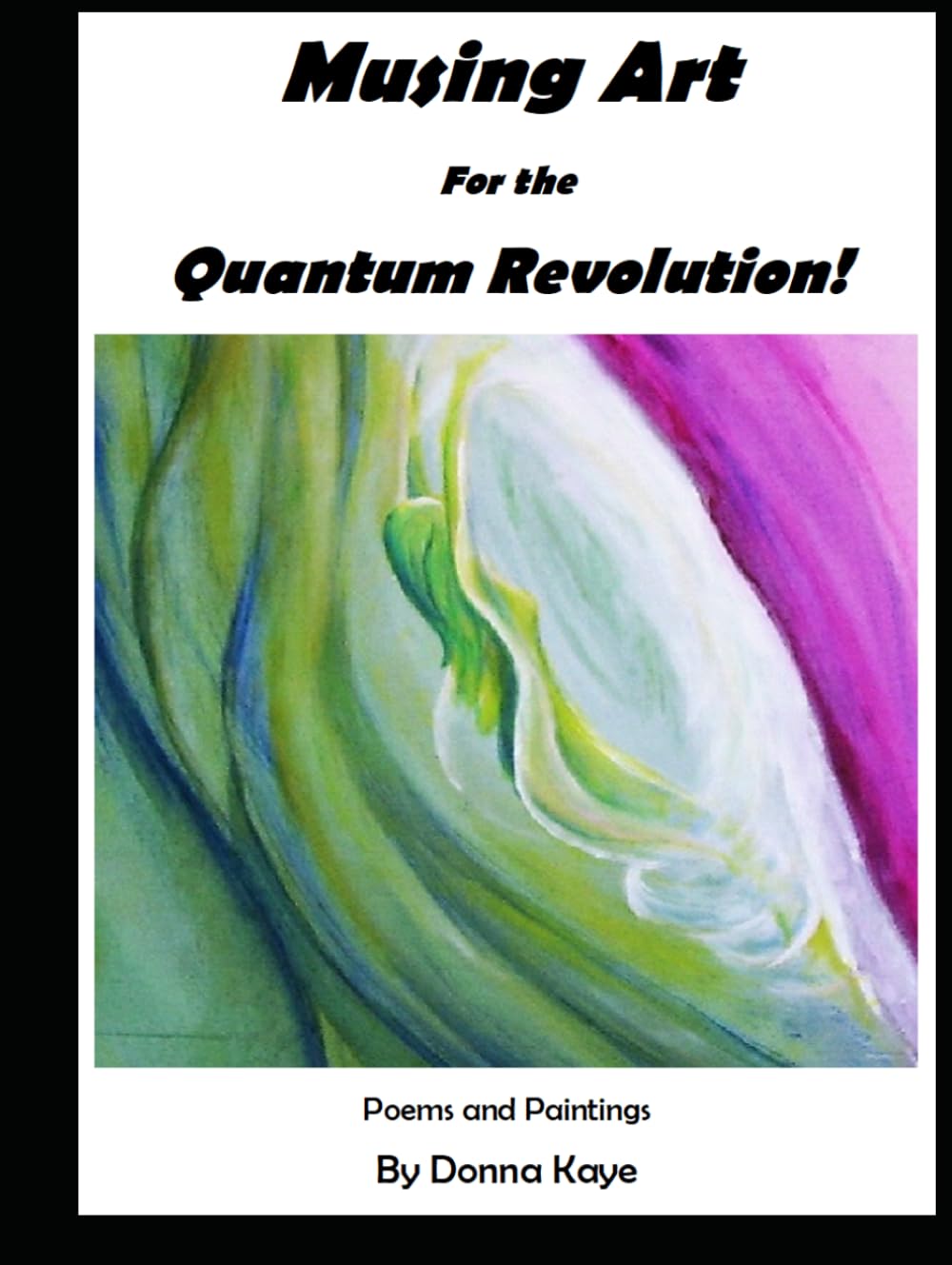
Musing Art for the Quantum Revolution! by Donna Kaye is a mixed collection of poems, spiritual reflections, political meditations, and original artwork centered on healing, freedom, human unity, and the idea that consciousness participates in shaping reality. The book moves from broad poems about war, fear, propaganda, poverty, and social control into more inward pieces about ego, anger, forgiveness, grief, and renewal, then closes with a short allegorical story about Freedom and several symbolic paintings that explain the author’s view of spirit, polarity, and illusion.
I read this less as a conventional poetry collection and more as an art journal with a clear moral compass. Donna returns often to the same core idea: the outer world won’t change unless the inner life changes first. That theme shows up in pieces like “Oh, Little Ego,” where the self is treated almost like a frightened child, and in “I Hate to Speak in Anger,” where anger isn’t dismissed but traced through the body, breath, words, and consequences. The poems are direct, sometimes chantlike, and often written as declarations rather than quiet observations.
What stood out to me most was the way the artwork and text talk to each other. The paintings use bright colors, cosmic imagery, figures, animals, symbols, and fractured shapes to make the book feel less linear and more like a sequence of meditations. Some sections, especially the Covid poems, are pointed and politically charged, so readers should expect the book’s worldview to be explicit rather than implied. Still, the book’s dominant movement is toward repair: peace over fear, sovereignty over compliance, love over division, and forgiveness as a practical act rather than a soft abstraction.
This book is best for readers interested in spiritual poetry, visionary art, metaphysical nonfiction, inspirational poetry, consciousness studies, healing, freedom, and social commentary. Readers who appreciate the aphoristic, devotional quality of Kahlil Gibran’s The Prophet may recognize a similar desire to turn private insight into public guidance, though Donna’s work is more contemporary, political, and visually esoteric. The Quantum Revolution is a candid, color-saturated appeal for personal healing as the first form of social change.
Pages: 86 | ASIN : B0H2JHTPYM
Our scientific capabilities must merge with the wisdom of the heart
if we are to survive our death spiral of war and aggression.
If we want a better world, we must heal our inner traumas and become better people.
Only then can we stand in the true power of compassion and effective change.
Thank you for letting me share my healing journey!
May we All find deep Healing, Peace and Love!
Femme Led
Femme Led: Hard-Learned Lessons from Women in Leadership is an anthology of women’s leadership stories that asks what becomes possible when leadership is no longer treated as control, performance, or self-erasure, but as truth lived in public. Across its chapters, the book moves from Sierra Melcher and Stephanie Mikulasek’s framing of the “leadership leap” to stories of reinvention, illness, entrepreneurship, grief, courage, and generosity. Catalina Escobar Bravo’s memories of growing up in Medellín, sleeping with taped windows during years of violence, eventually deepen into her purpose-driven work with Makaia. Carol Britton’s account of stepping into a high-pressure procurement role at the Bank of New York turns fear into a managerial instrument rather than an obstacle. Anna Dravland’s stroke and her transformation from a woman who did everything into a leader who built like a starfish instead of a spider web may be the book’s most tender image of all. Together, these essays argue that leadership isn’t a costume women must wear correctly. It’s a reckoning with one’s own voice, limits, power, and capacity to keep becoming.
What moved me most was the book’s assertion that the body often knows before the résumé does. I felt that idea gathering force each time a woman chose alignment over appearances: Tracy Macdonald turning in her badge and weapon after realizing the Secret Service no longer fit the life or values she could carry, Catalina stepping aside from the CEO role at Makaia to protect the mission rather than her title, Stephanie admitting that certainty itself had become a cage. These aren’t tidy triumphs. They ache. The book does a great job of showing how the emotional truth of leadership is often found in unmarketable moments: fatigue that rest doesn’t fix, ambition that has gone hollow, success that starts to feel like betrayal. I admired the way the authors return again and again to intuition without making it flimsy. Here, intuition is data of another kind, less quantifiable, perhaps, but no less exacting.
Some chapters read like polished keynote addresses, clear, instructive, almost ceremonious. Others arrive closer to confession, with rougher edges and a more immediate heat. Anna’s chapter, shaped around the aftermath of brain injury, resists a conventional arc, and I found that choice not only compassionate but artistically right. It lets form carry meaning. I was also struck by the range of metaphors the book earns rather than merely decorates with: the “leadership leap,” the internal flame, the spider web in a storm, the starfish that can keep functioning while it heals. The ideas circle familiar territory around purpose, resilience, and authenticity, but the best pieces refresh those words by grounding them in the particulars that people actually lived through, like Janice Marquardt leasing an office so her work would stop being absorbed by the quiet gravity of household labor, or Alexandra Yung reframing business as giving rather than transaction.
Femme Led respects uncertainty as part of the work. Leadership becomes most humane when women stop asking permission to be whole. I’d recommend this book to women in transition, founders, executives, coaches, nonprofit leaders, creatives, and anyone who has achieved the thing they thought they wanted only to feel some private truth pressing against the edges of it. This book’s gift is reminding us that crossing over can be frightening, scary, and necessary all at once.
Pages: 200 | ASIN : B0GQJPDW8Q

God Is Good: Simply the Gospel of Jesus Christ


God Is Good: Simply the Gospel of Jesus Christ by Ivon Hartness is a heartfelt, chapter-by-chapter walk through the Gospel of Matthew, written as both a teaching guide and a personal testimony. Hartness begins with Jesus’ genealogy and birth, lingers over Joseph’s quiet righteousness, follows the wise men, John the Baptist, the Sermon on the Mount, the temptations in the wilderness, the parables, the cross, and finally the resurrection and Great Commission. The book’s central conviction is steady and unmistakable: God is good, Jesus is the promised Savior, and the Gospel is not merely information to study but truth meant to remake the heart.
What moved me most was the book’s sincerity. Hartness writes like someone who isn’t trying to impress a classroom but to sit beside a reader with an open Bible between them. I felt that especially in the early chapters, when Joseph’s choice to protect Mary becomes more than a familiar Christmas detail. It becomes a picture of restraint, mercy, and obedience under pressure. The same warmth appears in the discussion of the wise men, where Hartness gently corrects popular nativity assumptions without sounding smug, and in the resurrection chapter, where the stone rolled away is treated not as a theatrical flourish but as an invitation to look inside the empty tomb. That kind of devotional imagination gives the book its pulse.
Hartness is passionate, direct, and deeply personal. The book explores themes of grace, repentance, obedience, spiritual warfare, and the new heart, with a preacher’s urgency. For me, that made the book feel wonderfully earnest in places. When he writes about the Beatitudes as a progression of the soul, or about Jesus resisting temptation through Scripture, the theology feels authentic. I didn’t always find the style polished in a literary sense, but I found it honest, emotionally present, and anchored by a genuine desire to help readers encounter Christ rather than merely analyze Him.
I found God Is Good to be an affectionate, plainspoken, and conviction-filled guide to Matthew, one that values clarity over complexity and devotion. Its concluding emphasis on the risen Christ gives the whole book a fitting sense of arrival, like a long walk ending in morning light. I’d recommend it especially to newer believers, small-group readers, or Christians who want a warm devotional companion through Matthew.
Pages: 199
Literary Titan Gold Book Award: Nonfiction

The Literary Titan Book Award recognizes outstanding nonfiction books that demonstrate exceptional quality in writing, research, and presentation. This award is dedicated to authors who excel in creating informative, enlightening, and engaging works that offer valuable insights. Recipients of this award are commended for their ability to transform complex topics into accessible and compelling narratives that captivate readers and enhance our understanding.
Award Recipients







Three Little Words by Lucy Clifford
Visit the Literary Titan Book Awards page to see award information.
Pursuit of the Impossible Dream
Pursuit of the Impossible Dream is part memoir, part success manual, and part manifesto about turning private ambition into public impact. Author Dee Brown frames the book around a life built in defiance of scarcity, doubt, racism, institutional betrayal, and plain old exhaustion, then organizes that life into lessons on dreaming big, education, resilience, branding, leadership, and building through partnership. What gives the book its spine is not just accomplishment, though there’s plenty of that, but the insistence that achievement means more when it widens the path for other people. The throughline is clear from the start, in the sections about Brown’s mother, his early hunger to outrun limits, and later the P3 philosophy of joining public purpose with private execution.
Brown writes like someone who has had to argue with despair in real time, and the chapter on his indictment and comeback gives the book a bruised, persuasive gravity that the more conventional motivational passages alone wouldn’t have carried. When he moves from the exhilaration of buying land, structuring deals, and becoming “the first” in room after room to the wreckage of prosecution, reputation loss, and rebuilding brick by brick, the book stops being merely instructive and becomes genuinely affecting. I also liked that his ambition is never presented as dainty or abstract. It lives in a mile race, he declared before he could run it, in a Geo Tracker he talked his way into as a teenager, in municipal projects, Navy contracts, community clinics, and the stubborn refusal to let someone else’s version of reality become his own.
The book is strongest when Brown drops the polished keynote cadence and lets the lived detail do the work. Now and then the prose leans on affirmation, but even that feels consistent with the genre he’s working in and the audience he wants to reach. The ideas themselves are not radically new. Dream bigger. Keep learning. Protect your name. Build partnerships. Give back. But what gives them weight here is the specificity of the life underneath them. I found the P3 philosophy interesting because it moves beyond self-help bromides into a concrete way of thinking about profit, infrastructure, and community benefit at the same time. And I appreciated the tension in the book between self-creation and obligation. Brown wants wealth, reach, and legacy, yes, but he also returns again and again to his mother’s sacrifice, to mentorship, to education as leverage, and to the moral burden of being first. That tension gives the book more texture than a standard victory lap.
I read Pursuit of the Impossible Dream as a hard-earned personal doctrine, delivered with conviction and real feeling. It’s earnest, sometimes blunt, often stirring, and at its best it carries the force of testimony rather than branding. I’d recommend it most to readers who are building something under pressure, especially entrepreneurs, first-generation strivers, professionals trying to recover from a serious setback, or anyone who wants a motivational book with scars still visible on the surface. This is a book for people who need to be reminded that ambition can be both expansive and useful, and that surviving the fall can become part of the architecture of the rise.
Pages: 127 | ASIN : B0GS4B8LCR
Water Your Flowers With Love: A Collection of Poems

Water Your Flowers With Love is a poetry collection that moves through grief, memory, exile, tenderness, and moral urgency without ever letting go of its faith in love as a sustaining force. Across poems about childhood, a lost father, immigration, war, kindness, and the consolations of the natural world, Author Koula Hadjitooulou keeps returning to one central conviction: the human spirit is fragile, but it isn’t finished. The book’s title poem crystallizes that vision by turning childhood harm into an aching plea for gentleness, while poems like “Cyprus and the Girl with the Water Jug,” “Warrior of Life,” and “Three Little Birds” widen the emotional field into displacement, survival, and the cost of violence borne by children.
What stayed with me most was the book’s emotional sincerity. This is not guarded poetry. Hadjitooulou writes as someone who means every line, and that directness gives the collection its pulse. The poems about her father especially landed hard for me. In “I Can Still Feel His Warmth” and “Letter to My Dad,” the grief isn’t abstract or ornamental. It feels authentic, almost tactile, as though memory itself were giving off heat. I also found myself moved by the recurring image-world of flowers, stars, hills, wind, and birds. In another writer’s hands, that language might feel overly sweet, but here it often works because it comes from a genuine instinct toward repair. Even when the book turns toward atrocity and abandonment, it keeps searching for what she calls “pockets of light,” and I admired that refusal to surrender to bitterness.
What I appreciated about the collection is also where I felt its limits. The writing is strongest when Hadjitooulou anchors her hopeful, exhortatory style in a specific story or image, as she does with the child carrying a water jug in a refugee camp, the young girl forced into marriage in “She Was Only Fifteen,” or the immigrant soul suspended between two worlds. In those pieces, the poems gather weight and texture. Elsewhere, the book leans on affirmation, repetition, and uplift. The ideas are earnest and relatable, sometimes beautifully so. What I felt was a writer trying, again and again, to make compassion usable. And in a collection so preoccupied with survival, resilience, and the moral necessity of tenderness, the insistence itself becomes part of the art.
Water Your Flowers With Love gave me the feeling that I had spent time with a voice shaped by hurt, gratitude, and an almost stubborn belief in mercy. I’d recommend it to readers who like accessible, heartfelt poetry, especially those drawn to poems about healing, family, displacement, inner strength, and the attempt to keep faith even when the world makes that difficult.
Pages: 160 | ASIN : B0G4F2K2TC
Glimpses of Grace

Glimpses of Grace is a slim book of personal essays that traces Judith Bowen’s life from childhood memories, through motherhood and a long career in occupational therapy, into the tender, uncertain terrain of aging and vision loss. Each essay lingers on a moment that could easily be overlooked: a lizard in the Texas sun, an anxious night waiting for an adopted daughter to arrive at JFK, a blue parakeet chirping in a retirement home, a solo trip to Chicago when her eyesight is failing. What ties these scenes together is her search for “glimpses of grace,” small flashes of connection, courage, and meaning that show up in ordinary days, in loss, in illness, and in the simple kindness of other people. The book is both a life story and a gentle meditation on how we learn to see differently when our literal sight starts to fade.
The writing is straightforward and visual, almost like sitting in a quiet room while someone pulls out old photographs and tells you the stories behind them. Bowen keeps her language simple, and that choice works well with the material. The scenes at the orphanage and in those early days with Mary, her adopted daughter, hit me hard. They felt calm on the surface and very raw underneath, which is not easy to pull off. The essays about her dogs and neighbors could have turned cute or saccharine, but the details save them: the wet blue toddler shoes, the towel over a beloved dog’s face, the way a neighbor’s glasses slip down his nose when he is scared about his wife. The pacing is unhurried, yet that slower rhythm also gives the book its reflective, almost prayerful mood.
What I enjoyed most was how Bowen writes about losing her sight and asking for help. Those chapters could have been technical or grim. Instead, she treats each new limitation as an invitation to another kind of connection. She lets a former student teach her Tejano dance in class. She talks with a young Algerian airport escort about teaching. She trusts strangers to walk her back when she gets turned around on Chicago streets. There is faith in the book, and a sense of the sacred, but it is held lightly, through images and encounters rather than sermons. The theme of “grace” is spelled out clearly for readers. Even with that, the honesty about fear, fatigue, and grief keeps the ideas grounded. She never pretends that transformation is easy, only that it is possible.
I would recommend Glimpses of Grace to readers who like reflective, real-life stories rather than plot-driven narratives. If you are caring for aging parents, living with illness or disability, adjusting to retirement, or trying to make peace with a life that has not gone in a straight line, this book will probably feel like good company. Folks who enjoy spiritual memoirs that are gentle rather than dogmatic, and anyone who believes that small, ordinary moments can change us, will find a lot here. It is quiet, warm, and steady, and for the right reader, that will be exactly what is needed.
Pages: 123 | ASIN : B0FL6XG768


