Category Archives: Interviews
Author Interview – Kiril Kristoff – “Finding Your Roots”
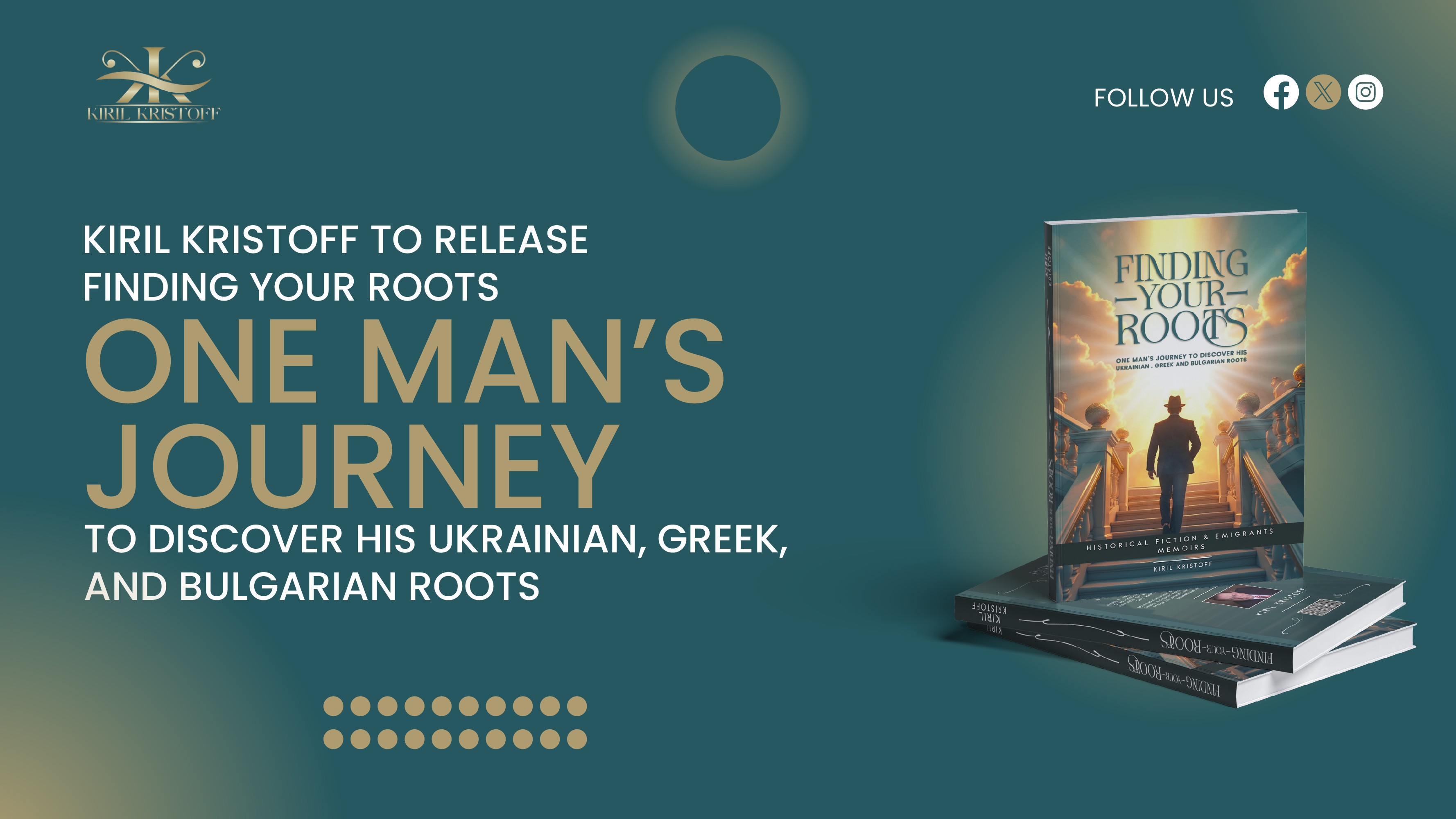
“Finding Your Roots” ‘One Man’s Journey to Discover His Ukrainian, Greek, and Bulgarian Roots’ follows an American man born into privilege who, after a near-fatal car accident, is transported back in time to 19th-century Tsarist Russia as a serf, where he faces the struggles and hardships that his ancestors once endured. What was the inspiration for the setup of your story?
The seed for this story came from a very simple but haunting question: What if we could truly step into the lives of our ancestors and feel what they felt? I’ve always been fascinated by the contrast between where we stand today and what those before us endured to get us here. For many of us, privilege, security, and opportunity are things we take for granted—but just a few generations back, the reality was far harsher.
I chose the device of a car accident and time travel because I wanted the contrast to be immediate and visceral. One moment, the protagonist is surrounded by the comforts of modern America; the next, he’s stripped of everything and forced to survive in a world where human dignity was often denied. It’s not just about history—it’s about empathy. By placing him in the shoes of a serf, I wanted to collapse the distance between past and present, so readers could feel that struggle as if it were their own.
Ultimately, the setup was inspired by my belief that our roots are never as far away as we think. The hardships of our ancestors still echo in us, and sometimes it takes a dramatic shift—whether in life or in literature—to remind us of that truth.
What inspired you to create Alexander Kakhovskiy, and how did you craft his outlook on life and the emotional changes he experiences?
Alexander Kakhovskiy was born into privilege—a spoiled child of the American Dream, raised in excess, never wanting. He was a prince of modern times, arrogant in his entitlement, untouched by struggle. He had it all— money, power, status—but no sense of who he was. Then, in a single night, everything was ripped away, and everything changed for Alex and Jennifer. After being drunk and high at a bar, a life-altering accident strikes him and his girlfriend, by another reckless driver. He falls to the ground, his body crushed beneath the weight of his choices. The next thing he knows—he is not in America anymore. He is no longer the wealthy, carefree boy of the 21st century, his family patron St. George sends them into a coma. Due to Saint George in Heaven, and his Grandpa George’s prayers on Earth, Alex survives, but remains immobilized in a Chicago hospital. But the accident triggers an otherworldly journey that defies time, faith, and even death. Alex and Jenniffer soon find themselves in the 19th-century Tsarist Russia, in the animal barn of his great-great-grandfather in his Kakhovka estate. It’s 1860, during the reign of Emperor Alexander II, the Liberator. There, the rebellious grandson meets his great-great grandfather, Alexander Kakhovskiy ( his namesake), a wealthy nobleman. Alex is not part of Kalhovskiy’s powerful family, but as a mere serf-a peasant bound to the land, a nobody, a slave in a world that does not know his name.
Then Alex begins to understand the true legacy of his ancestors. He is not just Alexander Kakhovskiy, the rich boy from America. He is part of a lineage that stretches across centuries—a bloodline shaped by war, ambition, loyalty, and betrayal. As he walks in the footsteps of his forefathers – Georgiy and Vasiliy Kakhovskiy-he sees the world through their eyes. One brother, Georgiy, stood for honor and tradition, remaining loyal to the empire that defined his people. The other, Vasiliy, was a radical, a Bolshevik, a man consumed by revolution and the birth of the USSR. Their choices shaped history. Their actions changed nations. And now, their story is his.
Now Alex must choose his destiny, whether he prefers the harsh cold of empires or the warm bonds of family. Discover faith, love, and redemption-and a battle between good and evil.
What were some themes that were important for you to explore in this book?
Several themes guided me as I wrote this story, but at the heart of it all was the question of identity—who we are when everything familiar is stripped away. I wanted to explore the fragile balance between privilege and survival, between the comforts of modern life and the raw struggles of those who came before us.
Heritage was another vital theme. By sending my protagonist back into the lives of his ancestors, I wanted to show that our roots are not abstract—they are lived realities that continue to shape us. The sacrifices, suffering, and resilience of those who endured oppression and hardship echo in us whether we acknowledge them or not.
I was also drawn to themes of empathy and transformation. Alexander’s journey is, in many ways, about learning to see the humanity in others and to measure worth not by wealth or status but by dignity, compassion, and endurance.
And finally, I wanted to explore time itself—how the past and present are never fully separate, how stories, memories, and even bloodlines carry forward across generations. By blending history with fiction, I hoped to show that while the settings may change, the human struggles of belonging, loss, and hope remain universal.
Where do you see your characters after the book ends?
For me, the ending of the book is not a closure but an opening. Alexander doesn’t return to his old life as the same man—he carries the imprint of what he has endured, and that awareness changes the way he looks at privilege, family, and responsibility. I imagine him moving through the modern world with a different kind of vision, one that allows him to see both the fragility and the strength of human existence.
The ancestors he encountered—those who shaped him in ways he could never have imagined—remain alive within him. Their voices may not guide his every step, but their lessons form a compass he will never be able to set aside.
In a broader sense, I see the characters continuing to live in the minds of readers. Their journeys don’t belong only to the page—they’re meant to spark reflection on our own roots, our own resilience, and the choices we make in light of those who came before us.
So while the written story ends, their inner lives keep unfolding—quietly, persistently—like heritage itself.

About the Author
Kiril Kristoff is an internationally recognized author whose works combine historical fiction, spirituality, and the immigrant experience. He is the recipient of the Literary Titan Gold Book Award, the International Impact Book Award (Author of the Year 2025) , Fiction & Historical Fiction), and accolades from Indies Today. His contributions to diaspora literature have been featured in The Philadelphia Journal.
📧 Email: kirilkristoff3@gmail.com
🌐 Website: booksbykirillristoff.com
Facebook: https://www.facebook.com/authorkirilkristoff/
Linkedin: https://www.linkedin.com/company/kiril-kristoff
Instagram: https://www.instagram.com/kirilofficial1/
Pinterest: https://www.pinterest.com/kirilkristoff/
Morally Compromised Characters
Street Brotherhood follows a teenage boy in 1970s New York, as his search for loyalty and belonging pulls him into a dangerous brotherhood where survival blurs the line between family and gang. What was the inspiration for the setup of your story?
The story is about building a family of choice when your family of origin has betrayed you. It’s about brotherhood forged in the face of adversity, boys who are thrust into bleak and dangerous situations due to familial and systemic neglect. But it also shows how these kids don’t just endure and accept their fate. They strive to exploit it. Street Brotherhood is the second book in the Street series, picking up where the first book left off, but each of them works perfectly as a standalone.
What drew you to set Johnny’s story in 1970s New York, and how did that time and place shape the characters’ lives?
The city plays a huge role in this book. New York in the 1970s was on the brink of financial collapse. Municipalities were struggling under massive layoffs, landlords were selling–or torching–buildings to get out from the debt, and crime was skyrocketing. Johnny’s story reflects all of that. He is cunning enough to see the cracks in the system and is able to use them to his advantage. The story could not have been told in any other place or decade without being inauthentic because the conditions changed. Many of the scenarios are tied to my own experiences, since I came of age at the same time, hanging out in those same streets.
Johnny is both sympathetic and frustrating. How did you balance writing him as flawed yet compelling?
From a writing perspective, the flawed and morally compromised characters are the most fun for me. I love pushing those boundaries for the reader: How bad can a character act while still commanding sympathy? Johnny is a street-smart gang leader, with lofty aspirations, living in a very adult world. But he’s still a teenager. Sometimes his youth is an asset, but other times it’s a liability. That becomes apparent in some of the choices he makes. His gang can also be loyal to a fault, by letting his decisions play out. Peppering in the scenes from Johnny’s childhood helped me make him more sympathetic, while also explaining some of his defects.
The violence feels necessary rather than gratuitous. How did you approach writing those scenes to maintain authenticity without sensationalism?
Great Question. Violence in movies and on TV is so pervasive we become numb to it. On the page, however, it translates differently. My early drafts were dripping with brutal details, but thanks to my beta readers, I toned a lot of it down. I learned that what’s not said can be even more ominous. In Street Brotherhood, the violence is necessary in order for the story to be realistic. But violence is also action, and too many details will slow down the pacing, so I tried to maintain a balance.
Author Links: GoodReads | Website | Amazon
Johnny becomes involved with Marco, a tempestuous drug supplier who inspires admiration, but also rueful reminiscence of Johnny’s father. His demands challenge Johnny’s morals, but the payout is hard to ignore. As is Johnny’s aptitude for carrying out his lethal tasks.
Amid his nefarious entanglements, Johnny falls for Jessica. She is witty and self-assured, opening him to normalcy and tenderness for the first time. But as his worlds spin ever closer, will he escape the brutality of his past or be forced to embrace it?
Author Interview – Kiril Kristoff – “Crossing Borders of Times”

“Crossing Borders of Times”‘One Man’s Journey to Search ForHis Ukrainian, Greek & Bulgarian Roots’ is a multigenerational saga where a grandfather and grandson unravel their family’s past through letters, dreams, and manuscripts to confront the pull of heritage and belonging. Why was this an important book for you to write?
In two short days on 10/04/2025 I will have Gala dinner & celebration when I will receive my International Impact Book Award 🏆my Oscar of books award, when my third sequel gained recognition in Hollywood, I felt ready to take this step.
I decided to submit my book to the International Impact Book Awards because this award is about more than recognition—it’s about sharing a story that can inspire others. My story begins in Bulgaria, where growing up under communism, it wasn’t easy to express a truth rooted in the Bible that the government didn’t allow. When my wife and I came to America, we carried only two suitcases and $200, but we also carried our faith, our stories, and our dreams.
For many years I looked for a traditional publisher or literary agent, but most doors were closed. Instead of giving up, I chose to self-publish. Today, I have written five books in English and two in Bulgarian, and my third English-language sequel—Crossing Borders of Time—has brought me here to Hollywood and this award.
To me, this recognition is proof that when you have a message and you persevere, the world will eventually hear it. My main message is simple: Never give up on your dream—because freedom and the opportunity to create are the greatest gifts a person can receive.”
This book was important to me because it represents both a personal and universal search for identity. I grew up under communist regime, surrounded by stories of displacement, resilience, and cultural memory, and I always felt that those voices—especially the quieter ones in the family—deserved to be heard across time.
By weaving together the experiences of a grandfather and a grandson, I wanted to show how heritage is not a static thing we inherit once and place on a shelf—it’s a living force that shapes how we see ourselves and the world. The letters, dreams, and manuscripts in the story are not just literary devices; they are metaphors for the ways we all try to reach across generations to make sense of who we are.
Writing Crossing Borders of Times was my way of honoring the struggles and sacrifices of those who came before us, while also asking what it means for the new generation to carry that legacy forward. It’s about belonging, yes, but also about courage—about daring to face painful truths and still finding the strength to carry them with love.
Your book blends memoir, novel, and meditation. How did you decide on this hybrid form to tell such a personal yet universal story?
From the very beginning, I felt that one single form wasn’t enough to contain the scope of this story. A traditional memoir would have kept me tethered to my own perspective, while a straight novel might have distanced me too much from the lived experiences that inspired it. What I wanted was a way to honor memory, imagination, and reflection all at once.
The memoir elements anchor the book in lived truth—those emotional landscapes that come only from direct experience. The novelistic passages allowed me to reimagine events, to step into the lives of ancestors and give voice to silences in the record. And the meditative sections provided the breathing space I needed to explore broader questions of time, belonging, and heritage, beyond just my own family’s story.
This hybrid form felt the most honest, because identity itself is layered—we live between fact and memory, between what happened and what it meant, between the past and the present moment. Blending these genres gave me the freedom to capture that complexity and, I hope, to offer readers not just a family story, but an invitation to reflect on their own.
George’s struggles with immigration and identity feel vivid and raw. Were these drawn directly from family experiences, or did you reshape them into fiction?
George is both personal and imagined. His struggles are deeply rooted in the real stories I grew up hearing—of leaving behind everything familiar, of carrying one’s culture across oceans, of learning to survive in places that were not always welcoming. Those accounts, especially from my family and community, gave me the emotional foundation for his journey.
At the same time, I didn’t want George to be a replica of any one individual. Instead, I reshaped those lived experiences into a character who could embody the universal immigrant condition—the constant negotiation between holding on and letting go, between remembering and reinventing. By fictionalizing parts of his story, I was able to protect the privacy of real people while also deepening the emotional truth.
So George is a mosaic. He carries the voices of my grandparents, the resilience of countless immigrants I’ve known, and the imaginative flourishes that allowed me to explore what isn’t always spoken aloud. In many ways, he became the vessel through which I could tell not just my family’s story, but the story of anyone who has ever felt torn between two worlds.
Alex’s search sometimes feels overshadowed by the past. Do you see this as a generational struggle we all face when trying to honor our roots while forging our own paths?
Yes, absolutely. I think every generation inherits both gifts and burdens. For Alex, the weight of history is so present—it arrives through letters, dreams, and stories that refuse to stay silent. That can feel overwhelming, almost as if the past is dictating the present. But that tension is real, and it’s one that many of us live with: how do we honor those who came before without losing ourselves in their shadows?
I believe it’s a universal struggle, especially in families marked by displacement or upheaval. Roots give us strength, but they can also feel like anchors. Alex’s journey is about learning to carry that inheritance without being consumed by it—understanding that honoring the past doesn’t mean repeating it, but rather finding ways to transform it into something new.
In that sense, his story mirrors what so many young people experience today: a longing for authenticity while still forging a future that belongs to them alone. The balance is delicate, but I see it as one of the most vital parts of identity—turning memory into possibility.
About the Author
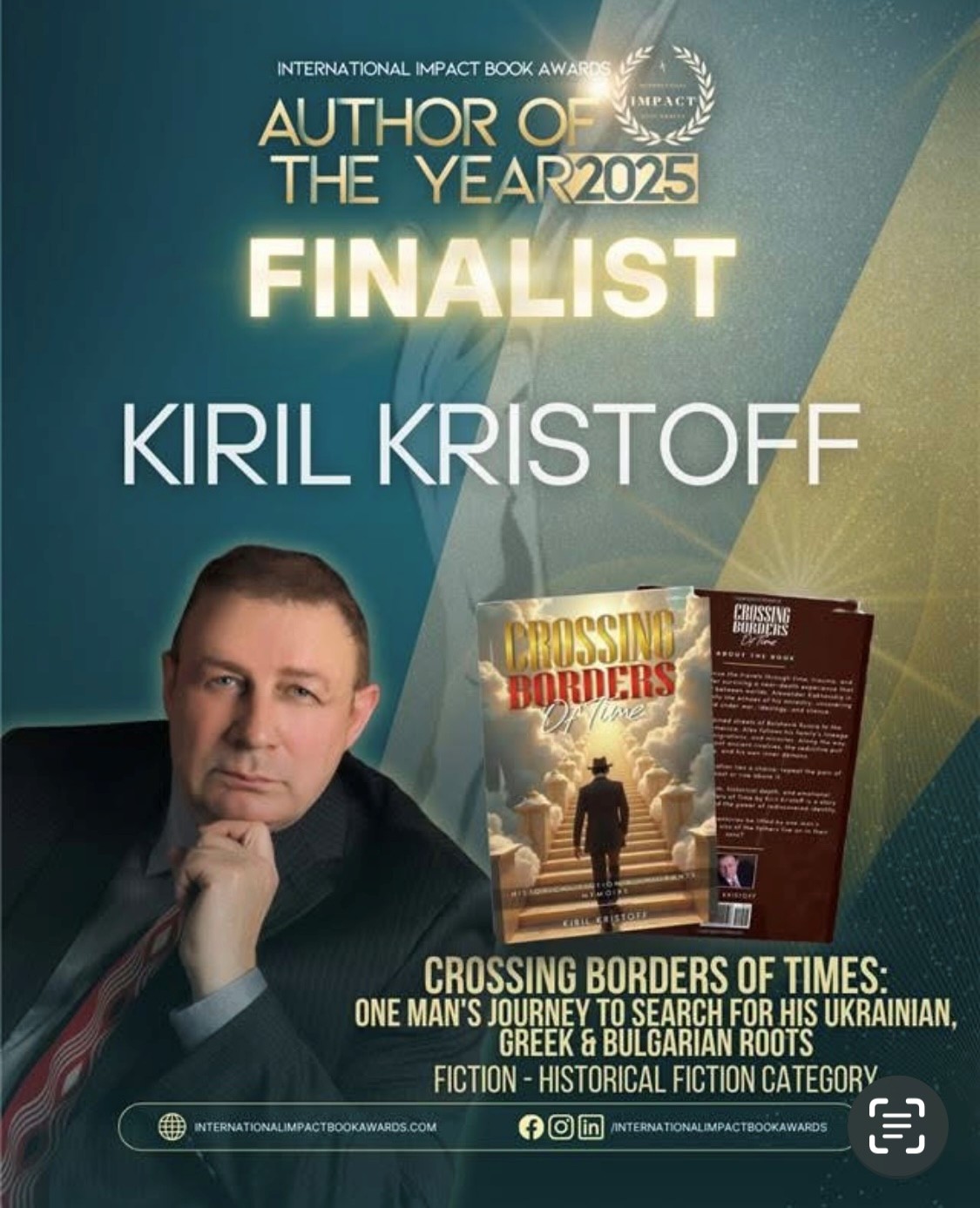
Kiril Kristoff is an internationally recognized author whose works blend historical fiction, spirituality, and the immigrant experience. He is the recipient of the Literary Titan Gold Book Award, the International Impact Book Award (Author of the Year, Fiction and Historical Fiction), and honors from the Indies Today Awards. His writing has been featured in The Philadelphia Journal for its contributions to immigrant literature in diaspora.
📧 Email: kirilkristoff3@gmail.com
🌐 Website: booksbykirillristoff.com
📌 Facebook | Instagram | LinkedIn | Goodreads
Author Links
Facebook: https://www.facebook.com/authorkirilkristoff/
Linkedin: https://www.linkedin.com/company/kiril-kristoff
Instagram: https://www.instagram.com/kirilofficial1/
Pinterest: https://www.pinterest.com/kirilkristoff/
Time to Tell Her Story

Beyond the Sky, written in two parts, follows a young woman through her college years and her involvement in the civil rights, and traces her ancestry from immigration from Ireland to the mountains of Hidden Valley. What was the inspiration for the setup of your story?
When Tillie first showed up in Hidden Valley in my debut novel, New Tomorrows, I knew she would be the one whose mysterious background would take her away from the valley to be involved in the activism of the Civil Rights Movement of the 1960s. My intent as a writer is to create engaging stories that readers can not only enjoy but also be drawn in to explore real, contemporary issues with characters they can relate to. I identified the racial tension our country has faced and dealt with, in one form or another, throughout our history, as one of several important issues I wanted to help my readers explore. I myself enjoy stories that have a touch of romance, but not in the traditional way romance is presented in many books in that genre. I see romance as just one aspect of human connections, and I wanted my stories to be about connections, especially in families and communities.
When I first imagined Tillie, we were witnessing legislative and societal changes influenced by my generation begin to erode or disappear. As a writer, I feel a responsibility to speak about the past to shine light on the present. It was time to tell her story.
I was deeply involved in the Civil Rights Movement myself in the 1960s. I decided to bring Tillie to the same University I attended, letting her arrive as a freshman the year I was a senior. Her story is not at all biographical, but I was able to write about a time period and events that I personally experienced. While the events are real, both those that are part of our well-known (and some not so well-known) history or the local events in Pittsburg, the characters all spring from my imagination.
What is it that interests you most about historical fiction?
Let me first share my perspective on fiction vs. non-fiction. I like to define fiction as learning through imagination, whereas non-fiction is learning through facts. Reading fiction gives us an opportunity to spend time in a life quite different from our own. I believe folks can often learn more history through fact driven, engaging fiction than they might from a history book. When that happens to us, we often come away with a new understanding or a wider perspective of what life is like living in another person’s skin, both figuratively and realistically. My hope with all my books is that readers might gain increased awareness, understanding, and empathy for the marginalized in our society who struggle daily for justice, inclusion, and dignity.
I have always been a bit of a history buff; my college degree is in Creative Writing, but my minor was history. If I am going to write about human connections, part of who we are is defined by where we can from – the ancestors of yesterday who built the foundation for who we are today. That was especially true for Tillie. Her story was not complete without the stories of the strong woman who came before her and the choices they made, along with the men who loved them.
How did you go about finding your characters’ voices while planning your writing?
First, let me say a word about my writing process. Some folks divide writers into two groups – the plotters, or the seat-of-the-pants writers. I’m a combination of both, but my plotting is very sketchy with only major plot turns in my mind. It’s no more a brief list, rather than a plot outline. My writing is very character driven and sometimes even those major plot turns change as I become more immersed in the life of a character. As I wrote and got to know my characters on a deep personal level, they often sent me off on an unexpected side trip. One such side trip was quite literal when Percy told me to take him back to Quebec because he had to talk to his grandmother and get the pearl ring she had promised him. I didn’t even realize the ring had a pearl instead of a diamond until Percy first heard Taynay’s song about the moon.
One of the greatest joys of writing Tillie’s story was getting to know the six generations of mountain women who came before her. I imagined these women, along with their families, making choices that were often difficult. Choices that went beyond the traditional thinking of their time period. Each one was different, so they spoke and acted in their own unique way.
My original intent was to reference their journals with quotes as Tillie was reading and learning more about her generations of grandmothers. As their situations and choices came to light, and as their words began to paint a picture of the challenges of her time period, I realized I could not merely include snippets of their lives. These women deserved to have their whole stories told, thus I created the entire second half of the book to include their entire first-person narratives.
Where will the next book in the Hidden Valley series take readers? When will it be available?
The next book is already in progress, but I have as usual, been doing a bit of research into its topic and only have a few opening chapters written. The title is One More New Chance: A Vet Tech Romantic Suspense. The male protagonist is Brink, but I won’t reveal the name of the female protagonist because it would be a spoiler. I will drop a brief hint that she is a character readers have met in a prior book, however briefly. Brink is struggling with two issues – his dedication to tracking down the criminal rings that are staging the dog fights in various remote hollers in the valley and his own personal identity conflict due to bullying he has experienced as a result of his bi-racial background. It will be out in 2026, but I do not have a firm date right now. In truth, it has briefly been placed on the back burner while I’ve been doing some minor revisions and reformatting of my first book in the series, New Tomorrows. That slightly revised book will be live soon, to coordinate with October being National Domestic Violence Awareness Month.
Author Links: GoodReads | Facebook | Website | Amazon
The passion of activism flourished on college campuses in the tumultuous sixties, and Tillie embraced it as a freshman at the University of Pittsburgh. Descended from Irish immigrants known in their Appalachian community as Granny Women – the healers – her compassionate nature drew her into the Civil Rights Movement. She could never have predicted how dramatically her life would change. When family journals reveal shocking news about her history and lineage, she’s forced to re-define her path to the future.
Which road will she choose?
After navigating new horizons, she may have to look for answers that lie Beyond the Sky.
Join readers on a thought-provoking journey through the divisions of the Civil War into the ardor of an era when our country’s youth led the way to a better national consciousness.
Empowered Readers

The Art of Thinking Critically with Clarity for Optimal Health: Your Longevity is Determined by How You Think! is a guide that addresses the challenges faced by patients and healthcare providers daily, emphasizing the importance of critical thinking in healthcare decisions. What inspired you to write this informative book?
I find too many of my patients are not advocates for their own care, and I wanted to provide a framework and structure so they can be better advocates for themselves.
What were some ideas that were important for you to share in this book?
The concept of metacognition and how it can be applied to everyday life to improve our health decisions and provide improved healthspan.
What is a common misconception you feel people have about their ability to be actively involved in their treatment plans?
Many people don’t see the importance of being their own advocate in a broken and fractured health care system.
What is one thing that people point out after reading your book that surprises you?
Many readers let me know how the book has empowered readers to approach health challenges with confidence, clarity, and a structured mindset. This lets me know the mission of the book was accomplished!
Author Links: X (Twitter) | Facebook | Website

I Shared A True Story

A Line in the Sand is the intimate yet unflinching story of a young woman in rural Bangladesh whose resourcefulness and hope are tested against poverty, political unrest, and the crushing weight of microfinance debt. What drew you to focus on the intersection of microfinance, poverty, and women’s resilience?
I shared a true story in the book. Nilima Rani Das (real name), a housewife from a poor-class family, had taken a loan of about $150 from Grameen Bank. She had paid back forty installments; only six were left when she fell into financial hardship and was unable to pay her 41st installment. The bank officials relentlessly harassed Nilima, and out of desperation, she committed suicide. The Grameen Bank and its founder, Dr. Muhammad Yunus, claim that he changed the fate of people with low incomes worldwide through the Grameen Bank, a narrative that was sold to the West as a false representation. Nilima’s story is not unique; there are many documented cases where women such as Nilima have taken loans from Grameen Bank and have lost everything, and have committed suicide, literally for a few dollars. I thought it was high time someone told their story.
The book’s raw language gives it a lived-in authenticity. Was this a deliberate stylistic choice or something that emerged naturally in the writing?
Yes, part one of the book, which tells Nilima’s story, has a raw, heart-wrenching emotion that is quite different from part two, which is her daughter’s story. Yes, the choice of language was deliberate to convey the depth of agony that the victims of Grameen Bank loans continue to endure.
What do you hope readers will carry with them after reading your book, especially those far removed from Nilima’s world?
My sincere hope is that readers will see the real picture that this so-called ‘poor people’s bank’ hides. That readers stop putting the proponent of this business model on a pedestal and see the real Man who chose to make himself super-rich at the cost of the super-poor. He destroyed so many people’s lives, the very people whom he promised to help. The Bangladesh government had prosecuted Mohammad Yunus, fined him for tax evasion, and sentenced him to jail. He orchestrated a coup, seized political power, and liaised with the corrupt Bangladesh Army. Upon seizing power, his first action was to reverse the court decision by removing the Supreme Court judges and replacing them with his handpicked appointees.
The scenes of village life are rendered with such sensory detail. Were these drawn from personal observation, research, or lived experience?
Actually, all three. I grew up in the Indian subcontinent, so I drew heavily on my childhood experiences. I researched the topography of the geographical area surrounding Nilima’s village to provide an accurate description of her surroundings.
Author Links: GoodReads | X | Facebook | Website
Resilience

Resilient follows a young woman hardened by growing up in the foster system who develops an attraction to not only her boss and VP of a motorcycle club, but his cousin as well, leading her on a journey of self-discovery. What was the inspiration for the setup of your story?
Resilient started as a small idea planted in my mind. My main goal was to create a strong female protagonist who embodied the admirable trait of resilience. My initial visions often took unexpected turns, but in the end, I hope I conveyed the message of resilience to the readers.
Your story features some unique and interesting characters who have their flaws but are still likable. How do you go about creating characters for your story?
Some of the characters are based on my own life and those of those close to me. While I incorporate elements of embellishment and fiction to heighten the excitement and intrigue for the audience, the essence of the characters remains grounded in genuine authenticity.
What were some themes that were important for you to explore in this book?
The title says it all: resilience is a topic that requires more discussion. Charly’s story emphasizes the importance of dealing with trauma and the ability to persevere despite the hardships she endured. Additionally, the support of friends and family played a significant role in how she navigated the obstacles placed in her path.
What will the next book in that series be about, and when will it be published?
The next book, Courageous, delves into the lives of three characters: Clark, Gun, and Vin. Their story explores the complexities of mental health, a topic familiar to many individuals. Through their experiences, I aim to shed light on the importance of understanding mental health and the various ways people cope with it. I’m genuinely excited to share their journey and the lessons they learn. Courageous was published in April 2025.
Author Links: GoodReads | Website
After a harrowing attack one night, Charly and her friend Jess seek refuge within the MC’s protective walls. At the clubhouse, she encounters Dominic’s charismatic cousin, Jax, and the air crackles with an undeniable spark.
When the men reveal their interest in her, Charly’s insecurities emerge. Soon, jealousies erupt from her coworkers, including Jess, prompting Charly to set aside her fears. She begins a journey of pleasure and self-discovery with Dom and Jax.
Unfortunately, their relationship is fraught with resentment, betrayal, and sabotage. And when her life is threatened, Charly’s only option is to escape.
Bonding Across Generations

Caleb’s Adventures with Granddad follows a boy and his grandfather who share a bond built on imagination and play, as they find a way to keep their adventures alive as they grow older. What was the inspiration for your story?
The inspiration comes from my grandchildren, especially Caleb. I’ve written stories that included one or more of them as main characters. For this story, Caleb and I talked about our relationship while on a trip we took together. He is very close to me and comes to me when he needs advice or just talk about life. As a result of our closeness, we reminisced about the times he spent with me growing up. This included making up adventures in the backyard (although perhaps not as elaborate as the ones in the book).
I loved the bond that Caleb shared with his grandfather, showing that just because we get older doesn’t mean we have to grow apart and forget the things we love. What were some ideas that were important for you to share in this book?
I wanted to convey the importance a grandparent’s role in grandchildren’s lives because not many people really see that importance today, let alone explore the love between the generations. The dynamics of the nuclear family has changed so much since I was a boy when we spent time with the older relatives. It is sad because young people don’t have that strong connection like we did.
What scene in the book did you have the most fun writing?
The scenes that show the different imaginative adventures Granddad provides for Caleb. It shows the love between the two. Also, the end with how Caleb reciprocates with a BIG surprise for his Granddad.
Is this the first book in the series? If so, when is the next book coming out and what can your fans expect in the next story?
This isn’t a book for a series, but with that said, I do have an idea for a story tentatively called “Granddad’s Treasures” that will include Caleb, his siblings, and his cousins. But this one will be completed within the next few years. My next book that’s coming out this fall is called “Kyle and His Pal Jake – What a Duo these Two Make!” Also, I currently have a story that’s in the editing stage. It’s called “Can We Get A Giraffe?”
Author Links: GoodReads | X | Facebook
Filled with vivid illustrations and a heartwarming story for readers of all ages, Caleb’s Adventures with Granddad reminds us that no one is ever too old to go on another adventure!



 LITERARY TITAN