Blog Archives
Butterfly Effects of Globalization

MERRY-GO-ROUND BROKE DOWN features nine connected stories that lead back to a high-stakes hostage crisis in a Manhattan hotel in 2008. Where did the idea for this novel come from?
We borrowed the structure from Arthur Schnitzler’s 1897 play La Ronde. In that play, the characters are connected through a chain of sexual relationships. In our book, the characters are connected through money.
Merry-Go-Round Broke Down explores the butterfly effects of globalization. The hostage crisis that brings the story together reflects both the darker side of globalization and its unintended consequences: in a tightly interconnected world, the same forces that create winners can also create losers.
What is it that draws you to the thriller genre?
We wanted to write a serious book that could also reach a wide audience. We thought the thriller genre—with its suspense and fast pace—would be the right vehicle for telling a complex story and the best way to bring the story of globalization to life.
Do you have a favorite scene in this thriller? One that was especially fun to craft?
My co-author and I have different favorites. Hers is the third chapter, about Simon, a British proprietary trader. Mine is the eighth chapter, about Arkady, the son of a Russian oligarch. Both stories are fast-paced and dramatic, with surprising endings.
What is the next book you are working on, and when will it be available?
We are working on a few different projects, but no timetable yet.
Author Links: GoodReads | Amazon
Fall 2008. The Waldorf Astoria New York. Two armed men storm the hotel’s famed bar and hold the occupants hostage: an American corporate raider, a Chinese tycoon, a British hedge fund manager, a Japanese housewife-turned-celebrity, a Mexican undocumented worker, a Wall Street bond salesman, and a Norwegian environmentalist.
Who are these terrorists? What do they want? And what ties them to their captives?
Merry-Go-Round Broke Down is a genre-breaking novel that explores globalization’s “butterfly effect”: how choices made in one corner of the world ignited an unstoppable chain of consequences that upended lives across continents.
Choices Impose Responsibility

Drinking From the Stream follows two young men in 1971 who are on the run and attempting to escape their pasts by traveling to East Africa, where their personal reckonings unfold alongside violence. What was the inspiration for the setup of your story?
Sometimes great events touch us deeply.
In June 1972, when I was twenty-two years old and hitchhiking across Africa, I was sitting in a student cafeteria at the University of Luanda reading the International Herald Tribune. Angola was then a Portuguese colony, but armed African guerrillas in the countryside were fighting to overthrow white-minority rule. I had been hosted at the Zaire border by conscripted Portuguese soldiers who had seen combat with MPLA guerrillas. An article caught my eye that morning about ethnic killings in Burundi. I had been within fifty miles of Burundi, having hitchhiked from Ethiopia through Kenya, Uganda, and Rwanda, then to Zaire (Congo) and Angola. The article described a bloody uprising in late April 1972, where Hutu rebels had used pangas — machetes — to kill hundreds of unsuspecting Tutsi citizens with the idea of sparking a civil war to end Tutsi rule. Even more shocking were the slaughters by the Burundi army that followed. It turned out that unemployed Hutu school teachers — unable to find a job in Tutsi-ruled Burundi — had led the revolt. Burundi’s solution to the unemployment problem was to kill all the educated Hutus they could find. The Tutsi-led army countered the Hutu death squads with a much bigger, much better-organized ethnic bloodletting of their own, killing any Hutu who had completed the fourth grade. Tens of thousands were already dead, the report said, and the killings were gathering momentum with no end in sight. By 1973, well over 200,000 Hutus had been murdered.
This made a deep impression on me. How could so many people be murdered so quickly? More importantly, why was the world ignoring it? And why and how did it come about? What if I had decided, as was entirely possible, to visit Burundi myself? And if I had, I would have been on the spot when the killings broke out. What then? The entire African continent seemed to be on a bloody run. A year or two back, peace had been restored to Zaire, formerly the Democratic Republic of the Congo, after ten years of mayhem and revolt. Mass ethnic killings were in full swing in 1972 in Uganda, when I was there, led by the Ugandan army under Idi Amin. Rwanda had seen bloody spasms of anti-Tutsi violence even before independence in the early 1960s. And all of southern Africa, not just Angola, was in revolt against white minority rule. The 1994 Tutsi holocaust in Rwanda was still twenty-two years away.
This is a coming-of-age novel, but a harsh one. What does “growing up” mean here?
I spent three years in Africa when I was quite young. I worked construction jobs in the bush and at line camps, I bumped into white supremacists. Basically, they were American nazis. I kept my distance even though they sometimes tried to recruit me. They spoke openly of violence against Jews and Blacks. Listening to them made me extremely angry. They had no idea I was Jewish. But what would happen if I weren’t Jewish and one of them thought I was? That was the inspiration for Jake Ries.
The characters discover that their choices impose responsibility that must be faced and borne; there’s no magic that will make it disappear, and its weight increases over time. Knowledge imposes its own burden. And it doesn’t matter if they never wished to make those choices or learn those things in the first place. Maybe they never asked for them, but they still can’t put them down.
What scenes were hardest to write—not technically, but ethically?
This may sound funny, given the extent of political chicanery in the plot, but the parts of the book that gave me the most trouble were working out Karl’s relationships with his girlfriends, first Helen, then Swee’Pea. Karl might have been conflicted about both those relationships, particularly in combination, but I wanted to present them as believable dilemmas not only for Karl, but for both women, while trying to be fair to all three.
What lessons from the 1970s feel disturbingly contemporary?
What I see today is that resentments never cease, that humanity is easily misled and memories are short; that peace is fragile, something not to be taken for granted; that politicians can seduce thousands, or millions, to contemplate unspeakable acts; that the great issues of the past, which we thought were finally settled, are never really settled; and that active individuals following the ancient moral codes or their own personal compass to judge right from wrong can do a great deal of good.
Author Links: GoodReads | Website | Amazon
Jake Ries, a twenty-two-year-old Nebraska farm boy turned oil roughneck, turns fugitive when he unintentionally kills a homicidal White supremacist on an oil platform in the Gulf of Mexico. On the run, he meets Karl Appel, a restless Oxford dropout and former anti-war activist struggling with his own personal demons. Together they throw caution to the wind and plunge into the Ethiopian and East African hinterland, where they discover that dictatorship and mass murder are facts of life.
Drinking from the Stream


Drinking from the Stream follows two young Americans, Jake and Karl, whose chance meeting turns into a long, hazardous journey across East Africa in the early 1970s. What begins as flight, Jake from a violent past in Louisiana, Karl from ideological and emotional dead ends in the United States, becomes immersion. As they move through Ethiopia, Uganda, Rwanda, Burundi, and beyond, their personal reckonings unfold alongside coups, ethnic violence, and the aftershocks of colonial rule. The novel braids coming-of-age restlessness with political catastrophe, asking what it means to stay human, or decent, when history is on fire around you.
I read this book with a mounting sense of unease, and I mean that as praise. Sacks doesn’t offer Africa as backdrop or metaphor; he insists on its specificity. Roads that punish the body, bureaucracies that toy with fate, conversations that slide from flirtation to terror without warning. Jake’s voice, in particular, is sharp-edged and morally alert, a man who knows he has crossed an invisible line and can’t uncross it. The novel’s early scenes on the oil rig, heavy with menace and casual hatred, establish a moral pressure that never really lifts, even when the landscape opens into beauty. I felt myself reading faster, not because the prose rushed me, but because it refused to soften what it saw.
What stayed with me most were the arguments about race, revolution, guilt, and responsibility that erupt in buses, bars, and borrowed rooms. These exchanges feel earned rather than staged, the product of young people who are smart, frightened, idealistic, and often wrong. The author has little patience for slogans, whether they come from Western radicals or newly empowered strongmen, and that skepticism gives the book its bite. Sometimes the historical density is demanding, but it mirrors the characters’ own overwhelm; ignorance here has consequences, sometimes lethal. By the end, I felt the weight of the knowledge the characters carry, knowledge they never asked for and can’t put down.
This book will most reward readers of historical fiction, literary adventure, and political coming-of-age novels, especially those drawn to morally complex travel narratives. If you admire the restless intelligence of The Sheltering Sky or the political consciousness of A Bend in the River, Drinking from the Stream belongs on your shelf. It’s a novel for readers who don’t want reassurance so much as reckoning. This is not a story about finding yourself abroad; it’s about discovering how much of the world you can carry back, and what it costs to do so.
Pages: 377 | ASIN : B0DXLQTN5M

Drinking from the Stream

Drinking from the Stream follows two young men on the run from themselves. Jake, a Nebraska kid turned Louisiana roughneck, flees the guilt of a killing on an oil rig. Karl, a disillusioned American student at Oxford, escapes the wreckage of the sixties and a painful relationship. Their paths cross, and they drift through Ethiopia, Uganda, Rwanda, Burundi and Tanzania in the early seventies, bumping into coups, massacres and love affairs as they go. The book stretches from the Gulf of Mexico to the Great Lakes region of Africa and on to Chile, and it ties private coming-of-age stories to state violence and postcolonial chaos.
I felt like the writing landed with real weight. The prose has muscle and rhythm, and it keeps a steady pace through long stretches of travel and talk. Scenes on the road, in trucks, on ferries, and in cheap guesthouses felt vivid to me. Dialogues carry a lot of the load. Characters argue about politics, race, faith, and guilt, and the conversations feel relaxed on the surface but tense underneath. I could sense the author’s years in Africa in the way a village lane or a border crossing appears in a few sharp strokes. The flip side is density. Historical detail piles up. I stayed invested in Jake and Karl, and in Beatrice, Bridget and the others, because the book lets them be flawed, funny and sometimes selfish, not just mouthpieces for a lesson.
The novel looks at racism and antisemitism inside Jake’s own story, then places him in countries where mass killing happens out in the open and on a terrifying scale. It plays with the dream of revolution and tears it apart. Young Westerners arrive full of ideals, then watch soldiers and militias burn those ideals along with villages. The book keeps asking who gets to walk away and who does not. Jake carries private guilt from the rig into places where guilt comes in rivers. Karl drags his Vietnam-era anger into a world where America is almost irrelevant. I felt anger, shame, and sadness while I read, and also a stubborn hope, because the story keeps circling back to friendship, loyalty, and small acts of courage. The novel does not pretend to solve anything. It simply puts you close to the fire and forces you to look.
I would recommend Drinking from the Stream to readers who enjoy historical fiction with grit, to people curious about East Africa in the early seventies, and to anyone who likes character-driven travel stories with real moral stakes. The book asks for patience and a strong stomach. It pays that back with a rich sense of place, big emotions, and a set of memorable characters.
Pages: 377 | ASIN : B0DXLQTN5M
The Communist Question
Jeanne The Woman in Red is a work of biographical fiction based on the life of Jeanne Tunica Y Casas, a fiery, uncompromising political activist, feminist, communist, and a woman of courage. What was the inspiration for the setup of your story?
If I had written a non-fiction account of Jeanne’s life and work, it would have sounded robotic and lacking in truth. Fiction was the only way to delve deep into her life and times. Many people she knew and worked with had passed away or were reluctant to speak or give any information. I understand and respect that, but facts, figures, and exact dates would have been missing. There is not much out there in English, and the work done, predominantly by a New Caledonian historian, provided a solid foundation from which to write. I had access to her articles, tracts, and speeches, and I was able to integrate this into the story as they had been written—typos and all.
I have always been inspired by strong characters in fiction and non-fiction. I was drawn to Jeanne straightaway. I had just arrived in New Caledonia for three years, and I was browsing its history, and I came across Jeanne. I wanted to visit her at the cemetery, pay my respects, but I discovered she had been buried in a common grave. I could not believe it. Disheartened but determined, I contacted the administration and decided that writing the book is only half of it. I wanted her recognised with a plaque. She fought for the rights of exploited peoples, and I wanted to fight for her legacy. Her remains were located, and a plaque now recognises her at a local cemetery. It has been a hard but satisfying journey.
What were some ideas that were important for you to share in this book?
Her relationship with her lover turned husband, Paco. The communist question. How much or how little did she know about Stalin’s atrocities? The right of women to vote. I wanted back-and-forth chapters where her life in the nursing home meets the past.
Did you find anything in your research of this story that surprised you?
I was surprised that she had lived in Australia for a while and opened up a restaurant in Sydney. Her continual battle with the authorities. She never gave up. I was also disappointed with a few reactions as if writing about a communist makes the writer a communist. This is not the case, and I could never have placed 2020 eyes on Jeanne’s life and get away with writing her story.
What is one thing that you hope readers take away from Jeanne The Woman in Red?
That she, like many others, must be remembered for inspiring and encouraging change without violence, and that history, far from being cancelled, should be remembered and studied – the good and the bad and learn the lessons on how to move forward. I am not just talking about feminists and politicians, but people who did not have a public role but were instrumental in shaping future generations.
The book has been translated into French and will soon be released.
Author Links: GoodReads | Amazon
Jeanne The Woman In Red

Jeanne The Woman in Red is a literary historical novel that follows the life of Jeanne Tunica Y Casas, a fiery, uncompromising political activist whose story unfolds across New Caledonia, the New Hebrides, France, and beyond. The book moves between her final years in a nursing home in the late 1960s and vivid recollections of her political battles, her marriage to Paco, and the people and places she loved. It’s a portrait of a woman who refuses to soften or apologize, even as age and loss begin to close in around her.
This book feels intimate. As if Jeanne were sitting across from me, telling stories that run on nerves and conviction rather than nostalgia. The writing has a rawness I didn’t expect. Scenes of the nursing home feel almost claustrophobic with their vinyl chairs, faint smells, and the slow drip of Jeanne’s frustration. Then the narrative swings wide open into her past, where she teaches children under mango trees, writes furious letters, argues politics with anyone brave enough, and paints scenes that reveal more about her spirit than any speech could. The author’s choice to weave Jeanne’s inner voice with historical detail gives the story both grit and tenderness. It is a quiet kind of political novel, but political all the same, carried by the force of one woman who refuses to be small.
What struck me most was how unapologetically the book stays with Jeanne’s contradictions. She is compassionate one moment and sharp enough to cut the next. She is grieving but stubborn. She is certain of her beliefs, sometimes to the point of alienating those who might have helped her. And yet the book never asks me to judge her. It just lets her be. Some passages read like memories folded in warm light, while others hit like sudden blows. The sensory details work best when they’re simple: a wooden floorboard Paco never fixed, a pot of chrysanthemums at a grave, the sound of children giggling through a vocabulary lesson. The author trusts these small images to carry weight, and they do.
This isn’t a sweeping epic or a fast-moving plot. It’s more like sitting with someone who has lived too intensely to fade gently. The genre sits somewhere between literary fiction and biographical historical fiction, and it will appeal most to readers who like character-driven stories, real history woven with imagination, and portraits of complicated women who challenge the world rather than charm it.
Pages: 213 | ASIN : B08CPNPNDV

Parental Love and Support

Orphans of the Living tells the story of a family’s complicated history spanning from 1920s Mississippi through decades of poverty and social change. What inspired you to write this novel?
The novel is based on my mother’s own family, of which I knew little. But things in the past have a habit of invading us today, and the more I researched, the more I realized my mother’s lived experiences influenced my life, and my children’s lives, in ways I had not understood. Yes, this is a novel, but the skeleton, the bones of the story, are real. It is a hell of a story, and I wanted to dig deeper into it.
Can you share with us a little about the research that went into putting this book together?
I really had three sources. Here’s how they came into play, for instance, in my grandfather’s sojourn in Mexico. I had the bits and pieces my mother gave to me in her life, between bouts of addiction and mental illness, such as “My father went to Mexico to grow bananas.” I explored the vast trove of information and connection at Ancestry.com and Newspapers.com, such as records of my grandfather’s trip to San Francisco, where he took a steamer to Mexico, and a manifest for a ship that brought him and his bananas to Galveston. And the third piece was how I followed what I learned from Ancestry.com and Newspapers.com. For example, I spent a lot of time learning how bananas were grown and raised in the tropics, and how United Fruit, then one of the largest corporations in the world — owned by men from the American South — employed Jim Crow tactics to control their labor force in Central and South America. Weaving all these sources together was an act of imagination and conjecture, and that’s why it’s a novel, not non-fiction.
What were some themes that were important for you to explore in this book?
So much about this era, and these people felt so current to me: the multi-generational impact of poverty, racism, inequality, sexism; the experiences of people who were at the margins, lacking education, perhaps confused about their gender or sexual orientation, long before there was any general knowledge of these issues; the impact of Western expansion and “manifest destiny” on how average Americans in the west thought about land and success; the importance of parental love and support.
What is the next book that you are working on, and when will it be available?
I have completed a memoir that is in many ways a sequel to Orphans of the Living. She Writes Press will publish it in spring 2027. And I’m way deep into writing a third book, another novel, a near-future political thriller.
Author Links: GoodReads | Threads | Instagram | Facebook | Website | Amazon
In the shadow of the Great Depression and Jim Crow south of the 1930s, an impoverished white family escapes—with the help of Black sharecroppers—from a vengeful Mississippi plantation overseer intent on lynching them. Arriving in California to start a new life, Barney and Lula Stovall are haunted by the past, the children they’ve left behind, and the daughter they cannot love or protect.
Orphans of the Living follows the peripatetic life of the Stovall family, woven from four parallel stories: Barney and Lula Stovall, and two of their nine children, Glen and Nora Mae.
Their California sojourn—from their hardscrabble dairy farm, to the brig at the San Francisco Presidio, to the building of the Golden Gate Bridge—lead them on paths toward each other and forgiveness. But redemption doesn’t come to them all.
Orphans of the Living: A Novel
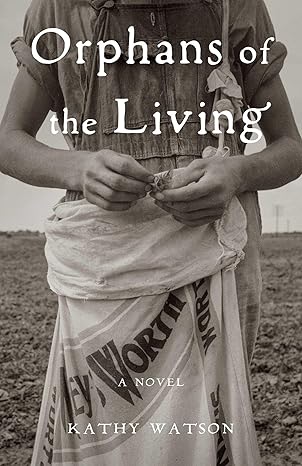
Orphans of the Living is a novel steeped in generational trauma, racial violence, and the slow unraveling of the American dream. Kathy Watson tells the story of Lula Stovall and her tangled family history, spanning from a Mississippi plantation in the 1920s through decades of poverty, migration, and social change. Lula, a white sharecropper’s wife, becomes both victim and agent in a life defined by loss and desperation. The novel, inspired by Watson’s own family, shifts between perspectives and decades, revealing how choices, often forced, sometimes chosen, echo through generations. It is part historical fiction, part personal reckoning, layered with the grit of real events and imagined truths.
Watson’s writing hits like a storm. The language is raw, unvarnished, and aching with honesty. The prose feels lived-in, like the old quilts and wood stoves that fill her characters’ homes. The pain is immediate and unrelenting. Lula’s desperate act with a piece of fencing wire early in the book stunned me. Not just because of what happened, but because of how real it felt. Watson doesn’t write for comfort. She writes to bear witness. There were moments when I had to put the book down and walk away, not because I didn’t want to keep going, but because it hurt too much to stay in the scene. That kind of writing is rare.
But it’s not just the writing that stuck with me. It’s the ambition of the book. Watson dives deep into race, class, history, and motherhood, often all at once. She gives space to the Black characters in Lula’s orbit, making sure they aren’t just there to prop up a white story. Violet Byrd, especially, is a force. Her presence radiates power and calm in a world built to crush her. The author makes the brave decision to include racist language and brutal events for historical accuracy. Nothing in this book is simple. No character is purely good or purely bad. Everyone is just trying to survive.
Orphans of the Living is not just a story about one woman’s brutal life. It’s about inheritance. What we’re given, what we pass on, and what we bury. I respected the story deeply. It’s a hard, unblinking book that left me gutted, moved, and wide awake. I’d recommend this book to readers who aren’t afraid of discomfort. If you’re drawn to stories like Jesmyn Ward’s Salvage the Bones or Toni Morrison’s The Bluest Eye, this will resonate. It’s a hard read, emotionally, but one worth sticking with. Anyone interested in Southern history, generational trauma, or the quiet violence of poverty should read this.
Pages: 352 | ISBN : 978-1647429782


