Blog Archives
A Love Letter

Ancilla centers around a bisexual woman in the 80s and 90s in Ohio as she finds herself unraveling her own Catholic upbringing when she enters into a relationship with a magus who becomes her mentor, dom, and soulmate. What was the inspiration for the setup of your story?
I took my inspiration from a number of different sources.
Some of it came from my own memories of growing up. I, too, was raised in Ohio, at roughly the same time my protagonist grew up. People have asked me just how autobiographical the book is, to which I would have to say, not much, except for the protagonist’s sexual orientation (I, too, am bi/pan and kinked – more on this later) and the book’s setting.
Putting the story in the time I remembered, in places where I had lived, allowed me to do my background descriptions more or less on autopilot so that I could focus on other things. I didn’t want to think too hard about whether or not I was describing a college campus, or downtown library, or city park accurately. It felt like a distraction. I wanted to use familiar material when writing. I prefer to pour my energy into other things: word choice, sentence structure, philosophy, foreshadowing, character development, and style.
Some of it came from a desire to fill a void – to fill multiple voids, actually. Bisexual people, for instance, are rare in literature. They’re rare in general. When we are portrayed, it’s usually in a villainous context (we’re depraved! Remember Basic Instinct?) or a pitiable one (just Google “hot mess bisexual” and “disaster bisexual” and see what you get – it’s an unfortunate trope). When we manage to be the main characters rather than just side characters, we’re still usually villains or “messy.” Or we’re hypersexualized! The bisexual literature category, commercially, is well-stocked with smut. This is not necessarily a bad thing if you are looking for validation or for one-handed reading material, but I think we deserve something serious, as well.
So I wrote something that was sort of like The Bell Jar, only its protagonist is a young bisexual woman. (Also, it takes the historical figures of Heloise and Abelard as its inspiration, and the main characters are vampires who can bend elements when adequately fed or otherwise sufficiently powered, because magical realism. I assume my readers are bright enough to figure that one out for themselves).
I worked in depictions of BDSM that centered informed, enthusiastic consent, because there’s a lot of material out there that romanticizes captivity, “dubious consent” with or without “betraying body syndrome” (news flash: “blurred lines” are just rape), and other abusive dynamics, and that’s not what BDSM is all about. Let’s have some good representation.
And I created characters who were different from what might be otherwise expected in more mainstream love stories. How often have you encountered a story about a couple of academic nerd types falling head over heels in love with each other, despite what was originally meant to be a purely tutorial relationship? And how often have those nerds been obviously neurodivergent? Although I don’t say so explicitly (there’s not a lot I say explicitly in Ancilla, ironically enough for a novel that is explicit enough when it comes to matters of sexuality) I coded “ancilla” and “Magister” as autistic. I am on the spectrum, so this is another way in which Ancilla is own-voice literature written for a demographic that, at least from what I have seen, seldom gets good representation. The autistic characters I’ve seen in books are often caricatures, or at least, our autism is treated as our entire personality, rather than as just part of what makes us who we are and ought to be taken for granted as such. Normalized.
I especially thought about breaking convention when crafting “Magister,” because I wanted to create a male character who didn’t fit at all into the “man box,” but who was nevertheless unquestionably masculine. Whereas most men in romance novels are alphas, even when they aren’t alphaholes, “Magister” is shy and reserved, and he is more than content to let other people take the lead when BDSM is not involved. He’s not a billionaire CEO or sports figure or firefighter or cowboy or spy or in some other hyper-masculinized, unrealistically romanticized line of work – he’s a librarian. He’s middle class, and that only barely. Hobbies? He cooks and bakes, listens to opera, reads, and plays tabletop role-playing games. Is he “ripped?” No, he’s actually rather slender, and his muscles are not prominent (although he is strong enough to carry “ancilla” in his arms without struggling – let the readers assume what they like about whether or not vampiric power factored into that one). He’s comfortable with showing his feelings and being vulnerable, too, although introvert that he is, he’s usually rather subtle about it… He is masculine, though. Very obviously. You wouldn’t have accused people like Bob Ross and Fred Rogers of not being men just because they didn’t fit into the prescribed masculine mold when they were alive, and I don’t think anybody could accuse “Magister” of not being a man, either. He is a wrecking ball to toxic masculinity.
I put these people into a setting I knew, and knew intimately, so that I could focus on them rather than on the setting. I wanted them to shine.
On another level, Ancilla is a love letter. The people I wrote it for know who they are. They might not see themselves in the characters – in fact, I sincerely hope they don’t, because my characters are distinct people in their own right, and were never meant to be based closely on anybody in particular, even in instances where I ransacked my memories, took things out of context that I thought would read well if fictionalized, and embroidered like mad – but they know who they are.
One of them was my first beta reader. She lost internet access soon after I completed the rough draft and sent her the final chapter in its raw form, and I hope she finds the final product on Amazon or in a library somewhere, reads it, and approves of it. And if she ever sees this interview, I hope she reads far enough to see that I say I miss her.
What drew you to frame your narrative in this particular setting?
Why northeast Ohio in the early 1990s, of all times?
Partly because, again, I wanted to rely on memory for descriptions of the setting. Nearly all the places described in the book are real, whether I’m describing a mansion in Cincinnati within walking distance of a posh private school, a small college on the edge of northeast Ohio’s Amish country, Severance Hall, or the neighborhoods and metroparks of Akron and Cleveland. The only made-up place in the entire book is “Magister’s” apartment, which I nevertheless set at the end of a real street. I didn’t want to interrupt my creative processes by researching locales. I just wanted to write my story and let the setting more or less take care of itself. I trusted my memory when thinking about how to describe places.
I also decided on northeast Ohio because it was generic. A colourful setting – say, Manhattan – would have become almost a character in itself. I wanted a setting that felt real, but not one that would steal the focus from my characters and from the book’s esoteric themes.
If I’d set the story too early, it would have been historical fiction, which would have required extra research. If I’d set it later, it would eventually become science fiction, because this is going to be part of a trilogy, and the third book covers “ancilla’s” later years. She’s writing her memoirs, and at the time of her writing, she’s either a centenarian or a late nonagenarian. That’s still going to put the final chapters of the last book in the future, but not very far. I don’t want the focus to pivot to science fiction scenarios… So the time is set where it is.
The eighties and nineties were not a good time to be queer in any way, unless you were maybe living in a haven like San Francisco. While I didn’t want to make that hostility to sexual divergence the most central part of the plot, it is nevertheless part of the background. It was all too common for kids to get disowned by their parents after coming out, or to be packed off to “deprogramming.” Coming out was terrifying if you lived in a conservative part of the country, which was most of the country at the time.
It was also difficult to be kinked back then. There wasn’t much support for it unless, again, you had the good fortune to live in a large city where there was an active subculture. Today, “ancilla” and “Magister” could have booked sessions with a kink-friendly, polyamory-friendly couples counselor to work on the challenges they faced (okay, that I set up for them). That option did not exist for them in their time and place.
The chapters are structured around the Tree of Life and its sephiroth, turning the novel into a kind of spiritual ladder. Why did you decide to organize the book this way?
It came to me.
It demanded to be written that way.
I still don’t know if I was up to the task that seemed to have been set before me. Only time will tell.
What do you hope readers ultimately take away from your protagonist’s journey through belief, identity, and desire?
Enlightenment.
Failing that, I hope I created something so beautiful that it felt like a dream, and so immersive that it felt like a pleasant form of drowning.
And for the readers on the margins of our heteronormative, neurotypical society, I hope they see themselves represented and know that they are not alone, and that they are valid.
We exist. We have a right to exist. We have a right to be visible.
Author Links: Reedsy Discovery | BookBub | GoodReads | Bluesky | Facebook | Instagram | Pinterest | YouTube | Website | Amazon
Ancilla: Master, Teach Me
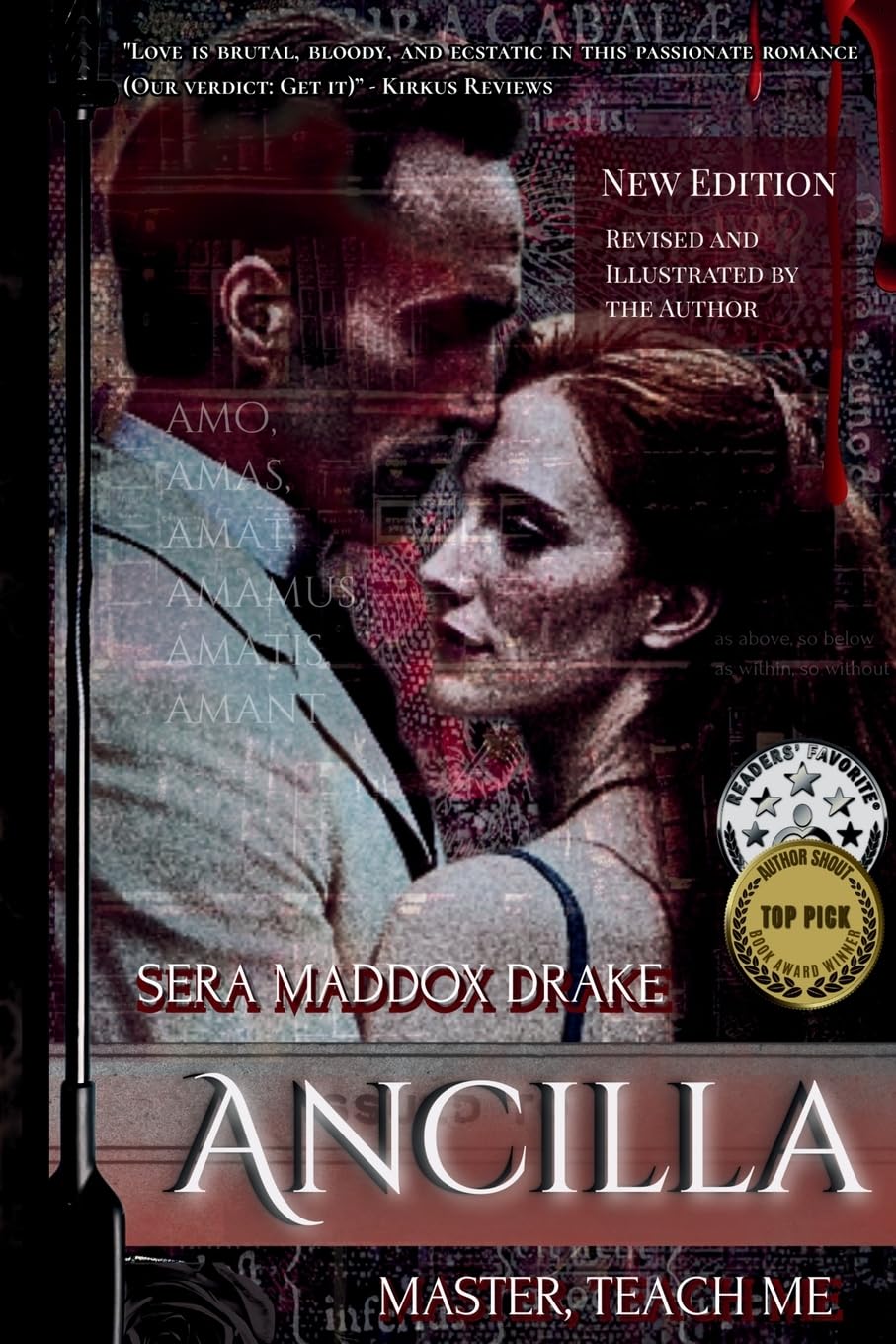

Sera Maddox Drake’s Ancilla: Master, Teach Me is an occult, sexually explicit BDSM romance that tracks a bisexual woman in late-80s to mid-90s Rust Belt Ohio as she unravels a strict sedevacantist Catholic upbringing and stumbles into a relationship with a charismatic magus who becomes her mentor, dom, and soulmate. The story is built around Western esotericism (Thelema and Golden Dawn style Kabbalah), and the chapters are explicitly organized around the Tree of Life sephiroth, with each section acting like a rung on a ladder of transformation rather than “just” a new plot beat. Along the way, the book leans into edge play and on-page sex, plus harder emotional material like food insecurity, chronic pain, vampiric starvation that mirrors depression, and moments where the protagonist gets close to the cliff of suicidal thinking.
What landed for me first was the author’s directness about what the book is and what it is not. The content warnings are frank in a way that feels almost like Drake is taking you aside before you enter the room, making eye contact, and saying, “This gets intense.” That honesty gave me trust, especially because the erotic material isn’t treated as a naughty bonus but as part of the protagonist’s learning curve. Sex here is not a fade-to-black reward. It’s language. It’s ritual. It’s also messy, risky, and sometimes emotionally heavy, which fits the “mentor/dom/soulmate” setup the author spells out early in the narrative.
I also kept thinking about the author’s choice to foreground the moral complications of the spiritual framework itself. Drake doesn’t pretend Western esotericism is clean or culturally neutral, and she names the colonial “cafeteria” dynamic head-on, including the way the characters “loot and pillage” ideas from oppressed cultures. That doesn’t magically resolve the tension, but it does change the feel. Instead of the book asking me to admire the system, it asks me to watch people reach for meaning through a flawed system, sometimes sincerely, sometimes blindly. The Tree-of-Life chapter structure reinforces that. It’s as if the author is saying: growth can be real even when the tools are imperfect.
By the end, I felt like Ancilla is best approached as dark, reflective erotic romance with occult and paranormal undertones, not as a tidy love story or a neutral “intro to magic.” If you like intimacy that’s explicit and psychologically charged, and you’re also curious about spirituality, power exchange, and the way belief can reshape a person for better and worse, you’ll more than appreciate this story.
Pages: 440 | ASIN : B0GLLRBK55



