Blog Archives
Healing Books For Women
This guide helps women identify their attachment wounds and help them reframe their thoughts to regain control over their relationships. What was the idea, or spark, that first set off the need to write Healing Your Attachment Wounds?
I’d not long self-published Women Going Sober when I experienced what I’d call a stark illumination of my wounded self. Researching Women Going Sober exposed me to Gabot Mate’s body of work, specifically his assertion that addictions originate in trauma and emotional loss. With this nugget of insight, I glimpsed how emotionally ill-formed I felt at my core. A harsh reality to own in my 60s! It dawned on me that I was showing up wounded in every relationship, be it with my partner, adult children, family, career choices, etc. This broken version of me was sabotaging any and all attempts to step fully into an authentic life I’d yearned for as a young girl. I wanted to understand what it meant to have attachment wounds, how I got them in the first place, and where the path to healing might take me. It was only a matter of months after publishing my first book that I launched into writing book #2 Healing Your Attachment Wounds.
What were some goals you set for yourself as a writer in this book?
The vision, when sitting down to write my healing books for women, bundled together as the Sisterhood series, was to blend the latest neuroscience research with an overlay of spiritual awakening, shared struggles and triumphs, peppered throughout with hope and sisterhood. I set out to create a relatable roadmap for personal transformation and healing that would guide my readers through issues emanating from attachment trauma.
In writing Healing Your Attachment Wounds, I imagined my readers would receive a comprehensive understanding of their attachment style and its effect on their interpersonal relationships.
I understood, as I embarked on this healing journey with my readers, I’d be taking courage to confront my own demons.
What is one thing that you hope readers take away from your book?
Healing implies emotional work. It requires us to put our suffering into perspective. To look for the gift wrapped up in the wounds we lay down. Letting go of our wounds, however, we got them in the first place, creates space for our story to be as magical as we can imagine. We commit to nothing less than a deeply loving opinion of ourselves.
Do you have future books planned for The Sisterhood Series? If so can you tell us what topics they will cover and when you expect them to be published?
Yes, I feel book #3 calling to be written. I took a road trip recently. It was a long, exhaustive 13-hour solo drive. Towards the end, I got a glimpse of the direction my next book in the Sisterhood series might take. I believe women, young and old, are on their own heroine’s journey to usher in personal transformation that will upshift us all. Using my own journey as the backdrop, as I did in books 1 and 2, might I create an impactful healing book that not only encourages transformative experiences but provides a roadmap to connect with and experience our heroic self?
Author Links: GoodReads | Twitter | Facebook | Website
Many women don’t have secure attachment styles, which impacts adult behavior. By identifying and addressing attachment scars, we can more authentically improve the way we develop positive relationships in life.
If you’re a woman struggling with codependent behavior, addiction, anxiety, intimacy, or other trauma, former attachment wounds are molding your current experiences. Negative attachments, obsessions, and lack of trust no longer need to dominate or destroy your connections with others.
It’s time to reframe your attachment styles once and for all so you can heal, create personal independence, and establish successful relationships.
With a thorough examination and understanding of attachment, you can learn to more genuinely bridge a healthy relationship between yourself and others.
We build strong and thriving interpersonal relationships by learning how to comprehend our past and mend any damage caused by negative attachments. In this second book of The Sisterhood Series, author Boadi Moore offers insightful, candid, and personal connections to help readers quickly and effectively realize their healing potential.
Inside Healing Your Attachment Wounds, you’ll discover:How attachment styles impact individuals far into adulthood
Ways to understand which attachment styles connect most to your life
Raw and relatable stories that highlight how women can learn to let go of negative attachments
Strategies to explore and resolve negative parental attachment
Methods to detach from childhood trauma
Techniques to identify and heal toxic attachments
Ideas for reframing personal boundaries and communication
Unique and constructive self-care routines to begin celebrating you!
Plus, you’ll receive ideas for sharing your story of attachment and healing.
Neuroscientists and doctors are making society more and more aware of the undeniable connection between the mind, spirit, and body—which are holistically integrated parts of our whole being. Doctors Gabor Maté, Amir Levine, and Bessel van der Kolk are but a few of the prominent names who advocate this integrative mind-body system.
While the past shapes our behaviors and interactions with others, attachment wounds don’t have to impede our ability to succeed in the present. True integration of our wounds gives us the power to embrace love and nurture the connections we hold dear.
Healing Your Attachment Wounds: A Guide to What’s Hidden in Your Attachment Style and Relationships


Delving into the intricate world of developmental theory, Boadi Moore’s Healing Your Attachment Wounds illuminates the significant influence of childhood attachment on adult relationships. Moore thoroughly unpacks how attachment styles, shaped during early development, permeate through every aspect of relational interaction, occasionally leading to trauma and misunderstanding.
In this sophisticated exploration, the second in the Sisterhood series, Moore seamlessly combines her personal narratives with comprehensive research. Her transparent and candid writing style elucidates complex theoretical frameworks, making the subject matter both accessible and enlightening. Serving as an empathetic guide, Moore adopts a holistic perspective on attachment disorders, offering tangible steps towards healing and self-improvement.
One of the standout sections of this insightful book is the chapter dedicated to the concept of ‘letting go’. Despite the common skepticism around this idea, Moore convincingly argues that there comes a point where blaming upbringing loses its merit. Letting go, she posits, creates the necessary mental space to facilitate healing—a vital gem among numerous others in this compelling read.
Healing Your Attachment Wounds not only presents a powerful discourse on attachment styles and their implications, but also fosters meaningful conversation around these often-overlooked aspects of relational dynamics. Moore successfully reframes the common narratives around ‘toxic partners’ by encouraging readers to understand the underlying causes of their behaviors, thus promoting empathy and compassion.
Designed for anyone grappling with challenges related to intimacy, trust, anxious attachment, and identity merging, this book can serve as a valuable starting point. While it does not replace professional therapy, it equips the reader with a comprehensive understanding of their attachment style and its effect on interpersonal relationships. It inspires readers to embark on the journey of self-discovery and self-improvement.
Boadi Moore’s creation is indeed a beacon of hope for individuals seeking healthier relationships, despite the lingering effects of negative childhood attachments. It emphasizes that the past, while significant, need not dictate the future adversely.
The compelling narrative, coupled with Moore’s authentic connection with the reader, makes Healing Your Attachment Wounds not only worthy of one’s time but also deserving of recommendation. It truly serves as an instrument of healing for readers from all walks of life.
Pages: 303 | ASIN : B0C8P968GQ

An Unhealthy Relationship With Alcohol
“In “Women Going Sober,” you take readers on an intimate journey illuminating the societal pressures faced by women and offering practical strategies to triumph over addiction and embrace a sober future. Why was this an important book for you to write?
Women finding solace at the bottom of a bottle deeply disturbed me. Everywhere I turned, gorgeous women in my life whom I cared deeply for seemed to have an unhealthy relationship with alcohol. And there was my own willingness to drink alongside my new partner, compliant to the point our habit of drinking heavily every day was hurting me. I was in ‘no-where-land’ trying to figure out what came next in my life after leaving a 37-year toxic marriage. Through a Facebook sober support group, I gained insights and offered support to others who battled every single day to get and stay sober. It was from this support group a handful of brave women shared their remarkable stories for inclusion in my book ‘Women Going Sober’.
I’d always dreamed of publishing a series of books that offer my readers invaluable insights and tools to embark on a journey of healing, empowerment, and personal transformation. Books that delve into the profound impact of rewriting our life’s narrative. Books that, through honest, heartfelt storytelling, integrate personal narratives with well-researched insights, invaluable knowledge and inspiration for positive change. The Boadi Moore ‘Sisterhood Series’ is a collection of books where the realms of neuroscience, storytelling, and the transformative power of reframing intersect.
I appreciated the candid nature with which you told your story. What was the hardest thing for you to write about?
Owning up to having a drinking problem was harsh. I imagined I was more in control. Drinking heavily with my new partner certainly shone a spotlight on hidden wounds sabotaging my life and relationship choices. Owning the unflattering parts of my life was not easy to do. Nor was putting it out there so others might take the lesson from it. ‘Women Going Sober’ features raw and real personal stories from women on their journey to be alcohol-free. These women taught me that we all face the same fears and challenges. We all feel similar vulnerabilities. We all fight similar demons regardless of our trauma and childhood circumstances that may have triggered addictive behavior. These days, I rather like this version of me who no longer needs alcohol to regulate the highs and lows of her life.
What is a common misconception you feel people have about alcoholism?
Drinking is promoted everywhere for every occasion! The ubiquitous subliminal messages that ‘normalizes’ drinking is triggering to someone who’s addicted to alcohol and wants to get and stay sober. Before I decided to go alcohol free myself, I was blind to such pervasive advertising. Many of us now see the wrongness of smoking. We’re affronted when smoking is wedged into our movies and other such mediums because the evidence of the health risks is now backed by research and public sentiment. I feel alcohol is having that moment in our awareness. Or at least ‘Women Going Sober’ hopes to illuminate the dangers and bring to the fore the evidence of the damaging impact of alcohol on the body, specifically on female bodies. Alcohol is one of the most addictive substances. Getting hooked on alcohol grabs us when we’re not really paying attention. We think we’re in control – until we’re not!
What is one thing you hope readers take away from your book?
To become aware of the emotions that drive our need to reach for a drink. In Gabor Maté’s words, “addiction is not the primary problem, it’s an attempt to solve the problem”. Drinking often masks long-held wounds we just cannot or choose not to face. When we consider Maté’s emphasis on the pain points and emptiness that underlie addiction, we realize that the root cause for our problems is much more than addictive substances.
In writing my first book, ‘Women Going Sober’, I mentioned various reframing techniques that were helpful to me and also other women who I engaged with. I believe that actively embracing a reframing mindset on a daily basis empowers us to hold a higher and deeply loving opinion of ourselves, which serves as a source of strength against toxic intrusions.
‘Women Going Sober’ opened up an opportunity for me to identify my wounds and start to address them in a compassionate way so that my healing could begin. I’m thrilled to announce the release of Book 2 in The Sisterhood Series – ‘Healing Your Attachment Wounds – now available on Amazon.
Author Links: GoodReads | Twitter | Facebook | Website
From the pain of addiction and the shame of seeking help to the joys of self-discovery and the power of community and sisterhood, “WOMEN GOING SOBER” is a book that celebrates the resilience and courage of women who refuse to be defined by their past mistakes.
In this first book in The Sisterhood Series, author Boadi Moore offers many different TOOLS and TECHNIQUES for women to use as they navigate the ups and downs of sobriety, including the powerful technique of REFRAMING.
This book offers readers the following BENEFITS:
Provides practical strategies and tools for women to quit drinking and embrace a sober lifestyle
Offers a holistic approach to recovery, addressing physical, emotional, and spiritual well-being
Recognizes the unique challenges that women face when it comes to alcohol addiction, including societal norms and the impact of trauma
Offers guidance on how to navigate shame and stigma related to addiction
Provides inspiration and encouragement through personal stories of women who have successfully overcome addiction
Draws on evidence-based practices and research related to addiction and recovery
Offers a supportive and empowering tone, encouraging women to take control of their lives and make positive changes
Provides tips on how to stay sober and cope with triggers and cravings
Offers guidance on how to build a support network and maintain healthy relationships
Provides tools for self-reflection and personal growth
Encourages women to prioritize self-care and cultivate a fulfilling and meaningful life in sobriety.
In this inspiring and uplifting book, the author shares the real-life experiences of women from all walks of life, from Gen Zers to Baby Boomers, who’ve struggled with addiction. Through their moving and often deeply personal stories, we are reminded of the POWER OF PERSEVERANCE, the importance of self-care, and the beauty of the human spirit.
Boadi Moore takes us on a RAW and UNFLINCHING journeythrough her own battles with addiction, and the many emotional and psychological challenges that came with her decision to get sober. With searing honesty and poignant prose, she explores the pain points that so many women face on their own paths to recovery – the feelings of shame, isolation, and self-doubt that can make it difficult to stay the course.
With a message of HOPE and INSPIRATION on every page, this book isa MUST-READ for anyone who has struggled with addiction or supported a loved one on their own path to recovery.
When you purchase your copy of “Women Going Sober”, you’ll also receive a FREE bonus JOURNAL to start reframing your life today. This elegant journal provides you with a workable space to tell your story, reflect on your accomplishments, and heal from alcohol addiction.
Scroll up and click “add to cart” now so you can start getting results with your new perspective on sobriety!
Women Going Sober: An Empowerment Guide for Women Going Alcohol-Free and Embracing Being a Non-Drinker
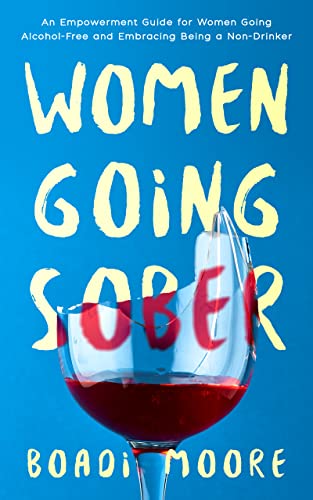
In her evocative self-help book “Women Going Sober,” Boadie Moore astutely addresses the often overlooked subject of women’s challenging journey towards alcoholism recovery. Drawing from her own battles and those of the women around her, Moore, with a spirit of gratitude to the supportive women in her life, pens a powerful narrative intended to assist those in search of a lifeline in their fight against addiction. As the inaugural book of the Sisterhood series, “Women Going Sober” navigates a range of weighty topics, including the potential roots of addiction in childhood attachment issues, the recognition of addiction as a disease, and the pivotal moment of change when one is ready to embrace it.
This book is not just a blend of theoretical information; it also provides practical methodologies to triumph over addiction and navigate discussions around this topic with loved ones. The primary objective of Moore’s work is to illuminate the incredible inner strength and resilience required to undergo such a transformative journey and to inspire others to step towards a brighter, sober future.
Moore’s candid style of writing is what sets “Women Going Sober” apart. With her ability to integrate personal narratives with well-researched insights, she achieves an optimal balance between recounting her own experiences and providing invaluable guidance. Moore’s adept crafting makes the book feel like a casual yet profound conversation over iced coffee, a trait that amplifies the readers’ personal connection to the narrative.
A striking aspect of the book is the spotlight it places on societal pressures endured by alcoholics, especially women, in their recovery process. Moore provocatively questions, “What if that same society that enables your drinking turns its back on you and judges you harshly when you cannot stop?” This crucial conversation is often overlooked, despite the blatant societal mistreatment of addicts and the intensified judgment faced by women battling addiction. The World Health Organization defines addiction as a chronic disease, yet the societal perception of the condition remains unsympathetic. Moore’s book takes a brave step in opening up this much-needed discourse.
While the book primarily focuses on women overcoming alcoholism, its scope and implications are far-reaching. Any individual battling addiction or disease can find solace in the universal message of solidarity: no one is alone in their struggles, and daily choices pave the way to healing and progress. Thus, I recommend “Women Going Sober” not only to those striving for sobriety or overall healing but also to mental health workers and practitioners. It provides a profound understanding of the individual experiences of those combatting addiction.
I commend the brave women who have overcome their demons to find sobriety, as well as those embarking on their initial steps to conquer alcoholism or any form of addiction. This book serves as a beacon of hope in their journey.
Pages: 182 | ASIN: B0BT4W4LF6


 LITERARY TITAN