Blog Archives
Choosing To Be Friendly

Rooted: A Young Tree’s Journey follows a young tree as he embraces the cycles of life in the forest and gains an understanding of his role as a provider of shelter and protection. I think this original idea is intriguing. How did you come up with this idea and develop it into a story?
Loyalty of a mother bird and the theme of relationships prompted the thought of “Nurtured,” a title for a new book. But I realized I could use this idea to create a sequel to Rooted: A Seedling’s Journey. The mother bird could make her nest on Dendro’s branches, the first nest he would host. The tree’s hesitation in welcoming noisy chicks would add dimension to the story. And this is how the “Rooted” series was born!
What were some educational aspects that were important for you to include in this children’s book?
Key themes of Rooted: A Young Tree’s Journey are:
– Making choices: Reliance on generational wisdom and being true to oneself
– Being welcoming: Choosing to be friendly opens doors for new relationships and opportunities
– Dedication: Persistence and focus are endearing character traits
– Learning from others: We are significantly influenced by the actions of others
– Choosing friends: Look for good qualities such as dependability and good character
– Managing feelings: Identifying and regulating emotions can positively shift perspectives
– Value relationships: Contentment and satisfaction are benefits of investing in others
What was one scene in the novel that you felt captured the morals and message you were trying to deliver to readers?
In the last scene, through self-regulation, Dendro models a growth mindset that reflects resilience. Dendro’s mood shifts when he dismisses negative thoughts and instead focuses on gratitude and valued relationships. Children also deal with difficult emotions, but connections are built when they can identify with characters in a story.
Where does the next book in the series take the characters?
In Rooted: A Mature Tree’s Journey, the third book in the series, Dendro’s character growth continues. Dendro experiences physical changes and becomes more of an extrovert. He develops a special relationship with siblings who visit him often in the forest. When Dendro faces a dangerous threat, the siblings heroically intervene to save their beloved tree. The story highlights the bond between humans and nature and the importance of leadership as Dendro continues to mentor the young seedling.
Author Links: Facebook | Instagram | Website
Rooted: A Young Tree’s Journey
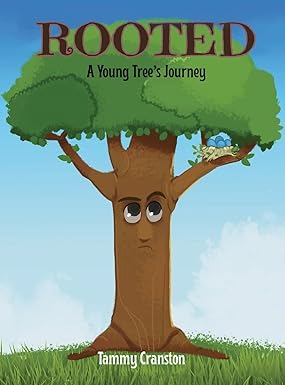

Tammy Cranston’s Rooted is a heartfelt and whimsical children’s book about resilience, change, and connection, told from the unique perspective of a tree named Dendro. Through his watchful eyes, we witness the cycles of life in the forest—stormy seasons, the growth of new friendships, and the struggles of nature. Dendro interacts with a little seedling, a devoted mother robin, and a lively critter named Rocco, all while navigating his own growth, challenges, and emotions. It’s a beautifully simple yet deeply reflective tale about embracing change and standing strong in life’s storms.
I loved how Rooted took something as quiet and still as a tree and made it feel so alive. Dendro is emotionally invested in the world around him. When the mother robin builds a nest in his branches, he has a choice—to embrace her presence or push her away. He chooses kindness, and in return, he gains a front-row seat to the miracle of life. There’s something touching about how he protects the nest from the sneaky rat snake, trembling with tension as he signals Rocco to step in.
One of the most striking moments in the book is when the baby birds finally leave the nest. After days of noise and motion, suddenly, there’s silence, and instead of relief, Dendro feels a strange sadness. That hit me hard. I also found myself chuckling at the seedling’s endless questions. The little one is so full of curiosity and complaints, but instead of indulging in negativity, Dendro gently guides him toward focusing on growth. It’s such a great metaphor for the way we should handle our own worries.
The illustrations bring so much life to the story, and I loved how expressive the characters are. The artwork adds an extra layer of charm that makes the book feel even more immersive and heartfelt.
I’d recommend Rooted to anyone who enjoys fable-like picture books with a gentle but meaningful message. It’s perfect for young readers but just as impactful for adults who appreciate nature’s quiet wisdom. If you’ve ever felt stuck, uncertain, or nostalgic for something that’s changed, this book will speak to you.
Pages: 34 | ASIN : B0DJKDBF4Z

The Power to Forge On
The Missing Children of Blackwood follows a sharp, quirky, and self-assured girl who gets swept up in the town’s haunted and dark past and needs to solve the mystery of the missing children to save her parents. What was the inspiration for the setup of your story?
My daughter was the inspiration for the setup of my story. She inspires everything I do. I’m a bit of a nervous dad, so if we are walking together in a grocery store or a restaurant or whatever, and I turn to grab something or look away for just a moment—and when I look back I don’t see her, even if it’s only a split-second, I panic. I mean, I really do. I swallow my throat into my stomach every time. She thinks it’s hilarious, but it scares the living shrimp out of me! I’m not a helicopter parent, (not fully) but I couldn’t imagine being separated from her for even a day, especially under circumstances like in my book where I have no control over it. Just the thought is scary. So, when writing the book, I tried to imagine what it might be like for her to feel the same way, and then tell it from her point of view. Obviously, there are some really terrible ways in which a parent and child could be separated in real life that may be more serious and less fun for a kid to read compared to something a bit far-fetched and fantastical, so I decided to go more supernaturally with it and keep it fun, for the most part. I wrote DaPhne to be brave and kept the focus of the story on her conquering whatever obstacles were thrown at her—be it the sadness of separating from her parents and eventually Sparrow, giant rocks of falling death landing razor close to her human body as she watched in her ghost form helpless to do anything about it, or the ground opening up like a monstrous mouth to swallow her whole. I wanted her to be strong and capable through it all and to keep moving forward, no matter what.
When creating DaPhne, did you have a plan for development and character traits, or did it grow organically as you were writing the story?
I never had a solid plan when writing this story. I started in the middle and worked backward. I knew, more or less, where I wanted to go with it, I just needed to find the right path. But I always had a clear vision of how I wanted to write DaPhne. I wrote her based 100% on the personality and style of my twelve-year-old daughter. I simply toned down the snark, and the sass (not kidding). One of the things I thoroughly enjoyed when writing the character, was feeling like a kid again, myself, and getting the stamp of approval from my wife and daughter about making sure not to sound too much like a “dude,” when writing the female characters. I got it wrong a few times, I’ll admit—even the editor called me out on it—but it all came together in the end and I’m pleased with how it turned out.
What were some themes that were important for you to explore in this book?
One of the most important themes for me, when writing this book, was perseverance. I never wanted DaPhne to give in, even when it seemed like all hope was lost. I wanted her to be a little fighter, just like my own DaPhne. I also wanted kids who read the book to feel like they can be little fighters—mighty, just like DaPhne —and that if they ever find themselves in a tough situation like DaPhne (whether it’s a ghost town possessed by a witch or something else), I want them to know they have the power to forge on and keep fighting, no matter what the odds are—because they do! We all do. Aside from that, I didn’t want the reader to become too settled. I took a few chapters in the beginning to plant the seed and get the story growing, but afterward, I wanted something happening (or about to happen) in each chapter. I have severe ADHD (three extra scoops of ADHD in a cone made of ADHD), and so does my daughter, so my main goal was to keep the suspense gripping as well as a fast-paced story told by a relatable character so as not to lose her attention. I figured if I could get her to read it, and she enjoyed it, I might have a chance with others her age. And of course, the humor. There needs to be humor in everything. The more humor the better. Thor 1 and 2 were good (anything with Chris Hemsworth is a winner), but Thor Ragnarok was GREAT : ) because it had more humor.
Is this the first book in the series? If so, when is the next book coming out, and what can your fans expect in the next story?
I don’t think I have fans just yet, but I like the idea : )
As far as the book goes, it was actually written to be a stand-alone book. I personally like the cliffhanger ending, I always have. The editor is the one who introduced the idea of a series. If I do decide to make it into a series, I have a few ways in which direction I could take it. All I can say for now is that the trucker lady would definitely be returning as one of the main characters—transporting some precious museum cargo that is more than just cargo—along with DaPhne and her parents and a few new characters, (DaPhne’s friends) for a new adventure. But like the weather, that could all change.
Fun fact, that bit in the book with the gum actually happened … to me : (
Author Links: GoodReads | Amazon
More than Just a Clear Sky: a collection of poems

Arjun Nair’s More than Just a Clear Sky is a vibrant and imaginative collection of poems that traverses themes like nature, creativity, relationships, and dreams. Written when the author was just eleven years old, the book exudes a youthful charm paired with surprising depth. The poems range from exploring universal ideas, like the interconnectedness of life, to whimsical musings on objects and concepts that feel personal and profound. It’s clear from the start that Arjun writes with a mix of curiosity and sincerity that’s both refreshing and heartfelt.
One of my favorite poems, “The Power of a Voice,” captures the urgency of speaking out for what matters. Its repetitive structure builds momentum, urging readers to realize their potential to inspire change. The poem balances youthful hope with a mature call to action, making it one of the book’s standout pieces. It’s impossible not to feel moved by the sheer earnestness of its message.
The collection also showcases a playful side, especially in pieces like “If Objects Could Talk” and “The Game.” These poems brim with humor and imagination, as the author gives personalities to everyday objects or dramatizes a child’s obsession with gaming. “If Objects Could Talk” features a tired cell phone begging for rest, while “The Game” turns a simple narrative about screen time into an epic quest. These lighter poems offer a delightful contrast to the heavier, more contemplative works, showing off Arjun’s range as a poet.
What truly impressed me was the recurring theme of perspective. Poems like “Seed” and “Life Inside a Staircase” look at growth, change, and resilience through metaphorical lenses. “Seed” subtly reflects on the potential within all of us, while “Life Inside a Staircase” turns an inanimate structure into a poignant symbol of abandonment and rebirth. These are deeply relatable and thought-provoking, evoking a sense of wonder about the world around us.
More than Just a Clear Sky is a testament to the power of youthful imagination and introspection. It’s a perfect read for anyone who enjoys poetry that is honest, creative, and accessible. I’d recommend it to young readers, aspiring writers, and anyone looking to reconnect with the simplicity and wonder of childhood.
Pages: 71 | ASIN : B0DPL4KQKD
Make Readers Laugh

Nate’s Noisy Nose follows the hilarious and heartwarming journey of a boy whose musical nose disrupts his life until he discovers the power of embracing his unique melody. What was the inspiration for the setup of your story?
I honestly don’t know where this idea came from! It just popped into my head and away it went! I liked the idea of having a noisy book where kids join in to repeat the sound words and I had great fun thinking up the words to accompany the character’s noisy nose.
I like to write stories that are fun. There are so many books out there that want to teach a moral lesson or highlight a particular theme – and although my story does have an underlying message, it’s not the main idea of the book. The main idea is to make readers laugh.
How did you develop the character of Gabby the Geek, and what was her role in shaping the story’s resolution?
My illustrator and I dreamed up Gabby. We wanted a mad-looking techy person who could invent a machine to help Nate. I liked the idea of kids being inspired by Gabby and designing their own machines. Initially, the machine Gabby invented was going to solve Nate’s problem by having a dial on it so he could turn the volume up and down, thereby being noisy when necessary but quiet in school and around town. But we thought it would be much funnier if the machine caused Nate’s nose to ‘explode’ and spew out the instruments! Do I give a spoiler alert here and say what happened next – perhaps not!
The illustrations are incredibly vibrant. Did you work closely with the illustrator, and how did you bring Nate’s world to life visually?
Dotti Colvin is an extremely talented illustrator. She illustrated one of my other picture books, Baby Worries, and I just knew she would be perfect for this story. We had great fun inventing each character and Dotti is an expert at adding hilarious detail to every scene. Her illustrations brought the story to life in a way that many other illustrators could not achieve. Nothing is left to chance with her illustrations – they are expertly planned and beautifully finished.
Can we expect more adventures featuring Nate, Rascal, or Gabby in the future?
I already have plans for future tales involving Nate and Rascal – after all, Rascal does become world famous! I am thinking of creating a chapter book series as a spin-off. There’s so much that these characters could get up to. Will have to wait and see what happens.
Author Links: GoodReads | Facebook | Website | Amazon
Join Nate as he navigates the challenges of a nose that’s a bit too special. With every tuneful toot, he finds himself in a new misadventure, whether it’s at home, at school, or out and about, making him the centre of attention wherever he goes – but not always in a good way!
Amid the chaos, Nate’s longing for peace grows stronger. If only he could find silence and slip under the radar like a regular kid.
But fear not! Nate isn’t alone on his quest. His loyal furry friend, Rascal, is by his side, ready to help him snuffle out solutions. Will Rascal’s devotion be the key to Nate’s noisy problem, or will a team of brilliant doctors and scientists come to the rescue?
This laugh-out-loud gem is perfect for families who love to giggle together. As Nate’s story unfolds, readers are reminded that even the quirkiest traits can lead to the most unexpected outcomes.
This noisy, interactive book is more than just a funny tale of a musical nose; it’s a celebration of friendship, loyalty, creativity, and finding solutions when life gets a little too loud.
Pursuing Our Own Passions


The Literary Hedgehog follows a mouse poet who struggles to have her voice heard and starts to doubt her worth, yet with the help of friends, she finds her confidence. What was the inspiration for your story?
Every author who questions their self-worth as a writer. Derek and I have both experienced this at some level, and we see this online in the Writing Community every day and with students when we present writing modules in local high schools. We want to offer support and encouragement to writers and let everyone know— you have a voice and deserve to be heard, just like Evie.
What were some ideas that were important for you to personify in your characters?
We wanted to juxtapose some biases and stereotypes by sharing a deeper view of the main characters. For example, when Mr. Hedgehog’s attitudes are shown, his beliefs are stuck in the past. When presented with an alternate perspective by Ms. Rabbit, he isn’t really a misogynist, and he proves this again when a crisis at City Magazine arises. He changed his mindset and gave Evie a chance— an opportunity for publication.
With Ms. Rabbit and even Evie, we wanted to demonstrate a common gender-role bias of a woman’s role in society that lingers today. Granted, this bias isn’t as strong as it once was, but gender bias still has a foothold in cultures around the world.
For Brayden, we wanted to demonstrate that although he has gifts and talents of his own, supporting others like Evie along their path doesn’t mean he isn’t pursuing his own. It shows he is supportive, friendly, and encouraging— help and be helped.
And finally, Evie demonstrates the importance of being true to ourselves by pursuing our own passions and not falling prey to doing what we think others or society expect from us. We all have gifts; we all have talents, and we live our most fulfilled lives when we utilize them.
Overall, there is more to each of us than meets the eye.
What scene in the book did you have the most fun writing?
One of our favorite scenes is when Brayden is searching for Evie so he can deliver the post message to her from City Magazine. He finds her near the woods picnicking and delivers Mr. Hedgehog’s request for Evie’s poetry. At first, Evie is uncertain, but Brayden tells her it is her big chance and that she can’t miss it. When Evie realizes he is right, she takes the lead, jumping on the front of the tandem bicycle, and Brayden hops on the back, and they head to the post office to call City Magazine. This is fabulous— it’s the moment Evie takes control of her fate.
What is the next book that you are working on, and when will it be available?
We are always working on the next project and usually more than one. Right now, we are creating Our Spring: Imagination, Creativity, & More, the fourth book in our family-focused Keepsakes series, which includes Our Christmas: Traditions, Memories, & More, Our Halloween: Mysteries, Monsters, & More, and Our Summer: Adventures, Amusements, & More releases on March 20th.
Additionally, we are creating the fourth book, The Enchanted Summer Faerie Realm, in our Enchanted Realms series of faerie-themed poetry books, each with a different aspect introducing children to the elements of poetry. It releases on May 6th. The next two books in our Enlightenment series are near completion and include kintsugi- inspired Life is Sweet: Words of Gratitude (February 11th release) and Bloom: Ho’oponopono Words of Love and Gratitude (March 11th release).
While all that is going on, I’m writing The Golden Locket, the sequel to Katie’s Attic, for my MG supernatural historical fiction Thread Through Time series, and it will be released on March 25th. And Derek released a new poetry book in December, New Year’s Frost, and he has another poetry book, Soulmates Forevermore, releasing January 7th. But his current solo project and this is exciting, is his first fiction novel— a sci-fi thriller, which is slated for release in the third quarter of 2025.
Needless to say, we aren’t short of projects; each brings us much joy.
Derek King’s Author Links: GoodReads | X (Twitter) | Instagram | Website | Amazon
Julie Kusma’s Author Links: GoodReads | X (Twitter) | Instagram | Website | Amazon
This delightful tale teaches children the importance of believing in themselves, challenging outdated assumptions, and the value of friendship and encouragement. Evie Mouse’s journey shows that determination, courage, and the support of others can make dreams come true.
What this book can teach young children: The importance of self-belief and following your passions.
Challenging stereotypes and societal expectations.
The value of encouragement and support from friends.
Courage in seizing opportunities and taking risks.
Introduce your young readers to The Literary Hedgehog, and let them discover how far self-confidence and the support of friends can take them. Spark their imaginations and inspire them to find their voice—just like Evie did. Add The Literary Hedgehog to your library today and join Evie on her literary adventure!
Alternative Realities

The Esperanza: Book Two of the Terracolina Trilogy, follows a twelve-year-old boy who struggles with his parents’ expectations and is sent to math camp. There, he makes new friends who he wants to enlist to help save Terrocolina. What were some themes that you felt were important to highlight in this story?
The themes from book one continue in this book two: Loss of youth, introversion, love of nature, the pull of escaping into a fantasy world, exploration, and found family—with the addition of real friendships (a different kind of found family than his magical friends). In addition, the protagonist must face deeper challenges created by the need to belong. Finally, I wanted to introduce the idea that our imaginations and alternative realities can be one and the same.
In many contemporary coming-of-age fiction novels, authors often add their own life experiences to the story. Are there any bits of you in this story?
Very much so! I loved to escape to my own private and magical world as a child, was a tree climber, a nature lover, and an introvert. Our family also made maple syrup and the big maple I climbed in as a child was the model for the one in the story. The earlier years of my adulthood ripped me rather abruptly from the safety of childhood. Thomas’s loss of his Grandpa represents that loss of youth, wonder, and safety I experienced as a young adult.
I find the world you created in this novel brimming with possibilities. Where did the inspiration for the setting come from and how did it change as you were writing?
I am an avid gardener and find it easy to imagine personalities for each of my plants. I have revived my vivid childhood imagination and am having a blast building the magical world of Terracolina.
What will the next book in that series be about, and when will it be published?
The final book of the Trilogy will bring Thomas “back to earth” and reconnect him with his real-world friends. He will find a better balance between living in his real world and an imaginary one, and he and his home world friends will find real-world solutions to the environmental issues that surround them.
Author Links: GoodReads | Facebook | Website | Amazon
His return home gives him a chance to save the hemlock forest he and Grandpa used to frequent and he’s finally making some friends in his real world. But he still misses his Terracolina buddies and finds a way to visit them. What he discovers is shocking. Not only have the Olgrots attacked again, but an aggressive vine is strangling the garden.
He realizes this time he alone can’t stop the tragedy unfolding in Terracolina. His real world friends have just the right skills to help out. He wants to connect his two worlds, but can they coexist?
Explore and Teach

Who Says Poo is a delightful and hilarious story that plays on words from different languages, each sounding like “poo” but with entirely distinct meanings. What was the inspiration for creating this unique story?
My partner was sitting on our couch in the living room using Duolingo to learn French. I was in the bedroom folding laundry. And then I heard her say “Poupée” and I giggled at how it sounded like “poo.” Then I instantly thought, ‘I wonder if there are words in other languages that also sound like poo!’ And that single moment sparked the creation of Who Says Poo!
The art in this book is fantastic. What was the art collaboration process like with the illustrator?
I wanted to make sure that the collaboration process was as seamless as possible. So I created a few PDFs that I sent to the artist. The first PDF was about character design, thoughts on color, and overall formatting. The other PDF was the full formatted layout of the book, and I included many reference images for each page, including detailed descriptions of exactly what I wanted in the illustration of each scene. But I also made sure to leave room for the artist to experiment, have fun, and add their own twists to each image.
My artist, Mark Nino Balita, did such a great job of making the art come alive! They were easy to talk with, and a joy to collaborate with. Mark would send me proofs, and if I had any notes, I’d send them their way. Mark nailed it! I had very few notes. Mark even added a few spins on the book that I had never even thought of doing. Mark’s hard work and expertise shine on every page.
What scene in the book did you have the most fun writing?
I made so many wonderful memories while writing Who Says Poo. But the scene I had the most fun writing would be on page 24, the Japanese sound, あっぷっぷ (“A-Poo-Poo”). It was the most challenging to write. Unlike the other words that have a perfect literal translation, this does not. It’s like a colloquialism, mixed with an onomatopoeia. So to try to craft the right definition for it, and use it in a sentence created such a wonderfully fun challenge, and when I look back through the book, it makes me so proud that I nailed it.
Is this the first book in the series? If so, when is the next book coming out, and what can your fans expect in the next story?
I never expected to actually write one children’s book, much less a series! For now this is just a single book. But if reception is good, I do have a few great ideas to turn this into a series of books where I might explore the onomatopoeia of different languages compared to English. There are some fun sounds out there to explore and teach. Other languages and cultures teach us so much about the world, and I think it’s a beautiful thing to start getting your child curious at a young age!
Author Links: GoodReads | Amazon
With a pet dog and a pet chicken, there are no normal days for Sally and her family. As they go about their wacky day, you learn words in different languages that all sound like the English word, Poo!
Through these pages, your child will learn words in other languages in a fun and silly way that helps to foster an enthusiasm for foreign languages and cultures.
Ideal for children ages 3-8 who think the word “Poo” is funny! Not only will this book help them steer away from Poo being “poo”, but it will show them that other languages are fun!
This Book:
• Helps kids talk about poo differently!
• Encourages language learning
• Shows that learning new languages can be fun
• Suitable for all readers and dyslexic-friendly!


 LITERARY TITAN