Blog Archives
One Last Question Before You Go: Why You Should Interview Your Parents
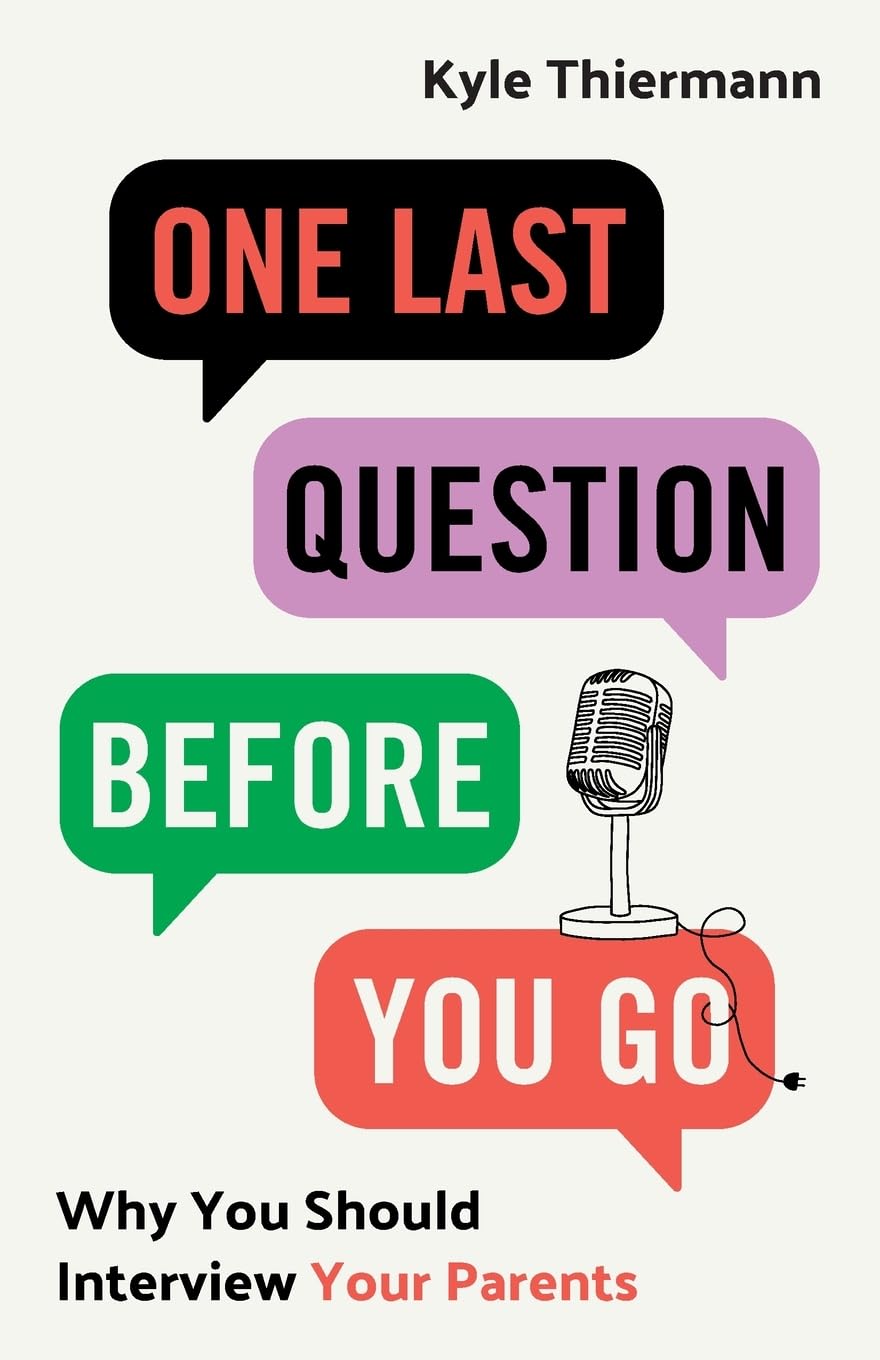

Kyle Thiermann’s One Last Question Before You Go is part memoir, part field guide for emotional courage. It begins as a practical project, recording conversations with his parents before it’s too late, but evolves into a moving exploration of love, misunderstanding, and reconciliation. Thiermann opens his life with remarkable honesty, describing a childhood shaped by idealism, tension, and unconventional choices. His storytelling blurs the line between instruction and confession, reminding readers that asking questions can be both a form of preservation and an act of healing.
Thiermann’s writing balances clarity and lyricism. He recounts moments from his youth in Santa Cruz with humor and unease: surf sessions laced with danger, family debates over truth and science, and a mother whose belief in conspiracy theories fractures their bond. When he writes, “Now when my mom and I look up at the same blue sky, she sees chemtrails, where I see clouds,” the simplicity of the line reveals something profound about distance and love. It’s this honesty, direct, unsentimental, but deeply felt, that gives the book its emotional weight.
His reflections on interviewing parents are both practical and philosophical. Thiermann treats listening as a skill that requires humility and patience. His advice to start with simple questions, to let silence breathe, feels genuine and attainable. He doesn’t posture as an expert but as someone learning in real time. When he describes forcing himself to write “bad questions” until something true appears, it captures the imperfect process of reaching toward another person.
The book’s rhythm is conversational yet purposeful. Thiermann alternates between intimate family vignettes and broader reflections on communication, mortality, and forgiveness. He resists the urge to offer neat resolutions, allowing discomfort and ambiguity to remain. That restraint makes his insights resonate more deeply.
One Last Question Before You Go manages to be both instructive and profoundly human. It’s a reminder that asking hard questions is not about control or closure, it’s about connection. This is a book for readers who value sincerity over polish, who want to bridge emotional gaps with their own parents, or who simply wish to understand their family stories before time takes them. Thoughtful, unguarded, and deeply affecting, Thiermann’s work lingers long after the final page.
Pages: 156 | ASIN : B0FR8JLM98

Journey Back to Ourselves

Don’t Disappoint Daddy shares with readers your story of growing up in a household filled with trauma, abuse, and believing you had to earn God’s love, to discovering a path of healing and the true meaning behind the Gospel and God’s love. Why was this an important book for you to write?
This book was important to write to share out loud that religion often confirms the lie we believe – that God is a bigger version of our unhealed daddy.
I appreciated the candid nature with which you told your story. What was the hardest thing for you to write about?
It surprises me that the hardest thing to write about was that God never spoke to me about what I thought must’ve taken tremendous effort for Him to forgive, because I know it will trigger outrage from religious systems. Yet, if I agree with them, we’ll both be wrong.
What were some ideas that were important for you to share in this book?
Each of us is on a journey back to ourselves—an adventure filled with peril and intrigue.
Our original identity doesn’t come from our parents, environment, or upbringing. Our identity originated in the mind of a good, kind, loving Father.
Unlearning lies we believe about God and ourselves is a crucial and liberating path toward healing an identity crisis.
What do you hope is one thing readers take away from your story?
I hope readers extend grace to themselves and others as we navigate one of life’s most pressing questions: Who am I?
Author Links: GoodReads | Facebook | Website | Amazon
Religion said she was a dirty, rotten sinner.
THEY WERE BOTH WRONG.
DON’T DISAPPOINT DADDY is an award-winning, raw and redemptive true story of Elisha Janine’s journey from childhood abuse and secrecy to healing and acceptance in the arms of a loving God. Marked by trauma, teen abortions, and the desperate need to earn love, she lived believing she had to serve God to pay Him back for forgiving her. But what she discovered was life-changing: experiencing the gospel isn’t about changing God’s mind about us—it’s about changing our minds about how we view Him and how we view ourselves.
This book is for every woman who’s ever felt disqualified by her past or afraid that God is disappointed in her. If you’ve been wounded by religion or life itself, Don’t Disappoint Daddy will lead you back to the truth: you are beloved, you are accepted.
What Readers Will Gain from Don’t Disappoint Daddy:
Healing for Deep Hurts
Readers will feel seen in their pain and begin to understand that their past does not disqualify them from love, purpose, or belonging.
Freedom from Shame
The book gently uncovers how shame distorts how we see ourselves and God—and shows how to shed that shame in light of God’s true heart.
A New Lens on God
Many will be surprised and comforted to learn that God isn’t angry, distant, or waiting to punish—but near, gentle, and deeply invested in our healing.
Relatable, Hopeful Storytelling
The story offers real-life validation that the journey from trauma to wholeness is possible, especially for those who’ve believed they’re beyond repair.
Permission to Rest, Not Perform
Readers will discover that God isn’t asking them to earn forgiveness—He’s offering restoration freely, inviting them to live from love, not for it.
A Sense of Belonging
The book invites readers to a deeper understanding of their identity as God’s beloved, not by achieving something, but by simply being who they are.
This is not a story of perfection—but of relentless, redeeming love from God who never counts our sins against us.
Don’t Disappoint Daddy: A Story of Abuse, Abortion and Acceptance in the Beloved

This memoir is a raw and unflinching account of childhood trauma, faith, survival, and eventual healing. It follows Elisha through her early years in a military household, where her father’s tyranny casts long shadows over every corner of life. Woven through beatings, verbal degradation, emotional confusion, and heartbreaking loneliness, the story also reveals slivers of hope through her bond with her mother, her growing relationship with God, and the slow, painful process of understanding her own worth.
Elisha’s writing is sharp, honest, and often devastating in its simplicity. She doesn’t try to dress up pain or smooth over the ugly parts. Her memories come to life with vivid emotional detail, pulling you into the child’s perspective. It’s not just a story, it’s an experience. Her use of humor, especially in moments of horror or confusion, is disarming. At times, I caught myself laughing through tears. The book doesn’t try to follow a clean arc or perfect structure, and that’s part of what makes it feel so real. It’s fragmented the way trauma is, and deeply reflective without being preachy.
I found myself angry. A lot. Angry for the child who was never protected. Angry at a society and a church that turned its head from abuse while preaching virtue. But I also felt proud. Watching her grow through those memories, learning to play piano, lead a choir, explore her voice, and find healing, was incredibly moving. Elisha doesn’t write from a place of self-pity. She writes from a place of survival, of transformation. There’s a quiet power in her words. She’s not begging for sympathy. She’s sharing so no one else feels alone.
This book is not for the faint-hearted. But if you’ve ever struggled with a difficult parent, spiritual confusion, or the long road of self-forgiveness, this memoir will speak to you. I’d recommend it for survivors, for adult children of abusive parents, for anyone working through religious trauma, and especially for those who feel like their story might be too ugly to tell. It’s not. Elisha proves that there is strength in telling the truth.
Pages: 143 | ASIN : B0D276HND1
Never Dull!
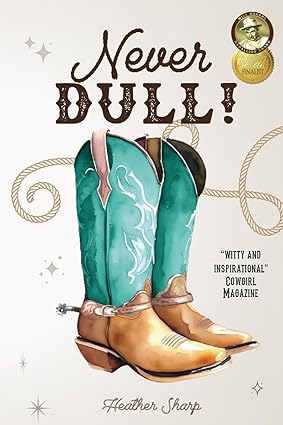
Never Dull! is a wild and heartfelt tribute to family, grit, and laughter, told through stories that feel more like tall tales around a campfire than your standard biography. At its heart, it’s a daughter’s loving homage to her vibrant parents—Marian and Nolan Sharp—and the larger-than-life characters that made up their world of rodeos, ranching, and rowdy good times. Through transcribed audio, photos, and personal anecdotes, Heather Sharp gives us a front-row seat to a life lived loud, full of joy, and never short on mischief.
Honestly, I didn’t expect to get as hooked as I did. The storytelling is casual and reads like someone pouring you a drink and pulling you into a story with a wink. The chapter “Live in the Moment” had me belly-laughing. A steer wrestler cuts off Marian’s ponytail in a bar as a joke, and her reaction? She rolls with it, gets a new haircut in the bar bathroom, and demands he buy drinks for life. That mix of sass and grace pretty much sums her up. And then there’s the moment where Nolan proposes after saving a cow with milk fever and roping it with a short rope. These stories aren’t just funny. They’re gritty, raw, and full of heart.
But it’s not all laughs. What caught me off guard was how emotionally honest the book is. There’s a recurring theme about living with purpose and keeping your word, especially in the chapter “The Guy in the Glass.” Nolan’s character comes through as humble, kind, and deeply grounded—a man who wasn’t of the cowboy world, but in it. His grandkids’ memories of him are gold. The chapter Come Fly With Me really tugged at my heart. I loved how it celebrated Marian’s late-in-life dream of becoming a flight attendant. At an age when most folks are slowing down, she was chasing the clouds, proving it’s never too late to go after what sets your soul on fire. The way Heather tells it—with humor, pride, and a little awe—made me want to cheer. It’s not just about flying; it’s about freedom, grit, and showing up for your dreams no matter how long they take.
Never Dull! is a rollercoaster of laughs, lessons, and lump-in-the-throat moments. It’s perfect for anyone who loves true stories that don’t shy away from messiness. If you like books with guts, grit, and a ton of charm—and especially if you’ve got a soft spot for cowboys or family tales—this one’s for you.
Pages: 330 | ASIN : B0C92KWNQQ
Humor is Like Social WD-40

The Awkward Optimist’s Guide to Human Connection is a hilarious, insightful, and refreshingly honest look at the challenges of social interaction. Why was this an important book for you to write?
The Awkward Optimist’s Guide to Human Connection grew from my own spectacular failures at small talk and my uncanny ability to say “you too” when waiters tell me to enjoy my meal. After decades of collecting enough awkward moments to fill a museum (or is that a mausoleum?), I realized I wasn’t alone in this special kind of social purgatory—and that maybe my pain could be everyone else’s comedy gold.
Writing this book was important to me because I believe humor is like social WD-40—it makes the squeaky, uncomfortable parts of life glide a little smoother. Plus, it felt therapeutic and cathartic to transform my most cringe-worthy moments (like the time I waved back at someone who was actually hailing a taxi) into stories that might make others feel better about their own social blunders.
Beyond the comedy, I wanted to create an antidote to those insufferable Instagram influencers who make authentic connection look as effortless as their “candid” sunset yoga poses. Real human connection isn’t filtered or perfectly lit—it’s messy, sometimes awkward, and occasionally involves spinach in your teeth during important conversations. Take a look at my podcasts and YouTube casts. They are not NPR Perfect-are you kidding? They are perfectly awkward and authentic.
Ultimately, this book is the guide I wish I’d had during my own journey—a reminder that we’re all just awkward optimists hoping someone will laugh at our jokes and forgive us for accidentally calling our boss “mom” that time in a staff meeting. Everyone else was laughing, so I joined in. That was awkward.
What were some ideas that were important for you to share in this book?
The core ideas I absolutely had to share in “The Awkward Optimist’s Guide” emerged from years of underfunded research (read: embarrassing myself in public and taking mental notes). Some of the most important concepts include:
First, the “Three-Second Rule of Overthinking” – not the one about eating food off the floor, but rather my discovery that giving yourself more than three seconds to analyze a social situation is like falling down a rabbit hole lined with your most embarrassing memories. Action before anxiety became my mantra.
I also needed to debunk the “Perfection Myth” – this bizarre cultural notion that everyone else is navigating social waters like graceful dolphins while you’re flopping around like a caffeinated seal. The truth is we’re all seals. Some just hide their flippers better.
The concept of “Authenticity as a Superpower” was crucial to include. I found that when I finally stopped performing what I thought was a convincing impression of a socially adept human and just showed up as my awkward self, people actually connected with me more. Turns out, vulnerability is like social catnip.
And finally, the idea that “Connection Happens in the Cracks” – those unplanned, unfiltered moments when someone sees you spill coffee all over yourself and instead of pretending to be perfect, you both laugh until your sides hurt. Real relationships aren’t built during flawless dinner parties; they’re forged in shared catastrophes and mutual weirdness.
I wrote this book to give permission to the awkward optimist in all of us to stop waiting until we’ve figured it all out, because spoiler alert: none of us ever do.
What is one piece of advice you wish someone had given you when you were younger?
One piece of advice I wish someone had given me when I was younger? “Your awkwardness isn’t terminal—it’s your personality’s immune system fighting off inauthenticity.”
Throughout my teens and twenties and thirties and forties, I treated my social awkwardness like a contagious disease that needed to be quarantined. I spent approximately 60% of my mental energy trying to appear “normal” in social situations (worrying about what others were thinking), 30% replaying my conversational fumbles in excruciating detail, and the remaining 10% avoiding eye contact with anyone who witnessed said fumbles.
No one told me that those cringe-worthy moments—like the time I confidently waved at my crush across the cafeteria only to realize I had ketchup smeared across my face like war paint—were actually building my resilience muscles. Or that the person who called out “enjoy your haircut” after I left the barbershop (to which I brilliantly responded “you too” to someone clearly sporting a shaved head) would become one of my closest friends because we bonded over mutual awkwardness.
If I could go back, I’d tell young me to save the energy I spent trying to be a smooth operator and redirect it toward something more achievable—like solving cold fusion or teaching cats to respect personal boundaries. Because eventually I learned that people don’t connect with your highlight reel; they connect with the blooper reel you’re brave enough to share.
So, my advice? Embrace the awkward early. It’s not the obstacle to connection—it’s the express lane.
What is one thing that you hope readers take away from The Awkward Optimist’s Guide to Human Connection?
If readers take just one thing from The Awkward Optimist’s Guide to Human Connection, I hope it’s the liberating realization that everyone else is also mentally rehearsing conversations before they happen and then performing extensive post-mortems afterward. We’re all members of the same neurotic book club—some of us just have better covers.
I still remember the day this truth hit me: I was standing frozen in the grocery store, contemplating whether saying “I like your shirt” to the really pretty cashier would come across as friendly or deeply unsettling and creepy. Then I noticed the person behind me muttering what appeared to be their own same conversation script under their breath. That’s when it clicked—we’re all out here simultaneously terrified of each other and desperately wanting to connect. It really hit me after the COVID 19 Pandemic. We needed understand personal connection again.
My fondest dream is that somewhere, someone will read this book in public, laugh out loud at a particularly embarrassing anecdote (probably the chapter about my disastrous attempt to network using only movie quotes), and the stranger next to them will ask what they’re reading. They’ll strike up a conversation, both fumbling through the social niceties, until one of them bravely acknowledges the awkwardness—and in that moment of shared humanity, a real connection will form.
Because ultimately, that’s the paradoxical magic I hope readers discover: our collective awkwardness isn’t the barrier to connection—it’s the bridge. So next time you accidentally text “Love you!” to your plumber or walk into a room and immediately forget why you’re there (I do this a lot!), remember you’re not failing at being human. You’re actually doing it exactly right. As awkward as it is, your call to action is to go buy my book. I can guarantee it will be a mistake worth making.
Author Links: GoodReads | Facebook 1 | Facebook 2 | Website | Reedsy | Kobo | IngramSparks
The guide navigates both digital and physical social landscapes, acknowledging that forming meaningful relationships in either realm can feel like trying to perform surgery while wearing oven mitts. Through chapters like “The Science of the Awkward” and “The Zoo, The Bar, and The Museum: Pickup Lines in the Wild,” readers explore how their most embarrassing moments might actually be their most endearing.
Unlike traditional dating and social skills manuals that promise to transform readers into charismatic smooth-talkers, this book embraces authenticity in all its messy glory. It suggests that waiting three hours to craft the perfect “casual” text message or accidentally walking the wrong way after saying goodbye are universal experiences that make us human rather than social failures to be corrected.
The author positions social mishaps as future anecdotes waiting to happen, teaching readers how to transform their most cringe-worthy encounters into entertaining stories. The book also offers unexpected perspectives on modern social phenomena, suggesting that being ghosted might be a hidden blessing and that failed attempts at wit might create more memorable connections than polished pickup lines.
Written for anyone who’s ever felt like a caffeinated rhinoceros in a world of graceful gazelles, the guide serves as both a practical manual and a permission slip to embrace one’s authentic self. It promises not transformation into a social butterfly, but rather the confidence to flutter awkwardly and own it. The result is a humorous yet insightful exploration of human connection that turns social anxiety into social advantage, one uncomfortable encounter at a time.
The Awkward Optimist’s Guide to Human Connection- A Field Manual For The Socially Ambitious
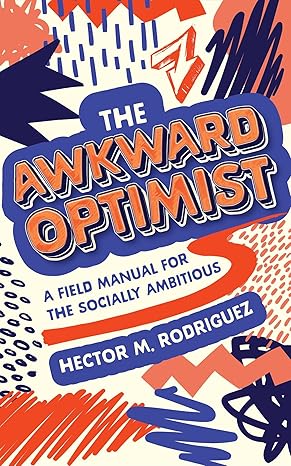
Hector M. Rodriguez’s The Awkward Optimist’s Guide to Human Connection is a hilarious, insightful, and refreshingly honest look at the challenges of social interaction. It’s part self-help, part comedy, and 100% relatable for anyone who has ever fumbled their way through small talk or tried (and failed) to master the art of a good pickup line. Structured as a “field manual” for the socially ambitious, the book breaks down everything from deciphering body language to navigating the terrifying world of dating apps. It reassures readers that awkwardness isn’t just inevitable—it’s a rite of passage on the road to building real human connections.
Rodriguez’s writing style is the best part of the book. He doesn’t drone on with clinical psychology or rigid rules; instead, he infuses every chapter with sharp wit, self-deprecating humor, and painfully relatable anecdotes. Take, for example, his breakdown of pickup lines in The Anatomy of a Pickup Line: A Postmortem. He dissects pickup lines with surgical precision, complete with real-world examples of just how cringe-worthy they can be. The book feels less like a lecture and more like a conversation with a friend who has been through it all and is here to make sure you don’t make the same mistakes.
One of the book’s standout strengths is its deep dive into nonverbal communication. The chapter Reading the Room and the Person’s Nonverbal Cues is packed with practical advice on how to interpret body language, but it’s never dry or clinical. Rodriguez presents it as a detective game—one where your mission is to decode subtle gestures, posture shifts, and even the dreaded forced smile. His discussion of the “Duchenne smile” (the real vs. fake grin) is both fascinating and useful, but what makes it memorable is the way he wraps it in humor. Instead of feeling like homework, it feels like an adventure in social sleuthing.
The book also shines in its breakdown of different social environments. Rodriguez goes beyond the obvious and explores places like libraries, museums, and even farmers’ markets as unexpected but prime locations to meet new people. The Safari of the Soul: Meeting People in Unexpected Places chapter made me laugh, especially the section about striking up conversations at the zoo. He encourages readers to embrace the weirdness of life and find opportunities for connection in the most unexpected places, reinforcing the book’s overarching message: human interaction is messy, awkward, and often ridiculous, but that’s what makes it fun.
The Awkward Optimist’s Guide to Human Connection is a must-read for anyone who struggles with social interaction, dating or just wants to laugh at the absurdity of human connection. If you want a book that embraces the chaos, teaches you useful skills while making you chuckle, and reassures you that awkwardness is just part of the process, then this is for you.
Pages: 153 | ASIN : B0DW4KTH76
Disastrous Dates

Kissing Toads follows a woman living in the 80s and 90s who is navigating the highs and lows of love and heartbreak on her path to self-discovery. Where did the idea for this novel come from?
The book concept was initially inspired by one of my middle-aged girlfriends who, fresh off a divorce, dove headfirst into the online dating scene. As she regaled me with stories of her disastrous dates, I found myself laughing out loud and wanting to tell a similar story.
However, I actually wrote chapter 4, “Nash,” first. I wrote it during the height of the Me Too movement in 2017 or 2018. I never intended to publish it or even share it; I was just reacting to the many stories I was hearing from women all over the country and decided to write a fictional story that represented the ways in which women were treated at that time (late 80s/early 90s) by law enforcement and the society in general. Then, when COVID hit and we were quarantined at home, I found that creative writing became a good way for me to channel my anxiety. I took the Nash story and I built around it.
What experience in your life has had the biggest impact on your writing?
I would say that having children has had the biggest impact on my life, and that translates into my writing.
What was your inspiration for Annie’s traits and dialogue?
I wanted this book to be an authentic look at the coming of age experience of a woman from Generation X. This is why I wrote it as a fictional memoir. I wanted to capture the real and raw emotions of that time period. Annie is an amalgamation of every young girl I knew growing up in the 1980s and 90s. Although the main events and characters are fictional, I will admit that there was one part that was 100% accurate. The dogs. My family did have four Golden Retrievers when I was a kid: Toby, Liberty’s Lady Annabelle, Starbelle, and Cooper. There was indeed an oil-on-canvas portrait of Toby (the mutt) hanging in my childhood home, and Annabelle and her pups were allegedly the spawn of President Ford’s dog (albeit, I can offer no proof of it—just my mom’s testimony). On my website, there is a picture of Toby’s portrait as well as a picture of Toby and me in my childhood backyard for anyone who would like to see them. https://www.kissingtoadsnovel.com/
What is the next book that you are working on, and when will it be available?
I am about 75% done with my next book called The Station. It is very different from Kissing Toads, however. The Station could be categorized as magical realism or even paranormal literature. It is essentially a story that explores the questions about what happens to us when we die. Like Kissing Toads, it does include moments of humor as well as moments of heartbreak. And yes, there may be a love story embedded in there as well. I hope to have it published by the end of 2025.
Author Links: GoodReads | X (Twitter) | Instagram | Website | Amazon
A feminist tale at heart, Kissing Toads is a fictitious memoir that tells the story of a now 50-something-year-old woman named Annie who takes the reader on her decades-long quest to find her “Prince Charming.” Believing that if she kisses enough toads, she will eventually find her prince, Annie has one goal as a budding young woman: fetch herself a man. Set in the late 1970s through the mid-1990s, the reader follows Annie throughout young adulthood as she searches for her soulmate amid the backdrop of misogyny, a loving but overbearing mother, and gender and societal expectations. Sometimes cheeky, sometimes heartbreaking, Kissing Toads explores Annie’s messy yet authentic misadventures in dating. But just when you think you’ve reached the happily-ever-after, brace yourself for an exhilarating plot twist. Kissing Toads is not just another coming-of-age tale; it’s a celebration of self-discovery, liberation, and the courage to write your own fairy tale.
Successful Long-Term Relationship

Quiet Love (& Growing It) is a practical guide blending science and social wisdom to help individuals cultivate lasting, fulfilling relationships through patience, growth, and quiet effort. Why was this an important book for you to write?
Everywhere you look, you find unrealistic depictions of what love is. Some people don’t have any examples of what a real, lasting relationship looks like and only see effortless or “romanticized” versions in movies or social media. It’s rare to find people who speak the truth about real love, how to find it, and most importantly, how to keep it.
What surprised you most while researching the science of love, and how can this understanding change the way people approach their relationships?
That there are actually formulas that make us more likely to fall in love, though it is more open-ended than one might think. Also, how quickly our subconscious can make judgments about another person after looking at them. It’s less than one second, though not always accurate for the purposes of a successful long-term relationship.
What advice would you give to couples who feel that their relationship lacks excitement but is still grounded in love and stability?
It sounds unromantic, but I wouldn’t suggest focusing on excitement at all. Excitement comes from the unknown, so as you learn more about each other, the excitement naturally fades. This is perfectly normal and okay, but if you expect it to last forever, you will always be looking for the next relationship. If you focus on consistent everyday actions and a shared purpose, the rest will fall into place toward a lasting and truly fulfilling relationship.
Which myth do you think is most harmful to relationships, and what steps can individuals take to reframe their thinking about love?
The No-Day Rule speaks about this, but anything like the “three-day rule” where you wait three days before contacting someone again after a first date. There’s nothing that will tangle the lines of communication more than things like these. And there’s nothing more attractive than someone who isn’t afraid to show competent and respectful interest in you.
Author Links: Goodreads | Website | Amazon
Do you long for a relationship that isn’t built on excitement and grand gestures but on the quiet, everyday moments? One that isn’t shaken by every challenge but strengthens over time through steady, purposeful love?
In a world full of lust, distractions, and short-lived passions, Quiet Love is your key to a deeper, more fulfilling connection.
Inside this book, you’ll find:
❤️ The 14 principles of “quiet love” that help sustain a relationship at any stage
💡 Insights into handling change to ensure your love grows together rather than apart through life’s unpredictable challenges
🗝 The 4 key factors that keep your relationship thriving in the long run
🙏 Simple but powerful gestures that show love in the smallest, yet most meaningful ways
🌱 How to cultivate shared experiences that deepen your bond and create lasting attachment
And much, much more—backed by 100+ references to scientific journals, articles, and studies.
With Quiet Love, you’ll discover how to nurture a relationship that feels grounded, genuine, and meant to last. Whether you’re single or married, young or experienced, Quiet Love offers timeless wisdom to fortify the foundations of your love life.
Start growing the love you’ve always wanted—click “Buy Now” and take the first step toward a lifetime of relationship success.



 LITERARY TITAN