Blog Archives
Learning Something New

Thomas Edison and the Magi Solution follows Thomas Edison’s former assistant as he finds himself on a journey to investigate allegations that Hitler has made a deal with the devil. What was the inspiration that created the fantastic journey these characters go on?
The inspiration for ‘Magi Solution’ was a piece of history I’d never known before. In the spring of 1941, Deputy Fuhrer Rudolf Hess stole a plane from the Augsburg-Haunstetten airfield and took off on a wildly improbable mission to Scotland to broker a peace between Germany and the Allies. He failed, Churchill and Hitler both deemed him insane and he was confined to the Tower of London. But was he insane? What if he possessed a secret of Hitler’s that no one has dared to imagine? And what if Hess went on to vow that only three men were worthy of this dark knowledge: Edison (who’s been dead for years), Roosevelt, who’s alive but unavailable, and John Dawkins, Edison’s intrepid assistant. And with that, the plot’s afoot!
What research did you do to understand the backdrop for your story?
A lot. When you’re dealing with a period as iconic as WWII you want to make sure you’ve got the underlying details just right so your novel has a historical foundation that allows your high-flying fiction to soar. It was work. It was also fascinating and the parallels to today’s world were startling. As Harry Truman famously said, “The only thing new in the world is the history you don’t know.”
What were some themes that were important for you to explore in this book?
Edison appears in the book as a reincarnated spirit: still feisty, determined and capable, but also diminished. As a modern-day Prospero he sadly observes, “I’m the ‘Wizard of Menlo Park. And I’ve lost my magic.” But he’s only lost his capacity to invent. He’s retained his ability to learn – and in the course of a series of hair-raising adventures, realizes that while the world is too big and too stupid to be saved, sometimes it can be helped immeasurably simply by saving one person. It’s Edison’s swan song and it’s an elegant one that’s worthy of his genius.
Can fans look forward to more historical fiction releases from you soon? What are you currently working on?
Possible. But not for now. My next project is a play and after that, who knows. I think I’ll leave Mr. Edison in retirement. He’s earned a rest. And so has John Dawkins. But John’s 10 year-old son, Josh? There’s a story brewing there. I can’t wait to see what might happen next.
Author Webpage
Thomas Edison and the Magi Solution
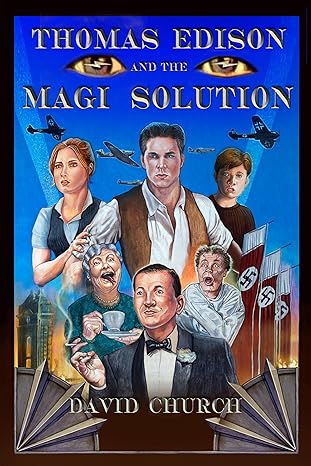

If you ever wondered what would happen if Indiana Jones met Thomas Edison, crossed paths with Groucho Marx, and then all three went on a mission to save the world from Hitler—with a dash of sci-fi and the occult thrown in—you’re in for one wild ride. Thomas Edison and the Magi Solution is the final book in David Church’s “Edison Trilogy,” and it doesn’t hold back. It’s historical fiction dialed up to eleven, a kind of high-octane alt-history caper where real figures from history go head-to-head with evil in ways you absolutely never saw in your high school textbooks.
The writing is a mixed bag in the best way. Sometimes it’s poetic and rich with mood—like the eerie prologue with Rudolf Hess making his jaw-dropping escape, or the haunting scene where U.S. troops discover the horrors of Ohrdruf. It’s rare for pulp-style fiction to pause and really make you feel the gravity of history, but Church pulls it off. Then, right after, he swerves into pure madcap adventure with moments like John Dawkins and his wife Sophie fighting off Nazi agents in their farmhouse, or a midair showdown involving fuel tanks as weapons. The whiplash is real, but I didn’t mind. It felt like switching channels between a war drama and a Saturday matinee. Somehow it works.
The book’s full of big personalities and colorful dialogue, but it’s the quieter moments that stayed with me. Like when Edison’s old radio interview plays in the background and Josh, the young protagonist, listens in awe. And that’s the weird magic of this book—it throws so much at you, but every now and then, it hits something honest and true.
The dialogue can be a little over-the-top, and the action can sometimes teeter into full-on absurdity. But I’ll be honest: I didn’t care. I was in it for the fun, and it delivers. This is the kind of book that knows exactly what it is—wildly ambitious, borderline ridiculous, but full of heart. There’s a real affection for history under all the chaos. Churchill isn’t a prop—he’s got gravitas. Same goes for Roosevelt and even the fictionalized Edison, who somehow manages to be both a wizard and an inventor without ever feeling like a caricature.
Thomas Edison and the Magi Solution is for readers who love genre-blending, who don’t mind their fiction a little messy if it means it’s got momentum and flair. If you like your history with a side of “what if,” and you don’t mind Thomas Edison being treated like a Marvel hero with a lab coat, then you’ll enjoy this book. It’s for the dreamers, the sci-fi nerds, the WWII buffs, and anyone who loves a bold swing.
Pages: 275 | ASIN : B0DPRDZL4G

A Quest To Reconstruct Edison
Thomas Edison and the Lazarus Vessel follows the former mentee of Edison, who is given a device that grants him the ability to speak with the dead. What was the inspiration for the setup of your story?
The two key historical facts that anchored the first book (Thomas Edison and the Purgatory Equation) were Edison’s obsession to create a machine that would communicate with the dead, and his never-explained disappearance for the entire month of February in 1918. The sequel takes place in 1933, two years after Edison’s death, and the historical lynch pins are the ‘business plot’ a coup hatched against Franklin Roosevelt during the first year of his presidency – and Edison’s decade-long exploration of the applications of hybridized rubber. The imagined result is his final invention: the simu-dermis – a synthetic vessel of skin capable of housing a soul and allowing the dead to walk again. When the ‘Resurrector’ device re-activates after several years of slumber, it propels Edison’s protege, John Dawkins, on a quest to reconstruct Edison and save the world.
With so many interesting characters in this novel, who was your favorite character to write for and why? Was there a scene you felt captured the characters’ essence?
Besides Mr. Edison, my favorite character is Groucho Marx. He’s an iconic comedian and I was both thrilled and daunted by the challenge of creating an honest portrayal of him within this fantastical, fictional setting. If Purgatory Equation was more of a traditional adventure, Lazarus Vessel is fueled by elements of a 1930’s screwball comedy, and Groucho is the ringmaster. But he’s also the unexpected soul of the novel and has a scene on the promise of America that’s one of my favorite moments in the entire trilogy. In ‘writing’ Groucho, I was able to realize one of my life’s ambitions: not just to meet him but, in a strange way, to work with him. I only hope it proves as rewarding a collaboration for Groucho as it was for me.
Within this book, you flawlessly blend historical fiction and science fiction/fantasy. It takes exceptional talent to blend the two genres together. How did you go about blending the two genres without disrupting the story?
The secret to this wild ride of a genre mash-up is that it’s anchored in fact. It requires an enormous amount of research to make sure every real-life character or incident blends seamlessly with the science-fiction/fantasy elements. One surprising reason they mesh so well is that the facts often trigger the fiction. Examples? The Chicago World’s Fair really DID feature an exhibit dedicated solely to Thomas Edison. Sally Rand, an exotic fan dancer, really DID help pull the country out of the depression by performing sixteen sold-out shows a day at the fair. Major General Smedley Butler really DID expose a cabal of big business titans who planned to stage a coup against President Roosevelt. And on it goes. As Harry Truman often said, “The only thing new in the world is the history you don’t know.”
Where does the next book in the series take the characters?
Book III takes place during the final days of World War II. John Dawkins has married Sophie Erskine, a former hot-shot newspaper reporter, and they’ve moved to Bucks County, Pennsylvania to raise their eleven-year-old son, Josh. Everything seems perfect – until it’s not – and the spirit of Thomas Edison is summoned one final time. Together, they embark on an expedition to London, Germany and Hell itself – and are joined on their quest by Winston Churchill, Aleister Crowley, the dark-arts magician, and theatrical playboy (and secret agent), Noel Coward. While the finale features derring-do action sequences and comic interludes, the stakes are higher and the tone more somber. For the endgame of the Edison Trilogy doesn’t so much address ‘what country will win the war?’ but rather, ‘which world will rule?’ The adventure continues!
Author Links: Website | GoodReads
Thomas Edison and the Lazarus Vessel
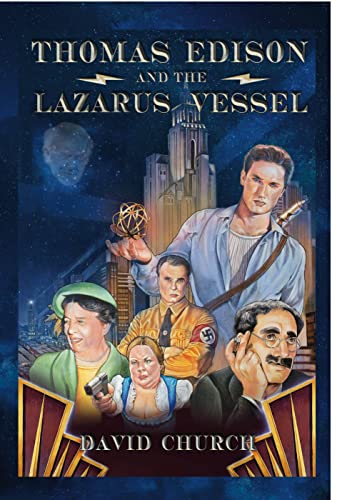
Thomas Edison and the Lazarus Vessel by David Church is a gripping page-turner. The main story follows John Dawkins, a man who, following the death of his former mentor Thomas Edison, is given a mysterious device that seems to grant him the ability to speak with the dead when he first activates it.
Two years pass, and the device never offers such a display again, leading John to think it was all in his head. That is until one day, when it unexpectedly begins to move, carving out a message telling John to find a former associate of Edison’s who has been kidnapped. This leads John on a thrilling journey to discover the secrets Edison left behind before they fall into the wrong hands.
This creative historical fiction book offers an entertaining alternate history starring many of the big names of the 1930s. Edison is, of course, a major character, but we’re also introduced to such memorable personalities such as George Gershwin, Groucho Marx, (both of which I feel don’t show up enough, if at all, in historical fiction novels) and the Roosevelts.
I would call this a historical thriller with some sci-fi and fantasy here and there that twist the story in fascinating directions, but so much is encompassed that it frankly seems to defy the traditional genre. The comedic moments sprinkled throughout earned a fair amount of chuckles from me, and there were even a few scenes I would classify as being genuinely effective horror. This occasionally creates some tonal issues, but nothing that diminishes the quality. I appreciate the writer’s ability to move between those moments and include them in one story.
The characters were written in such an engaging way that I wish we had gotten to spend more time with a few of them, which I think would have helped eliminate any trace elements of tropes and alleviate any issue with ‘fridging’ readers might notice. This is a sequel, but the story definitely stands on its own. The author also included just enough background information that readers will be able to follow the general setup, though not in a way that would be intrusive to anyone who has followed the series from the first amazing book.
I highly recommend Thomas Edison and the Lazarus Vessel to anyone looking for a fun and action-packed romp through 1930s America.
Pages: 270 | ASIN : B0BT4874XW
An Incredible, Untold Story
Thomas Edison and the Purgatory Equation tells the story of Edison’s greatest invention and the struggle for the soul of mankind in the dead zone. What was the inspiration for the setup to your story?
One day, I accidentally learned that Edison had tried to create a machine that would communicate with the dead. A lightbulb literally flashed over my head. This forgotten bit of history had the makings of an incredible, untold story. Intrigued, I contacted the Edison estate in Fort Myers, Florida and the docent confirmed that, yes, Edison had attempted to invent just such a machine. I began my research and learned that his ‘attempt’ lasted more than several decades. As I began plotting out a timeline, two items caught my attention. In February of 1918 the United States was preparing to officially enter World War I – and Edison disappeared for the entire month. Once I locked those elements in, all the other details fell into place.
Your characters are interesting and fun to follow. What were some driving ideals behind your character’s development?
In 1918 Edison was 71 and too old to serve as a traditional action hero, so I relied on the formula of the Four B’s for my primary characters: Brains (Edison), Brawn (John Dawkins, his heroic young assistant), Beauty (Emily Auburn, a Ziegfeld Follies showgirl), and Best Friend (the teenaged George Gershwin who is Emily’s musical accompanist.) The mix makes for a lively quartet as each of them brings their perspective and often surprising resources to the quest. Because they’re willing to confront their challenges with valor, each of them finds what they need most: Edison: insight; Gershwin: confidence; Emily: true love; and John: faith.
This seems like a fun book to write. What scene did you have the most fun writing?
The great thing about writing historical fiction is that the history itself often confirms your speculative choices. Writing the novel was a pleasure; the action sequences spoke to the ten-year old boy in me and the contemplative scenes spoke to an emotional truth any writer aspires to. But my favorite scene is the one in which Edison relates an actual event from his youth which I believe was his defining, psychological moment. He had been hired to deliver a telegram to a remote, countryside location in the middle of the stormy night and became lost. He was terrified but forced himself to complete the task, and later comes to realize his entire life has been dedicated to ‘lifting the darkness.’ The night, deafness, ignorance, death–all forms of darkness.
What is the next book that you are working on and when will it be available?
This is a trilogy, so my next book will be the second edition in the series: Thomas Edison and the Lazarus Vessel. It takes place in 1933 and is more fantastic, although still grounded in the backstory of history, with new characters including Groucho Marx, Eleanor Roosevelt and Deputy Fuhrer Rudolph Hess. As for Edison, he died in 1931 but finds a way to come back, via an accidental discovery he makes during his real-life experiments with the untapped potential of rubber. The launch is currently scheduled for November, 2022, and you can visit http://www.edisontrilogy.com for updates.
Author Links: Amazon | GoodReads | Website
THOMAS EDISON AND THE PURGATORY EQUATION

Thomas Edison and the Purgatory Equation is the popcorn movie of novels. Reminiscent of Flash Gordon, Indiana Jones, and The Mummy (1999), Thomas Edison and his crew of adventurers spring from action-packed set piece to set piece in this historical fiction novel. Set during the first World War, Edison is joined by former soldier and scientist John Dawkins, show girl Emily Auburn, and –somehow– George Gershwin, as they try to foil a German plot to destroy America’s war efforts. Armed with Thomas Edison’s inventions and knowledge, the quartet must protect what may be his greatest invention yet: The Resurrector.
Author David Church weaves a violent and at times old-fashioned tale. It made me nostalgic for the action films of the 80’s and 90’s. The characters bounce from one fight to the next, killing German agents in spectacular fashion all along the way. Church is very good at describing the physical action, giving a gutsy chronicle of each fantastical encounter. The bad guys have appropriately evil names, like Captain Krill and Colonel Wilhelm Skinehardt. The Germans are basically mustache-twirling cartoon characters, making them the perfect fodder for Edison and his team.
This is a very fast-paced novel that is absolutely jam-packed with bloody action. While I enjoyed the characters, I felt that they only have enough depth to carry the conversation to the next battle. The role of Emily, the sassy leading lady, is loved by the main character and is lusted after by pretty much everyone else. Conversations of faith and science come up at points throughout the book but the discussions are focused on getting to the next big, exploding, thing–and that absolutely works for a book like this.
Thomas Edison and the Purgatory Equation is unadulterated fun. Thomas Edison as an action hero is something I never would have thought of, but author David Church has turned him into one that readers will love to follow. This is a historical action adventure novel that moves at breakneck speeds and never forgets to entertain the reader.
Pages: 333 | ASIN: B09QBR4PY6



 LITERARY TITAN