Blog Archives
Love, Loyalty, and Moral Choice

The Accelerates: Forty Days to Dust follows a genetically engineered child and his teenage brother and protector, who struggle to survive in a post-apocalyptic society that is in collapse. What was the inspiration for the setup of your story?
Years ago, in a shopping mall, I watched a boy, perhaps seven years old, aggressively demanding something from his parents. When they refused, he lay down on the floor and began pounding it with his arms and legs. That image stayed with me and led me to wonder what the world would look like if children were born fully developed and, within forty days, began demanding from adults their jobs, homes, and everything earned over a lifetime. I noted the idea without knowing where it would lead.
My wife and I both grew up in households rooted in love and devotion to siblings, and we raised our two sons the same way. I have one brother, three years younger than me. Growing up in the former Soviet Union, the streets were tough, and we learned early to watch each other’s backs with loyalty and care. Now, in our seventh decade of life, that bond remains unchanged. I also witnessed the same devotion among my wife and her four siblings.
A few years ago, a tragedy struck our family when my wife’s oldest brother passed away in his mid-fifties. After his death, my thoughts returned to childhood, especially to memories of a young boy’s devotion to his baby brother during a serious illness. From there, imagination took over, and the emotional core of the story formed.
When I took early retirement, I finally had the time to do what I love most, telling stories on canvas, on paper, and through words.
That is why I dedicated this novel: For the ones we love, and for those in memory.
The supporting characters in this novel, I felt, were intriguing and well-developed. Who was your favorite character to write for?
All the characters are drawn from my family, so choosing a single favorite is difficult. Leo is inspired by my younger brother and by my brother-in-law, who passed away in his mid-fifties. Ethan reflects both my brother-in-law and myself. Clara is based on my wife’s older sister, as well as my wife. Mia is inspired by my niece.
Writing these characters felt less like invention and more like remembering. Each one carries a piece of someone I loved, which made them especially meaningful to bring to the page.
What were some themes that were important for you to explore in this book?
Many of my family members are doctors, including my wife, my older son, my brother-in-law, my sister-in-law, and her two sons, as well as many close friends. Because of this, I have spent years surrounded by conversations about moral and ethical questions in our society.
Those discussions shaped the heart of this novel. The most important themes I wanted to explore were morality and ethics, along with love, devotion, and family loyalty. In a collapsing world, I wanted to ask what values remain, and how human responsibility toward one another survives when structures and systems fall away.
What is one thing that you hope readers take away from The Accelerates: Forty Days to Dust?
I hope readers come away with a renewed sense of responsibility toward one another. In a world that often feels fractured and rushed, I wanted to remind readers that love, loyalty, and moral choice still matter, especially in times of collapse. If the book leaves them thinking about how we care for family, protect the vulnerable, and honor memory, then it has done its work.
Author Links: GoodReads | Facebook | Website | Amazon
When Clara gives birth to Ava, a genetically altered child, the echoes of a failed experiment ripple across time.
Leo is one year old, trapped in a five-year-old’s body, carrying the mind of someone a century old. Fragile, brilliant, haunted, he bears the weight of humanity’s final gamble.
Beside him stands Ethan, his reluctant protector, and Mia, hardened by loss and fury. Together, they scavenge what’s left of a world that forgot how to breathe. But in the shadows, a presence waits. Ava, part girl, part code, all vengeance, hunts them from the fire they tried to escape
Time is unraveling. The infected dream in equations. And every breath could be their last.
The Accelerates: Forty Days to Dust is a poetic, post-apocalyptic reckoning: part genetic horror, part elegy, part love letter to the children grown too fast.
For readers who believe memory is a weapon worth wielding.
Arid


Arid follows Joshua and a dwindling band of survivors who struggle to stay alive in a scorched wasteland where water is nearly gone, and hope feels just as scarce. The story opens with violence and fear and then tumbles into a tense rhythm of hunger, grief, and desperate choices. What begins as simple survival slowly grows into a harsh portrait of a world ruined by greed and war. The plot moves fast. The danger grows even faster. Every chapter places the characters on thinner ice, or really, thinner sand.
I was pulled into the raw emotion of the group. The writing surprised me with how blunt it was. It hits hard without dressing anything up, and it carries this grim honesty that kept me hooked. The world feels brutal and close. I caught myself clenching my jaw as the characters scraped by on scraps and bad luck. The book plays with fear and loyalty in a way that feels relatable. Even when the dialogue gets sharp or rough, it has this realness that fits people who have nothing left to lose.
I had mixed feelings about the pacing at times. Moments of danger slammed into moments of tenderness so fast that I felt a little off balance, but in a strange way, it worked. Life in a dying world would probably feel exactly like that. What I appreciated most was how the story leaned into relationships. Watching Joshua push himself past exhaustion made me feel for him in a deep way. The book never lets you forget how fragile everyone is. It never lets you relax, either. I liked that, even though it made me anxious along the way.
Arid feels like a story for readers who enjoy emotional survival tales that stay raw and gritty. It suits anyone who wants characters who fight with heart, make mistakes, and keep going even when the world seems determined to crush them. Arid reminded me a bit of The Road because both stories paint survival as a harsh grind, yet Arid feels more like watching a tight-knit group unravel, while The Road follows a quieter and more intimate struggle. If you like dystopian fiction that leans into both hope and heartbreak, this book will be a good fit.
Pages: 272 | ASIN : B09L6QF2XV

The Accelerates: Forty Days to Dust


The Accelerates: Forty Days to Dust is a post-apocalyptic science fiction novel about a world collapsing under the weight of a genetic disaster. It follows Ethan, a teenager trying to protect his rapidly aging baby brother Leo, whose accelerated growth is part of a larger outbreak created by GeneCorp. As society unravels, the story weaves through multiple characters and timelines to show how the world ended and what tiny, flickering pieces of hope might still remain.
The writing is intense, sometimes brutal, but always meant to push you deeper into the emotional core of the story. I kept feeling pulled along by Ethan’s quiet determination and the surreal horror of watching children become both victims and agents of destruction. The author leans hard into sensory detail, and while some moments feel almost overwhelming, they also give the story its heartbeat. Scenes like the hospital sequence with Clara and her daughter are vivid enough that I had to pause and breathe before moving on.
The shifting viewpoints create a mosaic of grief, fear, and stubborn love, and even though the world is crumbling, the relationships feel grounded. I was especially struck by how the book treats childhood. The accelerated children aren’t simple monsters. They’re mirrors held up to human ambition, or maybe human negligence, and that choice keeps the story from slipping into a standard “virus apocalypse” plot. There are moments that feel almost mythic, especially later in the book as characters begin to understand what Leo represents, and those moments give the bleakness a strange, luminous edge.
This is a heavy story, but it’s also a hopeful one in its own quiet way. I’d recommend The Accelerates: Forty Days to Dust to readers who enjoy emotionally driven science fiction with dystopian and horror elements. If you like stories that explore both the collapse of a world and the fierce love that refuses to disappear with it, this one will speak to you.
Pages: 325 | ASIN : B0F6HMC3SW

The “Hard Question”

The INCARNEX Rebellion follows a scientist and the girl he is raising in hiding as they try to survive the aftermath of a Britain reshaped by mind-transferring technology. Where did the idea for this novel come from?
The idea began with the “hard question” in consciousness theory, which asks where consciousness truly resides. Is it biological, something created by the mind and body working together, or something that exists beyond our physical form? That led me to wonder what happens in the moments after death and when exactly consciousness disappears.
Of course, if we ever discovered exactly where consciousness exists, someone would inevitably try to control it. That idea formed the core of The INCARNEX Compound, where resurrection is possible but comes with consequences.
For The INCARNEX Rebellion, I wanted to take things a step further. A company that could restore consciousness into a new host body would no doubt eventually try shifting it between bodies. Body-swapping is a classic sci-fi trope, but I wanted to explore it from a different angle, asking what happens when consciousness itself becomes something that can be transferred, stolen, or turned into a weapon.
The science inserted in the fiction, I felt, was well-balanced. How did you manage to keep it grounded while still providing the fantastic edge science fiction stories usually provide?
Thank you. That balance was something I worked hard on. My approach was to let the science serve the characters instead of overshadowing them. At its core, the story is about David and Celia and the people they join along the way. Their emotional journey keeps the technology grounded. If the characters feel real, the science feels more believable as part of their world.
I also made sure that INCARNEX had limits and real-world implications. These flaws helped keep it realistic and also added pressure and urgency to the story. The science needed to feel like a step forward from what we understand today, not something so advanced that it loses connection to reality.
What is the most challenging aspect of writing a trilogy?
The biggest challenge for me was developing character arcs that felt authentic across all three books. The events of the first novel have long-term consequences, and I needed to reflect how those experiences shaped everyone’s goals, fears, and choices in the second book. I did a lot of reading on trauma and psychology to help keep those reactions believable.
Another challenge was keeping everything cohesive while still escalating the stakes. I had to blend action, science, and character development into one larger narrative that still allowed the second book to stand on its own. It was a difficult balance but has also been one of the most rewarding parts of writing the trilogy.
Can you give us a glimpse inside the final installment of the INCARNEX trilogy? Where will it take readers?
Certainly. The final book is titled The INCARNEX War. Britain has split apart, and the events of the second book have pushed the country into full-scale civil war. David and the rebels lead the south, while the north is controlled by a regime built on fear, control, and ruthless ambition. It becomes a classic struggle of fascism and corporate power on one side and the hope for freedom and liberty on the other.
But war is not the only threat. A terrifying discovery forces the characters to confront choices far more difficult than they expected. They are no longer fighting only for freedom but for the survival of everyone touched by INCARNEX. A few familiar faces return, old rivalries resurface, and the stakes rise to their highest point.
Readers can expect a dramatic and intense conclusion, with twists, sacrifices, and the largest war dystopian Britain has ever seen!
David Harris has spent years in isolation, desperate to protect his adopted daughter Celia. But when his technology is weaponised in horrific new ways, hiding is no longer an option.
As Celia flees to New London, determined to take vengeance on the man who murdered her mother, David faces an impossible choice: join the rebels’ brutal scorched earth campaign and risk becoming the very thing he’s fighting, or lose Celia and any hope of a normal life.
Hunted, deceived, and pushed to their limits, both are forced towards lines they swore they’d never cross. To defeat a monster, they may have to become something worse.
The INCARNEX Rebellion
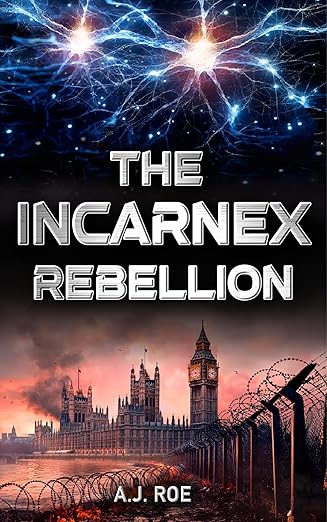
The INCARNEX Rebellion, by A.J. Roe, is a dystopian sci-fi adventure about a fractured Britain, a world reshaped by a mind-transferring technology called INCARNEX, and two people trying to survive its aftermath. We follow David, a reluctant scientist carrying the weight of his past mistakes, and Celia, the sharp, stubborn girl he’s raising in hiding. When Celia runs away to confront the man responsible for destroying their lives, everything spirals into a collision with rebels, corrupt leaders, and a system built to keep ordinary people powerless.
The writing stays close to the characters, especially in the early chapters, where we see the quiet rhythms of life at the cottage and the messy push-and-pull between David’s fears and Celia’s hunger for freedom. I liked that the writing doesn’t feel rushed. It lets moments breathe, even the simple ones like a missed step on the stairs or the silence between two people who care but can’t quite say so. When the action hits, it hits hard. There’s a grit to it that matches the world: street gangs armed with acid, labour camps, and collapsing governments. The scenes are vivid without feeling showy, which kept me invested rather than overwhelmed.
What stood out most was how the author handles the ideas behind the plot. The INCARNEX technology could’ve easily become a cold, high-concept gimmick, but instead it’s tied to identity, memory, grief, and the messy ways people try to fix what’s broken. David’s guilt and Celia’s anger feel real because they’re rooted in that same question the book keeps circling: what do we owe each other when the world falls apart? The political threads, especially the growing fractures between cities and the power struggles after Julius’s downfall, add a believable weight to the stakes without losing the human focus. Even the final scenes feel grounded.
By the end, I found myself caring about these characters more than I expected to. The story balances tension with warmth, and even in its darkest moments, there’s an undercurrent of stubborn hope. If you enjoy character-driven dystopian science fiction with a mix of action, moral questions, and emotionally messy relationships, The INCARNEX Rebellion will sit comfortably on your shelf. It’s a great pick for readers who like stories about rebellion but want them told through the eyes of people who never planned on becoming heroes.
Pages: 315 | ASIN : B0FX3F2C3W
They Could Be Saviors
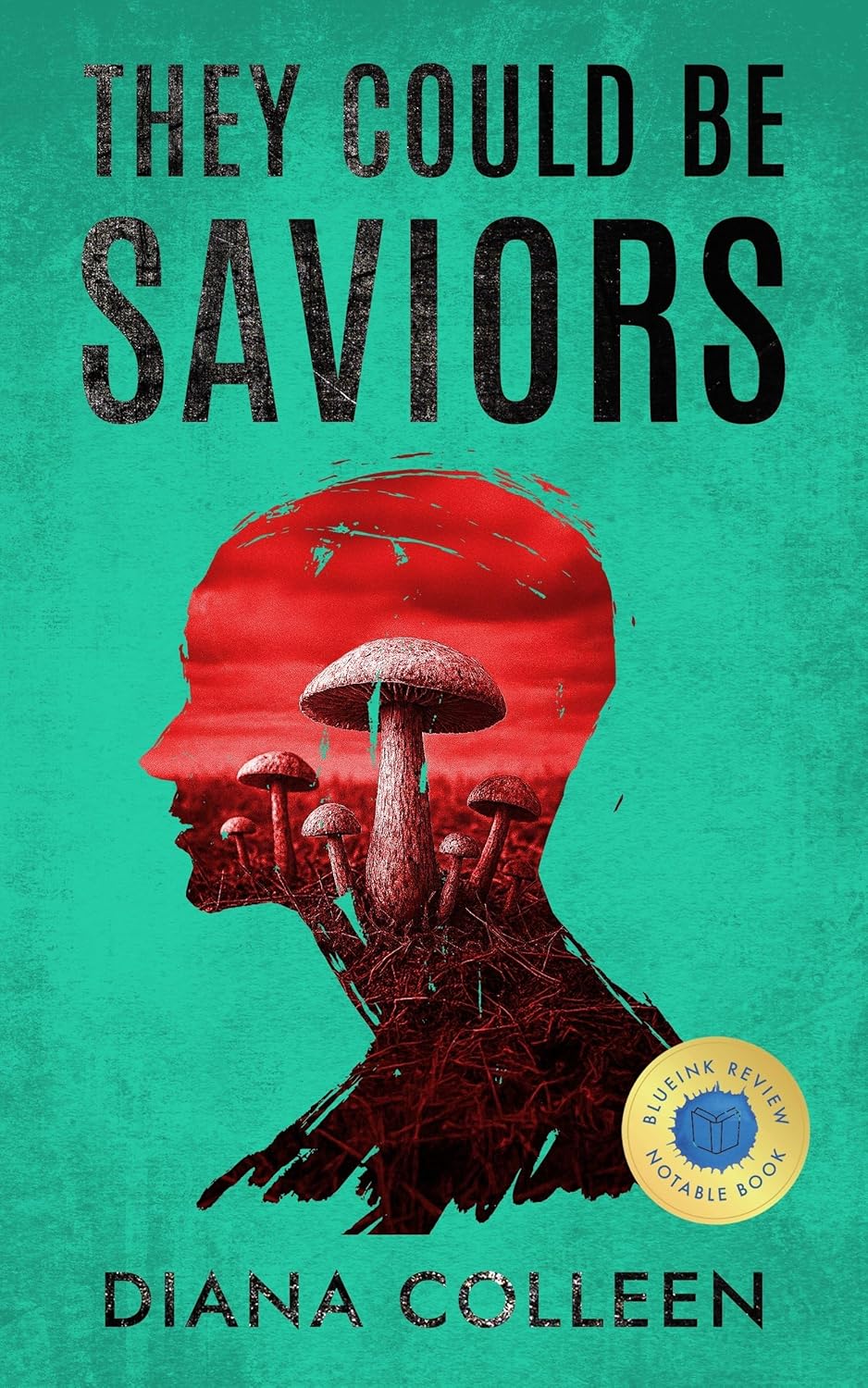
They Could Be Saviors is a wild and thought-provoking novel that blends psychological suspense with biting social critique. The story follows a group of billionaires kidnapped by a secret network of women, psychedelic therapists who believe the only way to save the world is to dismantle the egos of the men destroying it. As the captives awaken inside a high-tech facility designed for “healing,” the line between therapy and punishment blurs. It’s a heady mix of moral reckoning, hallucinatory experience, and social rebellion wrapped inside an eerie psychological thriller.
The premise sounds almost absurd at first, but author Diana Colleen sells it with conviction. Her prose crackles with sharp edges, alternating between satire and sincerity. The early chapters, especially those inside Josh Latham’s ruthless corporate mind, feel uncomfortably real. There’s a cold humor in watching a man who’s weaponized “sustainability” for profit wake up in a place that forces him to face himself. The writing feels cinematic yet claustrophobic, like being locked inside someone’s fever dream. At times, I felt disturbed, at others, unexpectedly moved. The story doesn’t let you sit comfortably, it pokes, prods, and dares you to care about people you’d rather despise.
What really grabbed me were the emotional undercurrents beneath all the sci-fi and social commentary. Mel, the therapist leading the operation, is a fascinating mess of empathy and control. Her struggle with addiction, grief, and idealism feels painfully human. I found myself torn between admiring her conviction and fearing her delusion. The women’s mission, noble on paper, curdles into something obsessive. Still, I couldn’t look away. The book doesn’t spoon-feed morals. It leaves you wrestling with big, ugly questions about power, redemption, and what “saving” the world might actually cost. The language swings from lyrical to brutal, sometimes in the same paragraph, which made it both exhausting and exhilarating to read.
If you like your fiction clean and uplifting, this one might rattle you. But if you’re ready for a raw, provocative trip into the psyche of our times, this book is worth every page. I’d recommend They Could Be Saviors to readers who crave stories that take risks and don’t shy away from moral gray zones. Fans of Black Mirror, Margaret Atwood, or Chuck Palahniuk will probably devour it.
Pages: 349 | ASIN : B0FP5X958N
A Confounding World
Not Yet Your Time follows a self-deprecating office worker whose mundane New York life derails after a near-death encounter with a mysterious woman, leading him to question everything he knows about time, fate, and faith. What was the inspiration for the setup of your story?
I have always felt that the best drama or comedy follows from individuals being placed in situations for which they are utterly unprepared. (Being trapped on Everest while climbing is not the same as crash landing on Everest in your swim trunks) I have also always had the sneaking suspicion that our history, our myths, and the foundations of our culture are on very wobbly grounds. Finally, as someone who spent a full career in marketing, I know that reality is just a press release away from changing.
I found Titus to be an interesting character who gets pulled into a strange situation and manages to adapt despite everything that happens to him. Were you able to achieve everything you wanted with the characters in the novel?
When I embark on creating, in effect, an entire world, I need a central character to react to, digest, and pass through it. I needed Titus to be that person. I gave him the vulnerabilities and hidden strengths to attempt to deal with a confounding world that has sucked him in against his will, only because he was attracted to a mysterious woman. I was also pleased with Kanenas, my, in effect, flawed and reluctant messiah. A good man with ideas, totally unprepared for the greatness that is hung on his shoulders. (Inside secret) I patterned him after the attitude and speech mannerisms of the late actor Peter O’Toole, also a great and deeply flawed person.
I found this novel to be a cutting piece of satire. What is one thing that you hope readers take away from your novel?
Absorb all you can in life from as many sources as you can tolerate because no one person or philosophy has all the answers.
What is the next book that you are working on, and when can your fans expect it to be out?
The world’s greatest historian has a dark secret. He travels back in time and gets deathbed confessions from great figures in history. A Gesture to the Wind is narrated by the historian’s unsuspecting assistant, who is drawn into a world of illegal historic relic dealers, Russian spies, EPA investigators, and the Battle of San Juan Hill, all while developing a deep and abiding friendship with a time-displaced Ben Franklin. (As you can see, I’m having fun.)
Author Links: GoodReads | X (Twitter) | Facebook | LinkedIn | Website | Amazon
This odd trio embark on a perilous odyssey that includes imprisonment in a labyrinthine security complex under the ruins of the World Trade Center; flight through a murky unfinished tunnel beneath the Hudson River, a safe house masquerading as a defunct museum; and a perilous train ride to link up with a terror cell. Ultimately, the reluctant Titus will face a rendezvous with life, love, death, and destiny in the green wilds of New York’s Hudson Valley.
What Might Be Possible

Dark Place centers around three students who stumble on an unsettling truth that society is being manipulated, and those labelled as “dispossessed” are being erased from existence. Where did the idea for this novelette come from?
I wanted to develop a near-future story in which a worldwide authority invokes extreme emergency powers to control a burgeoning population, resulting in the loss of freedom and rights.
The idea of a hidden penal colony came to mind, and a social scoring system would be the mechanism to segregate and banish the dispossessed.
My writing of the story started as a typical dystopian trope, but as it grew, I didn’t want it to be stark black and white: ‘good’ idealistic rebels versus ‘evil’ authority. So it becomes more nuanced when the three protagonists are stranded in the Dark Place and learn that it has a greater purpose with profound consequences. The protagonists must navigate not only external dangers but also their own internal struggles, confronting differences between themselves and moral dilemmas.
Dark Place has been described as subverting dystopian tropes and I hope readers find that rewarding.
What are some things that you find interesting about the human condition that you think make for great fiction?
There is a degree of anxiety in the world today about the future. Perhaps every generation in the past has had similar misgivings.
My intention is to write about what might be possible a few steps down the road. I don’t want to write far-future settings with fantastical technologies far removed from what we have now. Grounding the story in a familiar world, echoing some of today’s challenges, has more resonance.
The science inserted in the fiction, I felt, was well-balanced. How did you manage to keep it grounded while still providing the fantastic edge science fiction stories usually provide?
A lifelong interest in the societal implications of technology began in the 1980s when I taught the new technologies of microelectronics and microcomputers in colleges and universities. This early professional life directly influenced my creative pursuits, leading to my first story Larrs’ Ghost (published in a computing magazine) which explored a “computer-generated world” long before virtual reality was a common term. More recently Close To You is a cautionary tale about the imminent dominance of big corporations developing ever more powerful artificial intelligence and virtual reality.
Dark Place is set in a time just down the road from now, so the technology is a plausible extension of today: drones are becoming more advanced; flexible microelectronic circuits (I call them membranes) already exist in rudimentary form; AI is advancing at speed.
Can we look forward to more work from you soon? What are you currently working on?
I feel there’s a lot more to develop with the premise of Dark Place. Although the ending finished with a profound reveal, I deliberately left some aspects of the story open-ended that mirrors the uncertain future facing the characters and the broader society. The lack of a neat, conclusive resolution hopefully encourages readers to reflect on the story’s themes beyond the final page.
So now I’m working on parts two and three. Part two is how the people in the camps progress in the knowledge that the outside world is in total collapse and how they rise to the challenges they face. Part three is how they defend themselves from an external existential threat. How much will they fall back on technology to protect their new world? The three protagonists will have increasingly conflicting ideas on how they see their future world.
Author Links: Facebook | Website
In a near-future world ravaged by resource depletion, society is controlled by the Authority, which enforces a strict social credit system. Failure to maintain a high enough score means banishment to the mysterious “Dark Place.”
When three inquisitive students, Ros, Femke, and Domhnal, discover that parts of a hidden Earth have been concealed from the privileged population of the “Light Place,” they are determined to expose the Authority’s brutal culling system. To do so, they must intentionally lower their scores and enter the Dark Place, only to discover it holds secrets far more profound than they ever imagined.
Dark Place is a gripping novelette that transcends typical dystopian narratives. Praised for its compelling dialogue and nuanced characters, a testament to author Christopher Kell’s experience as an award-winning playwright, the story is a masterful exploration of moral ambiguity, technology’s ethical implications, and the enduring resilience of the human spirit. It is a thought-provoking journey that invites readers to reflect on the nature of freedom, the quest for truth, and what it truly means to survive. This powerful and multi-layered examination of contemporary issues through a dystopian lens is a key element of the novelette’s intellectual value and demonstrates the author’s ability to imbue a short work with significant philosophical weight.


