Blog Archives
Forgiven: A Novel
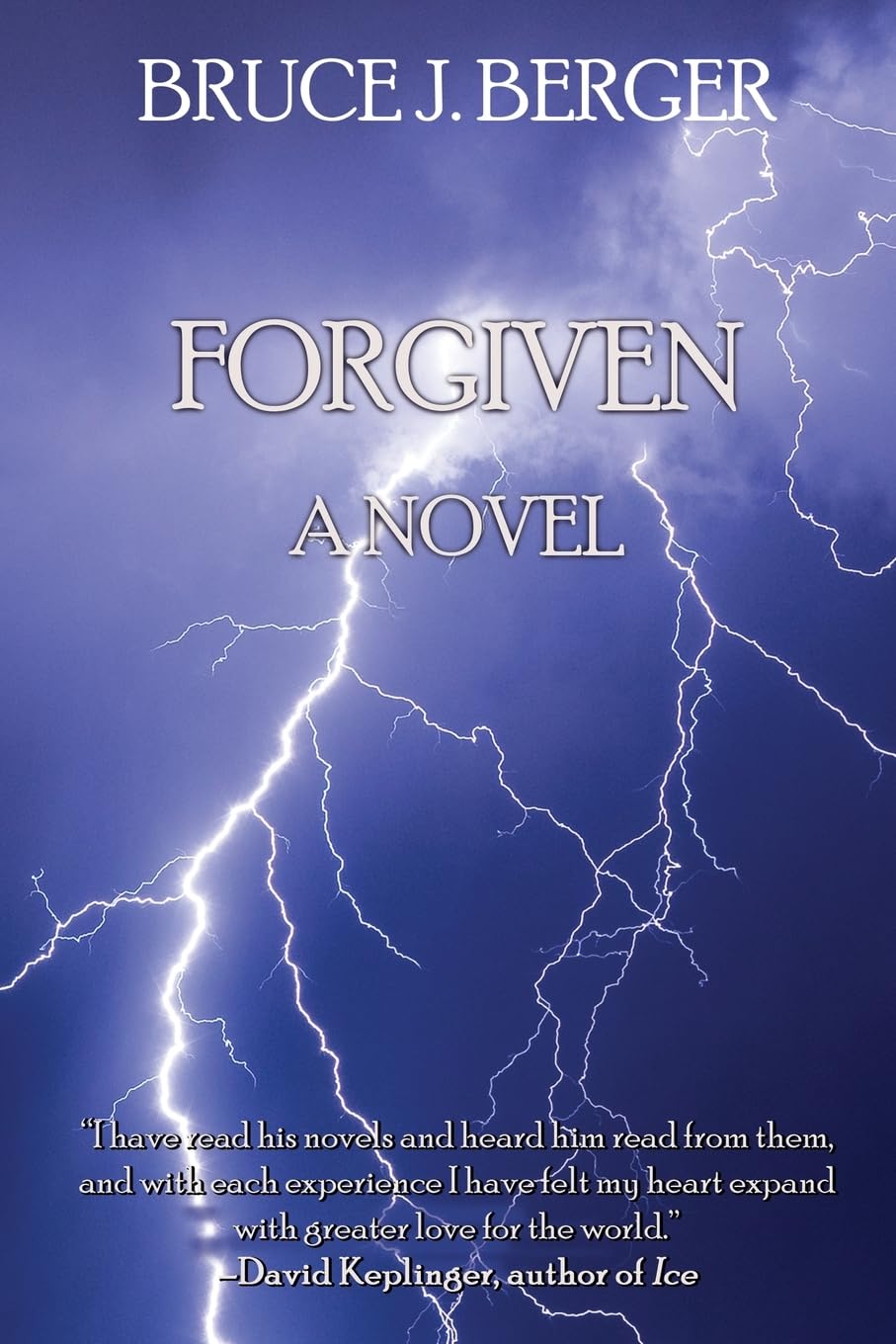

Forgiven tells the story of the Covo family as they face overlapping crises that test faith, morality, and love. Nicky Covo, a Holocaust survivor and aging psychiatrist, is sued for malpractice after a former patient’s suicide. His wife, Helen, grieves her dying daughter. His daughter, Kayla, wrestles with schizophrenia, creative paralysis, and religious doubt. His son, Max, struggles under career pressure. And hovering above them all is Sister Theodora, Nicky’s sister and a nun in Greece, who tries to heal her fractured family through faith. Across continents and faiths, the book explores guilt, forgiveness, and the ways suffering reshapes belief.
Reading this book felt like stepping into a storm of emotion. I admired the quiet power in the writing. The prose is unhurried but charged with feeling. I liked how the story moved between the ordinary and the sacred, between New York apartments and Greek monasteries. The characters felt raw, sometimes painfully so, and I often found myself wincing at their honesty. Nicky’s battle with disbelief hit hard. His bitterness toward God made sense, and his eventual return to faith felt earned. Kayla, though fragile, had a haunting beauty in the way she sought meaning through music. The dialogue felt real, especially in its awkwardness, and I appreciated that the author didn’t clean up the messiness of family life.
There were moments when the narrative lingers on introspection or theological debate. Yet, I can’t say I minded much. There’s a rhythm to the book. The writing is filled with quiet compassion, and by the end, I felt changed. Forgiveness here isn’t cheap. It’s painful, slow, and human. That truth stayed with me.
Forgiven reminded me of the emotional depth and moral searching found in Marilynne Robinson’s novels, especially Gilead, with its quiet struggle between faith and doubt wrapped in the tenderness of family love. I’d recommend Forgiven to readers who like stories that sit heavy in the heart. It’s for those who’ve doubted, who’ve loved someone they couldn’t save, or who’ve wondered where God goes when life falls apart. It’s not a light read, but it’s a good one.
Pages: 337 | ASIN : B0FHXML7BD

Betrayal of a Sudden Death
Last of the Autumn Rain follows a woman who witnesses the death of her best friend in a tragic nightclub accident, causing her to spiral into a psychological journey that touches on abuse, betrayal, obsession, and revenge. What was the inspiration for the setup of your story?
My best friend committed suicide, and my ex-boyfriend tried to murder me. I wanted to take those external events to explore the raw aftermath of sudden trauma.
What are some things that you find interesting about the human condition that you think make for great psychological fiction?
The fact that humans are often their own worst enemies and have a skewed perception of reality is a goldmine for psychological fiction. A character’s memories can be distorted by trauma, guilt, or self-deception, which creates suspense and forces the reader to question everything they’re being told.
What were some themes that were important for you to explore in this book?
(1) Betrayal: It’s not just the betrayal of a sudden death, but the suspicion of deeper betrayals that drive the plot. (2) The Unreliable Self: The protagonist isn’t just an unreliable narrator for the audience; she’s unreliable to herself. Her memories are suspect, her perceptions are skewed by trauma, and she struggles to differentiate between paranoia and genuine threats, and a search for justice. (3) Search for Justice: Can earthly justice truly be served when the motive is fueled by obsession and a distorted sense of reality?
Will there be a follow-up novel to this story? If so, what aspects of the story will the next book cover?
Last of the Autumn Rain: The Storm Within is Book 1 of a trilogy called the Broken Reflections Series. Book 2 of the series is titled A Twisted Crucible: The Riddle of the Ruined Soul, and Book 3 is titled Game of Souls: The Reckoning. A Twisted Crucible is a chilling tale of what turns out to be a serial killer’s descent into darkness and a father’s agonizing choice. Game of Souls is a poignant exploration of grief, guilt, and the human capacity for redemption through the eyes of a father. It probes the depths of the human psyche, examining the power of ancient rituals and the transformative potential of psychedelic experiences to seek healing and enlightenment.
Author Links: GoodReads | Facebook | Diane Webb | Diane Louise Webb | Amazon
Her life ignobly snuffed out at the young age of 32, Candice exemplified a fun-loving lifestyle and a warm kindred spirit—possessing all the requisite traits for a promising future. She never entertained a trace of ill will toward anyone. How could something so grisly happen to such a compassionate, enchanting human being?
Julie struggles to make sense of it all, reminiscing as she travels back to her hometown of Trenton, New Jersey. The two had met in Milwaukee and worked as underwriters for The Walden Company. But something went horribly wrong. Julie’s journey is one filled with elation and fear, jealousy and regret, happiness and indignation, and a horrifying act of disloyalty.
An unforgettable, tumultuous ride, Last of the Autumn Rain delivers an introspective and jaw-clenching tale, which not only rocks one’s moral compass, but invites a chilling question: in a world where the ground can literally fall out from under you, what else might be lurking beneath the surface?
Last of the Autumn Rain
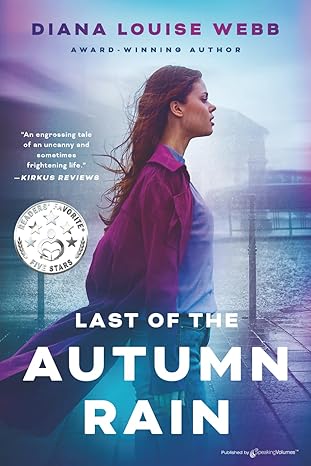

Diana Louise Webb’s Last of the Autumn Rain is an emotionally charged novel that weaves together trauma, tragedy, and mental health through the voice of a haunted narrator named Julie. The story opens with a deadly accident at a nightclub that kills Julie’s best friend and spirals into a psychological journey touching on abuse, betrayal, obsession, and revenge. As Julie revisits past experiences from her childhood in New Jersey to a near-fatal spring break trip to Mexico, she reflects on the forces that shape identity, morality, and the thin line between sanity and madness. With fictionalized events that feel brutally real, Webb holds nothing back in her mission to spotlight the stigma and neglect surrounding mental health.
The writing is sharp, vivid, and unsparing. Webb’s prose can be poetic in one moment and violently raw in the next. Her scenes of abuse and trauma are gut-wrenching without being gratuitous. I often found myself re-reading lines, not just for their emotional weight but because they caught me off guard in how directly they confronted the reader. There’s a beautiful messiness in the storytelling. Fractured timelines, flashbacks, inner monologues, and haunting hallucinations that all blend into Julie’s spiraling mental state. At times, the chaos felt overwhelming, but it always felt deliberate. It’s like the author doesn’t want you to read this passively, she wants you to feel every drop of blood, guilt, and silence.
I found myself torn over the narrator. Julie is not a reliable or particularly likable character. She is violent, self-serving, and damaged. But that’s kind of the point. I couldn’t shake the feeling that Webb was daring me to judge her. One moment, Julie is saving someone from abuse; the next, she’s casually describing a childhood act of horror with a twisted sense of pride. I didn’t always agree with the choices she made. The novel sometimes seemed to blur the line between victim and perpetrator, and I admired Webb’s courage in forcing us to sit with those contradictions. It’s rare to see a female protagonist written with this much moral ambiguity and rage. And it’s even rarer for a book to make me feel that conflicted and still want to keep reading.
Last of the Autumn Rain is not a light or easy read. It’s intense, messy, and emotionally exhausting, but in the best way. This book is for readers who crave raw truth over tidy resolution. It’s for those who have battled demons or known someone who has. I would especially recommend it to fans of Gillian Flynn or Alice Sebold, readers who don’t mind going into the darker corners of the human mind. Webb has something important to say about pain, silence, and survival, and she says it with brutal, unforgettable honesty.
Pages: 235 | ASIN : B0FGQMMC27

Freedom Highway

Priscilla Speaks follows a young girl living in poverty who is cast out of her home at sixteen, leaving her to set out on the Appalachian Trail, where she meets diverse people who help her learn about life and relationships along the way. What was the inspiration for the setup of your story?
The answer is broader than you might have anticipated. I have thru-hiked the Appalachian Trail four times, and have found each journey to be life-changing or life-affirming. As a consequence, it is an element in much (although not all) of my fiction. I find the trail to be regenerative. Most who successfully thru-hike it or even hike long sections of it feel the same. It is the total immersion that does it, having one’s ego worn down by sweat and hunger and bugs until the real you is exposed. A long weekend on the trail won’t quite get one there.
Relating to the Speaks Saga as a whole, and Priscilla in particular for the moment, during Hike 3 in 2018 I hiked into a town for resupply, a town brought closer by a trail relocation and a town I’d never been to before, in an area where rednecks were known to harass hikers, and where I’ve personally witnessed hillbillies doing some pretty bizarre things. I was struck by the despair of the place before I’d even entered the town, considering the drug paraphernalia I spotted littering the curb. Once in the town, I encountered people almost unintelligible in their speech who volunteered the most offensive racist comments to a total stranger, and many of whom sported the missing teeth and cleft lips of heavy meth addiction. I couldn’t hike out of that town quickly enough.
I pondered as I continued my hike, wondering how one could wrest oneself out of that environment, then realized that the Appalachian Trail, an actual freedom highway, lay right at their doorstep. I conceived the first novel, Timewall Speaks, within the next hundred miles, and have used the Appalachian Trail as a means of escape for every character since.
Priscilla is born into a world of poverty, addiction, and abuse, but refuses to let that define who she is or who she will become. What was your process to bring her character to life?
I knew from the beginning that Priscilla might be the most complicated character in the Saga, and I had to reimagine her a few times before I felt I’d gotten her right. The epiphany came as I was writing Chapter Two, the fight scene, her brother injured, and I knew right then who I wanted Priscilla to be. I raced back, did a lot of re-writing, made Pris autistic and fearless, had her cut off her braid (probably spoilers in this), and evolved her into an outsider in her own family. Unknown to Pris, she is more like her mother at that age than she would ever want to accept, strong, unyielding, fierce, and in her own emotionally-numbed way, proud.
What were some themes that were important for you to explore in this book?
As always, that transformation from dysfunctional to emotional health, and that people are not defined by their circumstances, but defined by themselves. I wanted to demonstrate that it is possible to escape, despite the burdens that Pris carried. I have known people in similar circumstances who have rescued themselves, so Priscilla’s journey is not a stretch.
Will this series continue in another book, or are you working on a different story?
There will be one more novel in the Saga, The Family Speaks, in which a story arc covering fifty years will be brought full circle. I intended to end it there, although I have been encouraged by many to expand the Saga to incorporate some of the secondary characters. That might happen in the future, novels in a Speaks Universe if you will, but immediately after The Family Speaks (and a fifth Appalachian Trail thru-hike), I will begin work on some unrelated novels that have been nagging me for a few years now.
Author Links: Goodreads | Website | Amazon
In Book Four of The Speaks Saga, Blaize’s second daughter, Priscilla, born during the worst of her mother’s addiction, begins at an early age to count the years until she can escape the drudgery and boredom of her dismal, impoverished life, all the while watching as her older siblings leave one by one.
Cast out on her own at the age of sixteen, Priscilla ventures forth in search of an uncertain future while grappling with her sexuality and the phenomenal capacity of her mind. Using the Appalachian Trail as a means of escape, distracted from her obsessive nature by the day-to-day trials of the wilderness, her journey thrusts her into the company of diverse people who steer her toward a fuller understanding of the complexities of life and relationships. Through confounding emotions, heartache, and moments of grace, she is forced to confront mortality, love, and loss, all pointing her toward a staggering awareness of space and time.
With deliberate cunning, Priscilla does battle on her own terms, calling forth the hardened legacy of her family as she fights against the abuses she encounters in society.
Parental Love and Support

Orphans of the Living tells the story of a family’s complicated history spanning from 1920s Mississippi through decades of poverty and social change. What inspired you to write this novel?
The novel is based on my mother’s own family, of which I knew little. But things in the past have a habit of invading us today, and the more I researched, the more I realized my mother’s lived experiences influenced my life, and my children’s lives, in ways I had not understood. Yes, this is a novel, but the skeleton, the bones of the story, are real. It is a hell of a story, and I wanted to dig deeper into it.
Can you share with us a little about the research that went into putting this book together?
I really had three sources. Here’s how they came into play, for instance, in my grandfather’s sojourn in Mexico. I had the bits and pieces my mother gave to me in her life, between bouts of addiction and mental illness, such as “My father went to Mexico to grow bananas.” I explored the vast trove of information and connection at Ancestry.com and Newspapers.com, such as records of my grandfather’s trip to San Francisco, where he took a steamer to Mexico, and a manifest for a ship that brought him and his bananas to Galveston. And the third piece was how I followed what I learned from Ancestry.com and Newspapers.com. For example, I spent a lot of time learning how bananas were grown and raised in the tropics, and how United Fruit, then one of the largest corporations in the world — owned by men from the American South — employed Jim Crow tactics to control their labor force in Central and South America. Weaving all these sources together was an act of imagination and conjecture, and that’s why it’s a novel, not non-fiction.
What were some themes that were important for you to explore in this book?
So much about this era, and these people felt so current to me: the multi-generational impact of poverty, racism, inequality, sexism; the experiences of people who were at the margins, lacking education, perhaps confused about their gender or sexual orientation, long before there was any general knowledge of these issues; the impact of Western expansion and “manifest destiny” on how average Americans in the west thought about land and success; the importance of parental love and support.
What is the next book that you are working on, and when will it be available?
I have completed a memoir that is in many ways a sequel to Orphans of the Living. She Writes Press will publish it in spring 2027. And I’m way deep into writing a third book, another novel, a near-future political thriller.
Author Links: GoodReads | Threads | Instagram | Facebook | Website | Amazon
In the shadow of the Great Depression and Jim Crow south of the 1930s, an impoverished white family escapes—with the help of Black sharecroppers—from a vengeful Mississippi plantation overseer intent on lynching them. Arriving in California to start a new life, Barney and Lula Stovall are haunted by the past, the children they’ve left behind, and the daughter they cannot love or protect.
Orphans of the Living follows the peripatetic life of the Stovall family, woven from four parallel stories: Barney and Lula Stovall, and two of their nine children, Glen and Nora Mae.
Their California sojourn—from their hardscrabble dairy farm, to the brig at the San Francisco Presidio, to the building of the Golden Gate Bridge—lead them on paths toward each other and forgiveness. But redemption doesn’t come to them all.
Connections Make the World Go Round

Before We Arrived follows three people, each marked by loss, resilience, and quiet strength, who seek refuge at a goat sanctuary; they find not only healing but also a found family. What was the inspiration for the setup of your story?
First I’d like to thank Literary Titan for the interview. I absolutely loved writing this novel and am thrilled it’s resonating with people on a deep level.
The idea for the rescue sanctuary came easily. I adore animals and the notion that they have the power to aid in the healing process for humans. ‘Herd’ species—goats, donkeys, horses, and alpacas—were chosen because they need each other as well as their human caretakers. It was also a way to inject a bit of fun into the mix with their shenanigans. I was keen to have the work volunteers live on-site, enjoying shared meals and private sleeping spaces. I’ve had personal experience with various forms of communal living and it made sense to incorporate that. I wanted King Solomon Sanctuary to serve as an interactive setting that chunks of the story arcs could pivot around. The workers have the option to come and go as they please during off-hours but most choose to stay in close proximity to one another and the animals—it’s their own special tight-knit community of second chances.
Henry, Rivka, and Jayce all come to the sanctuary for different reasons, holding onto trauma that has kept them closed off until now. What was the inspiration for the relationship that develops between the characters?
Connections make the world go round. In Before We Arrived we witness the interactions within each of the biological families, as well as between the narrators and secondary characters as new friendships are forged and old ties change shape. All three families have struggled through adversity, and we learn the details of their backstories as the chapters progress. The world can be harsh and cold, relationships complicated and messy. What are the multitude of elements that guide our path and our decisions? Can we build a meaningful life after experiencing tragedy? How do we best care for ourselves and each other? These are the kinds of questions that motivate me to create stories.
What were some themes that were important for you to explore in this book?
I’ll preface this answer by noting that I did not set out to write a book specifically about grief and resilience; that just happened organically as the outcome of each character’s story and their relationships with one another.
The novel explores questions about race/culture/identity, the short and long-term effects of personal and generational trauma, family dynamics, and issues around marginalization. I’ve also had a perennial fascination with ancestral memories, so that was layered in, along with the underlying truths about the universality of suffering and the value of connection and empathy. Naturally some of these themes overlap.
What is the next book that you are working on, and when can your fans expect it to be out?
Before We Arrived was recently released and I’m not quite ready to think about beginning a new project. Writing does energize me so another novel is within the realm of possibilities.
Author Links: GoodReads | Website
In the summer of 2005, three dissimilar people—Henry, a grieving Black landscaper; Rivka, a restless Jewish social worker; and Jayce, a guarded Indigenous archaeologist—find their lives colliding in quiet, powerful ways.
From New England to Vietnam, this lyrical novel traces their search for peace, meaning, and joy amid the rubble of personal and ancestral trauma. Lush, moving, and deeply human, Before We Arrived is a celebration of resilience, found family, and love in its many forms.
Before We Arrived is a soulful, literary journey through grief, healing, and unexpected connections. Fans of James McBride and Lily King will feel right at home.
Orphans of the Living: A Novel
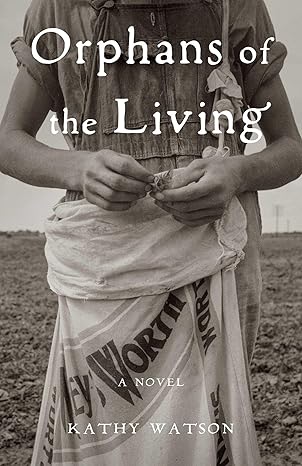
Orphans of the Living is a novel steeped in generational trauma, racial violence, and the slow unraveling of the American dream. Kathy Watson tells the story of Lula Stovall and her tangled family history, spanning from a Mississippi plantation in the 1920s through decades of poverty, migration, and social change. Lula, a white sharecropper’s wife, becomes both victim and agent in a life defined by loss and desperation. The novel, inspired by Watson’s own family, shifts between perspectives and decades, revealing how choices, often forced, sometimes chosen, echo through generations. It is part historical fiction, part personal reckoning, layered with the grit of real events and imagined truths.
Watson’s writing hits like a storm. The language is raw, unvarnished, and aching with honesty. The prose feels lived-in, like the old quilts and wood stoves that fill her characters’ homes. The pain is immediate and unrelenting. Lula’s desperate act with a piece of fencing wire early in the book stunned me. Not just because of what happened, but because of how real it felt. Watson doesn’t write for comfort. She writes to bear witness. There were moments when I had to put the book down and walk away, not because I didn’t want to keep going, but because it hurt too much to stay in the scene. That kind of writing is rare.
But it’s not just the writing that stuck with me. It’s the ambition of the book. Watson dives deep into race, class, history, and motherhood, often all at once. She gives space to the Black characters in Lula’s orbit, making sure they aren’t just there to prop up a white story. Violet Byrd, especially, is a force. Her presence radiates power and calm in a world built to crush her. The author makes the brave decision to include racist language and brutal events for historical accuracy. Nothing in this book is simple. No character is purely good or purely bad. Everyone is just trying to survive.
Orphans of the Living is not just a story about one woman’s brutal life. It’s about inheritance. What we’re given, what we pass on, and what we bury. I respected the story deeply. It’s a hard, unblinking book that left me gutted, moved, and wide awake. I’d recommend this book to readers who aren’t afraid of discomfort. If you’re drawn to stories like Jesmyn Ward’s Salvage the Bones or Toni Morrison’s The Bluest Eye, this will resonate. It’s a hard read, emotionally, but one worth sticking with. Anyone interested in Southern history, generational trauma, or the quiet violence of poverty should read this.
Pages: 352 | ISBN : 978-1647429782
Before We Arrived
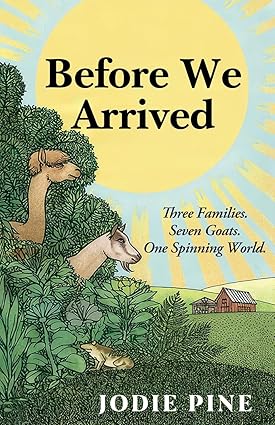
Jodie Pine’s Before We Arrived spins a beautiful tapestry of interconnected lives across time, grief, and healing. Told through alternating chapters set between 1975 and 2005, the story traces three families—each marked by loss, resilience, and quiet strength—as they find each other through fate and a shared sanctuary. A former archaeologist, a social worker, and a man recovering from injury and trauma become unlikely kin under the roof of a goat sanctuary, of all places. But it’s more than goats. It’s about second chances, and third. It’s about holding sorrow in one hand and still reaching out with the other.
As a widow, I didn’t expect this book to hit me like it did. From the very first chapter with Henry and his mangled hand, I felt my heart slide into that familiar hollow space. The line—“trying so hard to keep things light”—caught in my throat. That’s exactly what it’s like when you’re walking around with your grief zipped up under your coat. Henry’s story reminded me how healing doesn’t look like a movie montage. It’s awkward, reluctant, even a little muddy. His growth is slow but steady, like learning how to breathe again after forgetting for a while.
Then there’s Rivka. Oh, Rivka. I adored her. The way she stepped into Nina King’s quiet, grief-soaked apartment, dripping wet and uninvited, but still offering help with a kind firmness—it was deeply moving. Her voice felt familiar to me, like someone I would’ve met. Her compassion for baby David, and her refusal to flinch in the face of Nina’s silence or mistrust, showed the kind of stubborn kindness I’ve come to cherish in my own life. The moment when Nina finally lets her hold the baby? That nearly did me in.
Jayce’s chapters, especially the funeral scene and the pact he makes with his mother, stirred something in me. We can’t disappear with our dead. I loved how his archaeology background tied into the theme of digging—literally and emotionally—for what’s been buried. His arc wasn’t flashy, but it was profound. Quiet endurance. I know it well.
What Jodie Pine does so beautifully is show how people can be shattered and still be whole. There are no villains here, just folks doing their best with their pain. The prose is warm and alive, sometimes messy, just like real conversation. I chuckled more than once—especially during Henry’s first day with the goats—and found unexpected joy in the ordinary moments: Rivka eating Fig Newtons at her desk, David fixing a bike, a fox sculpture on a table. These small details made the world feel lived-in, like someone left the light on for you.
This book is for anyone who’s ever been broken open and needed help stitching themselves back together. It’s for people who are lonely but not hopeless. For readers who don’t mind stories that move like real life—with detours, overlaps, long silences, and sudden beauty.
Pages: 395 | ASIN : B0FG3L2V5Q



 LITERARY TITAN