Blog Archives
Amethyst


Amethyst is a hauntingly beautiful tapestry of poetry that weaves together identity, pain, rebirth, and the search for meaning. Divided into chromatic sections named after shades of purple, each representing a facet of human experience, the book feels like an odyssey through the inner worlds of selfhood and survival. It moves from loss and trauma to reclamation and transcendence, painting scenes of queerness, masculinity, intimacy, and existential ache. Every poem feels like a fragment of a larger confession, tender yet defiant, fragile yet ferociously self-aware. Author Fernando Rover Jr.’s voice is raw, rhythmic, and unapologetically human, like someone whispering truth through a cracked mirror.
Reading this book shook something in me. The language hits hard, sometimes uncomfortably close. There’s this honest grit in how Rover writes about love and pain, as if he’s bleeding on purpose to show that healing isn’t always graceful. Some lines feel like quiet prayers; others explode with profanity and rebellion. I love how he blends vulnerability with resistance, how “Problem Child” snarls right before “Father Hunger” breaks your heart. There’s a rhythm here that doesn’t care about convention. He’s not writing poetry for classrooms or critics, he’s writing to survive. And I felt that. The work feels alive in its contradictions, full of sadness and rage, yet bursting with this strange hope that we can build beauty from our bruises.
But what struck me even more was how Amethyst feels like both a mirror and a map. It asks hard questions about who we are when the world makes us feel unworthy. Sometimes it feels like a séance with the self, a way of calling lost parts of you back home. I caught myself rereading lines just to let them sting again. The collection is fearless in its queerness and in its refusal to make trauma tidy. There’s humor in the mess, too, and flashes of warmth that feel earned.
I’d recommend Amethyst to anyone who’s been cracked open by life and wants to believe that brokenness can still be beautiful. It’s for readers who crave raw emotion and unfiltered truth, who don’t mind getting lost in someone else’s chaos to find their own calm.
Pages: 67 | ASIN : B0FX9F4Y41

Maverick

Maverick, by Fernando Rover Jr., presents its purpose upfront in a crisp, cohesive, and certain manner—a moment of pre-contextual deliberation before readers are asked to take the plunge into this elaborate body of work.
Plain, generic titles served alongside poems constructed with intensity and intricacy serve as self-portraits of the complex human crushed beneath the burden of their role in corrupt society—the consequence of what occurs when a person is made to be seen as a laborer first and a human second.
The theoretical backdrop of this book, use of monochrome and modern design, and ability to blatantly state its arrival, presence, and pursuit is among the numerous elements that make Maverick worth reading. The specifics of its contents are powerful and thought-provoking. The stanzas and line breaks are phenomenal tools for allowing the breath of a poem to speak for itself.
Maverick isn’t a text of trickery, nor one of intellectual flexing and self-gratification. It isn’t written or compiled to impress the sea of nameless, faceless coffeeshop hipsters contemporary artists are pressured to indulge. Rather, it’s monochrome. It’s black, and it’s white. It’s text, and it’s art. It’s graphic design. It’s multimedia. Most of all, it is a calling out of capitalism, as well as all the ways in which we, as humans, are not only forced to survive under it but have actually become so accustomed to its vile lore that we have forgotten our own.
Maverick is an extraordinary work of poetry and art that gives the reader a chance to look into themselves and experience the message the author is presenting. In capitalistic fabrication, we lose our own authenticity — and that, in its most genuine essence, is what Maverick exists to call out and rebel against. I highly recommend this stimulating read for those who are looking for a creative outlet.
Pages: 100 | ISBN : 0578378868

The Uncomfortable Freedom

Labyrinth is a collection of poetry that illustrates Black masculinity through lenses of identity, vulnerability, heritage, and resilience. What inspires you to write?
What inspires me to write often is what I can’t or don’t understand. I’m inspired by curiosity- especially as it pertains to the human condition. I write to understand and not to be understood. I’m inspired by the writers that came before me like Toni Morrison and James Baldwin. I’m inspired to tell stories I know need to be told- stories on the Black gay male experience. I’m inspired by the growing pains that writing comes with. The uncomfortable freedom that comes from writing that is both exhilarating and excruciating.
My favorite poem in the collection is “Token (An Ode to Blackness)”. Do you have a favorite poem from this collection?
Let me preface it by saying that they are all my favorites for different reasons. But if I had to pick one poem and name that reason, it would be ‘Indigo’ because fun fact, it was one of the last poems written and it was inspired by the 50th anniversary of the Stonewall Riots. I wrote it as a homage to the Black gay male experience which is an experience I often find is ignored and is overlooked by both the Black and gay community. Indigo is one of my favorite colors and I love the enigmatic essence the color has. I wrote it because I was also inspired by the film ‘Moonlight’ and a lot of the camera shots used the color Indigo. If I could categorize what color represents the Black gay male experience, I would say Indigo because Indigo is a mixture of blue and purple; Blue representing masculine energy and Purple representing feminine energy and the synergy of the two colors are the essence of that experience.
What do you hope is one thing readers take away from your book?
One thing I hope readers take away from Labyrinth is knowing there is power in vulnerability. There is power in revealing one’s self and there is a transformative effect that comes along with being vulnerable.
Do you have plans to publish other works of poetry?
Absolutely. I am always working on something as a writer. I am always inspired or influenced by anything and everything around me. I have another project in me and I can feel it presenting itself but I am not going to say when it’s coming out. Just know when it’s ready and when it is released, it will be worth the wait.
Author Links: GooReads | Twitter | Facebook
Labyrinth
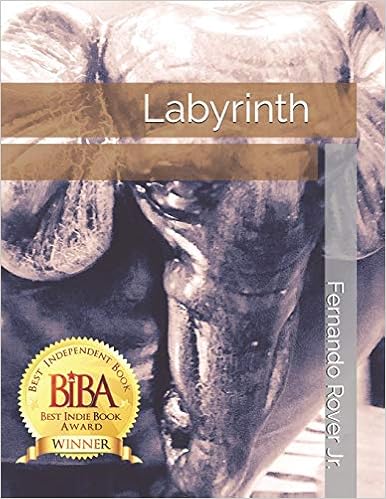
Labyrinth by Fernando Rover, Jr., both a statement of intention and a gentle cautioning to his more emotional readers. This collection of poetry, as mentioned by the author in the author’s note attached to the end of the collection, is meant to create a safe place where Black men can, “confront the perpetual pain that has kept [them] bound.” What the collection has achieved, though, is so much more.
Through a hodgepodge of rhyming and non-rhyming poetry, ones with clear rhythms and ones where the rhythms are harder to identify, Rover draws attention to the Black man’s struggles in America, both internal and external. Some of these are more commonly known if one just opens one’s eyes, others…not so much. He discusses those issues that few people are willing to open up about, let alone Black men: identity, vulnerability (including depression), heritage, lack of real change in society, and resilience. While he sometimes uses one or two words that are above the average reading level, Rover generally expresses his thoughts in simple yet powerful language that hits the reader right in the heart, no matter their race or gender. Do not be fooled into thinking that simple language means that you should read the entire collection in one sitting, though. It is possible, but I would not recommend it. Rover’s work is so emotionally impactful that you will be too drained halfway through the work if you choose to take this route, so you will be better off pacing yourself and taking it in chunks.
While the collection was intended for creating a safe space for Black men confronting their own pain, I think that Rover’s work has gone above and beyond that by showing readers outside that demographic the ways in which Black men suffer in silence and yet continue to carry on. My favorite poem in the collection, one that bridges the racial and gender gaps among readers due to the painful truths it presents, is “Token (An Ode to Blackness)”. Not only do the rhythm and random rhymes work together in a unique, almost angry-sounding, harmony, but the poem strikes at the heart of multiple truths: for Black men, that their identities are not up to the white world—to anyone else—to decide, and for everyone else, mostly white people, that we do this and need to stop. It is not a “comfortable” poem, but that’s the point—pain is the elephant in the room, and Rover is addressing it.
Of course, what Rover has to say and his mastery of the language aren’t all that there is to praise about this collection. Like all great poets, Rover knows how to use blank space to his advantage, and it shows with how he manipulates the shape of his poems on the page. Although reading the first couple poems with two columns can be a little confusing, the first two-column poem in which the verses are numbered clears up this confusion immediately. Once you know how to read the work, Rover’s use of blank space, particularly in poems such as “Dialogue” and “Braille”, ingeniously reflect the subject matter, theme(s), or both of the poem.
Additionally, Rover weaves photographs of Iona—a Scottish island and one of the sources of inspiration for the labyrinth and pilgrimage themes tying this collection together—in with his poetry. These images provide a nice visual break from the black-and-white space of the text and highlight the themes of the collection overall. The sepia tone through which the pictures have been filtered also enhances the overall mood of the collection. While the poems stand perfectly well on their own, the photographs are a great addition also.
The one critique I have for this collection is that there are, closer to the beginning of the collection, a few minor spelling errors that cannot be attributed to purposeful stylistic choices. They are very minor errors, such as “then” instead of “than,” and most readers probably will not notice them unless they are looking for them. Some quick proofreading would fix these non-purposeful spelling errors.
Labyrinth by Fernando Rover, Jr., is an emotional pilgrimage with the potential to bring you to tears. If you’re looking for traditional poems with traditional rhyming and rhythm schemes that steer clear of controversial or sensitive subjects, this is not the collection for you. However, if you’re a Black man looking for work that you feel really connects with your most hidden internal struggles or you are someone outside this demographic looking to connect with and understand the struggles of another, then Rover is your poet. If you are looking for some modern poetry that hits its readers hard in the heart, this work is also for you. Just don’t expect to be immune to the pain just because it isn’t pain you’ve experienced personally.
Pages: 53 | ISBN: 1074628985



 LITERARY TITAN