Blog Archives
Eva of the Nation: Romance and Rebellion in the Irish Famine


Eva of the Nation brilliantly delves into the life and legacy of Mary Anne Kelly, an eminent poet, and essayist whose prose galvanized the Irish spirit during the harrowing times of the Irish famine. A prodigious talent, at just 16 years of age, Mary Anne—later recognized as Eva—made her literary debut in The Nation, a revered journal established to embolden the Irish populace. Alongside two other female luminaries, Mary Anne earned the moniker of one of the “three graces.” As the famine intensified, her writings became a beacon, kindling the revolutionary fervor that surged amongst the Irish during this tumultuous era.
Crafting a historical fiction deeply rooted in factual events, Katherine Kirby Smith offers readers an immersive and enlightening exploration of the formidable Eva’s life and literary achievements. Narrated with the intimacy of Mary Anne recounting her life’s journey six decades later, we are acquainted with pivotal figures who were not just pillars of The Nation but also embodiments of the spirit of defiance prevalent during the Irish famine. Smith masterfully paints Mary Anne’s fervent patriotism and her yearning to see Ireland emancipated from British hegemony. This passion catalyzes her fateful encounter with Kevin O’Doherty, a doctor and compatriot in the Young Ireland movement.
While I enjoyed the story, I feel like the initial section of the book leans heavily into exposition, which may challenge the reader’s engagement despite its importance in setting the backdrop of the Irish revolutionary landscape. However, patience is rewarded as the tempo escalates, allowing readers to deeply resonate with and root for the evolving ensemble of characters. Midway, the narrative swells with momentum as Mary Anne matures, navigating the charged sociopolitical tapestry of Ireland.
Author Katherine Kirby Smith’s Eva of the Nation: Romance and Rebellion in the Irish Famine, while a work of historical fiction, stands as a compelling testament, making the captivating history of this era both accessible and evocative.
Pages: 401 | ASIN : B0C2SCNZBC

The Estelusti Trail


Set against the tumultuous backdrop of mid-nineteenth century Florida, where the very ground seems to tremble with tension, The Estelusti Trail by Roy V. Gaston plunges readers into the life of a young warrior navigating a landscape fraught with danger. As the English and Spanish colonists voraciously stake their claims—on lands, resources, and even people—the region becomes a powder keg. The stakes intensified with the pressing demands of the Indian Removal Act, kindling a fiery resistance among the Seminoles.
Gaston’s narrative is seen through the discerning eyes of Pete Horse, a teenage Black Seminole warrior. He’s not just a warrior of battles but of cultures as he grapples with the convergence of age-old traditions and foreign invasions. This historical fiction deftly blends real events with a rich tapestry of imagined experiences, portraying the profound cultural and political tugs-of-war of the period.
As societies with deeply entrenched beliefs and customs clash, trying to retain control over territories they each deem as their own, readers are offered an intimate look into the complexities of these cultural intersections. The plot’s dynamic pace ensures that The Estelusti Trail is not just an enlightening historical journey but also an enthralling page-turner.
Gaston’s narrative prowess not only holds the reader captive from start to finish but also ignites a curiosity about the intricate, multifaceted history of the Seminole Wars. This is historical fiction at its finest, providing both enlightenment and entertainment.
Pages: 307 | ASIN : B0CDD53ZLW
Inspiration Comes From All Over

Love Put Me In – Love Got Me Out tells the story of a man wrongly convicted of murder who asks his detective grandson to find the real killer and clear his name. What was the inspiration for the setup of your story?
The country and western song Ol Red, originally sung by George Jones, then re-released by Blake Shelton in 2001
Trey just wants to help his grandfather out but winds up discovering more than he expected and testing his skills as a detective. What was your writing process to ensure you captured the essence of the characters?
The characters in the song Ol Red gave me the idea for the main characters. With over 40 years traveling to all the counties in Oklahoma as well as several in the surrounding states and Utah, Wyoming, and Alabama for oil and gas companies, I listened to hundreds of books on tape and CD, which gave me a good insight and ideas. I made notes to myself about how I would write if I ever decided to write a book. In the years of listening to the books, I realized that it is best to limit the characters in the story to make it easier for the reader to keep track of the characters and not overload the reader with numerous characters. Also, I tried to establish a character’s personality early on and maintain the personality throughout the store.
As I was drafting an outline for my main characters and how I could make them more interesting to the reader, I began to think of actors and the characters they portrayed. For my book character Billy, especially in his older years, I thought of the character Gus McCrae, played by Robert Duvall in Lonesome Dove. I tried to use his mannerisms and humorous comments to bring him to real life for the reader. For my character of Trey, the retired detective and Billy’s grandson, I thought of Tom Selleck and the character Jesse Stone, with his laid-back approach and calm demeanor. Thinking of these actors and their characters made it easier for me to develop my characters in a way that would keep the reader intrigued and looking forward to the next chapter of my book.
Some events in the book were chillingly similar to real-life events. Did you take any inspiration from real life when developing this book?
Yes, I have done a lot of fishing for various types of fish, which made it somewhat easy to relate my fishing experience with the reader. Also, with my traveling experience, I would use maps to find the shortest route to my destination; therefore, it was fairly easy for me to use this experience in my story when Billy was mapping out his trip to Idaho.
Will this novel be the start of a series, or are you working on a different story?
I am working on another story based on another old country and western song, Long Black Vail. In this story, Trey, the retired detective, is trying to solve another murder back in the 1930s. Just like the song, an innocent man is convicted and hung.
Author Links: GoodReads | Twitter | Facebook | Instagram
After many years of worrying about being caught and wondering who had committed the murder, he told his grandson, Trey, a retired detective, about his past and how he had escaped from prison with the help of Ole Red. Even though the murder had been committed in the 1930s, Trey told his grandfather Bill he would go to Georgia and try to find out who committed the murder. Trey got more than he bargained for when during his investigation of the old murder, he uncovered crime and corruption that had been going on for decades in his grandfather’s old hometown of Harwood, Georgia. Trey’s investigation brought to light the person who murdered Luke Hampton so many years earlier and was a shock and total surprise to him and his grandfather Bill.
Love Put Me In – Love Got Me Out
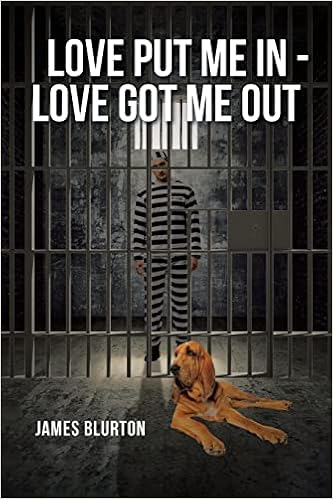
In Love Put Me In – Love Got Me Out, author James Blurton weaves a captivating tale of suspense and mystery centered around a protagonist unjustly punished for a crime he did not commit. After Luke Hampton is mysteriously murdered, Billy, who has just lost his wife at the hands of Luke, becomes the prime suspect. Despite his innocence, Billy is sentenced to 99 years to life in prison. Following a daring escape, he spends decades living off the grid, eventually revealing his secret to his grandson, Trey, a retired detective. Thus, begins a thrilling journey to uncover the true killer, unearthing a web of startling secrets about the county and its residents.
Blurton creates vivid, memorable characters, each ingrained with unique habits and mannerisms that bring them to life. For example, Billy is a coffee addict with a penchant for old-fashioned brewing methods. The novel deftly transitions through various moods and themes, ensuring there is never a dull moment. The story maintains a gripping pace, from the tender romantic atmosphere at the outset to shocking criminal acts and the gritty realities of prison life. Much of the narrative is dedicated to Trey’s complex investigation, featuring dramatic interviews and complex, puzzle-like analysis of clues.
This exciting novel is fast-paced, giving readers one thrilling moment after another. The author has put so much action into this story that it will be hard to put down as each clue expertly leads to the next. In addition, there are memorable characters that facilitate a strong connection with readers.
This unpredictable book offers an engaging blend of themes that will resonate with a diverse range of readers, including fishing enthusiasts, mystery buffs, dog lovers, fans of detective fiction, and Christian audiences. In addition, the novel maintains a strong sense of intrigue, keeping readers eager to solve its mysteries and rewarding them with a jaw-dropping, climactic conclusion.
Love Put Me In – Love Got Me Out is a riveting private investigator crime novel. If you are searching for a thrilling, suspense-filled mystery, this book is worth a read.
Pages: 277 | ASIN : B0BFBPGGMX
Science and Faith

The Pilgrim follows a man who wakes up to discover his life was all part of an advanced civilization experiment and that he also holds a rare spiritual ability. What was the inspiration for the setup of your story?
Because of my love of family, I have seen my fervor for history, as well as my passion for wondering about the future, deepen dramatically.
The Immortality Wars series was created from several questions I asked myself. For example, given the history of humanity’s conflict between good and evil, what will we be like 540 years from now in 2562? If we continue the exponential increase in our rate of knowledge, where will this rapid development take us? Will we be at peace, or will we be at war? What power will science hold over us? Will faith fall away?
When I was a boy my parents let me go to the movie theater to see Ben‒Hur (1959). I was completely in awe of this film. I was completely immersed in watching a powerful human drama set within the time of Christ. I never experienced anything like it. From that moment on, I wanted to see if I could ever write something similar. When I was older I read J. R. R. Tolkien’s The Hobbit (1937) and The Lord of the Rings (1954 – 1955). The same powerful response to Tolkien’s work that I had to Lew Wallace’s (1880) work of Ben‒Hur, as translated by director William Wallace onto the “big screen,” occurred.
In 2014, I felt I was ready to write, even attempt, such a story. I recalled the quote by Arthur C. Clarke, “Any sufficiently advanced technology is indistinguishable from magic.” It is Clarke’s third law about the future.
I wondered what it would be like if I could somehow bring people from the 18th century, like George Washington, Thomas Jefferson, Benjamin Franklin, and John and Abigail Adams, into the 21st century. These folks are people from a fire and horse culture. What would they think of our present-day world if they were taken to New York City, Paris, London, Tokyo, Abu Dhabi, Beijing, and Shanghai? Would they think of me as a mighty conjuror or wizard?
Then I thought, What would I think and believe if someone from the 26th century brought me into their world? What would such a world look like? What would civilization become? What would happen to faith? To science? To people?
That scenario became the basis for the beginning idea of the series.
I find the world you created in this novel brimming with possibilities. Where did the inspiration for the setting come from and how did it change as you were writing?
The setting in this novel was created based on my wondering about the future and fate of humanity. What will our world look like? Five hundred years ago, 16th-century Europe was ruled by three great powers, those of Henry VIII of England, Holy Roman Emperor Charles V, and Francis I of France. The divine rights of kings became accepted dogma and it led to an absolutism of corrupt power being placed in the hands of a powerful minority of people. It was a world of the horse, the sword, and wooden sailing ships. It was lit by fire and fire alone.
In looking at this world, the world of the 18th century, as well as in our time at the beginning of the 21st century, I wondered if we would have the same conditions in the use of power, fueled by greed, dominance over nature, and an overall corruption of the human spirit. I projected this timeline into the 26th century. I looked at our timeline on the Earth from the Stone Age to the middle of the 26th century.
I then thought about the Earth being polluted so badly, as well as other conditions becoming critically and alarming chaotic that they degrade our planet so badly that a major migration off the planet occurs. Global war, called “The First Armageddon” occurs from 2100 (Old Earth Time, oet) to 2075 oet. Eventually, the Earth is mostly abandoned. The various former world governments and powers seek nearby solace in terraforming and settling on 12 exoplanets that are located in the Orion Spur of the Milky Way Galaxy, which is in the same location as our solar system. They are called The Five Alliances.
The exoplanets were selected from what astronomers are finding from recent cosmological and data. I renamed them, such as Ouroboros where the main action of the Pilgrim ‒ Part I is set. It is located in the constellation of Scorpius and it is 23.6 light years, or 7.232 parsecs from our sun.
The setting of this story evolved with my exposure to the worlds that were unfolding. Each planet has its own individuality, which is based on current astronomical evidence of these exoplanets. As my knowledge of this world increased and it became populated by the beings inhabiting it, the setting became more detailed and real to me.
What were some themes that were important for you to explore in this book?
I wanted to write a story that has intense human drama in it and set it alongside of a background wherein science and faith interact with one another. I wanted it to be a crucible, a severe trial of human, machine, and cyborg endeavors in which rational and spiritual understandings respond and react to one another. I thought I would try to carry on the visions of J. R. R. Tolkien and C. S. Lewis in a 21st century sensibility and see what happens to them. I hope it will be a modern allegory in the manner of John Bunyan’s (1678 oet) The Pilgrim’s Progress. As a Christian, I wanted to see how faith plays itself out in such technologically superior cultures at this point in civilization’s development.
Can you tell us a little about where the story goes in book two and when the novel will be available?
Great question! It puts me on my literary toes.
Without giving a spoiler answer, I plan on returning to Evangel in the Pilgrim ‒ Part II. She is the main character in book two, the Penitent ‒ Part II, of my series. She and Pall Warren are soul mates, yet the story narrative seems to show them meeting one another only through their respective visions and dreams. Evangel, in part, is based on the character of Joan of Arc (c. 1412 – 30 May 1431 oet). She is a young woman with a powerful presence and charismatic personality. She is deeply connected to the Christian faith, which is forbidden in the culture in which she lives. Forces of good and evil gravitate around her more and more. Her high king’s champion advocates for her and brings Evangel under his protection.
I am currently researching and story boarding the next book. Several chapters have been composed but I’m not sure that they are what I want to employ for the completed story in this fifth book.
I used the AI–imager Midjourney v4 to generate a picture of her and I am stunned at the result. It’s a beautiful and captivating photo of Evangel. I plan on using it on the front cover of my next book.
Author Links: GoodReads | Twitter | Facebook | Website
After thinking he dies in combat, a young warrior learns he was in a world created as a human experiment by a ruthless society over 500 years in the future. He must draw upon his combat skills and spiritual power to fight amidst a galactic war whose twelve bases are in a deadly quest for immortality.
It is 2562 Old Earth Time. One reality, created by scientists, technicians, and a corrupt ruling council on a distant exoplanet seeking immortality, erupts into their own. He brings with him all the mortal capacity, knowledge, and prowess in combat he has gained through their experimentation on him.
A sergeant in an elite company of warriors, Pall Warren brings these acquired powers of a medieval time to this realm of sophistication. He also brings with him a rare spiritual ability not seen in 540 years.
Pall is sought by human greed, the morbid manipulation of scientific curiosity, the hunger for religious truth, and the might of cyborg masters. He must fight his way through a theater of war far beyond anything he has ever before witnessed or imagined.
Yet through his perilous journey in two dominions, he is sustained by the love and prayer of a mysterious and beautiful woman from his former life.
The Pilgrim Part 1
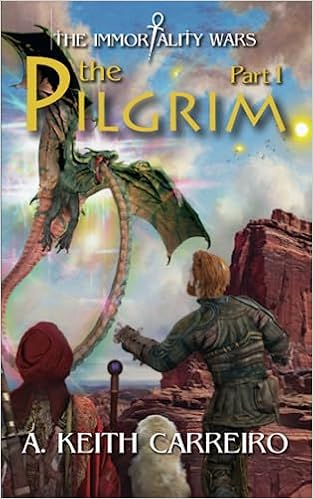
Pall Warren awakens disoriented in an alien world, only to stumble upon a revelation that jolts his understanding of reality: he now resides in a society 500 years advanced from his own, one that conceived his original world merely as an experiment. As a unique byproduct of this experiment, Pall’s characteristics captivate this futuristic society, and he soon realizes his potential role in their ultimate quest: the pursuit of eternal life. Thrust into a war among the twelve factions of this advanced civilization, Pall, the young warrior, grapples with navigating an intricately scientific and technological landscape.
The Pilgrim is a refreshing entry into the sci-fi genre and marks the first book in Keith Carreiro’s second trilogy.
Set against the backdrop of the 26th Century, The Pilgrim gracefully melds traditional thematic undertones with avant-garde characters and concepts, crafting an irresistibly gripping narrative. The book commences with an enigmatic allure, potentially invoking curiosity or perplexity in the reader. Personally, I found it captivating.
Carreiro’s prowess in world-building is noteworthy. He meticulously crafts vivid tapestries of his universe, enhancing the mesmerizing quality of the setting. His writing style can be likened to a masterfully curated art gallery, where each descriptive element coalesces to transport readers into the depths of his imagined universe, the psyche of his characters, and the core essence of the narrative. One can’t help but resonate with the protagonist’s tumultuous emotions, oscillating between multiple realities.
The Pilgrim delves into age-old themes such as the race for dominance through technological prowess, human innovation juxtaposed with greed, and more. Yet, Carreiro’s brilliance lies in weaving these threads in a world unfamiliar to us. Despite its length, the book remains a page-turner and is hard to put down.
Pages: 298 | ASIN : B0C2JML8VF
Raptor Canyon

Raptor Canyon by A. W. Baldwin plunges readers into a gripping tale where capitalism clashes with history and ancient relics. Dive into a world where a scheming group, which includes lawyers, unlawfully claims land from an elderly man to set up a resort. Their audacity doesn’t stop there – they plot to place fake petroglyphs on rocks, hoping to lure in more tourists. Yet, within this group, one conscientious lawyer overhears their intentions and bravely opts out, setting the stage for a thrilling chase.
Baldwin’s narrative style pulls you in, effortlessly blending action-packed sequences with realistic scenes that address today’s concerns about preserving natural landscapes. In a post-coronavirus world where we’re eager to explore, it makes us question: At what cost? The story reminds us that as we seek solace in nature, there are those who exploit it for profit, reshaping and even fabricating its history.
I was particularly enthralled by the vivid portrayal of the protagonist’s adventures and escapes. The encounters with sinister characters, the narrow getaways, and the intricate planning elements all craft an exhilarating thriller. While the ending offers hope, Baldwin leaves some threads untied, giving readers a touch of intrigue even on the last page.
Raptor Canyon is a must-read for those craving an adventure tale infused with timely environmental themes. Dive in and get lost in Baldwin’s riveting world.
Pages: 342 | ASIN : B07G1FFZ29
Whispers in the Breeze
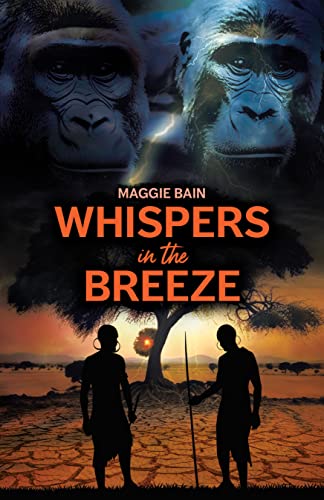
Maggie Bain’s Whispers in the Breeze is a riveting exploration of tribal politics, survival, and justice set within the seclusion of the African jungle. The narrative revolves around Wango, the Chieftain of the Wangoorie tribe, who embarks on a journey in search of food due to severe scarcity, leaving behind his wife, Mallee, and son, Zengie. However, as the season passes, Wango fails to return, sparking a cauldron of troubles within the tribe.
Adding to the turmoil, Wango’s malicious and cunning brother, Zulu, sees this as an opportunity to lay claim to the chieftainship. In his relentless pursuit of power, Zulu dispatches his henchmen to bring back Zengie, the rightful heir to the leadership. His nefarious plans, however, lead to unexpected chaos across the tribe, raising critical questions – Will Wango ever make a comeback? Will Zengie inherit the position that is his birthright?
From the onset, Whispers in the Breeze is a deeply immersive narrative that held my attention until the very last page. The unrest, deception, and ancestral wrath triggered by the Zulu’s unjust actions against the Wangoorie tribe make for a compelling storyline. Bain skillfully portrays Zulu’s character, emphasizing his manipulative nature and desperate power grab. Interestingly, the influence of the ancestors, voicing their dissent from beyond the grave, provides a fascinating layer to the plot.
The character of Zengie, a courageous young soul thrown into survival mode early on, is captivating. His father’s disappearance and the absence of guidance from his mother and tribal elders present him with extraordinary challenges. The narrative takes a suspenseful turn as Zengie, having escaped Zulu’s henchmen, must navigate the ruthless African wilderness on his own. Is he resourceful and resilient enough to survive?
This book kept me on the edge of my seat from the beginning. Bain evokes a gamut of emotions, providing a rollercoaster ride of a reading experience. As the plot unfurls and the pieces of the puzzle fall into place, the reader can’t help but hope for Zulu’s comeuppance for his atrocities against the Wangoorie tribe. The believability of the characters, the vividly described landscape, and the gripping storyline make one feel as though they are witnessing the events firsthand. The author’s ability to resolve loose ends ultimately results in a rewarding reading journey. Whispers in the Breeze is a must-read for all lovers of engaging and emotive literature.
Pages: 119 | ASIN : B0C3WMDCS1



 LITERARY TITAN