Blog Archives
Lost In My Imagination

Teneō is a powerful novella about a formless entity navigating survival, sensation, and selfhood as it inhabits human hosts and stumbles into the vast, aching wonder of being alive. What was the inspiration for the setup of your story?
It sounds so grand when you put it that way (I appreciate it)!
I think I often want the world to be more full of magic, wonder, and the unexplained than it actually is. And often I have to remind myself that the world IS an amazing adventure of a place despite the mundanity. I think that’s the basis for the creature. An otherworldly existence that could live beneath our notice, and also something appreciative of the worldly things I take for granted.
Outside of the creature, the inspiration for the story is all very grounded in my own experience. I am the person wandering through life lost in my imagination. I’ve stumbled into a life where the majority of my needs are met: I have free time, some disposable income and no idea what to do with them. I look around at all the various ways in which someone can live their life. The ways people are living their lives. And I wonder if I would be better off living mine like theirs.
It’s much more fun examining that through a formless entity’s perspective.
The tone of Teneō is so rhythmic and dreamlike. How did you develop that voice, and did it evolve as you wrote?
First off, thank you so much! Feedback on the rhythm and voice of the narration has been really gratifying to hear. I spent a lot of time trying to figure out the right flow and wording to communicate how I thought this particular creature would think (and I’m happy it seems to have worked). I wanted it to be very sparse and raw. Full of emotion and experience, but free of overthinking, anxiety, or any need for justification.
I don’t think that central idea changed much through my writing process. But the voice definitely evolved to be a bit more thoughtful and less purely experiential as the story went on. More human in a way? I’m not sure it’s a good thing for the character, but I think it’s appropriate for the story.
The book is emotionally rich despite the abstract narrator. How did you approach building empathy for something essentially alien?
It took some trial and error, honestly. I started with the idea of having both the creature and Jeanne as narrators, but it dramatically changed how a reader would interpret the story. Jeanne instantly became the defacto character you identify with, as the one most like you. I didn’t like that. And I also wasn’t looking forward to grappling with some of the more unseemly things later in the plot (from Jeanne’s perspective) as that’s not really what the story is supposed to be about.
So I tried to eliminate any human characterizations and just lean as hard into the narrator’s characterization and interpretation of the world as I could. A lot of my approach was inspired by Felix Salten’s “Bambi, A life in the woods.” I think that novel does an incredible job of not only ensuring you are entrenched in the mentality of a deer, but also making humans so…alien? I definitely didn’t do as well on the latter front, but it was a really great example to have read.
What is the next book that you are working on, and when will it be available?
There’s something I’ve started about friendships, being seen for what you truly are, and the storm of emotions that circle when someone enters or leaves your life.
I’m unfortunately not far along enough to give you a release date, but I’m very stressed out and ashamed about that now. So that’ll hopefully fuel a few chapters. In the meantime…I don’t know. Stay tuned?
Author Links: GoodReads | Instagram | Website
They’re all around us.
Wherever there’s enough of us to keep them alive. Waiting for their chance to occupy those of us whose consciousness lapses. There when we get lost in a thought. A daydream. A moment.
Through us, they experience the joys of the world in fleeting moments. By feeding on the scraps of attention we let wander, they live a little longer.
For most, those small glimpses of how we experience the world are all they get.
But some want more. They find another way.
They live among us. Within us. And in some cases, instead of us.
The Story Was Just There

Hermosa is a darkly tender thrill ride through L.A., where a real estate developer and a neuroscience resident are thrown together by a violent crime and discover danger, connection, and unexpected redemption. What was the inspiration for the setup of your story?
Some years ago, I was driving through the San Fernando Valley in the exact place where the book starts and the story came to me. I had never written before and didn’t know that I was going to start one day. The story was just THERE. It took me a while to figure out how to communicate it.
The villains in Hermosa are unsettling. How did you approach writing such morally twisted characters without glamorizing them?
I’ve met some terrible people in my life. Almost all people are good people, trying to get through their own lives, dealing with their own issues. But there are some that do not have empathy for others. They were born without it and don’t fully understand it. What kind of terrible could they be?
The humor in the dialogue feels so natural. Did any of that come from personal experience or real-life conversations?
My sense of humor is the only part of me in the book. I try to keep conversations fun and hope to bring that out in others, which I’m hoping comes through in my work.
What is the next book that you are working on, and when will it be available?
There is a follow-up to Hermosa currently in the works, expected to arrive in January.
Author Links: GoodReads | Facebook | Website
The Ballad of Midnight and McRae
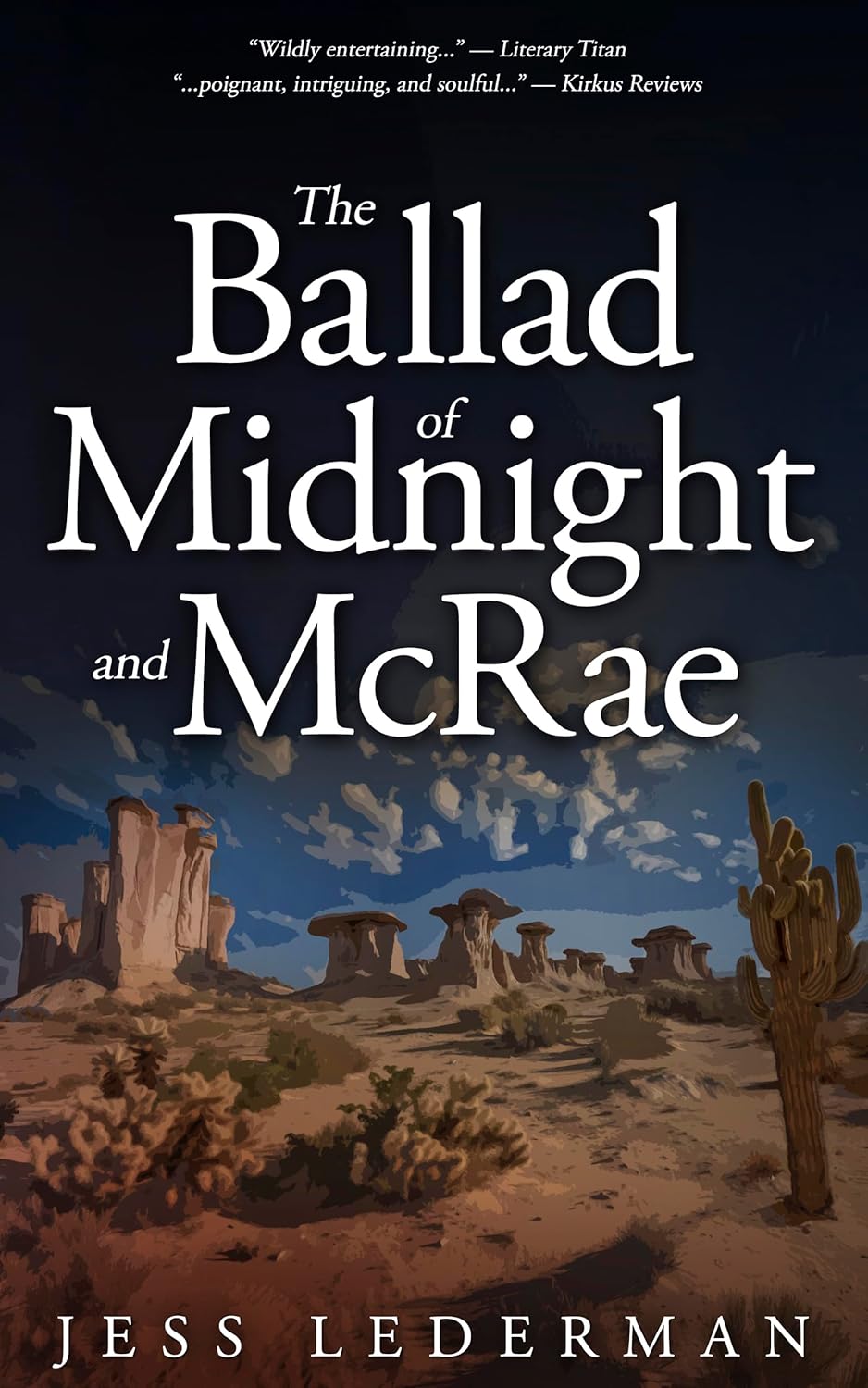

The Ballad of Midnight and McRae is an expansive and soulful journey through the deserts of the American West, both literal and emotional. At its heart is the improbable bond between two men: Caleb McRae, a zealous Texas Ranger with a hunger for justice and salvation, and Henry Midnight, a cultured outlaw with a poetic soul and a penchant for righteous mischief. Their chase through the Chihuahuan Desert turns into a spiritual odyssey that spans decades, delving into themes of faith, justice, identity, and the mysteries of love and grace. It’s part Western, part myth, and entirely its own genre. A ballad in the truest sense, where history, theology, and folklore collide.
Reading this book was like sitting around a campfire with an old storyteller who knew just when to drop his voice, when to make you laugh, and when to break your heart. Jess Lederman writes with a fierce tenderness, blending lyrical prose with grit and grace. The writing burns—sometimes with beauty, sometimes with the pain of recognition. I didn’t expect to feel so much for Caleb and Henry, but I did. Their philosophical sparring, their vulnerability, and their moments of silence spoke louder than gunfire ever could. I loved that the novel doesn’t hand you clean answers—it wrestles with God, with sin, with longing, and never lets go.
But this isn’t just a heady book full of big questions—it’s also wildly entertaining. There are gunfights, stampedes, firestorms, and even a cougar that lets you suckle milk from her belly. Lederman throws curveballs and magic into the dust of the Old West, and it all works. At times, the story risks teetering into the surreal, but it never loses its emotional center. Some of the theological passages felt a bit dense, but even then, the weight felt intentional—part of the burden these characters carry.
The Ballad of Midnight and McRae is a tale for the seeker, the wanderer, the broken-hearted believer, and the stubborn skeptic. It’s for anyone who’s ever chased something they didn’t fully understand and found themselves in the process. I’d recommend it to lovers of literary fiction, fans of Cormac McCarthy or Marilynne Robinson, and anyone who believes that stories still have the power to save.
Pages: 483 | ASIN: B0FJR7TS4N

The Rise : Book 3 In The Wall Trilogy

The Rise is a gritty, heart-wrenching, and wildly immersive dystopian saga that grabs you by the throat and drags you through blood-soaked arenas, haunted bunkers, and psychological minefields. The story follows Asher, a gladiator trapped in a collapsing society ruled by the tyrannical Renatus, as he battles enemies, inner demons, and a regime built on resurrection and control. Interwoven are the narratives of Cephas, Sarai, and Kenan, each fighting their own battles in a world where memory, identity, and survival are fragile and fleeting. What starts as a sci-fi gladiator tale quickly blossoms into a dark, emotional exploration of trauma, resistance, and sacrifice.
From the very beginning, the writing delivers an immediate and powerful impact. The opening scene with Asher squaring off against Apex in the arena, only to be unexpectedly spared by an earthquake, establishes a tone that is both cinematic and intense. One line in particular, “Small dust clouds emanated from the arena as if demons were casually puffing on cigars,” exemplifies the book’s vivid and lyrical prose. The language is unflinching and evocative, blending brutality with a strange kind of beauty. This isn’t a story that’s merely read, it’s experienced with all the senses: the dust, the roar of the crowd, the sharp crack of broken bones.
What kept me hooked wasn’t just the action or dystopian drama it was the emotion, the broken relationships, and the aching humanity buried under all that chaos. There’s a scene where Asher kills a man in the arena who pleads for his life, and Asher mutters “Sorry,” before driving the spear into his chest. That moment wrecked me. It said so much in so little. Later, Sarai reflects on seeing her husband kill for sport, wondering if he’s still the man she fell in love with. These moments are quiet but devastating, and they made me care deeply. Even Cephas, a grizzled war dog, has scenes of real vulnerability, like whispering apologies to his dead friend Jude or drunkenly mourning what Eden should have been. The book’s moral compass is messy, but intentionally so because it’s a world where even the “good guys” aren’t clean.
The most unsettling character in the narrative is not Apex or any elite combatant; it is Renatus. His psychological unraveling is profoundly disturbing. In one particularly harrowing chapter, he is depicted hallucinating while fishing, speaking to a photograph of his deceased son as though it were alive. The scene is haunting, pitiable, and deeply tragic. His chilling assertion, “All good things require a sacrifice,” leaves a lasting impression. What makes Renatus so compelling and horrifying is not gratuitous malice, but his unwavering belief in the righteousness of his actions. Most disturbing of all is his consistency. The system in which he operates enables him to function simultaneously as both deity and monster. This is where the novel excels: it constructs a world in which power does not merely corrupt, it gradually strips away everything that is human.
The Rise left a lasting impact on me. The characters feel deeply authentic, and the stakes are both personal and profound. For readers drawn to darker narratives, flawed protagonists, and antagonists who are disturbingly human, this book is a compelling choice. This is not light or escapist fare, it is a somber, emotionally charged, and battle-worn epic that leaves a mark. And truthfully, that’s precisely what makes it unforgettable.
Case Files From The Nightfall Detective Agency: Trail of the Zombies

Trail of the Zombies is a supernatural detective story set against the haunting backdrop of 1920s America. The novel follows a trio from the Nightfall Detective Agency as they unravel a sinister conspiracy tied to eugenics, Indian boarding schools, and a nefarious project called the Utopia Institute. Zombies, mind control, and historical evils merge into a narrative that is both pulpy and painfully relevant. At its core, the book is a thriller with a conscience, blending paranormal intrigue with real-world atrocities.
The writing in Trail of the Zombies is striking in its directness and conviction. Gordon confronts the grim realities of the era head-on, refusing to soften or obscure their brutality. Chapter five, in particular, stands out as we are introduced to the eugenicist architects behind the Utopia Institute. Their dialogue, steeped in cold-blooded ideology and unapologetic prejudice, is profoundly disturbing and all the more powerful because of it. Gordon draws unsettling parallels between fictional characters and historical figures such as Harry Laughlin and Madison Grant, blurring the line between fiction and fact. The result is a narrative that reads like speculative history, yet feels alarmingly authentic.
The novel’s use of zombies is particularly compelling in its departure from conventional tropes. Initially, I approached this element with some hesitation, given how frequently the genre relies on familiar, often superficial portrayals. However, Gordon subverts expectations by grounding his depiction of zombies in Haitian Vodou tradition, reframing them not as mindless predators but as victims, individuals chemically manipulated and robbed of their will. This interpretation transforms the horror into something far more poignant. The attack on Professor Wallace in chapter one, for instance, is not simply a moment of terror; it is a sobering reflection of exploitation and control. The fear evoked is not of the undead themselves, but of the systems and individuals who create and command them.
What I also loved was the supernatural detective team at the heart of the story. Tori is a vampire with attitude and compassion. Frank is a golem with a heart. Mueller brings a touch of old-world wisdom. Their banter adds humor, but more importantly, their compassion balances the grim subject matter. When Tori rescues Malia from the Institute’s goons at the synagogue, it’s a fist-pumping moment of justice. The way Gordon blends mythology with gritty noir detective work just works.
Trail of the Zombies is an unexpected yet impactful work, gritty genre fiction used as a vehicle for urgent historical and moral inquiry. Beneath its pulp-inspired exterior lies a pointed critique of systemic injustice, particularly in relation to eugenics, racism, and the abuse inflicted on marginalized communities. Readers with an interest in social history, speculative fiction, or political horror will find its themes both provocative and emotionally resonant. Some passages, particularly those involving the mistreatment of children, are difficult to endure, but they serve a necessary purpose. This is a forceful and unflinching novel one that challenges as much as it entertains.
Pages: 158 | ASIN :B0DFM8W9FJ

Femme Fatale: Shades of Retribution


Italia Tornabene’s Femme Fatale: Shades of Retribution is a gritty, heart-wrenching, and fiercely personal journey into the life of Italia Rossi, a dancer, single mother, sister, and survivor. Set against the neon-soaked backdrop of a strip club called The Velvet Viper, the story follows Italia as she battles poverty, motherhood, addiction (not hers but a friend’s), and the ghosts of a troubled past while plotting her quiet war for justice. It’s not just a tale of survival, it’s a slow-burning revenge story soaked in love, grief, and raw grit.
One of the strongest things about this book is its emotional honesty. The relationship between Italia and her best friend Olive hit me the hardest. There’s a real tenderness in the way they care for each other, especially in scenes like the one where Olive collapses in Italia’s arms, confessing her descent into addiction. It didn’t feel like fiction. It felt like something I had seen, or could’ve seen, in the real world. The slow unraveling of Olive’s spirit, and Italia’s growing sense of helplessness, was painful in a way that didn’t let me look away.
Tornabene’s writing is rich with atmosphere. She turns the club into a character of its own, dangerous, seductive, brutal. The opening chapters, where Italia and Olive perform together, are electric. Not because they’re flashy, but because they show power, women taking control in a world that wants to strip it from them. There’s this moment where Italia thinks, “They’re eating out of our hands,” and it’s not about ego. It’s about survival. About making the most of a broken system. There’s real complexity in how power is handled here.
The pacing can be a bit uneven, especially in the middle, where the narrative shifts toward Italia’s undercover attempts to infiltrate the drug world. Some of that felt a little rushed or too smooth, like she transitioned from grieving mother to spy a bit too easily. The story needed momentum, and the emotional stakes never went away. What redeems these sections is Italia’s constant return to her core motivation: Dominic, her son. Every risk she takes, every mask she wears, it all circles back to him. There’s this beautiful moment where she says, “He deserves the sun.” That line is so simple yet so powerful.
In the end, this book is for readers who want more than just plot. It’s for people who want to feel something deep and maybe a little uncomfortable. If you’ve ever lost someone, if you’ve ever had to fight harder than you should’ve had to, Femme Fatale will speak to you. It’s raw, it’s honest, and it doesn’t pretend to have all the answers.
Pages: 364 | ASIN: B0DS1JF9VZ
God’s Superheroes

Retribution follows a seasoned Reaper who tracks the demon Midos into a mysterious cave, only to find himself facing something far more powerful: a Fallen Angel. What was the inspiration for the setup of your story?
The inspiration was I didn’t want a repeat from “Reaper”. So I wanted to go in a different direction but keep the same conflicts. In the first installment, I use a combination of Christian, mythology, and recent monsters throughout the story. The use of Midos is another way I use mythology along with religious and modern monsters. The idea of everything Midos touches turns to gold just screamed bad guy to me.
What were some of the trials that you felt were important to highlight the character’s development?
The end battle was very important. Absolutely essential in the development of Jaml. The loss of his friend drives Jaml to become human once more. Without giving the ending away, let’s just say another side of Jaml is seen. Another scene that was instrumental in his development was finding the room full of gold statues. More importantly who he finds inside the room.
When you first sat down to write this story, did you know where you were going, or did the twists come as you were writing?
The big twists were planned from the beginning but as I began shaping the story, many small twists and deaths just flowed onto the page. I never plan on how characters die in the book (there are a lot of them!). As I reach a pinnacle inside the story, the death of the character just seems natural.
Where does the story go in the next book and where do you see it going in the future?
In the next book, Jaml will once again battle new monsters, and new fallens. This book tackles the concept of the seven deadly sins becoming manifested into real life. The third installment will bring another twist of our society to life. In the future, I hope to expand my brand and foster a following as I continue to share the adventures of God’s Superheroes.
Author Links: GoodReads | X | Facebook | Website
Caught in the chaos, Jaml faces a horrifying revelation- a new kind of monster has risen, and it is one he has sworn to protect: mankind itself. As morality blurs, he must grapple with an impossible choice: to protect humanity at all costs or to follow his divine directives and eliminate evil. Every step brings him closer to his greatest fear and most lethal foe- the Dark Reaper.
Set in the infancy of Christianity, this gripping saga unfolds as Lucifer’s minions wage war on mankind, with the Reapers- God’s superhuman warriors, protectors, and avengers- at the forefront of the battle between good and evil, while demons and lycans thrive on fear and flesh, and humans begin their climb in the cosmic conflict between heavenly brothers on different sides of the divine spectrum.
Follow Jaml, the killer of the fallen and wielder of the Sword of Darkness, as he forges his destiny and leaves an indelible mark on history in this epic tale of faith, war, and redemption.



 LITERARY TITAN