Blog Archives
Remembering the Bad with the Good

Frostbend follows a woman who returns to her hometown after the death of the man who terrorized her childhood, only to find herself drawn into a chilling supernatural mystery. Where did the idea behind this novel come from?
I’ve always been fascinated by old, formerly beautiful buildings and the secrets they hold. I knew for a long time that I wanted to write a haunted house story, but it took me many years to realize that my experience living in the Ozarks was something truly valuable that I could bring into the horror space. After deciding that I wanted to set it in the Ozarks, the idea of two sisters battling it out over the fate of a haunted house came to me next, and then the ideas continued to build until I finally had what today is Frostbend.
The Desmond mansion feels like a character in its own right, with its history, secrets, and unsettling presence. How did you go about creating such a vivid haunted house?
This is a wonderful compliment, as this was exactly the impression I hoped to leave with readers. Building the mansion at Frostbend was a culmination of all the gothic novels I’ve ever read and loved, all the sumptuous gothic horror movies I couldn’t stop watching, and a dash of research. I looked at many photos online of real buildings, picking and choosing elements that I thought most fit my novel and researching architectural terms. I love the feeling of wandering an old place alone, wondering what stories it would tell and making up fictional histories in my head. Frostbend is a natural extension of those interests.
Something else that I find fascinating is the way in which different spaces and buildings affect the psyche. For example, old gothic cathedrals that are impressive to behold. It’s hard not to feel small and a bit intimidated by spaces with such a presence. For Frostbend, I also wanted to feature a larger-than-life space that elicits a strong feeling. But I also felt it was important to include some beauty in the midst of the house’s horrible history, which is where touches like the mother’s stained-glass window come in. There are shafts of light and glimmers of beauty, even in the most horrible places. That feeling is an important thematic thread in Frostbend.
Isla is fiercely independent, sarcastic, and emotionally guarded. What drew you to writing a heroine whose greatest challenge is confronting the past she’s spent years avoiding?
I think most people can relate to the feeling of avoidance. There’s a temptation when you have a difficult past to try to leave it all behind, but the danger there is never processing the trauma in a healthy way. I think we all have things we would rather forget, and there’s a temptation to “demolish it.” Isla is redeemable and relatable for precisely that reason—who hasn’t wanted to leave all the unpleasantness of the past behind?
But the hopeful thing about Isla is that when she returns to her past, she discovers she’s not the same person she used to be. She is more capable. She has more people on her side. The scales have shifted, not because the horrors are less vivid, but because she has more resources and power.
The story asks whether escaping the past is ever truly possible. Was that question one of the driving themes you wanted readers to consider?
I think Isla could have escaped her past. She could have hung up the phone and never gone back to Frostbend, but she chose love for her sister instead. Even if she was kicking and screaming and cussing her way through it, she chose not to fully flee her past because of her love for Willa. And I think that is one of the themes I wanted readers to consider. That perhaps even a dark and terrible past is worth remembering, because you can’t always fully untangle the good memories from the bad ones. There is space in the heart to keep the good while putting the bad in its proper place. One question both sisters grapple with is whether they will allow their pasts to rob them of love, and this is a choice I think we all have to make at some point.
Author Links: GoodReads | Facebook | Instagram | Substack | Website
But when Isla returns home to rural Missouri after building a life in Chicago, the presence she encounters is much more personal and powerful than she or her estranged sister, Willa, could ever imagine.
As Isla and Willa’s relationship evolves from mistrust to a sisterly bond, they delve into their shared history, illuminating the darkest corners of their pasts. What they discover in the mansion is sure to change their lives and the future of Frostbend forever, if they manage to survive it.
Welcome to a town where you can’t escape your past. Welcome to a mansion where the dead are just as sentient as the living. Welcome to Frostbend.
Supernatural Threat

Awakening follows a group of neighbors caught in a bizarre and increasingly terrifying fight for survival when an ancient fungal intelligence awakens beneath a Los Angeles hillside. Where did the idea behind this novel come from?
I think it was really a combination of several ideas.
Part of it came from looking back on my youth, when taking mushrooms that somebody handed you without giving it much thought seemed like a perfectly normal thing to do. I liked the idea of a kind of perennial adolescent—someone who never quite felt the pressures of adulthood and was therefore still willing to do some of the foolish things the rest of us eventually learn not to do. That became Rage. I wanted him to be a little dim, but in an entertaining way, particularly in contrast to his much more cautious, rule-following roommate, Tim.
Navarro actually came from somewhere else entirely. Years earlier, I had written a short story about a long-dead murderer and sexual predator lying in his grave twenty years after his death. There was almost nothing left of him but his skeleton and one eye, and he spent his days trying to move a finger and thinking about how terribly unfair his situation was.
What I liked about that story was that, over the ten minutes or so it took to read it, you could actually begin to feel sorry for him—until you gradually realized what a terrible person he had been. More importantly, he never realized it. He still saw himself as the victim.
I liked the character enough to bring him into Awakening, and eventually he became connected to the fungal network that resurrects him.
From there, I mostly let the story go where it wanted. I spent years rewriting and playing with it while I was gainfully employed and had no particular expectation that it would ever become a published novel. At various points it was really a couple of smaller books that I eventually stitched together and fussed over until they became Awakening.
Underneath all of that, though, is an idea that still fascinates me: there’s much more to the world than what meets the eye, and sometimes those of us who become a little too civilized miss out on quite a lot.
How did you balance the book’s gruesome body horror with its dark comedy?
Realistically, I think almost everything is funny—or at least has a funny side to it.
Some of the grotesqueries in Awakening are so outlandish that I find them difficult to take entirely seriously. Rage is deliberately a little ridiculous, and putting someone like him in the middle of genuinely horrifying circumstances naturally creates humor.
But I don’t think I ever consciously sat down and decided, “I need a joke here.” Humor is just the way I tend to look at things. It makes the medicine go down a little smoother, particularly when the writing itself has a somewhat self-deprecating quality.
I also think horror sometimes takes itself too seriously. Horror is, after all, frequently absurd. Terrible, frightening things are happening that shouldn’t be possible in the first place. There’s something inherently funny about that absurdity if you allow it to be funny.
For me, the comedy doesn’t diminish the horror. If anything, I think the two work better together. You laugh, relax for a moment—and then something awful happens.
What drew you to fungi as the source of the novel’s supernatural threat?
As I may have already given away, I was a bit of a fan of fungi when I was younger. When I started writing Awakening, I was looking back on some of those years with considerable fondness.
What’s funny to me now is that I ended up turning the fungus into the apparent bad guy when, personally, I have rather warm feelings toward mushrooms.
But Mother—the fungal intelligence in the book—isn’t really evil. She’s amoral. She consumes dead and sometimes dying material and incorporates it into herself. The intelligence—or, if you want to call it that, the soul—of everything she consumes becomes part of her collective consciousness. In that sense, Mother isn’t an individual at all. She’s a family.
And she’s starving.
If you’re starving, you eat. Mother isn’t setting out to be cruel or malicious. She’s trying to survive, and unfortunately her idea of survival can be rather unpleasant for everyone else.
So despite having made a giant fungal intelligence the supernatural threat in a horror novel, I don’t really think of fungi as the bad guys. Mother is dangerous, certainly, but I think she’s also terribly misunderstood.
Can you give us a peek inside Book 2 of the Mother’s Little Helpers series? Where will it take readers?
One of the biggest changes in ReAwakening is that the center of the story shifts.
Rage is the protagonist of Awakening, but the person who suffers the most at Navarro’s hands is Pippi, the ten-year-old girl who fancies herself after Pippi Longstocking. ReAwakening begins within about an hour of the end of the first book, and Pippi realizes very quickly that whatever happened between her and Navarro isn’t over. Somehow, he is still affecting her.
Rather than retreat from that, she has to grow up a little. She has to decide what she’s going to do about it.
And ultimately, she becomes the hero of the second book.
Rage and Alicia are still there, as are the other characters from Awakening. In fact, pretty much everybody from the first book makes it into the second one, whether they’re alive or dead. We also add several new characters, so the world and the strange little family at the center of it become larger even though the book itself is a little shorter.
Someone who proofread Awakening once told me, “Rage is a jerk, but he’s kind of my spirit animal.” I loved that, because I think you have to be a certain kind of person to really root for Rage.
Pippi is different. I’d be hard-pressed to imagine anyone not rooting for her.
The threat is bigger in ReAwakening, the cast is bigger, and dealing with what’s happening becomes much more of a group effort. But at its heart, I think it’s Pippi’s book. She was the victim in Awakening. In ReAwakening, she gets the chance to become something else.
Author Links: GoodReads | Facebook | Website | Amazon
If it helps you find love and happiness, is it really so bad that it wants to kill and eat you?
Rage Sutherland, an unemployed, foul-mouthed 30-year-old, has never once made his dead parents proud—or tried to, for that matter. Instead, he lives happily in his consequence-free forever-adolescence in the house his parents left him.
Down the hill behind his home, Mother, a massive underground fungus, is having an existential crisis. Starving and desperate, she births a new offspring—a mushroom that promises boundless love, followed by a slow, blissful death.
When the mushrooms pop up in his yard, Rage can’t resist. One bite, and his world explodes into overwhelming ecstasy.
Meanwhile, Emile Navarro, a long-dead murderer, is resurrected into a fungus-fueled hunter to find Mother fresh food. Navarro, a remorseless sexual deviant who never found satisfaction, is determined to get this new life “right” this time.
As the mushrooms spread, Rage isn’t the only one pulled into Mother’s strange new world. There’s his rule-following college-student roommate, Tim, and ten-year-old Pippi, who catches Navarro’s attention as something more than just food.
For perhaps the first time in his life, Rage is genuinely happy. But before long, the last person anyone would mistake for a hero has people other than himself to worry about—and doing the right thing may mean giving up the best thing that’s ever happened to him.
Awakening


Chafin’s approach to horror relies heavily on the collision between the grotesque and the absurd. Navarro gradually assembles a functioning body from fungus, bones, animal remains, and human remains, creating some of the novel’s most disturbing images, yet his monstrous transformation is repeatedly interrupted by dogs stealing bones, neighbors misunderstanding what’s happening, and Rage responding to genuine supernatural danger with the judgment of a perpetually intoxicated adolescent. Fatty, Rage’s dog, is especially effective in this respect. His simple canine priorities repeatedly place him at the center of events, sometimes making him comic relief and sometimes making him unexpectedly consequential. The humor gives the novel an energetic, unpredictable rhythm, while the body horror becomes increasingly elaborate as Navarro acquires senses, limbs, voices, and greater knowledge of what Mother can do.
Beneath that surface, Awakening is deeply concerned with interconnectedness. Mother experiences life through a vast biological network, while Navarro’s resurrection gradually erases the boundaries separating one organism from another. Lisa’s consciousness becomes trapped within him after he incorporates her remains, animals contribute their senses and voices, and Rage experiences the fungus as an almost spiritual connection to other people and the earth. At one point, Mother is described as “a few million threads that wound together into a sort of democratically elected her,” an image that captures the book’s unusual conception of identity. Chafin repeatedly asks what remains of an individual when bodies, memories, desires, and consciousness can be absorbed into a larger living system. That idea gives the novel substance beyond its outrageous situations, particularly through Lisa, whose struggle to preserve her identity inside the man who murdered her adds a grim moral dimension to the supernatural premise.
The novel’s strongest quality is the way its separate characters and tones steadily converge. Rage’s mushroom-fueled experiences, Dora’s memories of her first husband, Pippi’s search for Bruno, Don’s determination to deal practically with an impossible threat, Lisa’s imprisonment, and Navarro’s growing ambitions all become parts of the same conflict. By the final confrontation, events that initially seemed like comic detours have acquired real significance, and even Rage is forced into a moment of genuine responsibility. Chafin closes the main story with consequences for both the survivors and the consciousnesses caught within Mother’s network, while leaving the larger biological threat alive for the series to continue. Awakening is an energetic mixture of supernatural horror, ecological speculation, irreverent comedy, and ensemble storytelling, held together by a striking central idea: life beneath the surface is conscious, hungry, interconnected, and beginning to wake.
Pages: 432 | ASIN : B0DJB23JGC

The Unknown
Makanda centers on a crime scene investigator investigating a series of mutilated bodies dating back to 1973 in a region where local legend, cryptid folklore, and biological terror blur into nightmare. Where did the idea behind this story come from?
There exist real police reports and other supporting documents from 1973 from people who saw the Big Muddy Monster firsthand. Funnily enough, I’m acquainted with one of several people who saw the monster and were interviewed by the local Murphysboro police department (though I didn’t find that out until after I’d written my novel). I took eyewitness accounts and local legend and combined them with violence, gore, fear, suspense, and a giant dash of biology to add my own nefarious spin onto the landscape and unsuspecting folks of southern Illinois.
Giant City State Park becomes almost a character itself in the story. How did the landscape and atmosphere of southern Illinois shape the tone and direction of the novel?
Giant City State Park is a legitimate character in real life. The park is huge and beautiful. Every day, folks come from all over the world to visit the park and its gorgeous winding trails, verdant expanse, and serene landscape. The Shawnee National Forest here in southern Illinois is exceptionally large, with a varied terrain of rock formations, woods, creeks, wetlands, and flora and fauna. The park is peaceful yet dark and brooding come sundown. It’s quite atmospheric in many ways.
The idea of a local legend returning in a new form is central to Makanda. What do you hope readers take away about the relationship between myths, fear, and the unknown?
I hope that folks understand that while times change, people change, and landscapes change, our cemented fears rarely change. Sure, it can be said that myths change – which they do (that’s part of the allure of our myths and legends). But at the end of the day, those myths, fears, and the unknown rarely change in our minds. The circumstances that cause that fear may change, but the idea behind the fear remains the same. We will always be afraid of the what-ifs. We will always be afraid of the unknown. And we will always be afraid of the boogeyman in whatever form it manifests itself. Don’t believe me? Go and read IT by Stephen King. That book will change your mind.
What is the next book you are working on, and when will it be available?
I write all the time. Even on days that I’m physically and mentally drained, I have to write so as to offer my mind some respite from itself. I refer to the endless library of information inside my mind as my Hoard. Inside my Hoard are a plethora of folks, and the only thing they require to become real and substantial is my unwavering, incessant need to write. If I write, those folks inside my Hoard become quiet. If they’re quiet, I’m allowed a smidgeon of peace from time to time. With that said, I have enough written works to release one novel every year or two for the next two decades. However, as it currently stands, I do not yet know what book will be released next. I’ll pray to God for clarity on what comes next. But I will say that I’m leaning towards a collection of short stories based solely on southern Missouri during the summer. Whatever book comes next will be within the next year and a half to two years.
Author Links: GoodReads | Amazon
When mutilated hikers begin turning up in Giant City State Park, crime scene investigator Janice Redfield suspects the truth is far worse than an animal attack. Decades earlier, locals whispered about the Big Muddy Monster—a towering nightmare blamed for a string of brutal deaths in 1973. Now the legend is waking up.
Born from a microscopic parasite older than history, the creature grows smarter and deadlier with every host it consumes—cricket, snake, deer, man—until it becomes a towering apex predator with a hunger for perfection. As blood floods forests, classrooms, and homes, science, obsession, and violence collide.
Makanda is a relentless descent into body horror, biological terror, and vivid brutality—where survival may demand the unthinkable, and mercy comes at the price of sanity.
Frostbend

K.M. Bennett’s Frostbend is a haunted house novel with its feet planted firmly in family trauma, small-town memory, and the messy bond between sisters. Isla Desmond returns to Frostbend after the death of Lionel, the man who terrorized her childhood, and what should be a grim but practical trip becomes something much stranger. The old Desmond mansion isn’t just a setting here. It feels active, hungry, and deeply tied to everything Isla has tried to leave behind.
The book works best when it lets the house speak through sensory details. The mansion is full of rot, dust, old polish, ruined rooms, and memories that don’t stay politely in the past. One of the strongest lines captures that mix of tenderness and horror: “It was the prosaic smell of their mother’s sweetness covering their father’s sins.” That’s really the heart of the novel. Every room holds two stories at once: the life Isla and Willa once had and the violence that warped it.
Isla is a compelling lead because she’s sharp, guarded, and often difficult in a very believable way. She’s not written as someone who has neatly processed what happened to her. She’s someone who has built a life out of control, distance, and sarcasm, then gets dragged back to the one place where none of those defenses work. Willa gives the story much of its warmth. Their relationship is prickly, funny, painful, and gradually healing, with moments like “But you’re my crazy bitch” showing how Bennett lets affection come through in imperfect, authentic language.
There’s plenty of supernatural horror in Frostbend, especially as the mansion, Lionel’s presence, and Isla’s strange ability become more intense. Still, the emotional story is just as important as the ghost story. The book is about what abuse leaves behind, how secrets calcify inside families, and how survival can look cold from the outside. Bennett also gives Frostbend itself a strong identity, from diners and funeral food to local history and buried art, so the town feels like more than a backdrop.
Frostbend is a dark, heartfelt gothic horror novel about confronting the place that made you and deciding what parts of yourself you still want to keep. It has creepy imagery, a bruised but stubborn heroine, and a sister relationship that gives the story its pulse. Readers who enjoy haunted houses with emotional weight, family secrets, and a strong thread of supernatural revenge will find a lot to settle into here.
Pages: 251 | ASIN : B0H1QM8V36
Case Files from the Nightfall Detective Agency: Fury of the Vampire
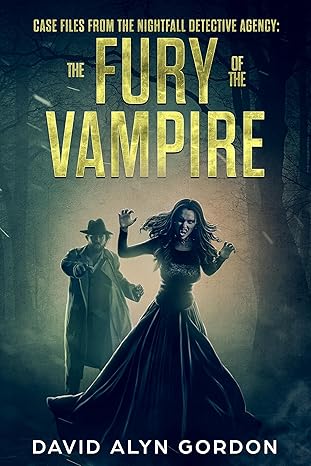

David Alyn Gordon’s Fury of the Vampire is a sweeping supernatural thriller that jumps across centuries, from ancient Jerusalem to 1920s Arizona, weaving together myth, history, and horror. The story follows vampires, werewolves, jinn, and humans caught in webs of betrayal, love, and ambition. At its heart is the eternal struggle between Lilith, Abram, and a cast of characters tied to mystical objects like the Ring of Solomon. Intertwined with this are political conspiracies, mob dealings, and the simmering tension of racial injustice in early 20th-century America. It’s a bold mix of folklore, pulp action, and noir detective work.
I enjoyed how daringly the author blends myth with history. Seeing Lilith spar with Abram in one chapter and then finding myself in the smoke-filled dance halls of Prohibition-era Tucson in the next kept me hooked. The pacing is brisk, and the action scenes pop with energy. I found myself leaning in whenever vampires clashed with werewolves or when political schemers whispered in dark corners. The dialogue can be blunt, sometimes even melodramatic, but it fits the pulpy, high-stakes feel of the book. It reminded me of flipping through an old serialized adventure, where the thrill matters more than polish.
Some passages carry raw emotional weight, like Malia grieving for her cousin, while other scenes are exaggerated. That didn’t ruin the ride for me, though. If anything, it made the book feel unpredictable. I enjoyed how unapologetically it leaned into its own wildness. It’s not a quiet or subtle novel; it’s brash, bloody, and loud. And I have to admit, I had fun with that. Sometimes I rolled my eyes, other times I grinned, and a few moments genuinely made me pause and think, especially the parts dealing with cultural memory and injustice.
I’d say Fury of the Vampire is best for readers who love fast-moving supernatural adventures, who don’t mind a little chaos in their fiction, and who want something that feels both familiar and refreshingly strange. If you’re into folklore reimagined as a gritty pulp detective saga, this is your book. It’s messy, it’s fierce, and it absolutely has bite.
Pages: 164 | ASIN : B0FLTB1L71

American Eugenics Movement
Trail of the Zombies follows a trio from the Nightfall Detective Agency as they unravel a sinister conspiracy tied to eugenics, Indian boarding schools, and a nefarious project called the Utopia Institute. What was the inspiration for the setup of your story?
Great question. I had recently heard of the recent stories about the mistreatment of Indian children in boarding schools and read/mostly watched several documentaries on the subject in researching the beginning of Trail of the Zombies. I also am a fan of the works of Edwin Black and his book, War Against the Weak, told about the height of the American Eugenics Movement which coincided with the timing of the persecution of the Indian children. I also wanted to portray zombies in the way they were meant to be depicted. Recent works and movies/television series inspired by Day of the Dead and The Last Man on Earth show them as flesh-eating monsters. Those are actually ghouls, not zombies.
What kind of research did you do for this novel to ensure you captured the essence of the story’s theme?
This kind of supplements my response to question one. I read and watched a lot of material like many documentaries on the persecution of the Indian Children, the American Eugenics Movement, and actual Zombies. You can find all the sources I used in the Acknowledgement section of Trail of the Zombies.
The Trail of the Zombies crosses many genres. What books or authors were the biggest inspiration for you?
Good question. I mentioned Edwin Black and his book War Against the Weak. That really helped. Universal Horror and Horror movies of that era from other studios like White Zombie were inspirational as well. Mystery-Noir works also guided me as well as the writings and shows of Rod Serling like The Twilight Zone. Historical Fiction like those by James Michener also influenced me.
I hope the series continues in other books. If so, where will the story take readers?
The next book in the Case File Series will be Fury of the Vampire and it will come out before Halloween this year. It picks up right where Trail left off and our heroes will have to solve a political assassination, prevent widespread contamination of a local water supply, stop the antagonists from creating an alternative reality, and combat a powerful Jinn. I think readers are going to enjoy it when it comes out.
Author Links: GoodReads | X (Twitter) | Facebook | Website | Amazon
For the first time since coming into their office, Simon struggled to lift his head, the bullet hole in his eye becoming more evident.
“To find out who killed me.”
Thus begins the next thrilling adventure for the Nightfall Detective Agency.
Vampire Detective Tori Jacobsen and Werewolf Detective Bram Mueller are drawn into the shadowy depths of the Utopia Institute to both solve the murder of the late Ira Simon and the reports of abuse of the Native American Students and those deemed unfit to attend there.
Set in 1929, just outside Marana Arizona, the pair unearth a web of dark secrets.
The Institute is a front for a sinister plot.
Evil Forces, once thwarted in their pursuit of the Eye of Aten, are now bent on creating an army of Zombie slaves from the people held at the Institute.
The ultimate goal?
A hidden Aztec treasure that could fund their designs for world domination.
Tori and Bram must race against time to prevent the ushering in of a new Dark Age of Terror.
If they fail, the world will descend into chaos and repression.
The stakes have never been higher.
Mysterious Stranger

Inescapable follows a 17-year-old boy dreaming of escaping his small-town life, whose life takes a strange turn when a vampire and a witch move into town, and bodies start mysteriously piling up. What was the inspiration for the setup of your story?
I find small towns intriguing because everyone knows everyone – and everyone talks about everyone. It’s like a soap opera. It can be great because there usually is a sense of community, but if you don’t fit in it can also be very lonely. When I was Dylan’s age – and I think it’s the same for most teenagers – I always felt like an outsider in my small town and I desperately wanted to leave. I loved stories about teenagers befriending the mysterious stranger who had just moved to town and turns out to be a vampire or a witch. But it got me thinking… What if – unlike in most YA vampire stories – the newcomer isn’t the good guy?
In many contemporary coming-of-age fiction novels, authors often add their own life experiences to the story. Are there any bits of you in this story?
As I said I’m from a small town. It is not as remote as Berlin, New Hampshire in Inescapable but everyone knows everyone there as well. I’m also really lucky to have an amazing mom – just like Dylan. We don’t have the same dynamic as Susan and Dylan, but I drew from my relationship with my mom to paint a convincing picture of Dylan’s.
What were some themes that were important for you to explore in this book?
I wanted to explore the concept of the vampire as an outsider – someone on the fringes of society who lives by their own rules – and what happens when they meet a human outsider. The concept of “monster” in general is something that I dive into in the book as well. What makes a monster? Who is the good guy, who’s the bad guy?
Friendship and family are an important topic, too. Who are we without the people who love us? And can we choose our own family?
Where does the story go in the next book, and where do you see it going in the future?
The next book will dive deeper into the vampire lore of the Immortal-Blood-Gift-universe. You’ll meet new characters and Dylan will face new challenges. I can’t really say much more without spoiling Inescapable. So go ahead and read it!
Author Links: GoodReads | Instagram | Website | Amazon
As bodies start piling up, each one more gruesome than the last, the town suspects a wild animal is to blame. But Dylan’s world is turned upside down when he learns that Marie is a vampire and Molly, the daughter of his mother’s new boyfriend, is a witch who believes Marie is responsible for the murders.
As Dylan finds himself drawn deeper into the supernatural world, he must make a choice: embrace the darkness within or fight for his humanity. But with a bloodthirsty monster on the loose and no way to return to his old life, Dylan’s decision may already be made for him.
\
Set against the backdrop of 1980s horror, “Inescapable” is a chilling coming-of-age tale that will keep you on the edge of your seat until the very end. If you enjoyed “Stranger Things,” you’ll love this thrilling tale of magic, monsters, and self-discovery.
Don’t miss out on this gripping read.


