Blog Archives
When The Actor Inspired Chaos and Bloodshed
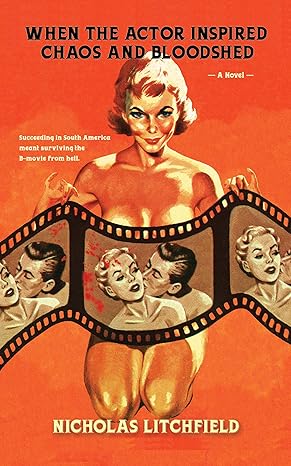

This book is a full-throttle plunge into the absurd, gritty, and dangerous world of low-budget international filmmaking, seen through the often-hungover eyes of Dominic Graves, a fading actor who stumbles into a bloody, chaotic shoot in Montevideo. What starts as a job meant to revive his failing career spirals into a bizarre descent where the lines between performance and real violence blur, egos clash, and survival becomes more than just a metaphor. The story zips from Los Angeles sleaze to South American intrigue, all while Dominic tries to hang on to whatever scraps of dignity he has left.
Litchfield knows how to throw you into a scene. The opening prologue, where a film shoot goes violently sideways, hits hard. Bullets flying, blood spraying, a screaming film exec belly-flopping for cover. It reads like some grainy ’90s action flick at 2 a.m. on cable. That’s the vibe throughout the novel: high tension, slapstick disaster, and sharp edges everywhere. Dominic, caught in the madness, isn’t exactly likable, but he is interesting. He’s the kind of mess you want to keep watching, even when he’s making every wrong choice.
What I really loved is how the book swings between outrageous comedy and deeper, sometimes bleak reflection. Dominic is a washed-up actor carrying guilt, shame, and a streak of self-loathing that sneaks in unexpectedly, like when he reflects on a disturbing sexual encounter with a woman he barely knows, and it genuinely shakes him. These moments add surprising weight to a book that could’ve easily stayed surface-level chaos. And the writing pops. It’s fast, visceral, sometimes poetic, sometimes grotesque, always alive. When Dominic finally meets the creepy director Ignacio, it’s like watching two predators circle each other.
That said, this isn’t a tidy book. It’s messy, like its characters. The pacing jumps around, the tone tilts from noir to satire to farce, and it leans on shock value at times. But I didn’t mind. It fits. The world Litchfield builds is unhinged, and that disorder is the point. When Dominic stumbles into the suite at the lavish Carrasco hotel, high on pills and low on expectations, I felt like I was right there with him, wondering how long it’d take before everything blew up. It’s part travelogue, part fever dream, and fully committed to the bit.
When the Actor Inspired Chaos and Bloodshed is for readers who like their thrillers with grit, grime, and a side of dark humor. It’s a wild ride through the underbelly of the film world, complete with egos, accidents, existential crises, and gunshots. Definitely recommended for fans of noir, black comedy, and stories where everything that can go wrong does, and then some.
Pages: 226 | ASIN : B0DN2Z3D3M

Ethan Tucker’s Job
Ethan Tucker’s Job is a gripping historical novel that plunges readers into the heart of 19th-century Florida. The book follows Ethan Tucker, a rugged ex-soldier turned reluctant lawman, as he is strong-armed into tracking down a dangerous outlaw, Alaster Conley. Against the backdrop of a rapidly changing America, Ethan’s journey is more than just a manhunt—it’s a deeply personal struggle between duty, morality, and the ghosts of his past. As he ventures deeper into the Florida frontier, his mission to bring Conley to justice is complicated by old friends, new enemies, and his own inner demons.
What really stood out to me about Ethan Tucker’s Job is the way Hayes writes action. The book opens with a cinematic, tension-filled scene at a saloon that immediately sets the tone. The shootouts are quick and brutal, the betrayals sting, and the quiet moments carry the weight of a life hard-lived. Hayes does a great job making the world feel real without bogging it down with unnecessary descriptions. The dialogue, especially between Ethan and his former militia buddy, Aiden Sage, crackles with life and keeps the pacing tight. It’s also refreshing to see historical fiction set in Florida’s wild frontier, a setting that isn’t as overdone as the classic Western landscapes of Texas or Arizona.
Some of the book’s emotional beats hit harder than others. Ethan’s struggle with his wife, Faith, is one of the more compelling aspects of the novel. The tension between them is palpable—her disappointment, his regret, and the deep frustration that they can’t seem to bridge the gap between them. The scene where Faith shoves his old pepperbox pistol back into his hands, basically telling him that he’s never going to change, hit me hard. It’s raw, and it’s one of the moments that make Ethan more than just a tough-guy soldier.
Ethan Tucker’s Job is a great read for fans of historical fiction, Westerns, and action-packed storytelling. If you love morally complex protagonists, intense gunfights, and a setting that feels alive with history, this book is definitely worth picking up. It’s gritty, well-paced, and carries just the right amount of heart to make it stick with you after you’ve turned the last page.
Page: 96 | ASIN : B0DYGDKP7Q
Wrath of the Storm Lord

Wrath of the Storm Lord is a sweeping tale of rebellion, memory, and the volatile cost of power. Set in the richly drawn world of Ver’Sut, the story follows Jerith, an outcast turned warrior-myth, as he rises to challenge the empire that crushed his people. What begins as a slow-burning character study morphs into a full-blown elemental war, with storms summoned by raw emotion and loyalty forged in blood. The novel weaves together political tension, intimate relationships, and supernatural forces to deliver a dark and layered fantasy that feels both timely and timeless.
What hooked me from the jump wasn’t the lightning-slinging protagonist—it was Harrison, the scribe. That guy is terrified, skeptical, and deeply human. Through his eyes, the reader gets a front-row seat to power that feels too big, too raw, and too dangerous to be trusted. The scene early on when he’s literally watching the ink on his page move was chilling. Like, I actually paused and thought, “Okay, Herod’s playing a deeper game here.” It’s not just about recording history, it’s about how power can warp even the telling of it. Harrison’s fear is real. You feel it.
Jerith, though. That’s where the book cuts deep. He’s not your clean-cut hero. The dude is powered by grief, rage, and something ancient. The scene where he finds out about his father’s death is wild. He literally becomes a storm. Not figuratively. He is the storm. I couldn’t stop reading as lightning turned the room to chaos, windows exploded, and he claimed the title “Storm Lord” like it was his birthright. It’s intense, and you believe it because Herod builds it slowly. You feel every loss, every scar. The relationship with Valeria was painful, honest, and beautifully tragic. She’s the daughter of the tyrant he’s sworn to destroy, and yet she stands with him. That kind of emotional tug-of-war hit hard.
The writing style is bold, cinematic, and a little unhinged in the best way. Herod doesn’t play it safe. There’s a rhythm to the prose that feels like it’s vibrating with energy, especially when Jerith taps into his power. Whole pages hum with electricity, figuratively. But it’s not just flash. There’s meat here. The philosophical backbone about whether power corrupts or reveals had me underlining entire paragraphs. Like the line, “Power doesn’t corrupt. Power reveals.”
If you’re into morally complicated characters, revolution brewing beneath snowy forests, and a storm god with daddy issues—this one’s for you. It’s not light reading. It’s charged. Heavy. But damn if it doesn’t leave a mark. Wrath of the Storm Lord is perfect for fans of Brandon Sanderson’s grit, Patrick Rothfuss’ poetic edges, and readers who want their fantasy with teeth. Highly recommend for anyone ready to get swept up in a storm.
Pages: 187 | ASIN : B0DVLGKL8F
Shadow of the Cataclysm


Shadow of the Cataclysm is a dark and gripping fantasy that plunges the reader into a world smothered by despair. The story follows Elucido, a former archivist and reluctant hero, as he struggles to navigate a broken land where light is more than just a metaphor—it’s a scarce and dying resource. The fall of the Aether Orbs has plunged the world into darkness, both literally and figuratively, and as Elucido pieces together the mystery behind their destruction, he discovers a growing power within himself. With shadowy enemies lurking, betrayals simmering, and a prophecy whispering of a savior, the novel unfolds as a relentless quest to reclaim the world from oblivion.
Baldwin’s writing is undeniably immersive. The prose drips with atmosphere, layering a heavy sense of foreboding over every scene. Right from the first chapter, where Elucido awakens in the cold remnants of a shattered world, the weight of his loneliness and desperation is palpable. The descriptions of the ruined landscape, the ever-present darkness, and the terrifying creatures that hunt in the shadows create a world that feels suffocatingly real. The contrast between light and dark is a powerful motif, not just in the world-building but in the character arcs as well. However, the heavy descriptions, while beautifully crafted, sometimes slow the pacing, making certain sections feel a bit too weighty when the plot begs to push forward.
One of the book’s biggest strengths is its character work. Elucido is not your typical sword-swinging hero—he’s a thinker, a scholar thrown into a fight he never trained for. His struggle with self-doubt makes his journey all the more compelling. His moments of hesitation, his memories of his brother, and his quiet grief add layers to his character, making his eventual growth into a warrior of light feel well-earned. The antagonists, particularly Caligo and the enigmatic King of Darkness, are chilling. The scene where Caligo overthrows the Regent in a swift, ruthless coup is one of the novel’s best moments, encapsulating the terrifying precision of the Shadow Garrison. However, some supporting characters feel underdeveloped, with only glimpses of their potential shining through.
The themes in Shadow of the Cataclysm hit hard. Hope in the face of despair, the fragile balance of power, and the corruption of ambition are all woven seamlessly into the narrative. The magic system, centered around Elemental Light, adds a fresh twist to familiar fantasy tropes, especially as Elucido struggles to harness it. His failed attempts at controlling his emotions to summon light mirror his own internal battle with grief and purpose, making his eventual success feel deeply personal. At times, the novel leans into exposition-heavy storytelling rather than letting events unfold naturally, which slightly dulls the impact of certain revelations.
Shadow of the Cataclysm is a gripping read for those who love dark fantasy with deeply thematic storytelling. Fans of The Broken Empire series or Mistborn will find much to appreciate in its bleak yet hopeful tone. It rewards patient readers with a rich and emotional journey. If you’re drawn to immersive world-building, morally complex characters, and a battle where the stakes feel devastatingly high, this book is worth diving into.
Pages: 296 | ASIN : B0DV89BBWK
Struggle and Self-reflection

Kelsey’s Crossing follows a man just out of prison for committing election fraud who agrees to help with a voter referendum campaign, where he is given a second chance to make a difference. What was the inspiration for the setup of your story?
I started to think about Kelsey’s Crossing when volunteering at a men’s homeless shelter for a few years. I came to know the residents pretty well and discovered most are men of high character and standards despite their current life conditions. They are proud men. Yet, they live with the sadness that society will not likely provide a break or an opportunity for a “second chance.” I kept asking myself, “What if they could start over? Would their result be different?” I wanted to give them a victory. From there, I created for them a leader, Greg Smith, an ex-convict who also needed a second chance. It was a perfect partnership.
What were some driving ideals behind your character’s development?
I followed on the news a former presidential advisor who was released from prison for several crimes he had committed. I later observed that he defiantly returned to his old ways. I wondered, “What if he put his enormous talents to work for a good cause, like working for the homeless?” So, I rewrote Greg Smith’s story only in a positive way. It was important that Greg Smith’s journey was not void of struggle and self-reflection. He needed to wrestle with the guilt of his old life, self-loathing and all. I also believe that people who truly experience “change” have people in their lives who love them. Greg had plenty of that with his daughter, best friend, and new love interest, Christine. Ultimately, I allowed what was already in Greg’s soul to come out.
What were some themes that were important for you to explore in this book?
The most important theme in Kelsey’s Crossing is that we are all human, which means we will likely make mistakes. The old saying, “I zigged when I should have zagged,” comes to mind. Sometimes, those mistakes can be fatal. But, given the opportunity, “crossing” to another place where honesty and truth prevail is possible? Besides, I’ve always been a sucker for an underdog who fights for truth and justice.
Author Links: GoodReads | Website
But when political corruption in the city of Kelsey threatens the good work of the Mission, Greg reluctantly agrees to direct the Mission’s voter referendum campaign to oppose the city’s self-serving leaders. The campaign soon results in unrest, including a tragic shooting. Greg and his army of homeless men work to restore calm to prevent further chaos. Their success leads them to second-chance opportunities none of them imagined. Kelsey’s Crossing reminds us that the past need not define the future, especially when we dare to accept the gift of a second chance and seek redemption.
Flexible Virtues
Flexible Virtues is kind of a slow-burn romance-meets-psychological drama set in New York. It follows Sandy Gray, a seemingly plain librarian who gets caught between two very different men—Cam, the dangerously charming lawyer with secrets, and Oggie, the awkward but sweet tech guy. But it’s more than a love triangle. The book dips into trauma, trust, transformation, and the emotional whiplash that comes with trying to feel safe again. All of it plays out in libraries, cafes, limos, and even during federal busts.
I thought this would be your standard shy-girl-meets-handsome-guy story. But wow, it turned out to be way more layered. I felt for Sandy. That scene where she gets nervous when Cam first asks her out for coffee? I got it. She’s not just shy—she’s recovering from trauma, and the book doesn’t gloss over that. When she changes her hair and makeup, it’s not about impressing a guy. It’s about taking back control. And the dynamic between her and Cam? Yikes. Red flags waving like parade banners. That twist where we find out Cam was assigned to get close to her for a court case was a gut punch.
I was rooting for Oggie, even though he’s a bit of a lovable mess. The Valley Forge date was adorable. That kiss-that-went-wrong was heartbreaking. I actually laughed and cringed at the same time. He’s trying so hard, and his awkwardness feels real—not forced or quirky for the sake of it. The writing lets those moments breathe. The emotions felt raw and messy in a good way. And then when Cam comes back and just kisses her in a parking lot like nothing happened? Ugh. I wanted to shake her, but also, haven’t we all been there?
Then the story shifts—literally and emotionally. After the fallout in New York, Sandy relocates to Tennessee. The small-town setting brings a breath of fresh air. Two new men enter the picture. Henry MacDonald, a kind, steady neighbor, and Vance Chambers, a soft-spoken veterinarian who manages the farm animals and, like the other three men, vie for Sandy’s affections. I felt like these new relationships aren’t just about romance, they’re about rebuilding. The emotional stakes feel different but just as intense, and watching her gain confidence in this new environment was satisfying.
The writing style is super readable. It’s not showy, not overly “literary,” which I appreciated. There’s this ease to it, but it still manages to carry emotional weight. I found myself breezing through chapters and then pausing to sit with the aftermath of certain scenes. The author doesn’t over-explain or give every little emotion a name. It’s just there, simmering under the surface.
Flexible Virtues hit me harder than I expected. It’s for anyone who’s ever second-guessed their gut, who’s tried to rebuild themselves, who’s learned the hard way that charm isn’t the same as character. It’s not a fluffy romance—it’s messy, complex, and kind of exhausting (in a good way). If you’ve ever had a Cam in your life, or an Oggie, or if you’ve been a Sandy… read this. Just be ready to yell at the book and then hug it after.
Pages: 187
Astral Seeds: Eclipse of The Celestial War

Astral Seeds is a cosmic fantasy epic that launches readers into a universe on the brink of unraveling. It’s a story about the ancient Astral Seeds—primordial fragments of creation—and the celestial war that stirs as they begin to awaken. Dragons, starborn witches, and zodiac titans populate this intricate world where prophecy looms large and bonds are tested. The novel follows Aric Draconis, a dragon rider caught between loyalty, legacy, and the gravitational pull of destiny, as he struggles to navigate alliances, prophecies, and a deepening rift with his dragon, Ignarion.
What really gripped me right away was the way the prologue set the tone—it was vast, eerie, and poetic. There’s something bold about opening with lines like “The sky is no longer silent. It screams with the promise of war.” That’s the kind of sentence that makes you sit up straighter. I loved how Mills wove together celestial grandeur and raw emotion. You feel the weight of the universe, but it’s also personal. Aric’s connection with Ignarion—fractured and fraying—was my favorite thread. Their bond, once unshakable, becomes this quiet heartbreak humming beneath the action.
The worldbuilding is lush and expansive. There were moments in the council chambers or during long internal monologues when I wanted things to move along. The stakes were sky-high, sure, but I did wish the plot got to the point a little faster at times. Still, scenes like the one where King Vaelion reveals his ambition to use the prophecy for control was chilling. He’s not your typical mustache-twirling villain—he’s methodical, frighteningly rational. That conversation between him and Aric had tension for days. And then there’s Eira, the king’s daughter, stepping up as a quiet force of rebellion. Her presence brings a grounded warmth to the book’s colder, star-drenched conflict. Mills is at her best when exploring the gray zones: not all the “good guys” are noble, and not all villains are soulless. The prophecy itself feels more like a mirror than a map—reflecting the characters’ choices rather than dictating them.
Astral Seeds is for lovers of rich worldbuilding, complicated characters, and stories that balance the epic with the intimate. If you like your fantasy with dragons, existential stakes, and a lot of emotional depth (think Eragon meets The Silmarillion with a touch of Dune), then this book will definitely scratch that itch. It’s not a fast read, but it’s a rewarding one. I’m really curious where Mills will take this in the next installment because the battle lines have been drawn—and the heartache has only just begun.
Pages: 388 | ASIN : B0DLBQY4FC
When Anna Came Home

When Anna Came Home dives straight into the shadows of power, wealth, and betrayal with a gripping opening, and refuses to let up. The story follows Anna Cahill, a young woman who, expecting to surprise her family with good news, walks into a nightmare—her entire family gunned down, and her world flipped inside out. What follows is a fast-paced unraveling of secrets, lies, and a tangled web of criminal conspiracy that stretches from family dinner tables to international arms deals. It’s part domestic thriller, part espionage drama, and entirely absorbing.
The writing was clean and fast-moving, but also rich with emotional detail. Condon doesn’t waste time. From the first page, she plants you right in the action. The opening chapter feels like a scene from a slick thriller, with men in black, secret cash exchanges, and ominous hangars. But then, we’re immediately pulled into Anna’s raw, personal hell. The hotel suite scene where she gives her statement is haunting, and her breakdown after realizing her family is gone hit me hard. It was real and messy and completely believable.
But what really got me was the subtle emotional manipulation going on in her family before everything fell apart. Chapter 3 paints a picture of Anna’s picture-perfect life with all the cracks starting to show. Her mother, Meredith, is this elegant, controlling force, and the scene where she comments on Anna’s weight while smiling lovingly was so sharp and real it made me wince. The way Oliver, Anna’s brother, confesses the truth about their parents’ criminal activity over Chinese takeout was the perfect mix of “I love you” and “you’re my only way out.” It’s all so layered—family, guilt, loyalty. Even when Anna’s getting her makeup done there’s this undercurrent of dread that never quite lets up. I kept waiting for someone to pull the rug out from under her again.
This book had me flipping pages late into the night. There’s action, emotional weight, and a steady drip of reveals that kept me guessing. If you’re into shows like Scandal or books by Lisa Jewell, you’ll probably eat this up. That said, there are definitely some heavy themes—abuse, manipulation, corruption—so it’s not exactly light reading. But it is worth it.
I’d recommend When Anna Came Home to fans of twisty thrillers and emotionally complex stories. It’s for readers who like their heroines smart, their villains slippery, and their plots loaded with secrets just waiting to explode. Shannon Condon doesn’t pull punches, and I was all in from page one.
Pages: 200 | ASIN : B0DVLW8VHG



 LITERARY TITAN