Blog Archives
Emotional Truth

Dirty South Haiku sketches a childhood and young life shaped by family legends, Southern landscapes, and the mix of sweetness and grit that sits in so many memories. What inspired you to write this particular collection of poems?
Growing up in the South, I was surrounded by family stories that were passed down almost like folklore, along with landscapes that left a lasting impression. I wanted to capture the sweetness and grit that often sit side by side in Southern life without overexplaining them. These haiku became a way to sketch moments from childhood and young adulthood in brief, distilled scenes. In many ways, the collection serves as a prelude to my upcoming Southern short story collection, where those same themes will be explored in longer narrative form.
What is it about the format of haiku poetry that you enjoy, and why did you choose to tell your story in this format?
A visit to Japan deepened my appreciation for haiku. The form encourages attention—to language, to silence, and to what can be suggested. That approach felt well-suited to memory, which often arrives in flashes rather than complete stories.
How much do real-life events and personal experiences influence your writing?
My writing is strongly influenced by personal experience, but I’m more interested in emotional truth. Real people, places, and moments often serve as a starting point, then evolve through reflection and imagination.
What was the biggest challenge you faced in putting together this poetry collection?
The biggest challenge was learning to sit with restraint. I had to accept that some moments would remain unresolved on the page, much like they do in real life. Allowing the haiku to stay open was a challenge, but it felt true to the nature of both the form and the memories themselves.
Author Links: GoodReads | Instagram | Website | Amazon
HAIKU FOR YOU A collection of simple haikus for early readers.


Poetry and poetics often take a back seat in books for young readers. That is a missed opportunity. When children encounter poetry early, appreciation tends to grow naturally over time. This effect becomes even stronger when the focus is clear and approachable. Haiku, with its compact form and playful precision, is an ideal place to begin.
This book introduces young readers to haiku in a way that feels inviting rather than instructional. Children explore the form through a delightful collection of poems centered on penguins bursting with personality. Each poem feels lively and expressive. The result is a charming blend of structure and storytelling. Narrative skills are quietly reinforced, and vocabulary expands along the way, all while readers spend time with these curious, endearing birds.
Haiku for You by Anthony J. D’Amato is a children’s book devoted entirely to haiku. It is especially well-suited for ages three to seven, given the tone and subject matter. Still, anyone interested in a quick and enjoyable introduction to haiku will find something to enjoy here.
Haikus are sometimes seen as intimidating due to their strict rules. Yet those same constraints are what give the form its striking elegance. This collection makes that point clearly. Many of the poems are lighthearted, even silly at times, but they remain beautifully crafted. The contrast works well and keeps the reading experience fresh.
This is very much a learn-as-you-read book. Educational value is woven throughout, never feeling forced. Just as important, the author’s enjoyment of language is evident on every page. That sense of fun is contagious. It recalls the spirit of Dr. Seuss, where playful experimentation lifts the entire experience. The joy behind these haikus becomes clearer the longer you linger with them.
Both children and adults will enjoy watching this penguin cast move through their world in neat, poetic lines. There is warmth here, along with wit and imagination.
Haiku for You offers knowledge, creativity, and visual appeal in equal measure. The engaging illustrations and D’Amato’s confident command of haiku make this a pleasure to read. It has all the makings of a bedtime favorite, one that families return to again and again.
Pages: 36 | ASIN : B0F4PXF1CZ

Feeling Driven

Bridges of Words is a collection of haikus that capture the spirit, mood, and humanity of cultures around the world. Why was this an important book for you to write?
Words are bridges, I’ve always thought. A Filipino-Australian, I have experienced the nuances of cultural differences as well as the silent need for understanding after growing up in one society and now residing in another. Born prematurely in a military hospital in Nueva Ecija—where my grandmother’s refusal to choose between saving my mother or me led to both our survival—I was named Esperanza, meaning “hope.” That word has carried me through my life.
Language has the ability to bring people together and bridge emotional and physical divides in addition to informing and persuading. Through the delicate compression of haiku, rather than through dissertations or manifestos, Bridges of Words allowed me to celebrate humanity in all its textures. A haiku can capture a universe in three lines: the echo of memory, a stranger’s grin, a city street after rain.
It was also a historical experience to write this book. Japan, which occupied the Philippines during World War II and left behind heartbreaking memories of hardship and tenacity, is the source of haiku. However, engaging with this literary genre became an unconventional act of reconciliation for me. By capturing beauty and transience in the rigid yet simple syllables of haiku, I was able to recognise sorrow without being overcome by it.
Furthermore, forgiveness itself is a bridge, isn’t it? A bridge that lets us go on instead of lingering in the depths of bitterness or rage. Every haiku became a tiny act of construction, a step toward comprehension—a means of expressing that, in spite of our differences and past experiences, we can still live amicably through our common humanity.
Can you share a bit about your writing process? Do you have any rituals or routines when writing?
In addition to the other facets of my entrepreneurial and professional endeavours, writing has always been part of my daily life, though not always in the way one might imagine. From my earliest days, words have been my companions—whether scribbling on my aunts’ college books at age 3, writing verses as a Grade 5 student who unexpectedly won in a poetry contest, serving as the English literary editor of The OLCAn in high school, or later leading The Corps as its first female editor-in-chief at the Philippine Military Academy. That role, along with becoming the Academy’s first female Journalism Awardee and first Languages Plaque recipient, confirmed for me that words could be both a personal refuge and a public responsibility.
My naval career deepened this focus, as I became the inaugural Navy Digest editor and later worked on the Navy Journal, Fleet Journal, and Polaris Magazine. Today, I still edit multiple publications professionally, which keeps me grounded in the discipline and craft of writing.
But Bridges of Words emerged differently. Almost without notice, it came like a bolt of lightning across a still sky. Often, a single sight or memory would prompt me to act immediately. I still recall sitting at my computer here in Adelaide, the morning sun streaming through the blinds, when a haiku began to take shape in my mind. It was like attempting to capture a bird in midair; I had to do something before it vanished.
My approach had been less about routine and more about spontaneity. Sometimes it was the laughter of my sons, sometimes the witty jokes of my husband, sometimes a walk along South Australia’s beaches, sometimes the Zamboanga sunsets of my childhood, or the scenic sights of Taal Lake that never left my memory. That was my rhythm: focusing on the small moments and feeling driven to convey them in words that might resonate with someone else, somewhere else.
Do you have a favourite haiku in the book, and if so, why does it hold special meaning for you?
Logically, I should be more drawn to the haikus that depict the Philippines and Australia, because they are my own countries.
The Philippines’ haiku embodies resilience, a trait I witnessed from an early age. Growing up in a land prone to typhoons and eruptions, I listened to stories and even witnessed at times how families and communities would quietly rebuild lives and spirits with steady resolve. That everyday bravery—the quiet courage of people who simply endure—was etched into me from childhood.
In comparison, Australia exemplifies diversity and unity. When I first set foot in Sydney in 2006, I fell in love instantly with its order, beauty, and openness. Years later, settling in Adelaide with my family in 2010, I discovered a deeper sense of belonging. Here, languages, faiths, and cultures cohabit and enrich one another, and that spirit of coexistence is what I sought to capture in haiku.
Together, these two countries’ haikus create a bridge that spans place and time, tying together memory and lived experience, origin and destination, past and present. Poetry is not only an art of words; it is an edifice of human experience—it speaks of the depth and resilience of human life.
That said, there’s no simple or safe way to answer this question. It feels like being asked which of my children I love the most. Every haiku in Bridges of Words has its own pulse and memory. Just as I cannot love one of my children—Huey, Sev, or Noah—more than his siblings, I cannot favour one poem over the rest. Each carries its weight; each is a bridge.
What is the next book you are working on, and when will it be available?
To be honest, I haven’t made any firm plans yet. Like Bridges of Words, I have a feeling that the next project will develop naturally, as I feel driven to capture it in the moment. For me, book writing started with intuition rather than a plan—a vision, a memory, or a passing idea that begged to be put into words. Perhaps in ways I cannot yet foresee, the next piece will continue to examine metaphorical bridges—between locations, times, or the silent, unseen moments of our everyday existence, though possibly in an altogether different way. I’m letting it take shape for the time being, trusting that the right words will emerge when the moment is right. In the end, writing is simply my way of building small bridges—one fleeting moment, one word, one resonance at a time.
Author Links: GoodReads | X (Twitter) | Facebook | Website | Amazon
Seventeen syllables.
In Bridges of Words, discover a quietly powerful collection of haikus from 57 countries—each a window into the heart of a culture. These verses don’t explain; they invite. They don’t shout; they hum.
Whether you find yourself beneath banyan trees or city lights, this book is a gentle reminder that even across oceans, we’re not so different after all.
Bridges of Words: Haikus Uniting Cultures From 57 Countries of the World

Bridges of Words is a journey stitched together in three short lines at a time. Esperanza Pretila gathers scenes, scents, and sounds from across the globe, distilling them into haiku that act as tiny postcards of the human spirit. From the cherry blossoms of Japan to the samba rhythms of Brazil, from Norway’s fjords to the deserts of Saudi Arabia, each poem captures the mood of a place without overexplaining. It’s a chorus of cultures, all humming the same song of connection and shared humanity.
I found myself reading this slowly, not because it was hard, but because each haiku lingered. The brevity makes you pay attention. Some verses felt like quick Polaroids, others like whispered secrets from the past. The restraint in the writing works well. It never tries too hard to be profound, yet it often lands that way.
What I liked most is how the book manages to be both intimate and universal. The voice is warm, almost like a travel companion who notices the little things others might miss. A few haiku didn’t hit me as strongly, they slipped by too softly, but even those had a role in shaping the overall rhythm. The dedication and acknowledgments at the start also set a deeply personal tone, reminding you that this is not just about places, but about the people and lives behind them.
I’d recommend this book to anyone who enjoys poetry that travels light yet carries weight. It’s perfect for readers who appreciate slow moments, quiet reflection, and the beauty of small things. If you’ve ever wanted to tour the world without leaving your chair, or if you just need a gentle reminder that we’re all connected, these bridges of words are worth crossing.
Pages: 130 | ASIN : B0FHVTBSQ8

Sundays with Jenny
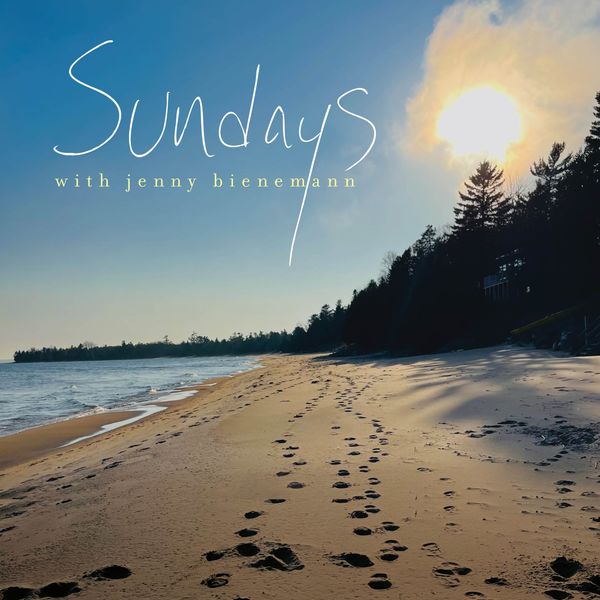
Sundays with Jenny by Jenny Bienemann is a luminous collection of haikus, thoughtfully paired with photographs and distinctive haiku art. Featuring nearly 150 poems, over 100 images, and close to three dozen pieces of haiku-inspired artwork, the book offers a multi-sensory experience. While most haikus follow the traditional three-line form, others unfold across multiple verses, inviting deeper reflection. The themes span a wide emotional and philosophical spectrum, love, resilience, serenity, hope, transformation, compassion, and the subtle nuances of human connection.
Reading this book felt like stepping into a quiet, contemplative space. I was especially drawn to its unique structure, which organizes the content by time of day, from the stillness of dawn to the hush of night. Each section carries a mood, allowing the reader to move through emotional and visual shifts as naturally as the progression of sunlight. The creative use of varying font styles throughout the book added a layer of visual interest, making each page feel curated and intentional.
What stood out most were the moments when text and image merged seamlessly. Instead of simply placing haikus next to photos, Bienemann sometimes integrates the verse directly into the visual composition. One poignant example: a haiku beginning with “Open up your door” appears written on the very surface of a door left slightly ajar, light streaming through the narrow opening, evocative and metaphorically rich.
Bienemann has a keen eye for everyday wonder. A basket of laundry, a pair of reading glasses, even a plate of strawberries, each becomes poetic under her lens. She elevates the ordinary, revealing hidden beauty in small, often overlooked details: a heart-shaped leaf on a sidewalk, a natural heart embedded in a tree stump. The vibrancy of some photographs, particularly those rich in color, is breathtaking. One personal favorite is the city skyline rendered in hues of purple and blue, the first image in the Dawn section. It set the tone with quiet grandeur.
The haiku art adds a unique and creative dimension to the book, with many pieces, particularly the watercolor-inspired ones, resonating deeply and beautifully enhancing the accompanying verses. While some artworks leaned into a more abstract or minimalist style, offering space for personal interpretation, others stood out more subtly, inviting the viewer to pause and reflect. This variety in artistic approach contributes to the book’s eclectic charm, even if a few pieces felt more understated compared to the vividness of the photographs.
Sundays with Jenny is a meditative and visually engaging collection. It invites the reader to slow down, notice more, and find poetry in the everyday.
Pages: 212 | ISBN 978-0-1234-6578-8
Sundays with Jenny
Sundays with Jenny, a collection of haiku and photographs by Jenny Bienemann, invites readers into a quiet, contemplative day filtered through the tender, unhurried gaze of a Sunday. The book unfolds in six thematic sections: Rejoyce, Rise, Renew, Reflect, Restore, and Rejuvenate. Each part marks a distinct time of day, tracing a gentle arc from dawn’s hush to the stillness of midnight. Along the way, it highlights the small, familiar rhythms of daily life.
The haiku, in true minimalist form, are concise yet resonant. Each one distills presence, healing, and wonder into just a few lines. There’s an emotional clarity in Bienemann’s verse, personal yet uncannily universal. Her images are spare but precise, offering a world that feels both intimate and expansive.
Reading Sundays with Jenny is like pausing at the top of a hill, letting out a breath you didn’t know you were holding. Bienemann captures the ephemeral, the half-thoughts and half-feelings we often brush aside, and honors them. Some haiku wrap around you like warmth on a cold morning. Others, such as “doubt magnifies faith, / asking the kinds of questions / only faith answers,” halt you mid-thought and hold you in silence.
One of the book’s quiet triumphs is its structure. The emotional progression echoes a soul’s gentle unfolding. With each chapter, readers drift from light and hope into self-reflection and eventual calm. The transitions are subtle but powerful, forming a seamless narrative of emotion rather than action.
Perhaps the most arresting quality is the immediacy it brings. These haiku do not merely observe, they awaken. Bienemann has a rare ability to locate grace in the unnoticed and pour reverence into the mundane. This book could be read in a single sitting, yet its resonance lingers. It’s especially evocative in autumn, when trees shed both leaves and memory, but its comfort endures in any season.
For those in search of stillness, or simply a companion for the quieter corners of life, Sundays with Jenny offers both presence and poetry in equal measure.
Pages: 212 | ISBN 978-0-1234-6578-8
Haiku Makes Me Happy!

How Do You Haiku? A Step-by-Step Guide with Templates helps readers understand the form of Haiku and teaches them how to write their own beautiful poetry. What inspired you to write this book?
I wanted to write a book I wanted to read as a child. I’ve always loved playing with words. I had many excellent teachers along the way but ten-year-old me would have loved to have had access to a book that taught me simple ways to understand and write Haiku while encouraging me as a shy child. I would have loved to have a book that told me my words were worthwhile and my poetry was worth sharing. This book is part technique, part pep-talk, and part wordplay with a whole lot of templates and Haiku crafts.
What draws you to the Haiku style of poetry? Is there one poet who stirred your love for this style of writing?
Haiku makes me happy! It isn’t a long, arduous poetry form, so I can write it on the fly or while I quietly observe the world through my window. I love that one can express so much with so few words. Writing and reading about little winking moments in nature and time significantly impact my well-being.
Of course, I admire the masters’ Haiku, but I also love Haiku written by current poets and fellow children’s book authors, such as the poets who contributed to this book, Kate Coombs, Raven Howell, and Amy Losak, among others. I also love reading Haiku written by children. Kids come up with amazing poems with unusual and entertaining wordplay!
What were some goals you set for yourself as a writer in this book?
Many kids (and adults) feel they can’t write poems or that their poems are not “good enough.” I wanted to give my readers ample opportunity to see that writing a poem can be easy and fun! My goal was to explain Haiku in a way that gets kids excited about it and gives them the confidence to try something new and be proud of their work.
Is this the first book in the series? If so, when is the next book coming out, and what can your fans expect in the next book?
How Do You Haiku? is a stand-alone book, but another Haiku book is available for my littlest readers (Preschool & up). Peek-A-Boo Haiku (Little Simon) features Haiku about hidden woodland animals, plus flaps that reveal those animals! It’s never too early to introduce kids to poetry!
Author Links: GoodReads | Instagram | Website
This book will help you understand haiku so you can create poems with powerful words and images. Each chapter contains examples from Japanese haiku masters and current poets. The included activities and templates will guide you through fun ways to “haiku,” including painting poem stones for your garden (Kuhi), creating haiku comic strips, and writing group poems with your friends (Renga). How Do You Haiku? This handbook will show you how— step-by-step.
Includes haiku by contributing poets Kate Coombs, Nancy Etchemendy, Matt Forrest Esenwine, Raven Howell, Linda Hoffman Kimball, Amy Losak, Bobi Martin, Angie Quantrell, Sydell Rosenberg, Lee Wardlaw, and Linda Whalen.
How Do You Haiku? A Step-by-Step Guide with Templates
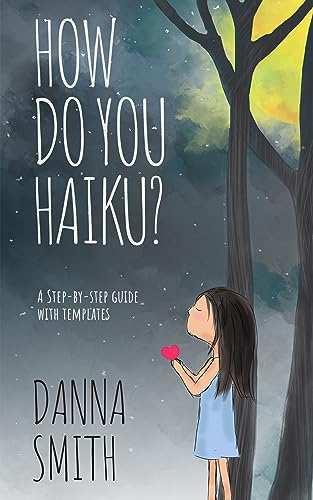
Poetry is an art form that allows us to express ourselves and concisely share feelings. However, the characteristics of poetry vary based on its place of origin. In Japan, for instance, we encounter Haiku, a seventeen-syllable poem with a unique structure and composition. The Haiku aims to draw us out of our daily routine, encouraging us to pause and appreciate nature as if we were capturing a special moment in a photograph. In this context, Danna Smith introduces us to How Do You Haiku? A Step-by-Step Guide with Templates. This guide showcases Haiku’s meditative aspects and highlights its ability to explore the dramatic and the amusing. Thus, Danna Smith leads us through the fundamentals of Haiku efficiently and engagingly, providing instructions, examples, and tips.
Danna Smith discusses how the Haiku sparks imagination and shifts our perception of our surroundings. But she goes even further. She shares vocabulary and explains how to find dynamic words to maintain a solid structure. One of my favorite parts was the Haiku’s history, as it offers insight into using poetry as a means of expression. Furthermore, the book presents clear explanations, and the numerous examples are enjoyable. Another aspect I appreciated is Danna Smith’s addition of translations and explanations for the Japanese terms she uses, enhancing our understanding of Japanese culture.
Writing poetry might initially seem complex, especially in Haiku, where space is limited. Nevertheless, Danna Smith does an outstanding job motivating us to give it a try. While more examples of Haiku would have been helpful to complement the emphasis on technical aspects, overall, the information is well-explained, and there’s ample material to inspire us.
How Do You Haiku? A Step-by-Step Guide with Templates is an exceptional children’s book to help educate and inspire children and adults. This guide is excellent for beginners, serving as a helpful tool to learn how to perceive the world through the lens of poetry and practice the art of Haiku.
Pages: 112 | ASIN : B0CF65LDHT



 LITERARY TITAN