Blog Archives
Humor is Like Social WD-40

The Awkward Optimist’s Guide to Human Connection is a hilarious, insightful, and refreshingly honest look at the challenges of social interaction. Why was this an important book for you to write?
The Awkward Optimist’s Guide to Human Connection grew from my own spectacular failures at small talk and my uncanny ability to say “you too” when waiters tell me to enjoy my meal. After decades of collecting enough awkward moments to fill a museum (or is that a mausoleum?), I realized I wasn’t alone in this special kind of social purgatory—and that maybe my pain could be everyone else’s comedy gold.
Writing this book was important to me because I believe humor is like social WD-40—it makes the squeaky, uncomfortable parts of life glide a little smoother. Plus, it felt therapeutic and cathartic to transform my most cringe-worthy moments (like the time I waved back at someone who was actually hailing a taxi) into stories that might make others feel better about their own social blunders.
Beyond the comedy, I wanted to create an antidote to those insufferable Instagram influencers who make authentic connection look as effortless as their “candid” sunset yoga poses. Real human connection isn’t filtered or perfectly lit—it’s messy, sometimes awkward, and occasionally involves spinach in your teeth during important conversations. Take a look at my podcasts and YouTube casts. They are not NPR Perfect-are you kidding? They are perfectly awkward and authentic.
Ultimately, this book is the guide I wish I’d had during my own journey—a reminder that we’re all just awkward optimists hoping someone will laugh at our jokes and forgive us for accidentally calling our boss “mom” that time in a staff meeting. Everyone else was laughing, so I joined in. That was awkward.
What were some ideas that were important for you to share in this book?
The core ideas I absolutely had to share in “The Awkward Optimist’s Guide” emerged from years of underfunded research (read: embarrassing myself in public and taking mental notes). Some of the most important concepts include:
First, the “Three-Second Rule of Overthinking” – not the one about eating food off the floor, but rather my discovery that giving yourself more than three seconds to analyze a social situation is like falling down a rabbit hole lined with your most embarrassing memories. Action before anxiety became my mantra.
I also needed to debunk the “Perfection Myth” – this bizarre cultural notion that everyone else is navigating social waters like graceful dolphins while you’re flopping around like a caffeinated seal. The truth is we’re all seals. Some just hide their flippers better.
The concept of “Authenticity as a Superpower” was crucial to include. I found that when I finally stopped performing what I thought was a convincing impression of a socially adept human and just showed up as my awkward self, people actually connected with me more. Turns out, vulnerability is like social catnip.
And finally, the idea that “Connection Happens in the Cracks” – those unplanned, unfiltered moments when someone sees you spill coffee all over yourself and instead of pretending to be perfect, you both laugh until your sides hurt. Real relationships aren’t built during flawless dinner parties; they’re forged in shared catastrophes and mutual weirdness.
I wrote this book to give permission to the awkward optimist in all of us to stop waiting until we’ve figured it all out, because spoiler alert: none of us ever do.
What is one piece of advice you wish someone had given you when you were younger?
One piece of advice I wish someone had given me when I was younger? “Your awkwardness isn’t terminal—it’s your personality’s immune system fighting off inauthenticity.”
Throughout my teens and twenties and thirties and forties, I treated my social awkwardness like a contagious disease that needed to be quarantined. I spent approximately 60% of my mental energy trying to appear “normal” in social situations (worrying about what others were thinking), 30% replaying my conversational fumbles in excruciating detail, and the remaining 10% avoiding eye contact with anyone who witnessed said fumbles.
No one told me that those cringe-worthy moments—like the time I confidently waved at my crush across the cafeteria only to realize I had ketchup smeared across my face like war paint—were actually building my resilience muscles. Or that the person who called out “enjoy your haircut” after I left the barbershop (to which I brilliantly responded “you too” to someone clearly sporting a shaved head) would become one of my closest friends because we bonded over mutual awkwardness.
If I could go back, I’d tell young me to save the energy I spent trying to be a smooth operator and redirect it toward something more achievable—like solving cold fusion or teaching cats to respect personal boundaries. Because eventually I learned that people don’t connect with your highlight reel; they connect with the blooper reel you’re brave enough to share.
So, my advice? Embrace the awkward early. It’s not the obstacle to connection—it’s the express lane.
What is one thing that you hope readers take away from The Awkward Optimist’s Guide to Human Connection?
If readers take just one thing from The Awkward Optimist’s Guide to Human Connection, I hope it’s the liberating realization that everyone else is also mentally rehearsing conversations before they happen and then performing extensive post-mortems afterward. We’re all members of the same neurotic book club—some of us just have better covers.
I still remember the day this truth hit me: I was standing frozen in the grocery store, contemplating whether saying “I like your shirt” to the really pretty cashier would come across as friendly or deeply unsettling and creepy. Then I noticed the person behind me muttering what appeared to be their own same conversation script under their breath. That’s when it clicked—we’re all out here simultaneously terrified of each other and desperately wanting to connect. It really hit me after the COVID 19 Pandemic. We needed understand personal connection again.
My fondest dream is that somewhere, someone will read this book in public, laugh out loud at a particularly embarrassing anecdote (probably the chapter about my disastrous attempt to network using only movie quotes), and the stranger next to them will ask what they’re reading. They’ll strike up a conversation, both fumbling through the social niceties, until one of them bravely acknowledges the awkwardness—and in that moment of shared humanity, a real connection will form.
Because ultimately, that’s the paradoxical magic I hope readers discover: our collective awkwardness isn’t the barrier to connection—it’s the bridge. So next time you accidentally text “Love you!” to your plumber or walk into a room and immediately forget why you’re there (I do this a lot!), remember you’re not failing at being human. You’re actually doing it exactly right. As awkward as it is, your call to action is to go buy my book. I can guarantee it will be a mistake worth making.
Author Links: GoodReads | Facebook 1 | Facebook 2 | Website | Reedsy | Kobo | IngramSparks
The guide navigates both digital and physical social landscapes, acknowledging that forming meaningful relationships in either realm can feel like trying to perform surgery while wearing oven mitts. Through chapters like “The Science of the Awkward” and “The Zoo, The Bar, and The Museum: Pickup Lines in the Wild,” readers explore how their most embarrassing moments might actually be their most endearing.
Unlike traditional dating and social skills manuals that promise to transform readers into charismatic smooth-talkers, this book embraces authenticity in all its messy glory. It suggests that waiting three hours to craft the perfect “casual” text message or accidentally walking the wrong way after saying goodbye are universal experiences that make us human rather than social failures to be corrected.
The author positions social mishaps as future anecdotes waiting to happen, teaching readers how to transform their most cringe-worthy encounters into entertaining stories. The book also offers unexpected perspectives on modern social phenomena, suggesting that being ghosted might be a hidden blessing and that failed attempts at wit might create more memorable connections than polished pickup lines.
Written for anyone who’s ever felt like a caffeinated rhinoceros in a world of graceful gazelles, the guide serves as both a practical manual and a permission slip to embrace one’s authentic self. It promises not transformation into a social butterfly, but rather the confidence to flutter awkwardly and own it. The result is a humorous yet insightful exploration of human connection that turns social anxiety into social advantage, one uncomfortable encounter at a time.
The Awkward Optimist’s Guide to Human Connection- A Field Manual For The Socially Ambitious
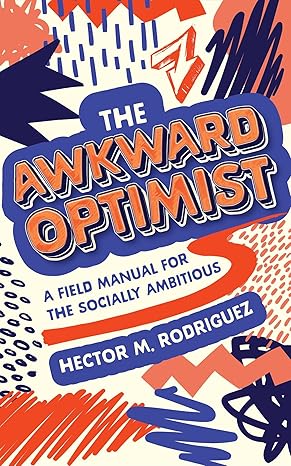

Hector M. Rodriguez’s The Awkward Optimist’s Guide to Human Connection is a hilarious, insightful, and refreshingly honest look at the challenges of social interaction. It’s part self-help, part comedy, and 100% relatable for anyone who has ever fumbled their way through small talk or tried (and failed) to master the art of a good pickup line. Structured as a “field manual” for the socially ambitious, the book breaks down everything from deciphering body language to navigating the terrifying world of dating apps. It reassures readers that awkwardness isn’t just inevitable—it’s a rite of passage on the road to building real human connections.
Rodriguez’s writing style is the best part of the book. He doesn’t drone on with clinical psychology or rigid rules; instead, he infuses every chapter with sharp wit, self-deprecating humor, and painfully relatable anecdotes. Take, for example, his breakdown of pickup lines in The Anatomy of a Pickup Line: A Postmortem. He dissects pickup lines with surgical precision, complete with real-world examples of just how cringe-worthy they can be. The book feels less like a lecture and more like a conversation with a friend who has been through it all and is here to make sure you don’t make the same mistakes.
One of the book’s standout strengths is its deep dive into nonverbal communication. The chapter Reading the Room and the Person’s Nonverbal Cues is packed with practical advice on how to interpret body language, but it’s never dry or clinical. Rodriguez presents it as a detective game—one where your mission is to decode subtle gestures, posture shifts, and even the dreaded forced smile. His discussion of the “Duchenne smile” (the real vs. fake grin) is both fascinating and useful, but what makes it memorable is the way he wraps it in humor. Instead of feeling like homework, it feels like an adventure in social sleuthing.
The book also shines in its breakdown of different social environments. Rodriguez goes beyond the obvious and explores places like libraries, museums, and even farmers’ markets as unexpected but prime locations to meet new people. The Safari of the Soul: Meeting People in Unexpected Places chapter made me laugh, especially the section about striking up conversations at the zoo. He encourages readers to embrace the weirdness of life and find opportunities for connection in the most unexpected places, reinforcing the book’s overarching message: human interaction is messy, awkward, and often ridiculous, but that’s what makes it fun.
The Awkward Optimist’s Guide to Human Connection is a must-read for anyone who struggles with social interaction, dating or just wants to laugh at the absurdity of human connection. If you want a book that embraces the chaos, teaches you useful skills while making you chuckle, and reassures you that awkwardness is just part of the process, then this is for you.
Pages: 153 | ASIN : B0DW4KTH76

The Path Taken
![The Path Taken - A Father and Sons Journey to Santiago de Compostella by [Hector M. Rodriguez]](https://m.media-amazon.com/images/I/31MY2B1P0+L.jpg)

The Path Taken: A Father and Sons Journey to Santiago de Compostella by H. M. Rodriguez is an awe-inspiring story that is filled with wisdom, enlightenment, and history. Rodriguez recounts his time trekking the Camino Frances with his son Simon as they immerse themselves in the spiritually enriched offerings of the journey.
Inspiring is the first word that comes to mind after reading this memoir! Rodriguez’s interpretation of the world around him is heartwarming, even when he discusses upsetting subjects. His accounts of the stories’ he heard while on the trek were my favorite parts.
There were times where I did not agree with some of Rodriguez’s sentiments, but I understood the source from which they came. I think that is an important lesson to be learned from this book. We must try to understand others even when we disagree with them.
Despite the religious undertones, there is something for everyone to take away. You will feel wiser and more thoughtful after reading the book. Although Rodriguez has a simplistic writing style, he makes you think long and hard about life and how you live it. There was more than one occasion where I put the book down to reflect for a few minutes on my own life.
It is hard to critique someone’s personal story, so this is why I’m telling you how the book affected me and less about how I think of the story itself. The Path Taken: A Father and Sons Journey to Santiago de Compostella is a short but thought-provoking travel memoir that I enjoyed reading.
Pages: 77 | ASIN: B08L8B7J4T

A Circular Argument

Hector M. Rodriguez Author Interview
What Happened to Joe French follows the winding story of a man who lives his life by impersonating, lying, and stealing at every turn. What was the inspiration for the setup to this interesting story?
Dyslexia. A person with dyslexia can see the world from an exact opposite perspective. Does it work is the question. I guess we will see if my book sells and teaches people something they will remember. Isn’t that why we write and create? This was my first volley at publishing. It can be a scary thing. I wish I would have started a long time ago. It reminds me of something I heard back in my forties. Something like…If you haven’t reached the top by thirty-five years old (i.e. Olympic gold.), you never will. I’ll keep writing because I kind of like it.
Joe is an intriguing and well developed character. What were some ideas you wanted to explore with his character?
Good question. While I was creating Joe, I wanted him to be likable but always on guard and keenly aware of his place in the world. Can you imagine a world where everyone did this?
Joe gets into a lot of curious and creative situations. How did you plan these events and how did they change as you wrote?
I am a movie buff and when I think of the movies that I enjoyed over the years four come to mind. Forest Gump, One Flew Over the Cuckoo’s Nest, Catch Me if You Can and Catch-22. If you have not seen those movies, they each present a character or situation that can happen and is believable. But it contains a potential ruse. The book, the story is a ruse an action intended to deceive some one. A trick. Tom Hanks in Forest Gump, person with a low I.Q. get to meet the president 4 times just by being in the right spot at the right time, becoming incredibly wealthy by buying Apple Stock when it was first issued, meet eh love of his life and loses her to some unknown disease and on and on. Joe French meets the rich and famous…Jack Nicholson in Cuckoo’s nest, too smart to fit into society. Joe French is an unwitting dyslexic. Too smart in some ways to fit into society. Nobody knew what dyslexia was in the 1950’s and 60’s. Great writing and story telling in Cuckoo’s nest The acting was spot on.
I met Frank Abignal Jr. who wrote “Catch Me if You Can”. It was based on his life. I met him at Trinity University in 1982. I read the book many years ago and watched the movie. (I have a signed copy of the book somewhere!) This character has always fascinated me. The ability to lie your way to success? Impersonating people is a crazy thing to do…not that I have done it…That is the moral of this story. Joe is lost…what the hell happened to Joe French?
A catch-22 is a catch-22. You cannot do anything about the question. A circular argument. I wanted Joe French to be a circular argument. Did it work?
I wanted an events with a little bit of each of these personalities and concepts mixed together.
What is the next book that you are working on and when will it be available?
I intend to publish three by the end of the year. They are all different. One is about the journey I took with my son. We walked the Camino de Santiago. It’s a story about the people I met, the places I stayed, the food, dogs, cats. I don’t want it to be a travel journal but rather a story. I have been working on it for some time and I am about done.
Next book is a translation of my Grandfather’s memoirs. He was a medical Dr. who migrated through Mexico to Texas in the early 1900’s. He hand wrote his memoirs when he was seventy-six years old. His story is worth telling. It’s almost like Indiana Jones in some ways but the adventures happen during the Mexican Revolution. He becomes wealthy is so many ways. He is a happy man and proud man. He learned to value education at all costs. He lived a good life. Some would say he was lucky, other would say he created opportunities. It’s a good story.
The last book is a compilation of twenty five of short stories I wrote. Some of them are pretty good.
Author Links: GoodReads | Amazon
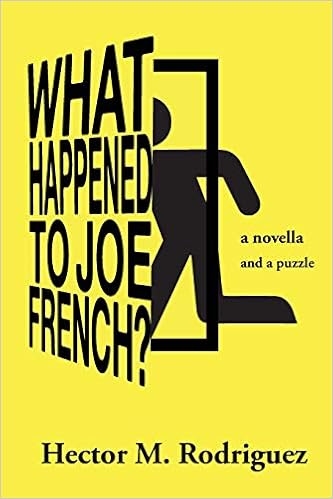 The story of what happened to Joe French is a mystery and a puzzle. As private in the U.S. Army he goes AWOL and sweet talks his way to thousands of dollars impersonating a Captain in the Medical Corp. French figured out a way to swindle cash from the U.S. Government and continues to manipulate his way through tight security, high-level managers, and military brass gaining acceptance as a Medical Officer. He then hides in plain sight as one of the rich and famous carrying on the charade as an up and coming popular songwriter/singer. He even winds up as Grand Marshal in the annual “Bud Billikin Parade ” in Chicago. An alert Sargent gets suspicious and finally catches French, but has no idea as to the extent the crime spree or the master plan that is in play. Sitting in a prison cell, facing years of incarceration, French reflects on his story. The tale winds between incredulous truth and incredulous fiction, between lost love and larceny, between delusion and deception. Behind this petty thief is a master of the con. He is an unknown and unwitting genius. This is where “Catch-22”, “One Flew Over the Cuckoo’s Nest”, “Catch Me if You Can”, and “Forest Gump” come together in one story and one person.
Hidden throughout the story are 33 clues to the puzzle of “What Happened to Joe French?” If you solve the puzzle successfully, the clues will lead you to an exact location. You will not have to travel to the location, only be able to identify it. It is a physical location and the clues, once deciphered, will reveal the name. This is where you will find Joe French. The first person to send the exact location and succinctly describe how they arrived at the solution will receive the 33 ingots of gold ( 2 pounds), referenced in the story. Once you have solved the puzzle, send your result to Seiko141@gmail.comwith the exact location in the subject line. You will be contacted if you are correct. Once the puzzle is solved, the solution will be posted on the author website at Seiko141.com. Visit the site for updates, blog posts, reader forums and additional books by Hector M Rodriguez.



 LITERARY TITAN