Blog Archives
Truth is Fundamentally Important

A Remembrance of Death follows a young man navigating loss, physical limitations, and the British Empire’s complex legacy in the aftermath of WWI. What was the inspiration for the setup of your story?
I wanted to write a story where the main protagonist is not an obvious hero. He is kind, courteous, and principled; he will not lie and understands right and wrong. At the outset, he is an observer of the events around him. He watches as his friend is thrown into a river and is helpless as his marriage falls apart. At the lowest point in his life, he goes to Nuremberg rather than stay with his wife because this is required of him. After Nuremberg, he must make a choice between loyalty to his country or exposing the truth. My inspiration for this story came about because I believe there is a growing trend for our news and history to be manipulated and that the truth is fundamentally important, no matter how uncomfortable it may be.
How did your research into historical events like the Mau Mau uprising and the Nuremberg Trials shape the narrative?
The two events are closely linked for the purposes of the story. My main protagonist, Basil Drewe, is shocked when confronted with the horrors of Dacau and Nazi atrocities and helps with the prosecution of Nazi War Criminals. Nine years later he must look into the Mau Mau uprising, where he learns that the British have closed their eyes to the torture of detainees and that nearly a million natives of the Kikuyu tribe have been resettled forcibly. Until this point in the novel Basil has mainly been a passive observer and now must make a choice as to whether to tow the British establishment line or not. From this point in the narrative Basil changes as does his life, particularly the trajectory of his relationship with his wife.
Laxman Choudhury is a memorable character. What motivated you to include his perspective and cultural experiences?
I was motivated to include Laxman’s perspective and cultural experiences to give a different perspective to the novel. Throughout the novel, there are instances of how foreigners, who are culturally different, are treated. For example, the Chinese workmen who built the railway across America, ‘The Dunera’ boys who were transported to Australia, the Kikuyu who were forced into unsanitary villages, and the detention and killing of Jews during WWII. Laxman Choudhury’s experiences show what it is like to be a foreigner in a time when a country does not respect someone else’s culture. He then returns to India where the tensions between the Hindu and Muslim communities are at breaking point. While he sees the faults of the British, he struggles to see what it is like being a Muslim in a Hindu-dominated society.
If readers take away one lesson or emotion from A Remembrance of Death, what do you hope it will be?
To learn from your mistakes and not to repeat them.
Author Links: GoodReads | X (Twitter) | Facebook | Website | Amazon
As he arrives at Oxford in 1917, Basil Drewe is coming to terms with the recent death of his brother Adrian in the Great War. Meanwhile at Ojai in America, Celia Lutyens and her illegitimate son Robert struggle to find their place in a foreign country. On returning to England, Celia renews her acquaintance with Basil and finds she must deal with the mistakes of her past and the constraints placed upon her by society and its expectations. Their journey takes them to India, Vienna, London, Nuremberg and Kenya. Finally, they return to Castle Drogo, the place where they first met, however, the castle no longer represents the ideal it once did for Celia but is now a mausoleum.
A Remembrance of Death was short-listed for the Yeovil Literary Price and received a high commendation. It was described as, “prose with a classic sensibility … evoking a clear and present time and place, the characters lifting effortlessly from the page with authentic dialogue and engaging set pieces.”
An Inside Track

The Maker’s Name is a suspenseful saga of family betrayal and corporate intrigue that unfolds against the backdrop of Ireland’s economic boom, where two brothers clash over their inheritance. What was the inspiration for the setup of your story?
I’ve always taken a strong interest in the way businesses develop, particularly family businesses. I worked for a number of years in the Irish Industrial Development Authority (IDA) where I was able to gain good insight into many such scenarios. The IDA gave me an inside track.
The characters are complex and often morally ambiguous. Can you talk about your process for developing such compelling characters?
I have often clashed with strong personalities in my career, which also took in multinationals like Colgate-Palmolive Company and Shell Oil. There one would come face to face with individuals whose ambition knew no bounds, and against whom one would need strong defences; rising through the ranks in big business is often a zero-sum game. The process of developing such characters for the novel consisted of little more than remembering back to the details of the personalities and behaviour of the people concerned.
The novel features a mix of dark humor and bursts of violence. How did you balance these elements to maintain tension without overshadowing the story’s deeper themes?
I have always been an avid reader. This, I believe, has encouraged me to a deep study of human nature whenever I have found it. I have also taken inspiration from the very best: Ernest Hemingway, Ian McEwan, Graham Greene, Robert Louis Stevenson, Auberon Waugh, Saul Bellow, Philip Roth, Claire Keegan, Anthony Trollope, Tom Wolfe, William Makepeace Thackery, Vladimir Nabokov, and many, many more of history’s superlative novelists. Not forgetting, of course, James Augustine Aloysius Joyce, for the style.
What is the next book that you are working on and when will it be available?
I am working on an outline, and have written about 30,000 words, of a novel that’s inspired by the kind of things that happened in Ireland in the 1980s, the period in which Claire Keegan’s novella, Small Things Like These, is set. According to one commentator, this book sells a thousand books a week, every week. The film version, starring Cillian Murphy, has just been released, to critical acclaim. My book will be ready in the first quarter of 2025.
Author Links: GoodReads | X (Twitter) | Facebook | Website | Amazon
Literary, historical, Irish family saga fiction, for grownups
Lucid, engaging prose covering half a century of a provincial Irish business family, which could be microcosmic of the nation, from a first-time author.
The Considine brothers, Rudi and Gus, are at war.
Their father, Malachi, has died in a ‘freak accident’. But is there such a thing as a freak accident? When Rudi attempts to grab Gus’s inheritance there’s a real prospect of human blood appearing on the Hawthorne Meats slaughterhouse floor. Enter Cosgrave, a solicitor with expensive tastes, and Toomarood, the banker with an eye to making money outside of his day job. Mix in the ‘free’ energy device, after experts have stated that the promoters are suffering from long-term, severe self-delusion. Does this all make up a catastrophe waiting to happen?
How will Gus’s childhood friend, Raymond Quinn, his partner, Kaarina, and their children, be able to deal with him being placed under an exit ban in China because of his part in a pyramid scheme that has defrauded Chinese small investors? Is Gus really the nice guy everyone thinks he is? His activities as a ‘celebrity butcher’ might suggest otherwise. Does Rudi go too far by defrauding Quinn senior and his business partner through the use of a shadow company?
Is Rudi capable of murder?
And Rudi’s wife, Penny – whose side is she on?
Treachery hangs over this story of the pressures and tensions, both personal and commercial, of Celtic-Tiger era Ireland, especially when that edifice is destroyed in the Global Financial Crisis of 2008.
For Rudi, the payback from Gus and Raymond is severe indeed.
How Oathbreaker Was Born

Oathbreaker follows a hero wracked with guilt on a quest for revenge who seeks to uncover the mystery behind the many mysterious shipwrecks and their connection to his father. What was the inspiration for the setup of your story?
There are two major ingredients behind my inspiration for my book, Oathbreaker. The first one is an article I read about archaeological excavations close to St Louis’ castle in Sidon, Lebanon. It has revealed two mass grave deposits containing partially articulated and disarticulated human skeletal remains.
No less than 25 male individuals have been recovered, with no females or young children. Radiocarbon dating of the human remains, a crusader coin, and the design of Frankish belt buckles found on the site strongly indicate that they belong to a single event in the mid-13th century. The skeletal remains show a high prevalence of unhealed sharp force, penetrating force, and blunt force trauma, consistent with medieval weaponry.
What happened back there? What If they had a chance? Why? Who is responsible?
I tried to investigate and tell that story through Peter’s eyes. His fate isn’t ordinary, as he is part of the Crusaders and a blood-brother of the sultan.
The other ingredient, well, I’m a simple man and a father. I try every single day to be interesting for my children, telling them exciting stories. One summer, I visited the Viking Ship Museum in Oslo, Norway, and it fascinated me. But the Galata Maritime Museum in Genoa is the biggest and the best Maritime Museum in Europe. I was impressed. There is a real replica of a 13th-century ship. After that with my son checked Barcelona’s maritime museum, a smaller one, and then we spent a whole day discovering Admiral Nelson’s ship HMS Victory in Portsmouth Historic Dockyard. Wow, it was a fantastic rainy day! So, yes, I like ships. My children, because of me, like ships, too. So together, we added a ship. To be precise, two ships in the story.
One day with my son, we organized a crime investigation table and created a mind map like in the movies. We showed it to his sister, and she wanted a princess to be involved. They really liked how the story developed.
There is a moment when you realize that the more your children grow, these precious moments we spend together and we laugh, discuss and talk become even more rare.
So I decided to ‘publish’ this moment in a book. That’s how Oathbreaker was born.
Peter encounters many interesting and unique people on his journey. What character did you enjoy writing for? Was there one that was more challenging to write for?
Thank you, it’s a hard question. I tried to view things through the eyes of the characters. Yet the world was so different back there, in 1272. I enjoyed writing the most about the character of Lord Broca. With the captivating Lady Helen and her poetry, they stood out and together they provided Peter with an exhilarating experience.
But I can say the character of Princess Abal, the sultan’s daughter, was a real challenge. According to the official sources, the Legendary Sultan Baibars had three sons and many daughters (at least seven). Still, he managed to fulfill his role as a ruler and a father.
Did you find anything in your research of this story that surprised you?
I found a lot of surprising things. The Atlit Crusader cemetery, in the north of Israel, is the largest and best-preserved cemetery.
The way the coroner today can find out what happened to a human skeleton is not so different in the 13th century. Yes, today we use modern technology, but the steps, the techniques are quite the same. I even discovered an English translation of a diary written by a Chinese coroner from the 13th century, revealing his techniques. His methods are still relevant in contemporary police work. I tried to use that in the Ivar’s notebook.
Another surprising one for me is the speech and the way the people wrote letters in 1272. The language and vocabulary used back then were much richer than what we have today. We just text something short via different mobile apps.
But the most interesting thing I realize is that sometimes I catch myself thinking we, the people, will never change. There are always fights and struggles for power, for richness, and for love. There are always battles, betrayals, and belongings. Even thousands of years ago. Today, only technologies are different, and the language is simple, but people are the same with their passions, desires, and sins. Is there a hope for a better world in a thousand years after us? I hope so.
Can you tell us a little about where the story goes in book three and when the novel will be available?
Peter, Red Herring, and his followers will go rogue. That’s all I can say for now. I am almost finished with the first draft, and I need a two-week break from it. Then I’ll have to check for inconsistencies or issues from book one and two. Then, as usual, I’ll rewrite it again, some self-editing and editing. I hope the 3rd book will be ready for release before the end of the year.
Author Links: GoodReads | Facebook | Website | Amazon
Oathbreaker continues the thrilling historical fiction series which began with Award Winning Author Dimitar Gyopsaliev’ debut novel Longsword: Edward and the Assassin.
★★★★★
“Oathbreaker is more than a historical novel; it’s a tapestry of battle, betrayal, and belonging. It invites both seasoned enthusiasts and new readers into its vividly rendered past. While it stands strong, delving into the first book might enrich the experience. Overall, it’s a compelling blend of meticulous research, dynamic characters, and a story that resonates long after the last page.” — Literary Titan
“A man is only as good as his sword”
Experience the thrilling historical fiction novel Oathbreaker, set in the aftermath of the Second Battle of Ayn Jalut during the Crusades. Follow the gripping journey of Peter Longsword, a hero wracked with guilt after his friend’s death and on a quest for revenge. Struggling to find his place in a tumultuous world, Peter must confront both external threats and internal demons as he navigates through political intrigue and historical conflicts between Christians and Mamluks. Along the way, he develops relationships with Lady Eleanor, Princess Shajar al-Durr, Lord Broca, and Ivar as he seeks to uncover the secrets behind mysterious shipwrecks and his father’s legacy of honor versus betrayal. With powerful emotions and a strong conflict at every turn, will Peter be able to protect those he loves and find the truth before it is too late? If you enjoyed books such as Ken Follet’s Pillars of the Earth, then you’ll love Oathbreaker. Buy now before the price changes!
Oathbreaker
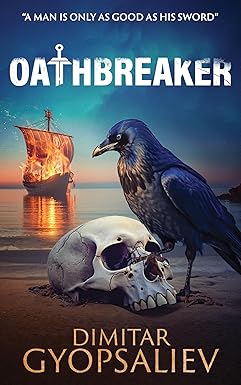

Dimitar Gyopsaliev’s Oathbreaker, the second installment in the Return of the Son series, is a captivating journey back to the turbulent times of the Crusades. This medieval historical fiction begins in the volatile aftermath of the Second Battle of Ayn Jalut, continuing the saga of Peter Longsword, a character whose very name evokes images of bravery and honor. Haunted by past failures and the death of his friend Adam, Longsword is a man transformed by grief and driven by retribution. His path is not just a personal quest but a navigation through the intricate historical animosities between Christians and Mamluks, with dangers lurking at every turn. Yet, Longsword’s journey takes an unexpected detour. A mysterious shipwreck uncovers a conspiracy tied to his lineage, shifting his quest from simple vengeance to a deeper exploration of identity and legacy.
This narrative twist adds layers to an already complex character, showcasing Longsword’s evolution from a mere street orphan to a figure of nobility and determination, reminiscent of the heroes in Ken Follett’s ‘The Pillars of the Earth’ series. Supporting characters like Lady Eleanor, Princess Shajar, and Ivar provide more than just narrative scaffolding; they are the emotional pillars that challenge and deepen Longsword’s journey. The dynamics among these characters enhance the story, offering moments of introspection and camaraderie amid the chaos. Gyopsaliev’s writing is fluid and gripping, weaving historical accuracy with rich, imaginative storytelling. The balance between action-packed sequences and character development is commendable, ensuring the pace is relentless yet reflective. The looming possibility of loss adds a layer of tension, making each moment and decision crucial.
Oathbreaker is more than a historical novel; it’s a tapestry of battle, betrayal, and belonging. It invites both seasoned enthusiasts and new readers into its vividly rendered past. While it stands strong, delving into the first book might enrich the experience. Overall, it’s a compelling blend of meticulous research, dynamic characters, and a story that resonates long after the last page.
Pages: 383 | ASIN : B0CP4PQPPN

Shanghaied


Shanghaied by Jon Howe presents a riveting tale set in the 1800s, focusing on Eamon, a local printer who unexpectedly finds himself at sea aboard the commercial ship Atalanta. The novel begins with a startling premise: Eamon, along with two other men from his town, is drugged, abducted, and forced into service as part of the ship’s crew. What follows is Eamon’s journey of adaptation, acceptance, and an unwavering determination to return home.
Throughout his voyages on the Atalanta, Eamon encounters a series of harrowing experiences, including a brutal beating, the kindness of strangers, a shipwreck, and the loss of comrades. Each moment offers a fresh lens through which Eamon views the world and himself, painting a vivid portrait of resilience and personal growth. The concept of resilience – the ability to recover from difficulties – is a central theme eloquently explored in the narrative. The author skillfully contrasts characters who succumb to their circumstances against the backdrop of Eamon’s steadfast perseverance, highlighting the transformative power of resilience. Jon Howe’s writing is notable for its meticulous attention to detail, particularly in the realms of historical and nautical knowledge. The narrative is rich with comprehensive descriptions and fluid dialogue, immersing readers in the intricate world of 19th-century merchant vessels. The vivid portrayal of life at sea is balanced with the stark realities of the era’s hardships and challenges. While the book excels in its authentic and contextually appropriate descriptive language, it is worth noting that readers unfamiliar with nautical terminology may find certain sections challenging. However, the author does include an extensive glossary of nautical terms at the back of the book.
Shanghaied stands out for its compelling storytelling and well-crafted characters. It’s a novel that will particularly resonate with enthusiasts of historical fiction and maritime adventures, offering a journey not only across the oceans but through the resilience of the human spirit.
Pages: 277 | ASIN : B0CGHY92J8
Always Stay True to the Characters

My Dearest Miss Fairfax follows a young woman who is forced to hide her engagement to the man she loves as she navigates the lies the two have created. What was the idea, or spark, that first set off the need to write this story?
MDMF is my third Jane Austen-inspired book. Jane Austen Lied to Me is a modern romantic comedy, and A Woman’s Persuasion is a modern LGBTQ translation (I went through Persuasion chapter by chapter and rewrote it to prove that Persuasion is ABSOLUTELY relevant to modern audiences… when you have the stakes right!). In order to work on marketing my other novels, I was learning about how to join groups – including Reddit. I found subreddits for historical fiction for other books I’ve written, and historical costuming subreddits – and the Jane Austen subreddit. You don’t just jump on there and sell your book – you go take part in conversations. It’s so much fun!
So I got into this involved conversation, that somehow or other turned to Emma. The girl everyone loves to hate. I must be a very cantankerous person, I have a fondness for the characters that everyone loves to hate. Mrs. Bennet. Emma. (And after writing this book, Frank Churchill.) The thread that ended up in me writing this novel started with me writing a defense of Emma. We need to look at her without the modern lens. Women at this time have only ONE opportunity in her life to improve her situation – by marrying well. Is it terrible that Emma is focusing on helping Harriet marry well? Or is it selfless?
It was a very long and interesting conversation! And like a good conversation, it wandered over many interesting points and topics. Somehow, it came to the point that there isn’t much written in Jane Austen Fan Fiction on Jane Fairfax. Someone said there is a book out there, but it’s actually really bad. So now, I’m intrigued. I re-read Emma, watching for the bits of Jane and Frank’s story. I went and bought a used copy of Emma, and took a pink highlighter to it while I re-read it again.
The hints to Frank and Jane’s story are all over Emma!
Now I needed to write this story.
What were some of the emotional and moral guidelines you followed when developing your characters?
The biggest guideline that I follow for all my stories is to always stay true to the character. In this particular case, my characters are not mine – they are Jane Austen’s. I cannot violate that guideline! I have to, have to, have to stay true to Austen’s characters. The first thing I did was to take all the hints in Emma that we have about Jane’s romance with Frank, and put them in chronological order. And then start asking questions, and look for the most logical answers whenever there is a gap in the information.
What was your favorite scene in this story?
Probably the proposal. The scariest thing to write.
Scenes that aren’t part of Emma are the most terrifying part – when there is NO information to go on, and I have to rely on the Weymouth Historical Society, and Jane Austen reddit fans and JASNA members. To me, it’s absolutely imperative that the story rings true. It needs to feel like the truth. It needs to be what Jane Austen would have written had she chosen to tell us that part.
What Mrs. Dixon’s first name is, that was concerning. Sophia Dixon nee Campbell gets her first name from one of King George and Queen Charlotte’s children. Why are there so many Janes and Elizabeths in England? Names of queens. How did Frank and Jane meet? That was the second most frightening thing to write. So, “write what you know;” it’s based on a visit to a restaurant in Madison when I’d gone back for a visit. When it came time to write the proposal, I was terrified. It needed to be romantic. It needed to be unique. It needed to ring true with Janeites (even though JA never gives details on proposals in her books). And it needed to be memorable.
To this day, I can’t tell you where it came from. The muses paid me a visit one day, I started writing, and suddenly the scene was done, and I sighed with satisfaction. It felt right.
What is the next book you are working on, and when will it be available?
Sadly, right now my personal life is going through some chaos, so it is going to be a little while until I get back to the research and writing. But for those who expand beyond reading regency era books, I am working on a third book to finish out the Scions of Pittsburgh books. Wealth and Privilege and Brains and Beauty are set in Pittsburgh between 1875 and 1889. I get to write about bustle dresses instead of bonnets and spencers. The third book will be called Deceptions and Desires.
As for Jane Austen inspired books? I’ve had a few ideas, but nothing that has driven me yet to go buy a used copy of the book and get out my pink highlighter. Historical fiction is my first love, and after My Dearest Miss Fairfax, I don’t think I want to go back to modern interpretations.
I’m working on making Audiobooks of all my novels. But that’s EXPENSIVE. But for a reason. Talented people have to put in a lot of hours recording and editing an audiobook. The only way to avoid that expense is AI – which I can’t condone using instead of an actual talented person… so I have a GoFundMe to raise the money to pay for a narrator! Please check out my GoFundMe HERE.
Author Links: GoodReads | Twitter | Facebook | Website | Instagram | YouTube
Miss Jane Fairfax has spent her life—though poor and expecting the eventuality of a governess position—by the side of a Colonel’s daughter, living beyond the means she was born into. When she meets the enigmatic and handsome Frank Churchill in Weymouth, she can’t help but fall for him. It’s love at first sight.
Mr Frank Churchill, the heir to his aunt’s fortune and dependent on her goodwill, knows that he cannot marry without Mrs Churchill’s permission. Desperate to marry Jane, he proposes not only marriage but a plan to hide their engagement until his aunt approves of the match. The couple travel separately to their same small hometown of Highbury, where Jane’s ridiculous aunt and the notorious Emma Woodhouse threaten the understanding between them, and as the months pass by, Jane worries that they will be secretly engaged forever, with no happy ending in sight.
As their lies and deceits pile up, can their love survive the social pressures that threaten to tear them apart?
My Dearest Miss Fairfax
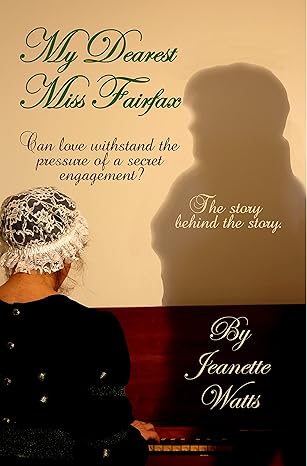
Immerse yourself in the captivating world of My Dearest Miss Fairfax, a novel that breathes new life into Jane Fairfax, a memorable character from Jane Austen’s Emma. In this inspired retelling, Jeanette Watts masterfully unfolds the hidden layers of Jane’s life, exploring her secret engagement with Mr. Frank Churchill. As Jane navigates the aftermath of her parents’ demise, she bravely faces a future as a governess, despite her refined upbringing. Her journey takes her from Weymouth alongside the newlywed Sophie Campbell to the quaint town of Highbury, the residence of her grandmother and Aunt Bates.
This novel is not just a story; it’s a vibrant tapestry woven with the intricate threads of character-driven narrative and eloquent dialogue. Readers are invited to delve deep into Jane’s inner world, experiencing her struggles and resilience amid a society obsessed with the lives of others. The blossoming, yet covert, romance between Jane and Frank is both touching and fraught with challenges, making their journey a heart-rending experience. While the climactic resolution of their love story and Jane’s final reckoning with the meddlesome townsfolk may leave one yearning for a more gratifying closure, the overall experience is a delightful foray into Austen’s world.
Watts’ narrative prowess shines through every page, seamlessly introducing a rich array of characters and their motivations. The story’s brisk pace and engaging dialogue bring each character to life, offering a fresh perspective on both beloved and lesser-known individuals from Emma. Whether you’re a devout Jane Austen fan or a newcomer to her works, My Dearest Miss Fairfax promises a journey filled with intrigue, romance, and a nuanced exploration of societal norms. Step into Jane’s shoes and embark on a journey that will leave you contemplating the intricate dynamics of love, society, and personal fortitude.
Pages: 322 | ASIN : B09TG5XMWX



 LITERARY TITAN