Blog Archives
A Cowboy’s Quest
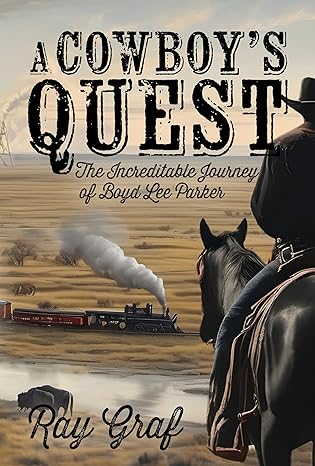

In A Cowboy’s Quest, by Ray Graf, the life of Boyd Lee Parker unfolds in a sweeping story that charts his evolution from a vulnerable 10-year-old orphan into a man of exceptional character. Graf takes readers on an emotional journey, weaving together the highs and lows of Boyd’s life as he navigates military service, forms enduring friendships, and earns the admiration of a Native American chief and community. Alongside these achievements, Boyd pursues his entrepreneurial aspirations while confronting heartbreak, lost love, and moments of deep loss. Through his struggles and triumphs, Boyd emerges as a figure of integrity, leaving a lasting impact on those around him.
The novel’s expansive timeline is one of its most compelling features. Spanning Boyd’s adolescence through his later years, the story unfolds with precision and care, avoiding the pitfalls of feeling rushed or drawn out. Graf’s pacing is exceptional, allowing readers to grow alongside Boyd, experiencing his triumphs and challenges in vivid detail. The immersive nature of the narrative is bolstered by the author’s meticulous attention to historical accuracy. Every detail, from the era-appropriate settings to the authenticity of the characters’ attire and lifestyles, reflects extensive research and thoughtful craftsmanship. The result is a rich and believable world that fully draws the reader in.
While the main story effectively centers on Boyd’s journey, I would have loved to have seen some of the side stories further developed. These subplots show great promise, but their resolutions come a bit too quickly for me and left me wanting to explore them more. It’s clear that the author prioritized Boyd’s central arc to maintain the story’s focus, yet a deeper dive into these secondary threads might have added additional layers to an already rich and engaging narrative.
A Cowboy’s Quest remains a fascinating and highly enjoyable read. Graf has crafted a story that resonates with authenticity and emotional depth, making it a must-read for adult audiences who appreciate cowboy tales and stories set in bygone eras. This historical fiction novel is more than a recounting of one man’s life, it’s a testament to resilience, growth, and the enduring power of the human spirit.
Pages: 385 | ASIN : B0D7WPZCNS

An Unsung Neighborhood

The Mystery from Way Back When follows a man returning to his childhood church where he meets a young woman who is the baby he rescued years ago. She now needs his help to find her birth mother. What was the inspiration for the setup of your story?
My father grew up a member of a close family that were proud members of Sacred Heart Church in the Keighry Head neighborhood of Elizabeth, New Jersey. He attended Sacred Heart School and was even an altar boy. Sacred Heart Church later became Our Lady of Fatima Church. I wanted to set a mystery there, in Keighry Head. It’s an unsung neighborhood and, from my late dad’s stories, the way it once was when he was a boy during the Depression and World War II has pretty much disappeared.
What were the morals you were trying to capture while creating your characters?
Above all, strength of character and decency! The main character, Benny, doesn’t hesitate for a second when he sees a young girl at a distance abandoning a baby on the steps of his church. He takes the baby right home to his mother, knowing she can help the little one, and then tries to identify who abandoned her. It’s World War II. The people are patriotic. The kids have their eye on a suspected spy. Maybe a lot of people these days don’t realize this, but Catholics have always taken a lot of flak in this country, even yet, and especially since the whole situation came to light about the pedophile priests. In this story, the priest doesn’t belong in jail. He’s a really good guy.
What was your favorite scene in this story?
Oh, that’s an easy question! When Benny brings the abandoned newborn baby home and his mother tends to her, she starts to sing to the baby, and naturally, the song is “Baby Face.” Benny, his brothers, and even the old grandfather who lives with them chimes in. It’s joyous! It turns the baby’s sad start into something of a celebration of her arrival.
What is the next book that you are working on, and when will it be available?
There were two books that I had started working on and then put temporarily aside. I picked them up again and I’m continuing with both. They’re mysteries. One is set on a cruise ship and the other in a non-profit organization where someone is corrupt to the core and stealing the funds. I also have another one in mind, and it’s a mystery that unfolds during a wedding, where the parents of the bride are divorced and it’s always a battleground when they’re required to get together. So I’ve got three books in the works, and they should be available later in the year. Somehow, for me, it works out beautifully to work on more than one book at a time. I’m loving the whole process of creating all of these stories!
Author Links: GoodReads | X (Twitter) | Facebook | Website | Amazon
The only clue to the child’s origins is a note found in the basket requesting that she be raised Catholic. The police arrive to get the baby to the hospital while the parish priest arranges for her adoption. Meanwhile, the boys try to play detective and figure out who gave the baby up. Benny even has a likely suspect, Nancy Kilkenny, but she hotly denies it.
Years later, the baby, all grown up, has an urgent reason to connect with Benny and Timmy to try and find out what really happened way back when. Who was the mother who gave her away? What happened on that memorable day in 1944? And can she ever manage to find out the truth?
Everything in Prosperity: Book 2 – Prosperity Series
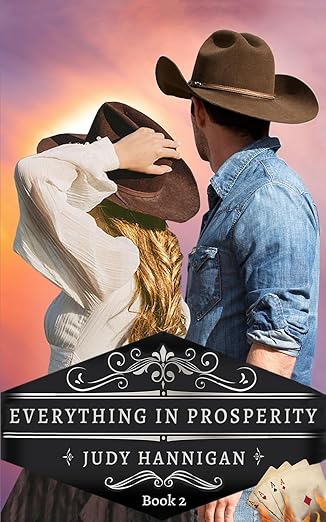

In Everything in Prosperity, Judy Hannigan masterfully transports readers to the rugged, untamed world of the Old West, weaving a tale rich in action, romance, and suspense. The novel follows Sam and Jackson Knight, whose partnership with Deputy U.S. Marshal Price Hardin to dismantle the notorious Colson Brigham Gang sets the stage for conflicts that reach far beyond gunfights and outlaws. Their most perilous battles are not against their enemies but within their own hearts. Sam carries a secret that weighs heavily, her past shrouded in whispers and shadowed by guilt. Meanwhile, Jackson wrestles with his loyalty to Sam and his connection to Jessa Nolan, the widow who saved his life and whose son may hold an unspoken bond with him. Complicating matters further is Deacon Storey, Sam’s childhood confidant and former suitor, whose return stirs old emotions and unresolved tensions. As danger closes in and trust is tested, Sam and Jackson must navigate a maze of jealousy, doubt, and betrayal to determine if their love can withstand the pressure—or if the past will tear them apart forever.
Hannigan’s storytelling stands out for its meticulous research and seamless integration of real historical figures like Annie Oakley, anchoring the fictional narrative in a vivid sense of authenticity. Her portrayal of frontier life brims with detail, painting scenes of dusty trails, bustling saloons, and the raw, unpredictable nature of life on the edge of civilization. Every description immerses readers in a world that feels both gritty and alive, pulling them into the drama and danger. At its core, this is a story about resilience and redemption. Sam and Jackson’s relationship is layered and deeply human, their love tested by external threats and personal demons alike.
Sam’s strength and vulnerability make her a compelling heroine, while Jackson’s loyalty and inner conflict ground him as an imperfect yet endearing partner. The supporting cast adds richness to the narrative, from the determined Deputy Hardin to the enigmatic Deacon Storey, and even young Peter Jack. Together, they create a tapestry of relationships that feel genuine and multifaceted. The villains, meanwhile, bring a chilling edge, their menace adding tension and urgency to the story.
Everything in Prosperity isn’t just a tale of romance and adventure—it’s an exploration of the themes of forgiveness, loyalty, and the enduring power of love. Hannigan’s ability to balance heart-pounding action with deep emotional resonance ensures that the story grips readers from beginning to end. Fans of historical fiction, romance, and suspense will find much to admire in this novel.
I highly recommend this book, as it is an unforgettable journey into the trials and triumphs of the Old West. It leaves readers pondering one of the oldest questions of all: Can love truly conquer the scars of the past and the challenges of the present? With its gripping narrative and emotionally charged characters, Everything in Prosperity delivers a resounding answer.
Pages: 402 | ASIN : B0DMYGL3LM
Human History is Brutal

Montjoy: A Novel in Five Verges follows a Jewish professor and historian grappling with personal and professional crises who is entrusted with a Nazi diary written by a camp guard. What was the inspiration for the setup of your story?
Montjoy unfolded over many years and many iterations. I originally envisioned the story as a classic revenge narrative, but felt it trivialized events, and pointed to the same myths that Walter Benjamin criticized. Benjamin was an enormous inspiration for this book (Montjoy would not exist without the Frankfurt School of philosophers), and the story is very much told from an anti-historicist perspective. Like my protagonist Owen Schoenberg, I had to understand that history cannot be understood as a linear version of events. History is a shadowplay between past and present, and never truly done with us. This is most exemplified by the Ungeist character, who is like a ghost that can’t be chased away. Human history is brutal, unforgiving and ugly, but it is who we are. Once I realized this, there was no way I could go back to my original story. It seemed superfluous by then.
What were some goals you set for yourself as a writer in this book?
I don’t start out with a set of goals necessarily, but I did know that I wanted to experiment with the historical fiction narrative, and create something that felt close to a documentary. Writers like W.G. Sebald, Thomas Bernhard, Paul Auster and J.G. Ballard (his book Running Wild especially) were huge inspirations to me while writing Montjoy, and I wanted to play with fiction and non-fiction elements almost like a Hegelian dialectic. However, what I arrived at was Theodor Adorno’s notion of the negative dialectic, where contradictions are upheld and no easy resolution is possible. This is what Owen Schoenberg eventually has to grapple with. Behind the more philosophical elements of the story, I wanted to write a story about loss, and how someone who is emotionally closed off deals with that. Owen Schoenberg looks at everything through a non-fiction lens, so it was only natural that he would be consumed by fictions. The merkbuch as well as a version of his son that never existed.
What were some themes that were important for you to explore in this book?
Response: Obviously, the war on truth is concerning for us all and I wanted to show how important it is that we stick to the facts. Wittgenstein said that “the world is the totality of facts, not of things” and I would be hard pressed to see his logic anywhere in the world today. Montjoy explores many subjects (anti-historicism, the Holocaust, the Nazi war machine and its bureaucracy), but most crucial is the embrace of facts, which are not always easy to confirm and can be hijacked by conspiracies. As we are well aware, the truth is now easier to manipulate, skewer and propagandize, and I wanted to show the dangers of such myths and where they can lead. Orwell feared that objective truth was fading out of the world and lies would be our history. Montjoy makes a case for the truth and all its illusions.
What is the next book that you are working on, and when can your fans expect it to be out?
My next book is another historical mystery that shares some of the same themes as Montjoy, but from a completely different angle. I am currently in the writing stage with an eye on a 2026 release.
Author Links: GoodReads | X | Facebook | Instagram
Told in an experimental style that echoes the works of W.G. Sebald and Iain Sinclair, Montjoy is a chilling story about the ghosts of history and the shadows that linger long after the clock tolls.
The Mystery from Way Back When

In The Mystery from Way Back When, Carolyn Summer Quinn weaves a compelling narrative that bridges the present and the past with elegance and emotional depth. Benny Finnegan, accompanied by his wife Imogene and daughter Tara, returns to his childhood church in New Jersey for its final Mass. This seemingly routine visit transforms into a poignant journey through time when Benny reunites with Antonia “Baby Face,” a woman he once found as a baby on the church steps alongside his brother. Now a mother herself, Antonia urgently seeks Benny’s help to uncover the identity of her biological mother—a quest made critical by a medical crisis. As Benny reflects on his wartime childhood and the earlier, fruitless search for Antonia’s family, the narrative delicately unfolds layers of memory, revealing how the passage of time brings clarity and resolution to the long-unsolved mystery of her origins.
Quinn balances suspense with warmth, crafting a story that is as engaging as it is uplifting. The intrigue surrounding Antonia’s past, paired with her urgent search for answers, offers just enough suspense to keep readers hooked without veering into melodrama. Simultaneously, the wholesome tone of the book lends a comforting, heartfelt quality that makes the story both accessible and deeply satisfying.
The author’s writing style and pacing are fantastic. The narrative moves seamlessly, blending mild suspense with moments of reflection and revelation. Quinn’s ability to evoke both emotional resonance and curiosity ensures that readers remain fully invested in the characters’ intertwined journeys.
At its heart, this novel is a touching exploration of belonging and identity. Quinn beautifully captures the significance of family bonds and the profound sense of rootedness that comes with understanding one’s history. Through Benny’s and Antonia’s interconnected stories, the book offers a poignant reminder of the enduring importance of connection, whether by blood or choice.
The Mystery from Way Back When is a wholesome, engaging, and thought-provoking read. With its blend of mild suspense and heartfelt moments, it holds universal appeal and is highly recommended for readers of all ages seeking a story that will both captivate and uplift.
Pages: 166 | ASIN : B0DQP1RJ4P

Montjoy
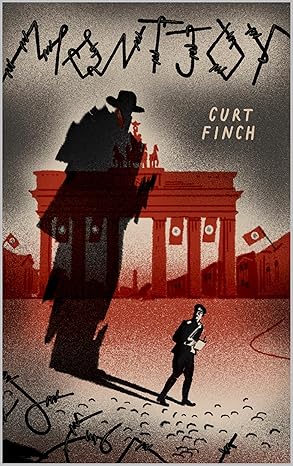
Curt Finch’s Montjoy is a narrative shaped by loss, memory, and the weight of history. Told through the reflective lens of its protagonist, Owen Schoenberg, a historian grappling with personal and professional crises, the novel traverses Europe, exploring Manchester, Vienna, Berlin, Linz, and finally a return home. Finch weaves together themes of grief, identity, and the search for meaning against the backdrop of Holocaust history and contemporary existential malaise.
One of the most striking aspects of the book is Finch’s writing style. It’s intricate, even meandering at times, with sentences that seem to mirror the protagonist’s restless and pensive state of mind. There’s an early scene in Manchester where Owen receives a phone call from Ella Grunebaum that sets the story in motion. Finch writes with a blend of dry humor and melancholy that hooked me immediately. Owen’s ruminations—on the collapse of his marriage, the death of his son, and his Baillie Gifford Prize for a book that feels hollow in hindsight—strike a deeply human chord. Finch captures the emotional weight of these experiences without tipping into melodrama. The balance between Owen’s sharp wit and his palpable sorrow made him a compelling, if occasionally infuriating, narrator.
Vienna—the second “verge”—is where the novel truly shines. Here, Owen immerses himself in the archives of the Mauthausen Memorial, unearthing both historical and personal truths. The city becomes a character in itself, with its wintry streets and grand cafés reflecting Owen’s internal isolation. Finch excels in painting Vienna as a place of contradictions: cultured yet haunted, vibrant yet subdued. A particularly vivid moment is a dinner with Ella and her husband Noah, where the conversation spirals into philosophical debates about memory, history, and the ethics of storytelling. This scene epitomizes the book’s intellectual richness, though at times, the dialogue can feel academic. Still, it’s these dense exchanges that give the narrative its weight and texture.
One aspect I found challenging was the novel’s pacing, especially in Berlin and Linz. While Finch’s prose remains evocative, the plot occasionally feels bogged down by Owen’s introspection and the historical detail. For instance, Owen’s discovery of the mysterious “merkbuch” in Linz—a journal buried at the Mauthausen site—is a fascinating thread, yet its unraveling is slow and laden with tangents. That said, the merkbuch’s contents—recounting acts of defiance and despair during the Nazi era—are haunting and memorable, raising questions about the interplay of fact and fiction, morality and survival.
By the time Owen returns “home” in the final verge, the novel feels like it’s circling back on itself, much like its protagonist. The ending is understated yet poignant, leaving more questions than answers. I found it fitting for a story so concerned with the elusive nature of truth and reconciliation. Finch doesn’t offer easy resolutions, and that’s precisely what makes the book linger in your mind.
Montjoy is a novel for readers who enjoy thought-provoking literature steeped in history and philosophy. Fans of W.G. Sebald or John Banville will likely find much to admire here. For me, it was a moving and intellectually rewarding read, though one that demanded patience and reflection. Finch has crafted a novel that’s as much about the stories we tell ourselves as it is about the ones we uncover in the world around us.
Pages: 147 | ASIN : B0DLLHSTY7
Her Story Spilled Onto the Page

In The Titanic Test, a time-traveler yearns for a simple life, but she is forced to revisit the doomed Titanic and retrieve a valuable book before the ship meets its fate. What was the inspiration for the setup of your story?
The Titanic Test was born out of my obsession with the concept of time travel and with the ill-fated voyage of the Titanic, especially as so beautifully brought to life in James Cameron’s 1997 film. Put those two things together, and voilà! The Titanic Test.
The notion of a high school test in time as the central theme of the book came from one of those “lightning” moments when an idea just strikes you. After that, Charlie took shape in my imagination, and her story spilled onto the page.
I added “A Love Story” as a subtitle to the book because, of course, Charlie and Quinn’s relationship is a huge part of the story, but also because Charlie finds love for humanity through her experience in 1912.
Why choose this period in time for your time-traveling main character to visit?
Because of the role of the Titanic in the book, the time period was decided for me. Happily, the late Edwardian era was a time of elegance, technological advancement, and change, making it the perfect backdrop for Charlie’s life-altering trip in time.
What were some of the trials that you felt were important to highlight Charlie’s development?
Charlie is a girl who lives in the moment and doesn’t appreciate the past. She dreads Windline Academy’s Junior Year Test, even more so when she learns she is to sail on the Titanic. When she engages with real-life people on the ship, she begins to realize that the right thing, in her eyes, and the rules of the test are incompatible. Then, when she makes her choice, she must fight an uphill battle — against time, against fate, and against the men who run the ship. The entire test is designed to bring out Charlie’s strengths, and it succeeds in spades.
What is the next book that you are working on, and when will it be available?
I’m deep in the throws of finalizing the audiobook for The Titanic Test, working with an excellent narrator, Lillian Field. It will be available in late January. After that, I’ll be diving in (so to speak) to The Titanic Test’s sequel…. At the moment, I’m learning so much from this journey and enjoying every minute of it!
Author Links: GoodReads | X | Facebook | Website
When Charlie learns her test is to sail on the Titanic, she vows to hide out in her cabin. But soon she meets the ship’s colorful passengers and has to choose between her conscience and passing the test. To make matters worse, Quinn, her childhood best friend turned annoying and super popular senior, shows up to keep her on track.
Sparks fly when she and Quinn clash, but soon their perspectives—and their hearts—meld under the Titanic’s stars. Time, they learn, is a tough adversary, and in the end, the Titanic changes Charlie’s future . . . forever.
1066: What Fates Impose

1066: What Fates Impose dives headfirst into one of history’s pivotal years, 1066, blending historical detail with vivid storytelling. Through the lives of monarchs, warriors, and the common folk of England and Normandy, author G.K. Holloway vividly portrays the dramatic events surrounding the Norman Conquest. The narrative begins with an aging William the Conqueror on his deathbed, haunted by guilt and the specters of his past, then sweeps back to the intertwining lives of King Edward, Harold Godwinson, and others whose decisions would change England forever. This book is as much about the weight of destiny as it is about the human struggles beneath crowns and chainmail.
Holloway’s writing immediately struck me with its immersive quality. The opening scenes of William’s fevered reflections are intense and unsettling. The imagery of the dying king haunted by grotesque visions of his deeds grips you with its rawness. The meticulous detailing of Edward’s wedding preparations, though rich in texture, felt drawn out. Yet, these moments of languor seem deliberate, creating an eerie calm before the storm. For instance, King Edward’s awkward wedding night encapsulates his inner conflict and sets up a subtle commentary on power and personal failure. Holloway has a knack for using these quiet moments to build tension.
What I found most compelling was the characterization. Harold Godwinson shines as a figure of complexity—proud, impulsive, and occasionally reckless. His encounter with Edyth, the woman who catches his eye at Edward’s wedding, is both tender and electric, showing his human vulnerabilities. Contrast this with Sweyn’s chillingly violent exploits on the docks, and you see how Holloway uses characters to reflect the broader chaos of the era. The dialogue is sharp and believable, and while some scenes—like Sweyn’s drunken assault—are unflinchingly graphic, they underscore the brutal reality of medieval life.
Edith, King Edward’s queen, and Edyth, Harold’s love interest, are compelling in their own rights but often feel overshadowed by the men’s larger political struggles. Holloway hints at their intelligence and agency, yet their arcs are left underexplored. It’s a shame because moments like Edith’s sharp confrontation with Edward on their wedding night reveal layers of strength and wit that beg for more attention.
By the end, What Fates Impose left me reflective on the capricious nature of power and fate. Holloway’s knack for intertwining personal and political stakes pays off in spades. The climactic scenes build to an inevitable, tragic crescendo that you see coming but are powerless to stop—much like the characters themselves.
I’d wholeheartedly recommend 1066: What Fates Impose to lovers of historical fiction who enjoy layered narratives and authentic period details. If you’re a fan of Hilary Mantel or Bernard Cornwell, this will be right up your alley.
Pages: 559 | ASIN : B00BPDGWNA



 LITERARY TITAN