Blog Archives
The Best of Both Worlds

Disheartened follows a woman living a separate life in 1860 and 2020, remembering everything as she drifts between the two, struggling to protect the people she loves in two different centuries. How did the concept of E.V.E. first develop?
The concept of E.V.E. (Essence Voyager Era ― the inherited gift of having the ability to live two parallel lives on two separate planes of existence as the soul travels nightly – essentially falling asleep on one plane and awakening to a new day on a new plane) came about due to a strange dream I had in the summer of 2009. I immediately started writing the first book in the E.V.E. series, Essence. After it was published in 2011, it grew into a series of four books that centered on Jocelyn (Sidney’s younger sister) and Jackson’s relationship. The Spirit Quest series is a spinoff of the original series, except this series focuses on Sidney’s experience with E.V.E.
Sidney carries the memories of two different lives. What was the greatest challenge in writing her perspective?
The greatest challenge with this particular character and period was researching from both perspectives (North and South) for the 1860 era and trying to offer a varying perspective of the 2020/Covid era experience, which we all lived through.
Foreknowledge plays a central role in the novel. How would you respond to the question of whether knowing the future is a gift or a burden?
Different members of different families who have inherited the gift (or curse) of E.V.E. have expressed their opinions of it. Some believe it to be a gift that allows them to experience the best of both worlds. Others feel it is a curse because despite knowing what the future holds, they are almost helpless to stop it in any meaningful way.
What lies ahead for the Spirit Quest series?
The third installment in the series, Foreshadowed, is due to be released later this year. The span of the novel covers the day after the 1860/2020 presidential elections through the first shots fired at Fort Sumter. It focuses on the personal challenges Sidney faces with the global pandemic, extended family pressure, and navigating increasing political division that is tearing apart the country in both of her lives.
Author Links: GoodReads | X (Twitter) | Facbook | Website | Scarlett Ink Publishing | Amazon
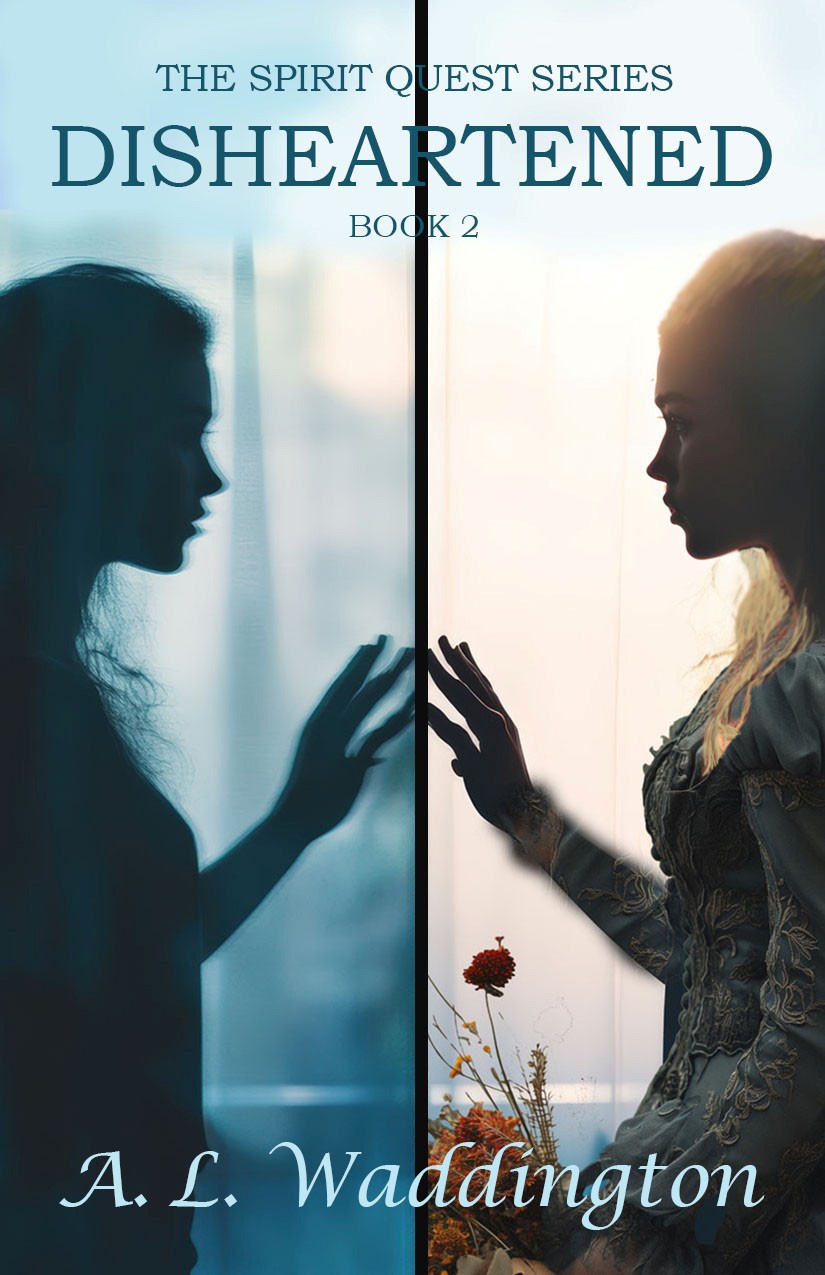
Gifted or cursed with the inherited ability of E.V.E., Sidney is forced into the inconceivable ― her 1860 self-watches on the eve of the American Civil War as the Northerners and Southerners dismantle the fabric of the nation. Whereas her 2020 self-witnesses the extreme Progressives and Liberals under the guise of the Democrat umbrella shred away the decency of the American Culture on a world-wide stage and making the USA the laughingstock of the globe.
Sidney is heartbroken watching everything her loved ones and countrymen from her other life fought to preserve be undone by a minute mindless minority of entitled fanatics and a political party so hell-bent on spreading violence and hate, they would rather burn the nation to the ground than relinquish power.
But what can she do? Can one small voice change the mind of millions with hate in their heart? Can she find her way back to the solace she once treasured in both her lives?
Disheartened


A.L. Waddington’s Disheartened, the second book in the Spirit Quest Series, follows Sidney as she lives two parallel lives 160 years apart. In 2020 Boston, she and Landon face medical school, hospital work, the COVID-19 pandemic, political unrest, and a painful family loss. In 1860, she is married to physician Keifer, gives birth to their son, visits his family in Savannah, and travels to Chicago as the nation moves toward civil war. Through the inherited gift of E.V.E., Sidney remembers both worlds and struggles with the desire to protect people whose futures she already knows.
I liked the alternating chronology because the two periods reflect each other without feeling identical. Both are marked by fear, social division, and families trying to preserve ordinary life while larger events close in. The domestic scenes give the novel much of its texture: shared meals, hospital shifts, childbirth, letters, road trips, and quiet conversations between couples. Sidney’s grief over Nicholas is especially effective because he connects her two lives, and his death leaves her emotionally unmoored.
The novel is also strongly political. Its characters debate COVID restrictions, race, elections, slavery, taxation, secession, and Lincoln’s role in the coming war. These views are presented from a distinctly conservative perspective, and readers will need to be comfortable with that approach. At times, the political dialogue slows the story and makes several characters sound alike. The book is strongest when those beliefs produce personal consequences, especially in Keifer’s divided loyalties and Sidney’s confrontation with the father who abandoned her.
I’d recommend Disheartened to readers of historical fiction, time-slip fantasy, family saga, political fiction, and romance. Its divided-life premise recalls Diana Gabaldon’s Outlander, though Waddington focuses more on parallel families and foreknowledge. Disheartened is ultimately about having two homes and knowing neither can ever be safely left behind.
Pages: 442 | ASIN : B0GR9PWSL2

Man of Determination

Season of Life follows a free Black farmer in the aftermath of the Civil War who returns home only to be drawn into military intelligence alongside a Union spy. What was the inspiration for the setup of your story?
I’ve always been fascinated by the American Civil War. It was such a convulsive rupture of the American Republic. At first that fascination was with the military aspects, but gradually expanded to other facets of the war such as military intelligence and espionage, which grew to almost an art on the Union side. The effects of the war on the civilian population were both terrible and fascinating — it was fought in towns and rural areas across the country, affecting hundreds of thousands of people. Many people lost everything: homes, farms, property. War is a callous and uncaring consumer of people’s lives. The military aftereffects of battle at this time astonished me. This was an age when the medical arts were still in their infancy. Germ theory was only just beginning (Louis Pasteur only published his work on microorganisms in 1861, and Joseph Lister’s experiments with carbolic acid as a disinfectant in surgery only began in 1865, after the war had ended). Also shocking was the lack of forethought given to the treatment of the inevitable wounded organizationally, in a time when weapons like the rifled musket increased casualties exponentially. Civilian volunteers became common and vital after battles. Season of Life was my attempt to try to bring all these things together…with a surreal twist.
How much of Basil Biggs’s story is based on the historical figure, and where did your imagination take over?
Historical Fiction is usually, if not always, about filling in the gaps when primary evidence is spotty, incomplete, or sometimes almost non-existent. Basil Biggs was indeed a tenant farmer on the actual battlefield, whose home and farm were devastated by the battle. He lost almost everything, including stock, trampled and burned crops, and a pillaged home. He then went on to become instrumental in the reinterment of Union dead from hastily made graves across the battlefield to the new National Cemetery, a task he did with great respect for the dead. He also inherited the land where the final terrible fight on the third day of the battle occurred, Pickett’s Charge. All of this was recorded. In that slender folio of facts, I saw a man who would not be beaten down, a man of determination and courage and resolve who would do his best for his family, and for others. It is unlikely that he met John Babcock of the Bureau of Military Intelligence and was conscripted into espionage work. But not impossible. A man of his character and resolve could have risen to dangerous work like that. It is unlikely he would have met Cornelia Hancock at the field hospital at Camp Letterman, but also not impossible, given the nature of his task at re-burying men, and his obvious quality and care for others. And of course the entity of Wesley Culp was my creation, but a useful one to bring my main characters together.
Basil is constantly aware of the realities of race while navigating Union military circles. How important was it to portray those complexities honestly?
This was an age of great racism in the United States, and not only in the South. It permeated every aspect of the country (and one could say it still does today). Books like Leon F. Litwack’s North of Slavery were instrumental in giving me the tools to deal with this respectfully and honestly. It was clear that in the Federal Army there were many men who did not fight so much for the end of slavery as for the preservation of the Union. A Black man in the North could be free, but he was not equal. The caution, resolve, and courage it took to navigate that state is testimony to their quality. Racism is a persistent sin of humanity and one that needs to be addressed.
The ending leaves readers wondering whether Wesley Culp’s story extends far beyond this novel. Is there more you hope to explore in this world?
The Wesley Culp/Entity character was my observer. His interest in the three main characters is how I drew them together, and how I wanted to highlight the quality of the historical people they are based upon, to show my eternal respect for who they were. As such, I find him very useful and intriguing, and he will appear again, but in a different context and time.
Author Links: Website

Season of Life
Season of Life, by Jeff Janoda, is an absorbing work of Civil War historical fiction that begins in the raw aftermath of Gettysburg. Basil Biggs, a free Black farmer, returns home to find his land torn apart by battle and soon gets drawn into military intelligence work alongside Union spy John Babcock. What starts as a grounded story of survival develops into a historical adventure novel filled with espionage, dangerous travel, battlefield medicine, and a strange encounter with the dead Confederate soldier Wesley Culp. The book has a big canvas, but Basil’s practical concerns about his family, animals, livelihood, and freedom keep it personal.
Janoda gives the historical fiction a lived-in quality through physical details that make the war feel immediate. Roads are clogged with wounded men, homes become improvised hospitals, armies depend on rumors, and civilians are forced to make choices with little reliable information. The story also makes room for Cornelia Hancock, whose nursing work provides a compassionate view of the suffering left behind by military glory. Basil remains the strongest presence, though. He’s observant, stubborn, funny, and deeply conscious of how racism shapes every conversation, job, and moment of danger. His growing friendship with Babcock works because respect builds through shared experience rather than easy declarations.
The novel’s supernatural fiction elements add an eerie current without pulling the story away from its historical setting. Rosalie’s voice, the recurring crows, Wesley Culp’s impossible appearances, and the ancient being behind them turn the book into a blend of historical fantasy and supernatural thriller. That presence plays with fear, belief, memory, and human violence, which fits a landscape already haunted by thousands of deaths. The supernatural mystery becomes more prominent as the characters move behind Confederate lines, giving the middle and later sections the momentum of an espionage thriller while raising questions about whether help offered by a powerful being can ever be trusted.
What stayed with me most was the book’s interest in the lives growing around famous history. Generals and battles matter, but Season of Life focuses on farmers, nurses, scouts, teamsters, servants, wounded soldiers, and Black communities whose experiences are often pushed to the edges of Civil War stories. Its combination of Civil War fiction, historical adventure, supernatural fiction, and military espionage creates a distinctive reading experience with plenty of action and an emotional core. The epilogue gives Basil, Babcock, and Cornelia’s journeys satisfying historical weight, while the final note about Wesley Culp leaves the door open to a much older and stranger story.
Available Now
The Self-Liberation of Parson Sykes – A Novella

The Self-Liberation of Parson Sykes – A Novella follows Parson from bondage on a Southampton County farm through a dangerous escape with his brothers, his service in the United States Colored Troops, and his return home in Reconstruction, where he tries to turn fragile legal freedom into a real life of land, work, and dignity. The book blends vivid scenes of daily plantation labor, clandestine reading at Boykins Depot, and tense military life in the XXV Corps with clear explanation of campaigns around Petersburg, the fall of Richmond, and the uneven promise of the Freedmen’s Bureau and the Reconstruction Amendments. Across that arc, the story keeps one central idea in view. Freedom is not granted from above. It is seized, defended, and then tested again in the hard years after war.
I felt the writing worked best when it stayed close to Parson’s body and mind. The early scenes in Cross Keys, the hidden scraps of North Star, the first steps east toward the Blackwater, all have a sharp, cinematic feel. The language there is tight and charged, and I could almost hear the night sounds and feel the mud under his feet. The mix of fear, anger, and stubborn hope felt honest, and I appreciated how the book shows quiet resistance as much as open flight. The narrative sometimes pauses to explain laws, troop movements, and agencies in a very direct way. Those passages are useful, almost like short history briefings, but they sometimes slow the emotional drive. I wanted to stay in the scene with Parson a bit longer before shifting back into exposition about corps structure or federal policy.
I liked how firmly the author rejects any version of emancipation that treats Black people as passive recipients. Parson’s habit of scavenging newspapers, mapping telegraph lines, and studying rights language turns him into his own strategist, not just a grateful subject of Lincoln or Grant. The later chapters, where he faces the broken promises of Reconstruction, hit a different nerve. His decision to buy land, argue for equal standing, and invest in education feels hopeful, yet the narrative does not flinch from backlash, economic control, and the rise of second–class citizenship through new laws and terror. That balance of aspiration and hard truth gave the book a sober tone. I felt anger, but also respect, because the story refuses easy comfort or tidy closure.
I would recommend The Self-Liberation of Parson Sykes – A Novella to readers who want historical fiction that leans toward documentary detail and moral clarity, rather than pure adventure. It suits high school and college classrooms, book clubs that enjoy discussion about Civil War memory and Reconstruction, and general readers who like learning real history while following one family’s fight to own their lives. For readers willing to sit with context and reflection, the novella offers a moving, thoughtful look at how freedom works in practice.
Pages: 81 | ASIN : B0GHSXD3NC
Greed and Treachery
The Image Maker follows three men chasing opportunity, legacy, and identity in the Pennsylvania oil fields during the Civil War era, whose lives intersect during this pivotal time in history. What was the inspiration for the setup of your story?
The inspiration for the setup for the story told in The Image Maker was a conversation with a friend a couple of summers ago. Her family has a rich archive of information about their great-grandfather, who was an integral part of the processing of crude oil shortly after it was first pumped from the ground by Drake in 1859. Before this, oil was a commodity that the Indians used for salves, war paint, and to caulk their canoes. The early settlers found it a nuisance, contaminating their well water and always floating on the shallow oil creek waters.
I met, through the first family, another whose great-grandfather was a roustabout, doing all jobs required to get oil out of the ground. He became an oil scout, a spy for an oil company who hid behind bushes to find out whether the competitor’s well was a gusher or if it was a bust, often in peril of his life. He became the editor of the international oil newspaper, the Oil City Derrick, a resource for all oil people on current production, a breakdown of what was happening and where, and new tools invented on the spot to make oil production easier. Papers, photographs, and family tales from these two sources gave me the impetus to tell their stories. I added a photographer who became as famous, and Brady, who photographed the Civil War atrocities at about this same period. John Mather, glass negative by glass negative, taken in the fields, and often in danger from the gushing oil, documented the complete history of the infancy of the petroleum industry.
What intrigues you about this time period enough to write such an interesting and engaging period piece?
This time is within that of my grandparents and great grandparents, who were all alive when I was growing up, across the PA border from where this happened. Around 1880, oil was being found in the southern half of our county. So much of the background information needed to write about another period didn’t come from books or the internet, but from my 101-year-old father, a historian, who read the chapters, one by one, and helped my accuracy and added the smells and tastes of that time. His sharp mind and his love for history molded my writing career. My other books include the Book of Fretz, a 1750 historical novel on Kindle about one of my relatives coming at great risk to his life to America. I’ve also written a history book called The Bemus Point-Stow Ferry: A History about the early history of the Chautauqua Lake region. This Ferry started as a raft in 1811, crossing the narrows of the lake, and over the years became a barge carrying cars and people across the lake. It was fun showing how the whole history of our region was centered by this small ferry, now in her 114th year of continuous service. I gave the proceeds of the book to the Ferry to help with the maintenance of this aging piece of history.
What were some themes that were important for you to explore in this book?
The themes of this book included the prevailing greed and treachery of the early days of oil coming out of the ground in a very rural farming area, an area where the only export was wood from their hilly farms. The sudden wealth was mind-altering, making some folks very rich while others lost everything. The towns of only several hundred people were suddenly cities full of hotels, barrooms, brothels, and churches. Factories for processing the oil were along the shallow oil creek, while the barrels of oil, carried on barges, could only get to the deep flowing Allegany River by flooding the creek from the oil logging ponds along the way. Railroads were built, and when the independent drillers were at their best, along came Standard Oil and the underhanded buying up of all transportation, processing, and drilling businesses. You joined them, or you were doomed. The story is told from the three main characters and their families and friends. It gives the story an ability to relate to their feelings of hope, of despair, and of the importance of family. All three characters have flaws, but don’t we all?
What is the next book that you’re working on, and when can your fans expect it out?
I am currently writing a story, quite unlike The Image Maker. A friend read it and came to me saying her Great Grandmother was “something else, quite a character.” I was intrigued right away. She provided hours of family stories that I recorded, papers, short pieces written by Lila, and thousands of slides to plow through. Lila was born in 1906 in North Dakota. She got off the farm to live with her older sister in Chicago in 1930, working at Cook County Hospital in the typing pool. She was assistant to the CEO within 2 years. From there, after being jilted by her pilot boyfriend as WWII started, she joined the WACS. She went directly to Italy, where she was an administrative assistant to Patton as he took Italy and marched on to Germany. After the war, she took a job as an administrative assistant to the Army Corps of Engineers in Alaska, where she worked summers, spending her winters in San Diego. There she started going on trips, wherever the vessel went, on trawlers and freighter ships. She eventually circumnavigated the globe several times in her lifetime. She was never married but was seldom alone. What a setup! This should be out late 2027.
Author Links: GoodReads | Facebook | LinkedIn | Amazon
A Cowboy’s Quest
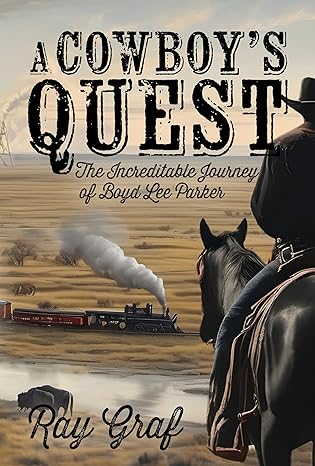
In A Cowboy’s Quest, by Ray Graf, the life of Boyd Lee Parker unfolds in a sweeping story that charts his evolution from a vulnerable 10-year-old orphan into a man of exceptional character. Graf takes readers on an emotional journey, weaving together the highs and lows of Boyd’s life as he navigates military service, forms enduring friendships, and earns the admiration of a Native American chief and community. Alongside these achievements, Boyd pursues his entrepreneurial aspirations while confronting heartbreak, lost love, and moments of deep loss. Through his struggles and triumphs, Boyd emerges as a figure of integrity, leaving a lasting impact on those around him.
The novel’s expansive timeline is one of its most compelling features. Spanning Boyd’s adolescence through his later years, the story unfolds with precision and care, avoiding the pitfalls of feeling rushed or drawn out. Graf’s pacing is exceptional, allowing readers to grow alongside Boyd, experiencing his triumphs and challenges in vivid detail. The immersive nature of the narrative is bolstered by the author’s meticulous attention to historical accuracy. Every detail, from the era-appropriate settings to the authenticity of the characters’ attire and lifestyles, reflects extensive research and thoughtful craftsmanship. The result is a rich and believable world that fully draws the reader in.
While the main story effectively centers on Boyd’s journey, I would have loved to have seen some of the side stories further developed. These subplots show great promise, but their resolutions come a bit too quickly for me and left me wanting to explore them more. It’s clear that the author prioritized Boyd’s central arc to maintain the story’s focus, yet a deeper dive into these secondary threads might have added additional layers to an already rich and engaging narrative.
A Cowboy’s Quest remains a fascinating and highly enjoyable read. Graf has crafted a story that resonates with authenticity and emotional depth, making it a must-read for adult audiences who appreciate cowboy tales and stories set in bygone eras. This historical fiction novel is more than a recounting of one man’s life, it’s a testament to resilience, growth, and the enduring power of the human spirit.
Pages: 385 | ASIN : B0D7WPZCNS
Fan of Historical Novels

Hard Road to Freedom follows a Union officer through his imprisonment into the political and social aftermath of the Civil War. What inspired you to write this book?
Having taken a course on American history while at university, I became interested especially in the events leading to, during, and after the US Civil War. This interest was revived 50 years later when my dying mother asked me to write a bio. I refused, saying if I did so. I’d be arrested. We laughed but having done so I remembered my student interest in the Civil War and thus inspired, started to write, not knowing that I had so little time to present something worthwhile to my mother (who was also a fan of historical novels) before she passed on.
What were some of your inspirations as a writer?
First of all, I don’t consider myself to be a competent writer as such. I am more of a poet as my 4 books of poetry will attest to. With that said, other than my mother, my inspirations were fine writers such as Margaret Mitchell, John Jakes, Ernest Hemingway, Arthur Hailey, Alex Haley, James Michener, and my father Anthony Carter who wrote 4 illustrated books on native legends of British Columbia.
How much research did you undertake for this book, and how much time did it take to put it all together?
For 4 months, writing from 5 am to 10 pm every day (thousands of hours doing research) I finished books 1-3 just in time for my dying mother to read them. Book 4 was written a month later. The next 17 years was spent editing and re-writing (I suffer from mild dyslexia, two-finger typing, and now old age ..I’m 79), and then a few years ago I added illustrations to each book.
Can you give us a glimpse inside book 4 of the Matari series? Where will it take readers?
Full of action-packed suspense, Book 4, The Bastard Ground, was written mainly because my readers at the end of Book 3 were left wondering if the villain Lucas Garrow having fallen into the rapids of the Tennessee River had somehow escaped due justice. Thus provoked I wrote Book 4 as a post-Civil War ‘western’ to conclude the series with a satisfactory ending. Book 4 deals with the reconstruction phase that occurred when the Confederates were defeated on the battlefield but not in their hearts or minds. As a result, the Jim Crow laws persecuted blacks south of the Mason-Dixon line and to some extent north of it. Blacks also suffered the violence of the KKK and others so inclined. Through lynching, intimidation, the Lost Causers, and other racist methods, the defeated attempted to regain their honor as exemplified in Lucas Garrow. To counter this persecution, utopian colonies sprang up, Harambee being just one of them. Book 4 will satisfy those readers willing to partake in a wild and unpredictable adventure that personifies the times in which they occurred.
Author Links: Website


