Blog Archives
She’s A Witch!
Toil and Trouble follows an eccentric witch, her daughter, and her grandchildren coping with the death of their father, who set out to visit her new home and encounter humorous adventures and a chance at healing. What was the inspiration for the setup of your story?
First and foremost, I wanted to entertain. I didn’t have a fun, loving, or even nice grandmother. She was quite mean. In fact, my daughter pulled my wife aside one day and said to her (very seriously), “I know why dad’s grandma is the way she is … it’s because she’s a witch!” And so I had to write a story about it. I actually based the villainous Lady Bishop on my own grandmother.
I loved how charismatic and compassionate Martha is. When creating her character, did you have a plan for her development and character traits, or did it grow organically as you were writing the story?
It was a little bit of both. Martha is based on the shared quirks between my daughter and me. I imagined, as best I could, the grandmother I would have liked to have had, magic or not, and then I took her to the extreme (in the best way), because let’s face it, grandmothers should be extreme in all that they do.
What were some themes that were important for you to explore in this book?
Kindness! To me, it is the most important and powerful gift every person can and should give. It’s free, for one, and just a smile can change someone’s day and even their life for the better. I also explored dealing with death and the way a loss can affect everyone differently, and the power of forgiveness and love, truth and support, and the bonds of family. I lost a dear friend at a young age without a good support system at home, and sometimes, unfortunately, that’s just how it goes. But I had other family members who impacted my life greatly, and still do to this day.
I loved following Martha May McKenzie and her adventures. Do you have more stories planned for her?
Yes! As of now, Toil and Trouble is unpublished, but even so, I am currently working on book 2, Boil and Bubble, which follows the witch on an even more chaotic adventure, not through time, but through a portal to another realm—the witches’ realm—where more secrets unfold, and the stakes are even greater.
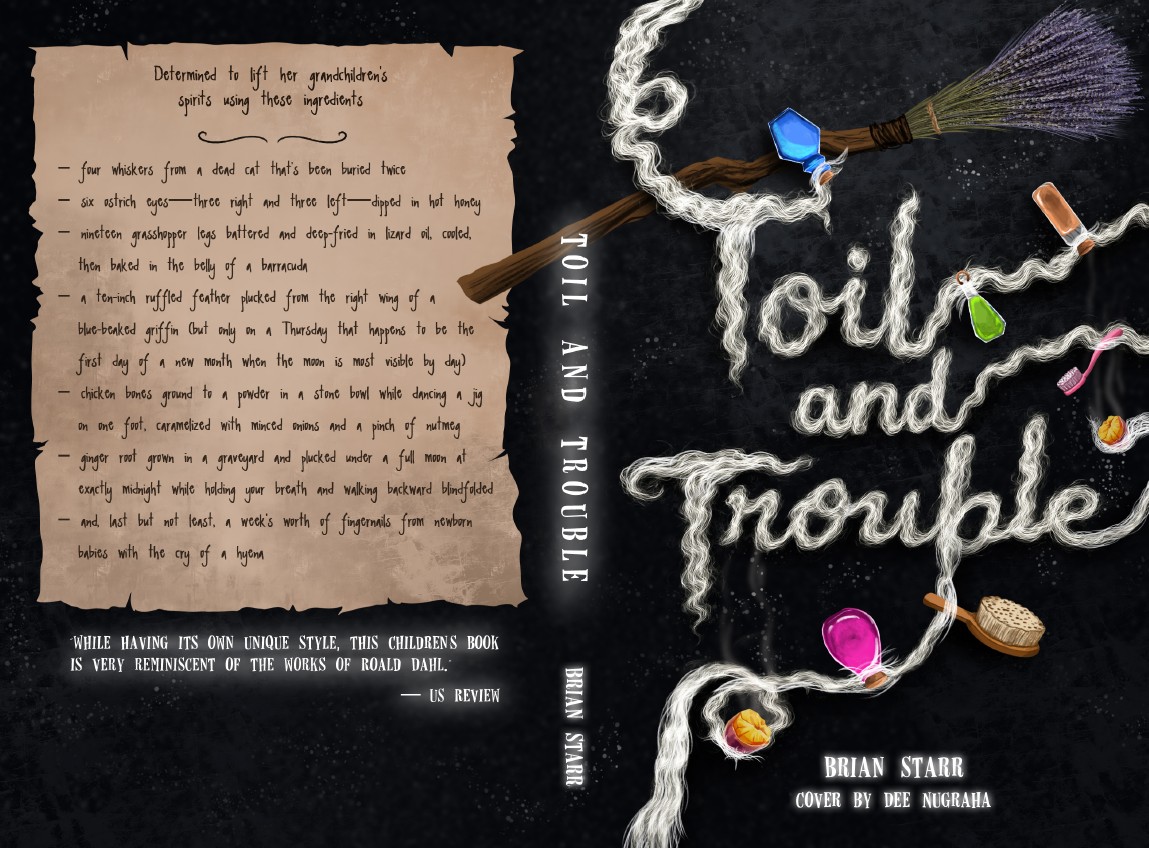
Toil and Trouble
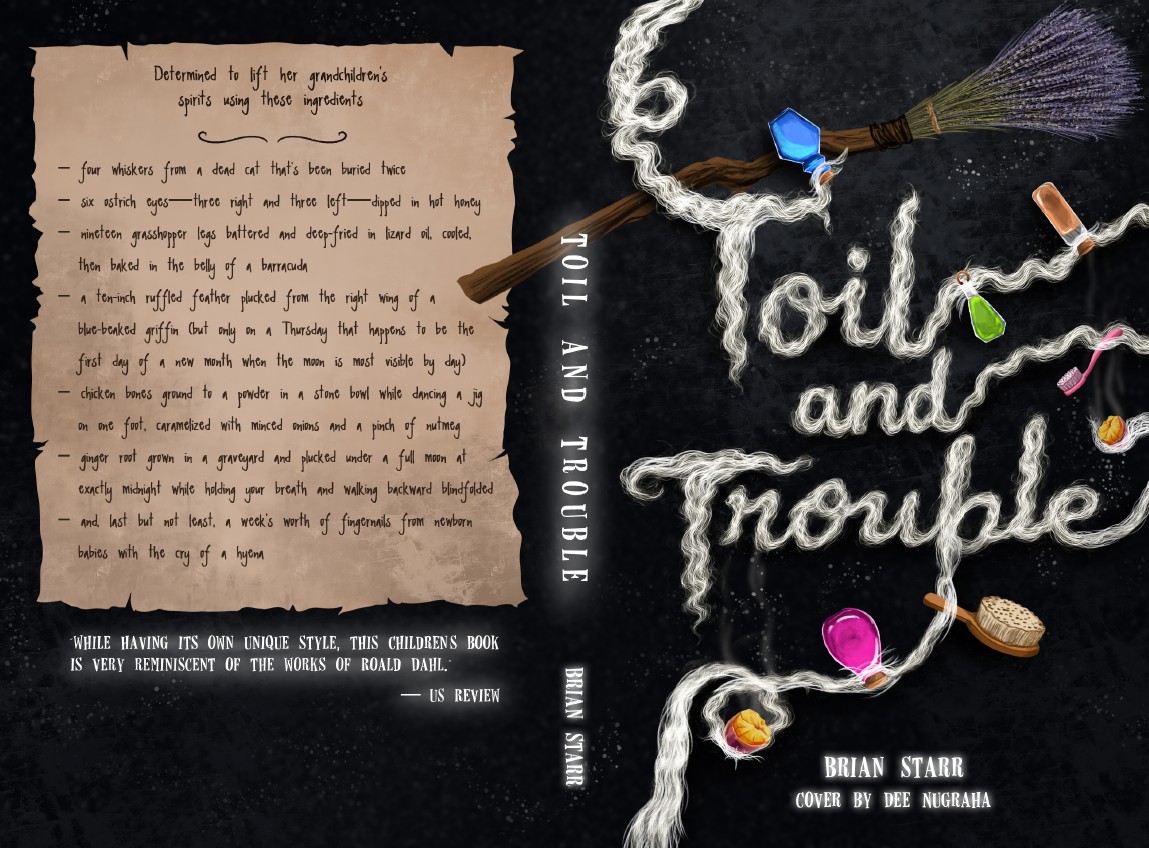

Toil and Trouble follows Martha May McKenzie, a wildly eccentric witch who hides her magic behind a tangle of snowy hair, a questionable eye patch, and a whole lot of chaotic charm. The story kicks off with her zipping across the countryside using a lavender broom she refuses to ride in the traditional way. Soon, her daughter Jamie and grandchildren arrive at Martha’s strange new home, still grieving the loss of Scott, their father and husband. From there, the book tumbles into a mix of heartfelt family struggles, magical mishaps, an unforgettable goat named Bubbles, and a dangerous witch’s council with secrets of its own. It blends grief, humor, and adventure in a story that keeps shifting between tender moments and absolute mayhem.
As I read, I kept catching myself laughing at the sheer weirdness of Martha’s world. The sparkly helper who explodes into sand, the nose-summoning magic, the whistling fish in business suits, even the awful but lovable goat, Bubbles. The writing leans fully into its own silliness, and honestly, I enjoyed that. The author knows how to paint a scene in bright colors. Sometimes the descriptions get a little long, yet I never felt bored because the voice stays playful. It felt like listening to a great storyteller who waves their hands a lot and grins at their own jokes. Beneath all the glitter and goop, though, you can feel the weight of the family’s grief. Scott’s death hangs over everything, and the moments where Martha tries to lift her family’s spirits hit surprisingly hard. I didn’t expect that blend to work, but it does.
The humor comes fast, sometimes so fast it interrupts the emotion. There were somes scenes that would leap into another gag or magical mishap before the emotions of the previous scene can settle in. Still, the characters won me over. Martha is ridiculous in the best way, and Jamie’s frustration feels painfully real. Their clashing personalities create a lot of the book’s energy. The kids bring softness to the story, too. They are grieving but curious, scared but hopeful, and watching them slowly open up again gave the book heart. Even the villains have flair. The witches’ council is both frightening and funny, and their magical poker games made me laugh more than I expected.
Toil and Trouble struck me as a warm and quirky story about family, healing, and the messy ways we try to take care of each other. It is silly, loud, and full of wild imagination. It is also gentle where it needs to be. I would recommend this book to readers who enjoy whimsical fantasy with strong character voices. It is perfect for anyone who likes heartfelt stories wrapped in humor, magic, and a touch of chaos.
Pages: 200
Vidge Floyd and the Secret Frequencies


John Davis, Jr.’s Vidge Floyd and the Secret Frequencies follows a young boy named Harrison Floyd, nicknamed “Vidge,” whose obsession with radio scanners and secret transmissions pulls him into a strange web of intrigue, paranoia, and truth-seeking in early 1990s Florida. Told through his log-like diary entries, the book moves between the humdrum of small-town life and a surprisingly complex mystery involving arson, corruption, and self-discovery. It’s a coming-of-age story disguised as a conspiracy thriller, written in a voice that’s both sharp and painfully vulnerable.
Vidge’s voice is so vivid that I could almost hear the static from his scanners buzzing in my own head. His thoughts race, skip, and circle back in ways that feel real and a little heartbreaking. The kid is smart, misunderstood, and caught between the comfort of his secret world and the chaos of reality. I found myself rooting for him, even when he made me uneasy. The writing feels raw in the best way, Davis doesn’t clean up the messiness of adolescence or mental confusion, he leans into it. The pacing sometimes slows, but that roughness actually fits the story. It mirrors Vidge’s mind, restless and crackling with energy.
There’s also something deeply nostalgic about the way Davis paints the era. The static, the dial tones, the small-town boredom, it all hums with an eerie beauty. At times, I caught myself feeling both comforted and unsettled, like I was remembering something I never lived through. The book has moments that feel almost cinematic, then others that sting with loneliness. It’s rare to find a story that captures isolation and obsession without turning them into clichés.
If you like slow-burn mysteries mixed with emotional grit, this book is worth your time. It’s perfect for readers who grew up tinkering with radios, computers, or anything that hummed and blinked in the dark. It’s for those who see beauty in static and meaning in noise. Vidge Floyd and the Secret Frequencies isn’t just about sound, it’s about being heard, finally, after a lifetime of listening.
Pages: 151 | ASIN : B0FVD89MDP

Resiliency and Strength

All She Knew follows a twelve-year-old girl who loses her mother suddenly, leaving her with chaos, confusion, and grief as she tries to navigate a new world in a new place she has no connection to. What was the inspiration for the setup of your story?
The inspiration for the story is my own. I lost my mother at a young age, and All She Knew is loosely based on my story. I didn’t have the opportunity to connect with other kids who had experienced a loss at that time. I wanted to provide a story that other children and those young at heart can relate to; to connect with the challenges the character goes through; to know they are not alone and can be ok through their journey.
What were some ideas that were important for you to personify in your characters?
I wanted to show the range of emotions Charity goes through and the different experiences she has. I wanted to show that it’s ok to laugh, cry, feel uncomfortable, angry and unsure as you go through grief. Grief isn’t linear, it has ups, downs, and sideways turns. I wanted to normalize this for children experiencing loss and different ways of navigating through it.
What were some themes that were important for you to explore in this book?
It was important for me to highlight the loneliness, sadness and confusion Charity goes through. When anyone loses a loved one, they can feel isolated and alone. For a child, those feelings are more confusing, hard to understand and work through. I wanted to connect and explore the different dynamics and struggles Charity goes through. The various ranges of her grief journey and trying to understand her new reality, who she is and will need to become after her loss. It was important for me to show all the different angles to her. I wanted the reader to connect with the character; to see themselves in what Charity is experiencing.
What is one thing that you hope readers take away from All She Knew?
I hope readers take away that they aren’t alone in their grief and they can get through it. I want readers to know, as is written in the synopsis of the book, “while tragedy can feel like a pit of turbulent emotions, resiliency and strength are always within us.”
Author Links: GoodReads
Charity’s life becomes a roller coaster. She’s lonely. She has to go through a grieving process she doesn’t understand. And in all of this she has to leave her home and move to a place she doesn’t feel connected to. It’s overwhelming. How is a young girl supposed to get through this?
In this powerful story, All She Knew looks at the human spirit to remind us of this important truth; while tragedy can feel like a pit of turbulent emotions, resiliency and strength are always within us.
A Finalist in American Book Fest 2025 American Fiction Awards which honors literary excellence.
All She Knew
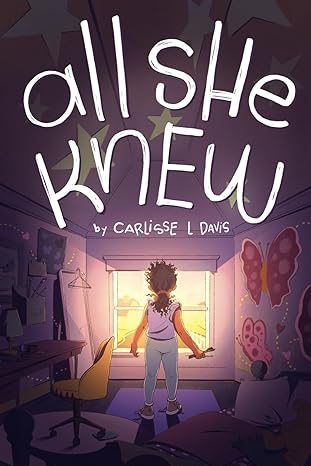
All She Knew tells the story of Charity, a twelve-year-old girl whose world turns upside down after the sudden death of her mother. In a voice that feels both tender and raw, the book walks us through her grief, the disorienting changes of moving in with relatives, and the awkward navigation of friendships and school life in the shadow of loss. The narrative is intimate, almost like leafing through Charity’s private diary, showing her memories of her mother, her inner thoughts, and her small moments of joy and sadness as she tries to make sense of a life she didn’t choose.
The writing is simple but honest, which makes the emotional weight even heavier. There’s no filter on Charity’s feelings, her anger, her loneliness, her confusion, and it hit me how rarely we allow young people that kind of space in real life. I found myself protective of her, frustrated with the adults who clearly cared but sometimes didn’t know how to show it, and touched by the fleeting, sweet moments that gave her hope. The book doesn’t rush her healing, and I liked that. Grief is messy, and the author lets it stay messy.
Some scenes linger in places that are uncomfortable, but those moments are often the most truthful. I appreciated how the book showed the push and pull between wanting to hold on to the past and needing to step into something new. It’s not a dramatic, twist-heavy story. It’s a quiet one, built on small shifts in emotion, and that’s where its strength lies.
All She Knew is for anyone who has had to start over after losing someone they love, especially teens and young adults trying to figure out who they are without that person. It’s heartfelt, gentle, and painfully real. This isn’t a book you race through. It’s one you sit with, maybe with a box of tissues close by, and let it remind you that even when the shape of your life changes completely, the love you carry stays with you.
Pages: 157 | ASIN : B0CZJT6HDT
Social Isolation

Dylan Dover: Orion’s Quest follows a 12-year-old warlock and his twin as they try to uncover the mystery of their origins and the powerful forces that seek control over them. What was the inspiration for the setup of your story?
I started writing the Dylan Dover series during the Covid pandemic, when the province that I live in (Ontario, Canada) was under a complete lockdown. At that time, my son named Dylan (no coincidence!) was 12 years old and like so many other young people, he was suffering from the effects of social isolation. He turned to books as an escape mechanism and I wrote the first two books of the series (Dylan Dover: Into the Vortex and Dylan Dover: Orion’s Quest) as a creative outlet for the both of us during this very challenging time. My son and I would spend hours discussing characters and plot twists, and then I would turn those ideas into written words which he would then read and critique. When you consider how the pandemic completely interrupted our regular lives, and the feelings of vulnerability and the lack of control that many of us experienced during that time, I think that those emotions were strongly at play in the writing of these first two novels in the series. Dylan, and his brothers Remy and Seth (later joined by their missing sister, Siri), are all trying to be controlled by evil forces but together, they find ways to increase their powers and to face adversity. During a time when our world was in chaos, the Dylan Dover immortal universe was born!
Do you have a favorite character in this novel? One that was especially fun to write for?
The character Dylan is my favourite character to write for because the voice in my head, is that of my youngest son, Dylan. I like to tell people that the character of Dylan Dover is based entirely on my son, except of course for the fact that my son has no magical powers and is not part of a secret prophecy! As my son aged and went through various challenges in his real life, those situations were mirrored in the novels. Discovering who you are and where you fit into the world, what your goals and values are, how you want to be perceived by others, how you deal with setbacks – these are all aspects of growing up in the real world and in the Dylan Dover series. I also found it both fun and challenging to make the voices distinct for all four of the siblings. I wanted them each to have very unique personalities, strengthens and weaknesses as individuals because even though they must learn to trust each other and work together to maximize their powers, they are each special in their own ways.
Did you create an outline for the characters in the story before you started writing, or did the characters’ personalities grow organically as you were writing?
I did not have any outline created before or during the writing process. My son and I would discuss ideas and I would then write a chapter based on what we had talked about. The characters, plot lines and settings all developed organically during the writing process. The more I wrote, the more alive the characters became in my head. The character of Dylan was based on my own son, so that character was easier for me to imagine in my head, and the development of Dylan Dover through the series in many respects mirrored the development of my son. My experiences as a mother of three children and as a high school teacher for over twenty years, helped me to find the voices and evolve the characters as the writing progressed. Having my son critique each chapter as it was created also was a huge help. If I wrote something that seemed disingenuous, he wouldn’t hesitate to tell me!
Can fans get a peek inside the next installment in this series? When can readers expect to see it released?
Book 3 in the series is called Dylan Dover: Players of the Prophecy. I hope it will be published in early 2026. It is currently in the advanced editing stages. Here is a brief synopsis:
In Dylan Dover: Players of the Prophecy, the siblings are convinced that the ancient prophecy is on the verge of being realized. They must further develop their powers and learn to work together if they have any chance of successfully thwarting Baltazar’s evil plans to seize the siblings’ powers for himself before killing them, destroying the immortal world and then dominating all humans and supernatural beings for his own pleasure. The siblings discover amazing new talents when they combine their magic, including their ability to time travel, but they are still so young. Will they make the right decisions, and will their powers be enough to subdue this threat and save their immortal home?
The siblings are not alone in their quest, and there are other allies working to help them in unexpected ways. And of course, there is Thea. As she discovers her genetic lineage which biologically links her to Cius, the vampire with the gift of foresight, she learns that she too shares the ability to see future events before they occur. But some of Thea’s visions are frightening and show her playing a direct role in the destruction of her friends. Thea tries desperately to remove herself from the future combat which she sees will result in the death of Dylan, but can she control her own destiny, or is her vision unalterable despite all of her efforts?
In a climactic ending, a monumental battle pits the malevolent Baltazar against the siblings. This final encounter brings the ancient prophecy to its end… or does it?
Author Links: Into the Vortex | Orion’s Quest | Facebook | Website | Instagram | Amazon
Dylan, Remy, and Seth (identical warlock brothers), Thea (a wizard), Halle and Oliver (shapeshifters) and Via (a fireball) are hiding out in the forest near Dylan’s human home, using magic to hide their location. They are on the run from the immortal Ministry and an evil vampire named Baltazar. Their goal: find their missing sister Siri to complete an ancient prophecy of four siblings who will change the course of history for magical and non-magical creatures alike.
New characters are introduced as they travel the world to find Siri. Dylan’s entourage is assisted in their quest by earthly and immortal beings, including the Greek God Orion. The story is a whirlwind that takes the action from New York City, to Mexico, Bhutan and Alaska.
Mica Powers and the Legend of the Superstitions
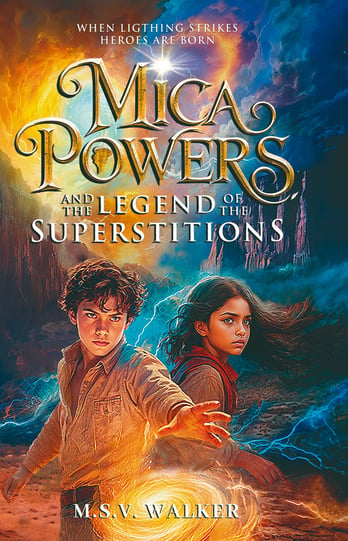
Mica Powers and the Legend of the Superstitions is a young adult fantasy adventure wrapped in mystery, myth, and self-discovery. The story kicks off with a tragic prologue, Mica’s family torn apart by something dark and unknown, then leaps ahead to present-day Mica, a smart, brave, and often sarcastic boy caught between reality and something more magical. From the Thunder Cycle to ghost encounters, ancient feathers, and secret portals, the book spins a fast-paced and emotionally charged journey through the Arizona desert and into realms unknown.
Right away, I was pulled into the story by the way M.S.V. Walker mixes vivid desert landscapes with a strange, almost dreamlike tension. The first chapter, “Be Brave My Little Mica,” hits hard. The writing is cryptic and frantic, almost like reading a memory on fire. You can feel Mica’s confusion and pain as his father tries to save her, and that emotional punch stays with you. Honestly, the disjointed text at the start threw me off at first; it felt chaotic, but once I realized it mirrored the trauma Mica was going through, it clicked. That rawness became part of the charm.
What I really loved was the world-building. Places like the “Thirst No More Oasis” and “Imperia 101” were just fun to imagine. Walker has a knack for names that sound both ridiculous and mysterious, like “The Channel of Light” or “Wakinyan.” And the characters! Estee Bradford, with her fierce loyalty and cutting wit, is probably my favorite. She and Mica have this banter that feels real and unforced. There’s this scene in “The Banquet Part Two” where they crack jokes while dodging literal chaos; it’s wild but also kind of hilarious. Walker manages to keep things emotionally grounded, even in the middle of fantasy madness.
There are chapters where the plot moves at a thrilling pace, sweeping you along so quickly that it’s easy to get caught up in the momentum. “Invasion” and “The Weapon” are especially fast-paced and packed with action. Mica’s voice is witty, sharp, and deeply heartfelt. He’s flawed, afraid, and constantly questioning, but he never stops moving forward. And I was with him every step of the way, through the dust, the danger, and the magic.
Mica Powers and the Legend of the Superstitions is a heartfelt, sometimes messy, but deeply imaginative ride. It’s perfect for teens and adults who love fantasy with a beating heart and don’t mind getting a little weird. If you liked Percy Jackson but wished it had more ghosts, mystery, and desert heat, this one’s for you.
Pages: 260 | ISBN : 9798992339109
Forebearer’s Sight: Strangers Among Us

Ayodeji Ayinde’s Forebearer’s Sight: Strangers Among Us is an epic tale that fuses historical adventure with African spirituality and rich mythological storytelling. Set against the backdrop of a mysterious land discovered by European sailors, the novel explores the clash of civilizations, the spiritual power of indigenous people, and the destiny of a young stowaway named Frederick. The book seamlessly weaves two worlds, the invading seafarers and the mystical Yoruba kingdoms, into a tense, often brutal narrative about survival, identity, and power.
Right from the opening chapter, I was hooked. Ayinde’s prose has a cinematic quality that grabs your senses—there’s thunder crashing, wind howling, ships nearly capsizing, and a scrappy twelve-year-old fighting to prove he belongs. Frederick’s bravery during the storm won me over immediately. He’s smart, stubborn, and full of heart, and Ayinde gives him just enough edge to feel real. But what really impressed me was the layered emotional undercurrent, especially that moment when Afonso, the rough first mate, hugs Frederick and then awkwardly pulls away. It’s small, but it’s loaded.
Now, when the story shifts to the Yoruba kingdom, things get mystical and deep fast. The introduction of Ifaromi and the spiritual depth of the Ile-Ife culture is powerful. The world-building is detailed. The customs, the Orishas, and the rituals are immersive and rich, though at times, they can be a bit dense. Ayinde treats African spirituality with reverence and flair. The astral plane sequences and the role of the Hand of Olodumare gave the book a fresh, fantastical vibe that reminded me of why stories rooted in indigenous lore are so necessary.
One thing I didn’t expect was how intense the violence would be. The ambush in the forest was absolutely brutal. Heads rolling, throats slashed, and warriors emerging from tree trunks like ghosts—it’s savage, raw, and effective. Ayinde uses brutality to highlight the stakes of cultural collision. The native warriors aren’t just “villains,” they’re defenders of a sacred land, and that moral grayness is compelling. I also liked how even the supernatural moments, like Frederick’s body going limp from a mysterious touch, are handled with subtlety.
Forebearer’s Sight is a wild mix of swashbuckling adventure and spiritual epic. It’s not a light read, and it definitely asks you to pay attention, but if you’re into rich world-building, complex characters, and bold storytelling, it pays off. I’d recommend this book to readers who loved Things Fall Apart but wished it had more pirates, or fans of Black Panther who want something with more traditional African spiritual elements. It’s daring, emotionally charged, and wildly imaginative.
Pages: 221 | ASIN : B0BRBLHMYG



 LITERARY TITAN