Blog Archives
Cyber Case Prima


Cyber Case Prima, by Ken Tentarelli, is a cyber-technothriller about a self-driving truck demonstration that turns disastrous when Prima Ace strikes a cyclist and keeps going. What first looks like a technical failure becomes something darker as Seph Carano and her CSA team dig into corrupted software, corporate pressure, autonomous vehicle testing, and a hacker whose motives are tangled up with grief and revenge. The story moves between government cyber work, startup ambition, and the uneasy question of what happens when smart machines fail in very human ways.
As someone who enjoys technothrillers, I liked how grounded this one felt. Tentarelli doesn’t treat the technology like magic. The lidar, software versions, testing procedures, and agency politics all feel connected to real systems, but the book stays readable. I never felt buried under jargon. The opening accident is a strong hook because it is visual and unsettling. A truck that simply does not “see” a cyclist is scary in a clean, modern way, and the book understands that the fear is not just the crash itself. It’s the silence after. The machine keeps moving.
I also appreciated the author’s choice to make the villain’s motive personal rather than cartoonish. The revenge thread gives the cyber plot an emotional pulse, even when the investigation is moving through code comparisons and agency approvals. Seph is a steady lead, curious and humane, and I liked that she doesn’t solve problems by acting like the smartest person in every room. She listens. She worries about mission drift. She notices people. Some scenes are more procedural than tense, and readers looking for constant explosions may find the pace measured. For me, that worked because the book is interested in process, not just payoff.
Cyber Case Prima is a thoughtful and accessible technothriller with a strong cybersecurity angle and a timely concern about autonomous vehicles. I would recommend it to readers who like Michael Crichton-style “what if this technology goes wrong?” stories, but with more investigative teamwork and less spectacle. It will especially appeal to readers who enjoy cyber thrillers that feel plausible, careful, and human at the center.
Pages: 266 | ASIN : B0D1BYLCFM

Minority And Female Action Characters

Address follows three sharp, secretive investigators as a campus murder tied to nanotechnology spirals into a geopolitical conspiracy threatening the President’s State of the Union. What was the inspiration for the setup of your story?
My inspiration was a negative inspiration. I noticed the lack of minority and female action characters in the literature who are also intellectuals (I am a Brown Belt in Taekwondo and fancy myself a developing scholar). I also noticed in the literature the marginalizing and trivializing of minority and female voices and achievements. I therefore set out to create larger than life minority and female characters who would in the end, save America.
Henry, Braum, and Camilla have very different voices and temperaments. Which character came to you first, and which was the hardest to write?
Camilla came to me first because I am a young African-American woman, fluent in Spanish and a student of Hispanic culture. Braum was the hardest voice to write simply because I am not a male Navy Seal law professor in his mid to late 30’s.
The novel balances grief, banter, violence, and political danger. How did you approach tone in a story that moves between personal loss and geopolitical stakes?
That is a wonderful question. I didn’t think about it as I was doing it. It seems that the following process happens for a lot of the writing that I have done. I simply put myself in the moment (inside the head of the character, the physical location of the character etc) and then the writing happens. The next time I write finds me in a different moment. The tone is therefore defined by the moment in the book that I happen to be writing about at that time. Once I’m done with Moment A, the next time I write, I will be in Moment B. I have never found myself trying to write in Moments A and B simultaneously.
The book has a very cinematic sense of escalation. Were there particular thriller writers, films, or real-world events that influenced its structure?
The most important real world event that is relevant to the book is the political tension that exists between the US and Russia/China. That tension drives the novel. “A Few Good Men” is one of my favorite movies and I feature it in the book. Other than that, I wrote the book against a mental backdrop of a lifetime of watching the standard action thrillers (e.g., James Bond, The Avengers etc). I wrote the book in the hopes that it will be adapted into a movie.
Author Links: Amazon | Website
Killing Einstein

Killing Einstein is a historical thriller with a wonderfully eccentric brainpan. Author Morris Hoffman imagines a wartime FBI surveillance operation around Albert Einstein and Kurt Gödel, then yokes it to espionage, philosophical argument, and an assassination plot. The story is told by Charlie Richards, a Bureau man whose first task is to trail the two thinkers through Princeton and eavesdrop on their walks, only to find himself drawn into their friendship, their ideas, and finally a lethal tangle of divided loyalties. It is, improbably, a novel about spies, logic, friendship, betrayal, and the terrifying gap between truth and proof, and it makes that odd compound feel deliberate rather than gimmicky.
Charlie is funny without being cute, self-deprecating without becoming shapeless, and just vain enough to feel human. Hoffman gives him a conversational intelligence that can pivot from deadpan Bureau satire to genuine wonder, and that tonal agility keeps the book buoyant even when it wanders into difficult intellectual country. The Einstein-Gödel scenes are the live wire here: Einstein comes off as playful, porous, almost meteorological in his energy, while Gödel is all fretful rigor and haunted exactitude. Their friendship has real charge. I didn’t feel that I was being handed two monuments in overcoats; I felt I was trailing two singular men whose minds alter the weather around them.
I was also surprised by how confidently the novel lets abstract thought matter. Many books flirt with big ideas and then retreat to plot when things get difficult. This one keeps its nerve. It asks me to care not only whether Einstein survives, but whether Charlie can understand what Gödel is trying to show him about incompleteness, and whether such understanding can actually change a life. That ambition gives the novel its splendor. The exposition is generous. Readers allergic to mathematical or philosophical detours may feel the gears showing. But I would rather read a book that risks density than one that trims its own mind to look more streamlined. Killing Einstein is thoughtful and contains more than a standard thriller usually dares.
I’d hand this to readers of historical thrillers, espionage fiction, alternate-history-adjacent suspense, and anyone who likes novels where ideas have teeth. Fans of Philip Kerr or Umberto Eco would probably find familiar pleasures here, though Hoffman is less noir than Kerr and less baroque than Eco; the closest comparison might be a wartime spy novel written by someone who genuinely enjoys the metaphysics. This is a book for readers who don’t mind being asked to think while the window glass is breaking. Killing Einstein is a thriller that makes the mind feel like a battlefield.
Pages: 218 | ASIN: B0GPHMMVPM
I kept pulling that thread.

Verified follows a journalist, an FBI agent, and a rebel broadcaster who uncover the truth behind a verification system meant to stop the spread of disinformation, but in reality is a form of control to decide people’s worth. What first sparked the idea of a society built around biometric “verification” as truth?
It started with Mark Zuckerberg’s January 2025 announcement that Meta was dismantling its entire third-party fact-checking program across Facebook, Instagram, and Threads—replacing it with a crowdsourced “Community Notes” system modeled on what Elon Musk built at X. Not because fact-checking had failed, but because the political winds shifted. One man, unelected, accountable to no regulatory body that could actually touch him, deciding what two billion users would no longer be protected from.
I kept pulling that thread. A few months earlier, Musk had used his Department of Government Efficiency operation to target the CFPB—the very agency that had been considering regulating X. The fox didn’t just enter the henhouse. He got a government ID badge. And I realized: if the information environment gets bad enough—and I think most people would agree it already has—then the demand for someone to fix it becomes overwhelming. And whoever answers that demand gets to define what “fixed” looks like.
The biometric verification system in the novel isn’t a dystopian invention. It’s a customer service solution. That’s what made it frightening enough to write about.
I wanted to write the version of authoritarianism that arrives with a thank-you email and a user satisfaction survey.
Maya is neither naive nor rebellious at the start—how did you build her internal conflict as she begins to see the system differently?
Maya was the character I was most afraid to write, because she’s the one who looks the most like the reader. She’s not ignorant of what the system is. She’s talented, credentialed, doing important work. She wins awards. And every one of those awards is given to her by the machinery she thinks she’s holding accountable.
Her internal conflict had to be slow because real complicity is slow. I didn’t want a dramatic red-pill moment. I wanted the accumulation of small compromises—a source she doesn’t follow up on, an angle she decides isn’t worth the risk, a story she kills because it would make the wrong people uncomfortable. She doesn’t change her mind about the system in one conversation. She changes it over dozens of conversations she chose not to have.
She’s every reporter at the Washington Post who watched Jeff Bezos kill their own paper’s presidential endorsement in October 2024 and went to work the next day anyway. That’s what complicity looks like in practice—not a dramatic betrayal, but a quiet Monday morning.
I built her conflict by making her good at her job. That’s the cruelest thing I could do to her. If she were bad at it, leaving would be easy.
The novel suggests that eliminating misinformation can come at the cost of freedom. What does the novel ultimately argue about how people accept systems that limit them?
I think the novel argues that people don’t accept limiting systems despite their intelligence. They accept them because of it. The Verification system works. It does, measurably, reduce misinformation. It does make daily life more navigable. And the people who designed it aren’t cartoon villains—they’re problem-solvers who got exactly what they asked for and couldn’t stop the machine once it started solving problems they hadn’t intended.
That’s not fiction. India’s Aadhaar system has enrolled 1.4 billion people in biometric verification. It works. It has reduced fraud. An eleven-year-old girl in Jharkhand also starved to death because her family’s food rations were cancelled when their Aadhaar link failed. China’s social credit infrastructure blacklisted over 200,000 people in 2025—46 percent for something as ordinary as a contractual dispute, not crimes. The EU’s Digital Services Act—genuinely well-intentioned—enabled platforms to make nine billion content moderation decisions in the first half of 2025. Nine billion decisions. Ninety-nine percent made by algorithms, not humans. The Green Zone isn’t a metaphor. It’s a design pattern that already exists in at least three different versions on three different continents.
The novel’s argument, if it has one, is that comfort is the most effective form of control. Not fear, not violence—comfort. The moment a system makes your life easier, you develop a stake in its continuation. And once you have that stake, every critique feels like a threat to your own stability. The zones in the novel—Green, Yellow, Red—aren’t enforced primarily by surveillance. They’re enforced by the fact that Green Zone residents have good coffee and reliable Wi-Fi and genuinely cannot imagine going back.
That felt like something worth writing about honestly, because I don’t think the answer is simple, and I didn’t want the novel to pretend it was.
What do you hope readers will question about their own relationship to truth and information after reading Verified?
I hope they notice the next time they feel relieved that someone else has decided what’s true.
Not outraged. Not suspicious. Relieved. Because that’s the feeling the novel is actually about—the gratitude we experience when a platform removes a post we find objectionable, when an algorithm filters our feed into something manageable, when a system promises us that the information we’re receiving has been checked, verified, approved. That relief is real, and it’s rational, and it’s the exact mechanism by which we hand over the authority to define reality to institutions that may not deserve it.
I don’t have a clean alternative to offer. The novel doesn’t either. The information environment is genuinely broken, and the people who say “just think for yourself” are underestimating the problem as badly as the people who say “let the algorithm handle it.” What I hope the book does is make that tension uncomfortable enough to sit with. Not to resolve, but to feel.
If a reader finishes Verified the same week Meta officially shut down fact-checking on Facebook and Instagram—not because the system failed, but because Mark Zuckerberg decided it was no longer politically convenient—and feels a flicker of something they can’t quite name, that’s the book working. That flicker is the moment before you decide whether the absence of a fact-check banner is freedom or abandonment. The novel lives in that pause.
Author Links: GoodReads | Website
Fourteen years after the Verification Act reshaped American society, a biometric implant behind every ear broadcasts who you are, what you’re worth, and whether you belong. The system was built to end an age of disinformation — and it worked. The deepfakes stopped. The conspiracy theories died. So did the freedoms no one thought to miss until they were gone.
Maya Chen is a star journalist at the Washington Herald, winning awards inside a system designed to make her work harmless. When a classified document crosses her desk, she begins to see the architecture of the cage she’s been decorating. Marcus Webb, a decorated FBI agent haunted by his father’s role in building the Verification system, follows a thread of falsified data into its rotten foundations. And in the Red Zone — where the Unverified survive without status, without medicine, without names — a former federal prosecutor named Emma Brennan runs a pirate broadcast network, willing to sacrifice everything for the revolution. Everything except the daughter the state took from her three years ago.
As their paths converge, Maya, Marcus, and Emma must decide what truth is worth when the system that defines it can erase you with a single scan. In a world divided into Green, Yellow, and Red — where your zone is your destiny and compliance is your currency — the most dangerous act left is to speak.
Verified is a novel about surveillance and complicity, about the seductive comfort of certainty and the terrible cost of letting someone else define what’s real. For readers of Kazuo Ishiguro’s Never Let Me Go, Dave Eggers’ The Circle, and Christina Dalcher’s Vox.
What Happens When The World Finds Out?

Biolume is a family survival novel turned ecological reckoning, in which the discovery of a bioluminescent lifeform sparks a battle over wonder, ownership, and the cost of calling destruction innovation. What was the inspiration for the setup of your story?
About five or six years ago I was thinking about short film ideas, and I had this one scene I couldn’t stop thinking about, a father and his son trapped in an underground cave system, phone dead, and these blue firefly-looking things land on the phone and charge it. That was it. Just that single scene in my head. The whole story grew outward from that moment.
The setting came next. The Gunnison Canyon felt right because it’s real, it’s remote, and the landscape already makes you feel small. The family grew around the father and son, Ethan, Maya, Jack, and Lucy, because I wanted to explore how different people respond to the same impossible thing. And once the Embers existed as something beautiful and useful, the bigger question arrived on its own, what happens when the world finds out? When the first instinct isn’t to protect something miraculous but to own it? That tension between wonder and extraction felt like one of the defining conflicts of our time, and it gave the story its spine.
Lucy feels authentic and alive on the page. How did you develop her voice without turning her into a symbolic “wise child”?
I wrote Lucy as a kid first and a character second. She doesn’t understand everything that’s happening around her, and she doesn’t need to. What she has is a kind of radical openness, she notices things the adults have trained themselves to filter out. I gave her contradictions, she’s brave but she gets scared, she’s perceptive but she misreads things, she cares deeply but she’s also eleven and sometimes just wants to go home.
I think the “wise child” trap comes from making a kid a mouthpiece for the author’s themes. Lucy isn’t carrying a message. She’s just paying attention in a way the adults have forgotten how to. If she feels real, it’s because I let her be inconsistent and curious rather than wise.
Were the Embers always meant to embody both beauty and threat, or did their political and scientific consequences emerge later in the writing process?
From the very beginning. I never wanted the Embers to be just a plot device or a simple metaphor. They had to be genuinely beautiful, the kind of thing that stops you in your tracks, and at the same time, their existence had to create real consequences.
The beauty is what makes the political and scientific stakes matter. If the Embers were just dangerous, it’s a containment story. If they’re just beautiful, it’s a nature documentary. The tension between those two things, that something can be wondrous and still put people into conflict, is really the engine of the whole book. I wanted readers to feel the same pull the characters feel, you would want to protect this thing, but you also understand why others want to control it.
Biolume seems to ask whether humans can encounter wonder without commodifying it. Did you begin with that question, or did the story lead you there?
The story led me there. I started with a family, a canyon, and a discovery, and the question emerged as the characters had to make choices about what to do with what they’d found. But once I saw it clearly, it became the spine of everything.
I think that’s how the best themes work, they’re not imposed from above, they’re uncovered through the characters and the pressure they’re under. And it’s a question I don’t think the book fully answers, because I’m not sure there is a clean answer. We’re wired to protect what we love and exploit what we find. Sometimes those impulses point at the same thing. I wanted the book to sit honestly inside that tension rather than pretend to resolve it.
It won’t be the last we hear from Lucy.
Author Links: GoodReads | Amazon
The river took them underground. What they found there could change the world.
When Ethan Calloway, his wife Maya, and their two children are swept into an uncharted cave system beneath the Colorado Rockies, survival is all that matters. But deep in the darkness, they discover something impossible: a living phenomenon unlike anything science has ever seen.
They escape with evidence. Then the real danger begins.
As corporations, governments, and shadow interests close in, the Calloway family is pulled into a battle over ownership, control, and a discovery that could rewrite everything we thought we knew about life itself.
If something this beautiful is found, does anyone deserve to own it?
“A family-centered story with a strong ethical undertow.”— Literary Titan ⭐️⭐️⭐️⭐️⭐️
Verified

Verified is a dystopian science fiction thriller that follows Maya Chen, a respected journalist living inside a near-future American verification regime where implants sort people into tiers of worth, while Emma Brennan fights to survive and resist from the margins, and FBI agent Marcus Webb begins to realize the system he serves was built on a lie. What starts as a conspiracy story widens into something more unsettling and more human: a book about complicity, bureaucracy, and the slow, painful work of pushing back when truth itself has been fenced off and managed.
The writing has a clean, steady intensity to it, and the book knows how to make cold systems feel intimate. The repeated sensation of the implant pulsing behind the ear could have become a gimmick, but instead it turns into a quiet little horror that keeps reminding us how control gets under the skin. I also liked that Mercer writes with texture and atmosphere without losing momentum. The rooms smell like ozone, bleach, dust, old paper. The checkpoints, offices, clinics, and corridors all feel lived in, but never overdecorated. The prose leans on that polished dystopian seriousness, and I could feel the novel working to keep every scene loaded. Still, I’d rather have that than a flat book, and here the intensity usually earns its place.
I also appreciated the author’s choices about character and structure. Maya is the center that gave the book its real moral weight for me, because she is not evil and not naive either. She is talented, careful, and decent in ways that still leave her tangled inside the machine. That is a much more interesting choice than giving us a simple rebel hero from page one. Emma and Marcus broaden the book in smart ways, one pushing from outside the system and the other from deep within it, and together they give the novel a wider argument about what change actually takes. I was especially glad the ending does not offer a neat triumph. The reform is partial, compromised, and already under pressure, which felt honest.
I felt like I had read a novel that wants to do more than warn. It wants to ask how ordinary people get trained to accept comfort as truth, and how hard it is to unlearn that. I’d recommend Verified most strongly to readers who like dystopian fiction with a political conscience, especially people who enjoy stories where systems matter as much as plot and where the tension comes from moral pressure as much as physical danger. Readers of near-future speculative fiction, surveillance-state novels, and character-driven thrillers will probably find a lot to hold onto here.
Pages: 336 | ASIN : B0GQDKM7B6
Biolume
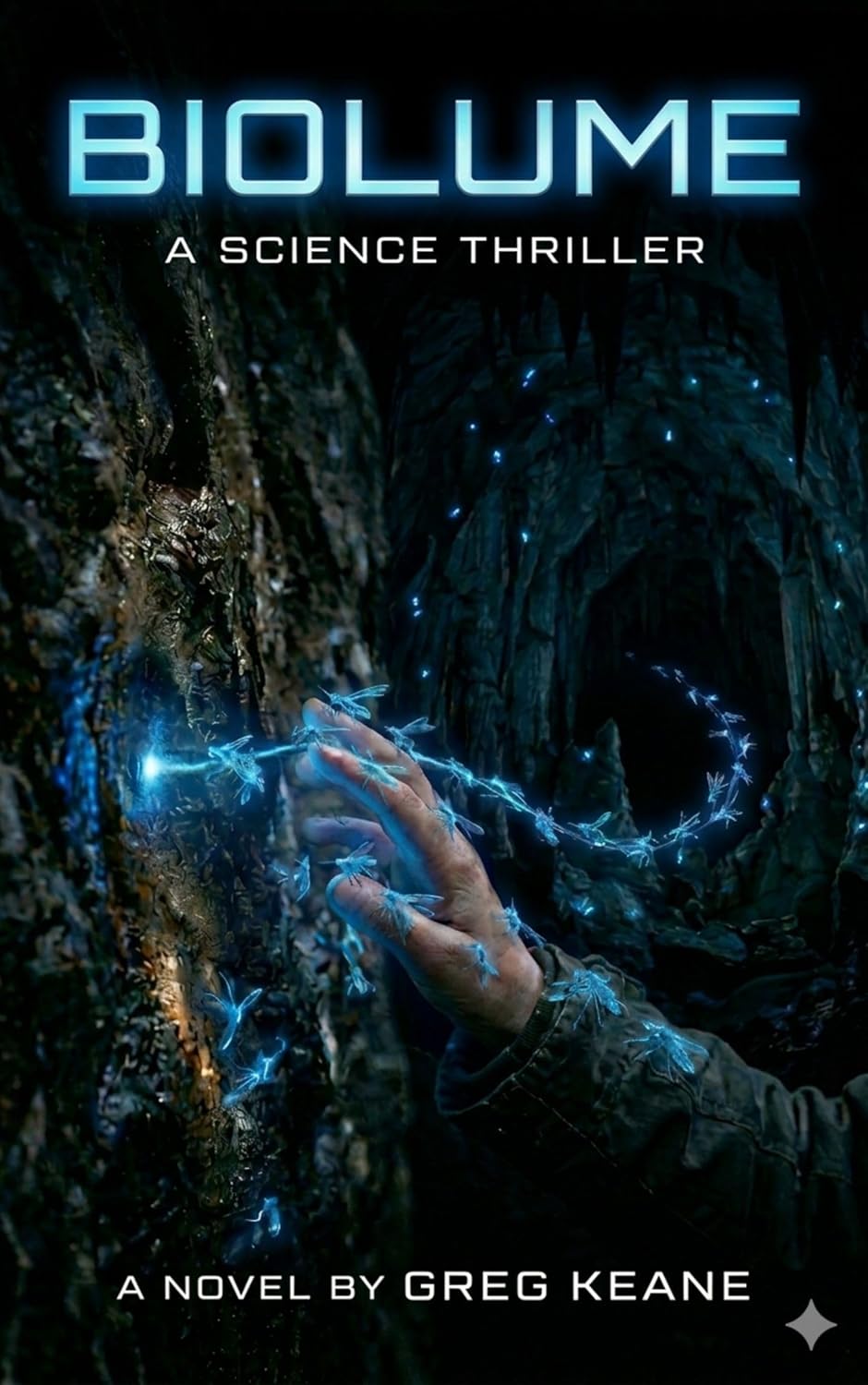
Biolume begins as a family river trip and turns, with unnerving speed, into a subterranean survival story, a discovery novel, and finally a moral struggle over who gets to own wonder. Author Greg Keane drops Ethan, Maya, Jack, and Lucy Calloway into a hidden cave system beneath the Gunnison canyon, where they find the Embers, bioluminescent organisms whose beauty is matched by their scientific and political consequences. What follows is not just an escape narrative, but a widening conflict about family, attention, extraction, and the human reflex to convert the miraculous into property.
I was hooked first by the book’s propulsion, then by its tenderness. The early cave sections have a tensile, claustrophobic grip, but what I liked was how carefully Keane tracks the weather inside the family: Ethan’s guilt, Maya’s competence, Jack’s wary intelligence, Lucy’s radical openness to the living world. Lucy in particular could have been written as a stock “wise child,” and she isn’t; she feels specific, observant, and gloriously unflattened. I also admired the novel’s sensory confidence. The blue-lit cavern, the mineral air, the hum of the Embers, the feeling of darkness as a physical medium, all of it has a lucid, almost phosphorescent vividness.
What I responded to most, though, was the novel’s refusal to stop at awe. Keane lets discovery become argument. Once the family resurfaces, Biolume expands into a story about science, media, law, public narrative, sabotage, and the predatory appetite of institutions. That shift could have felt schematic; instead, it feels earned, because the book has been quietly asking from the start whether wonder can survive contact with markets and power. The later sections grow more overtly thematic than the ravishing middle stretch underground, but even then, I found myself leaning in. The novel has a live wire in it: indignation, yes, but also grief. It knows that the saddest damage is often done by people calling destruction innovation.
I’d hand this to readers of science fiction, eco-thriller, speculative fiction, survival thriller, and literary suspense, especially anyone who likes family-centered stories with a strong ethical undertow. It will likely appeal to readers who enjoy Jeff VanderMeer’s ecological unease or the wonder-and-consequence machinery of Michael Crichton, though Biolume is warmer in the bloodstream and more intimate in its loyalties. Biolume asks a good question in a startling new form: when we find something beautiful, do we know how not to ruin it?
Pages: 248 | ASIN: B0GQNY85PZ
“a couple of suspicious deaths”

The Judas Saints follows an FBI Agent and a Park Police Sergeant whose cases overlap, and what begins as a couple of suspicious deaths slowly unfolds into a coordinated campaign of silencing, corruption, and cover-ups. What was the inspiration for the setup of your story?
The inspiration came from watching how easily institutional authority can mask wrongdoing when people assume those in power are acting in good faith. I was drawn to the idea of two law enforcement officers, each discovering pieces of a puzzle that neither could solve alone. The setup with FBI Agent Saville and Park Police Sergeant Pritchard allowed me to explore how suspicious deaths can be dismissed as suicides when the right people control the narrative. What fascinates me is that moment when patterns emerge, when “a couple of suspicious deaths” reveals itself as something coordinated and deliberate. The overlapping cases create natural friction between jurisdictions, which mirrors how conspiracies often survive. Not through elaborate planning, but through bureaucratic disconnection and the assumption that someone else must be handling it.
Saville operates outside Bureau approval. Pritchard risks her badge. What draws you to characters who push against their own institutions?
I’m drawn to these characters because they face consequences most thriller protagonists avoid. Saville operates outside Bureau approval knowing his career already hangs by a thread after Miami, and Pritchard risks her badge pursuing a case that’s been officially closed. What interests me isn’t rebellion for its own sake, it’s the moral calculus these characters make. Saville has promised a grieving mother he’ll find her son’s killer; Pritchard sees evidence of murder that everyone else dismisses. They’re not revolutionaries. They’re professionals who realize the system they serve has been corrupted in this specific instance. The tension comes from their loyalty to the institution’s ideals conflicting with its reality. Pritchard still wants that FBI Behavioral Science Unit position even as she investigates federal crimes. Saville still believes in the Bureau even as he works unauthorized. These contradictions feel authentic to me. Good people trapped between conscience and career.
The novel questions how power justifies itself in the name of national security. Why is that theme important to you?
This theme matters because “national security” has become the phrase that ends conversations rather than starts them. In the novel, the SAINTS surveillance program represents technology that could serve legitimate security needs but gets weaponized for profit and power. What troubles me is how easily the phrase “national security” provides cover for actions that have nothing to do with protecting anyone. Victor Farnsworth, Ken Burton, and others in the conspiracy use national security rhetoric while actually serving their own interests: financial gain, political survival, personal revenge. The theme explores how those words create a kind of moral immunity, where questioning becomes unpatriotic and oversight becomes obstruction. I wanted to show that the greatest threats to security often come from those claiming to protect it. When power can justify anything by invoking national security, we’ve lost the ability to distinguish between genuine threats and convenient excuses.
Will this novel be the start of a series, or are you working on a different story?
I’ve designed The Judas Saints to work as both a standalone thriller and as the foundation for a potential series. Saville and Pritchard’s partnership could continue, though their trajectories by the novel’s end suggest different paths. Saville’s unauthorized investigation and the conspiracy’s reach leave plenty of unresolved threads, while Pritchard faces decisions about her future in law enforcement. If I continue with these characters, I’m interested in exploring how their choices in this case haunt them professionally and personally.
That said, I’m also developing other projects. My next novel, Aftershock, is an espionage thriller that takes place during the heyday of the Cold War and is a prequel to my first novel, Devil’s Brew, featuring CIA agent David Jourbet.
Whether Saville and Pritchard return depends on whether readers connect with their struggle, and whether their story demands continuation or stands complete on its own.
Author Links: GoodReads | X | Facebook | Website
FBI Agent Mike Saville is already on thin ice with the Bureau when investigative journalist Davy Clough walks into his office with an impossible story. Clough claims he’s uncovered evidence of massive government corruption, but he’s killed before he can provide proof. The local medical examiner rules it suicide. Case closed.
Except Saville doesn’t believe it.
In Washington, D.C., Park Police Sergeant Lowri Pritchard is asking dangerous questions about another apparent suicide: Deputy White House Counsel Victor Farnsworth, found dead in West Potomac Park. The evidence doesn’t match the official story, but when Lowri pushes for answers, she’s told to back off. The case is closed. Move on.
She won’t.
What connects these deaths? A revolutionary software program called SAINTS that can track anyone, anywhere. Stolen from its creator and weaponized by government agencies, the program is worth hundreds of millions. People will kill to protect it. People have killed to protect it.
As Saville and Pritchard’s unsanctioned investigation intensifies, they uncover a network of staged suicides, corrupt officials, and a conspiracy that links a small-town sheriff, an Israeli intelligence operative, and Washington’s political elite. But someone is always one step ahead. A decorated detective with a taste for torture. A grieving widow with secrets of her own. And somewhere in the shadows, the person who orchestrated it all.
The deeper they dig, the deadlier it gets.
Saville is operating without Bureau approval, burned by past mistakes and running out of second chances. Pritchard is risking her badge, her career, and ultimately her life. When their investigation threatens the wrong people, the conspiracy strikes back with brutal efficiency. Partners die. Evidence disappears. And the two investigators find themselves hunted by the very system they swore to serve.
Perfect for fans of political thrillers that don’t pull punches, THE JUDAS SAINTS delivers a relentless story of corruption, conspiracy, and the cost of seeking truth in a city built on lies. With authentic procedural detail, morally complex characters, and a plot that twists through the dark underbelly of government power, this thriller asks a chilling question: What happens when the people sworn to protect us are the ones we need protection from?
From covert Israeli operations to White House intrigue, from torture chambers to the highest corridors of power, THE JUDAS SAINTS is a brutally realistic political thriller that exposes the machinery of conspiracy and the price of justice in modern America.
If you love the political intrigue of Brad Thor, the procedural authenticity of Michael Connelly, and the conspiracy depth of David Baldacci, THE JUDAS SAINTS delivers a pulse-pounding thriller that will keep you reading late into the night.
Justice isn’t blind in Washington. It’s for sale. And some truths are worth killing for.


