Blog Archives
Tissiack: A Sierran Siren


Tissiack: A Sierran Siren follows Awena, a Native American and white high schooler who runs cross country, deals with family pressures, hears a mysterious ancestral voice, and tries to figure out who she is. The story jumps between her school life, her tribe’s struggles, and big moments like the State meet and the winter Bracebridge feast. It also weaves in deep cultural history, government injustice, and a coming-of-age kind of quest that Awena doesn’t fully understand at first. By the end, she starts shaping a path that blends tradition, identity, and her own sense of purpose.
The writing sneaks up on you. One minute it feels like a simple YA story about running and friendship, and then suddenly it drops these heavy truths about Native history and government failures that made my stomach twist. I kept getting caught by the quiet moments, especially Awena’s talks with Ama. They felt warm and sad at the same time. I liked that the book didn’t rush those scenes. The whole vibe had this mix of modern teenage life and thousands-of-years-old memory that gave the story a kind of echo. It made the book feel bigger than it looked.
The scenes with the BIA meetings made me mad. The explanations about broken treaties and stolen land made me sit back and just stare for a second. I kept thinking about how unfair it all is, and the book didn’t sugarcoat any of it. I liked that the story leaned into the messy parts of identity and didn’t pretend everything works out cleanly. Some moments were blunt. Some were tender. Some were almost funny in a dark way, like the boys’ cross-country team acting tough and then totally wimping out in front of a mountain lion. The mix of moods kept the book alive.
By the end, I felt proud of Awena. I wanted to cheer for her. She isn’t perfect, and that made her real. She stumbles, she doubts herself, and she fights through it. The writing made me feel like I knew her. I also loved how the story kept circling back to the idea of hearing your own voice, not just the ancestral one but the inner one.
If you like coming-of-age stories with heart, culture, humor, and a real sense of place, Tissiack: A Sierran Siren would be great for you. It feels especially perfect for teens or adults who enjoy stories about identity and heritage, and for anyone who loves the outdoors or running. It also works well for readers who want something thoughtful but not heavy in a gloomy way.
Pages: 64 | ASIN : B0F922QL54

Themes That Are Still Valid Today

My Place Among Them follows the lives of a 12-year-old boy and a teacher who form an unlikely friendship and bond despite their different cultures. What was the inspiration for the setup of your story?
I was inspired to tell the story because the two main characters actually existed and dealt with the issues and events that are portrayed in the novel. I also believe the mandatory school attendance as a form of cultural change for native children should be told as a part of US history.
What kind of research did you do for this novel to ensure you captured the essence of the story’s theme?
I had my great-grandfather’s employment records from the archives of the Bureau of Indian Affairs as well as a rough manuscript he wrote about the life experiences of John Iron Horse. Because Covid limited my access to library research, I purchased numerous non-fiction books that documented life on native reservations from 1800 to 1950. I also used archival records of the various government schools that are depicted in the story. When details from my research conflicted with current widely accepted information, I reached out to native elders to confirm the authenticity/accuracy of the sources I used.
What were some themes that were important for you to explore in this book?
Some of the themes that intrigued me were:
- While government policy may appear as the work of all persons within “the government” and thus the desire of the nation, in fact, there are often individuals who act on their own beliefs/desires within the bureaucracy that have the greatest impact, both good and bad.
- While it is easy as an outsider to look at others who are struggling with “life” and say, “get over it” or “if you just work hard enough, you can improve your life”, it’s not as easy as it sounds. There must be some “hope” that an individual can grasp as he/she works to improve their status in life or they may be overwhelmed by their daily struggles.
- “Education” has a profound impact on the future of society when it is used to indoctrinate or when policy encourages standards that become social norms whether by intent or accident.
These themes are as valid today as they were at the turn of the 20th century.
What is the next story that you’re writing, and when will it be published?
I have just begun writing a “coming of age” novel about John’s daughter Johanna, set in the midst of the Women’s Suffrage movement. Its title is “Tonic of Wildness”. The publication date has not been set.
I’m also planning a novel about life on a modern family farm…possibly titled “Worth Fighting For,” but it is still in the basic, basic development stages.
Author Links: GoodReads | Twitter | Facebook | Website
Carter Heath teaches in the government-run educational system and knows there’s more to his position than what’s happening in his classroom. He’ll soon learn that, in bureaucracy, politics, money, and ulterior motives are always intertwined.
Can the bond between an extraordinary student and a dedicated teacher survive in a world that pits red man against white?
My Place Among Them: A Novel
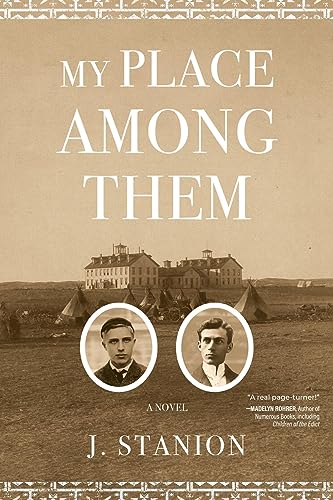

In the aftermath of the devastating massacre at Wounded Knee, we find John Iron Horse, a survivor navigating the harsh realities of life in a marginalized Native American community. By virtue of education and the acquisition of the English language, John is able to access greater occupational opportunities than most of his kinsfolk. Similarly, we meet Carter, a school teacher striving to make a difference within this community governed by a mismanaged, malevolent department. J. Stanion’s novel, My Place Among Them, masterfully explores the lives of these two characters— a White man and a Native American boy— as they seek to overcome adversity, burdensome quandaries, and strenuous societal expectations in a world marred by prejudice.
My Place Among Them has a biographical feel, following its characters through various stages of their lives while intertwining real historical figures. The narrative primarily showcases the viewpoints of John and Carter, detailing their evolution from a naive understanding of the White-Native American dynamic to a more profound realization of its complicated, often exasperating, nature. The reader journeys through the character’s many life milestones, such as birth, loss, education, employment, romance, and friendship.
While the characters are grounded in reality, Stanion effectively differentiates between the fictitious events depicted in the novel and the actual historical context. The challenges the characters face symbolize the authentic trials encountered by Native Americans in the late 19th-century United States. Woven into the narrative are thought-provoking themes and questions, such as, “How could his people preserve their freedom while confined within reservation boundaries?”
My Place Among Them is a compelling narrative that resonates deeply, creating a profound emotional investment in its characters. Its spiritual undertones elicit introspective sentiments and advocate for the adoption of humanistic principles. This novel is an excellent choice for those drawn to historic, culturally vibrant narratives emanating from authentic human struggles. Both heartwarming and enlightening, My Place Among Them is a genuinely captivating read!
Pages: 360 | ASIN : B0C7FFJLK7
A Winding Path to Flat Water
A Winding Path to Flat Water by Rob Soles tells the story of his great-grandpa, Henry Soles, who was taken from his parents when he was just a baby. Nishkiinzhig was Henry’s nanny and kidnapped him when she left with her tribe. Henry and Nishkiinzhig are forced to move around several times and to different places to get away from white settlers and other tribes. They stay at a home for widows and orphans where Henry, now known as Niniij, learns to hunt and help out around the home. Nishkiinzhig learns she has cancer, so she sends Henry out into the world to become a man and live his life. Soon after she passes away, Henry sets out to find the family he was taken from. He must also now reintegrate and reestablish himself in a white society.
Rob Soles has written an unpredictable, historical tale of Henry’s journey of finding a place for himself in society. The novel moves at a smooth pace and follows the different experiences that Henry goes through. Readers will love Henry as he is not angry at what happens to him, instead he still loves Nishkiinzhig and considers her his mom. His character is intelligent and capable and builds friendships with people along the way. Soles’ descriptions allow the reader to imagine what the characters in the story look like along with the surrounding areas. I enjoyed the many interesting characters in this novel; however, I would have liked to have heard more of what they were thinking and the motives behind their actions to connect more with them. The ending of this engaging novel leaves readers with much to think about, allowing them to take the story with them after they read the last page.
A Winding Path to Flat Water is a riveting story about American history, and western expansion told from a biographical fiction viewpoint. It gives readers an interesting look at Native American culture and what it could be like to live across two very different worlds.
Pages: 326 | ASIN : B09N8LH21H



 LITERARY TITAN