Blog Archives
Invisible Strings: 113 Poets Respond to the Songs of Taylor Swift
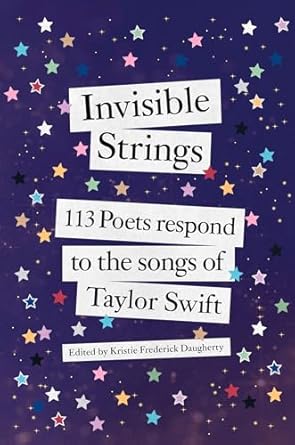

Taylor Swift’s music has always been full of poetry sharp, confessional, sometimes wistful, sometimes vengeful, always deeply felt. Invisible Strings, edited by Kristie Frederick Daugherty, takes that connection and runs with it, bringing together 113 poets who respond to Swift’s lyrics not with direct references but with their own poetic interpretations. The result is a deeply layered, often moving collection of poetry that feels like an artistic conversation. It’s a book that blends fandom with literary appreciation, proving just how much Swift’s songwriting has shaped modern culture.
What really struck me about this anthology was how it captures the emotional landscape of Swift’s music without ever quoting it outright. Some poems are straightforward responses to a song’s themes, like Bianca Stone’s Love’s Cure, which plays with the idea of love’s fleeting and sometimes dangerous nature much like Swift’s The Archer or You’re Losing Me. Others, like Maggie Smith’s Pull, echo the isolation and longing found in exile and tolerate it, using stark natural imagery to convey deep personal truths. I loved the puzzle-like aspect of this book, trying to match poems to the Swift songs that inspired them, but also appreciating how each poet makes the subject their own.
Some pieces stood out immediately. Andrea Cohen’s Duet has that quiet ache of unspoken heartbreak, much like Swift’s most devastating ballads. Then there’s Jessica Laser’s Concessions, which nails the feeling of post-breakup ghost sightings, the way someone lingers in the background of your life long after they’re gone. These poems aren’t just responses to Taylor Swift; they’re extensions of the emotions she puts into her music, proving that heartbreak, nostalgia, and reinvention are universal themes that cross from pop songs into poetry.
The book is also incredibly well-curated. Daugherty’s introduction captures the spirit of a true Swiftie and literary enthusiast, explaining how the anthology came together and why Swift’s work matters in a poetic sense. The order of the poems feels intentional, creating an emotional arc much like a Swift album does. There are moments of joy and lightness (Glitter Gel Pen energy), then deeper reflections (Fountain Pen introspection), then gut-punch endings that stay with you. This is a genuinely moving collection that any poetry lover could appreciate, whether they’re a Swift fan or not.
Invisible Strings? is perfect for Swifties who love poetry, writers who appreciate the lyrical quality of songwriting, and anyone who enjoys exploring emotions through multiple artistic lenses. If you’ve ever cried to All Too Well or screamed along to The Lakes, you’ll find something here that resonates. It’s proof that great lyrics don’t just live in songs; they spark ideas, stories, and emotions that keep echoing long after the music fades.
Pages: 282 | ASIN : B0D8CDBJP1

A Means of Self-Healing

The False God’s Lullaby is a collection of poetry and prose that explores the beauty and tragedy of the human experience, taking readers on a journey through your memories and emotions using in-depth imagery. Why was this an important collection for you to publish?
I’m entering the last phase of my productive life when I’ve found myself having reached the end of so many other journeys. Although I’ve been writing poetry since 1990 (when I first became interested in it), it wasn’t until I had reached an existential nadir so-to-speak in June of 2023. New poems just seemed to flow out of me, and so I went back to edit others I’d written over the years that I thought were suitable for publication. Something (more accurately someone) inside me desired to speak. It’s the time in our life when we wish to leave something that might survive our absence.
Were there any poems that were particularly difficult to write? If so, why?
If you’re asking, “Was it difficult for me to expose my inner life?” the answer is no. I began writing poetry after my profound experiences at the Esalen Institute in Big Sur. I’ve viewed my poetry as a means of self-healing (if you’ll excuse my use of a rather tedious California cliche).
How do you know when a poem is truly finished?
That is an interesting process question. It’s a matter of reaching a nodal point of comfortable satisfaction. This generally occurs within a week or so when the nagging feelings cease (eg. “Something’s not working but I can’t figure out what it is yet.”). Afterward, there’s a period of minor word-smithing that goes on for months. But finally, I have to tell myself to stop. There’s a point when “fine polishing” begins to weaken the poem’s impact.
What is the next book that you are working on, and when can your fans expect it to be out?
I’m already deep into investigating and writing my third collection of poetry (and perhaps some prose) focused on the works of Jacques Lacan and others on topics such as the connection between nothingness and spirituality and transformation. It’s largely a continuation of my interests in the multiplicity of selfhood. The working title is The Shadowed Crossing from a stanza in Rainer Maria Rilke’s Sonnets to Orpheus.
Author Links: GoodReads | Facebook | Amazon
The poetry is presented by topics that move like moods. The collection begins with contemplations of what the author calls “interior worlds.” This comprises over half of the poems and are the first and last titled sections. Interior worlds are expressed in such poems as “Memory,” “Confluence,” and “Longing.” This is followed by “Closeness and Distance” with poems describing experiences of both sexual (“Absolution”) and emotional intimacy (“Endearment”), as well as withdrawal (“Disillusionment”). The mid-topic sections move into the darker subjects of mortality (“Wandering,” “Big Sur”) and despair (“Awaiting the Pandemic”). Pulling back from these dark explorations are the poems found in “Lightness of Being.” These range from metaphorically comedic sexuality (“The Drummer’s Advice”) to a gathering with friends (“Friday Dinner”). “Interiors Worlds” are returned to with a prolific, seven-part poem exploring the external and internal aspects of familiarity (“Home”) and ends with the poem from which the book is named (“The False God’s Lullaby”). The final section is a small collection of prose pieces that add context to many of the poems. It also ends with a work from which the title poem was created.
Two major themes form the basis of internal worlds. First is the notion expressed by Lou Andreas-Salome’ of primitive consciousness arising in-utero. The poet fuses this with Soren Kierkegaard’s notion that we internally possess a sense of “the eternal.” The second theme ponders the implications of evolutionary neurobiology: that we are largely governed by the ancient powers of our animal brain (eg. “Limbic, paralimbic structures”). What Freud called “The It.” These are explored in the poems “Confluence,” “The Ancient Within,” and “Otherness.”
Despite the deep, dark themes of life that pervade many of these works, the author endeavors to find for himself and his readers how these encounters unavoidably lead to a sense of endearment and gratitude for life itself. In this, the author reveals the influence of his most beloved poet, Rainer Maria Rilke; for whom the poem “Wandering Rainer” was written.
The False God’s Lullaby


Aaron Gedaliah’s The False God’s Lullaby is a collection of poetry and prose that explores the beauty and tragedy of the human experience. It is divided into thematic sections that span interior reflections, love and loss, and the lightness and darkness of existence. Gedaliah writes with evocative imagery, from intimate moments of solitude to sweeping observations of the natural world. The book’s structure allows the reader to travel through time, memory, and emotion, often finding themselves face-to-face with universal truths about longing, connection, and mortality.
Gedaliah’s writing is stunningly vivid and deeply poignant, yet it’s also unafraid to linger in moments of vulnerability. In “Memory,” the way he captures fleeting, significant moments like watching “a minnow move about its day” is beautiful. These moments are small but resonate with the enormity of life’s mysteries. His ability to weave the profound into the everyday creates a sense of intimacy with the reader. However, at times, the dense imagery risks overwhelming the core emotion, requiring the reader to pause and find meaning.
The section “Loss and Departing” left me breathless. Poems like “Big Sur” and “Numbness” tackle grief with an unflinching gaze. The longing to be remembered through nature in “Big Sur” is a sentiment that lingers long afterwards: “Come visit me instead / in a place mere humans / were not meant to be.” This line alone stirred my own reflections on how we leave traces of ourselves behind. At times, these reflections take on a universal quality that gently softens the edges of the poet’s personal pain, allowing readers to connect broadly, though perhaps at the cost of some intimate specificity.
One of the book’s most captivating themes is the duality of connection and estrangement, explored in poems like “Otherness” and the prose section “Intimacy.” In “Otherness,” the connection between the poet and his dog evokes an unspoken depth, as much about human loneliness as it is about love. Meanwhile, the prose on intimacy explores how our need for sanctuary and trust can paradoxically deepen despair. These pieces struck me as relatable, even when their philosophical leanings sometimes leaned too abstract for my tastes.
The False God’s Lullaby is a heartfelt and deeply reflective work. Gedaliah’s writing will resonate most with readers who have a love for poetic language and philosophical musings. It is a book for those who savor the richness of imagery, those who don’t mind sitting in the quiet discomfort of life’s unanswered questions. If you are drawn to works that traverse the emotional landscapes of longing, loss, and self-discovery, this book will hold you in its embrace, much like the fleeting but profound moments it so beautifully captures.
Pages: 89 | ASIN : B0CLL5N4BM
Unconditional Love

A Tree For Me shares the story of a child and their bond with their favorite tree and the unconditional love they have for one another. What was the inspiration for your story?
The inspiration for my poem comes from my childhood. The illustrations depict a tree that I visited as a young girl, tirelessly searching for unconditional love. While working on my memoir, I recalled this beautiful oak tree and the deep sense of love I felt in its presence. Those memories flooded back, and I began to speak them out loud! My tree was always there for me—strong, steady, and a source of unconditional love. This realization shifted my focus from my memoir to a message meant for children: a message of love and acceptance. I wanted to help guide children to find this unconditional love within themselves early on, just as I did. As someone who was orphaned and adopted into a family where I didn’t quite fit, finding that love within was my saving grace.
What were some ideas that were important for you to share in this book?
The core idea is that the love we seek from the outside world must first be nurtured within ourselves. We often need to face our reflections much earlier in life than we might wish to.
The art in this book is fantastic. What was the art collaboration process like with the illustrator Karine Makartichan?
Karine and I clicked right from our first collaboration. I shared my vision for the book, and she grasped it immediately. It felt like a perfect partnership, allowing us to bring the story to life beautifully.
What is the next book that you are working on, and when will it be available?
A Tree for Me is the first in the Nature and Nurture series, and I’m excited to share that the next book,
A Flower for You, is on the horizon and coming soon!
Author Links: GoodReads | Shopify

The Mole Vol XIX: New York Poems and a Subway Shooting

Ronald Raye’s The Mole Vol XIX is a poignant blend of poetry and reflection, diving into the chaotic, electric spirit of New York City while weaving in the dark realities of urban life. The book traverses the subway cars, bookstores, and streets of Manhattan, presenting the city as a living, breathing organism, teeming with aspirations, heartbreaks, and history. At its core, it captures the juxtaposition of dreams and despair, most notably through a harrowing retelling of the infamous 1984 subway shooting incident.
What struck me first was Raye’s vivid imagery. In poems like “Sketches of New York,” the city unfolds as both a muse and a menace. His portrayal of immigrant struggles and the pursuit of elusive dreams felt raw and personal. Raye’s strength lies in his ability to craft images that evoke emotions, whether it’s the chaos of subway commutes or the haunting stillness of Central Park.
Some poems flow like a rhythmic celebration of life’s grit. The recurring motif of being “a lost twenty-something” wandering Manhattan was relatable. That said, poems like “Under a New York Sky” reignite the emotional potency of his narrative, offering a striking balance of hope and melancholy.
The section on the subway shooting is where Raye shifts from introspection to reportage. His recounting of the event, combined with poetic interludes, makes for a chilling read. The description of Thornton’s actions and the subsequent fallout is gripping yet unsettling. Raye’s treatment of the subject raises moral questions, leaving readers to grapple with their own judgments.
The Mole Vol XIX is a heartfelt tribute to the struggles and stories of New York’s inhabitants. Its blend of poetry and prose captures the city’s heartbeat. This book is a compelling read for those who crave the grit of urban life, the nuance of moral dilemmas, and a narrative that doesn’t shy away from uncomfortable truths. If you’re a fan of poetry that challenges as much as it inspires, Raye’s work deserves a spot on your shelf.
Yes, it’s a bit of a wild ride.

HOMEMADE SHRINE is a collection of poems centered on themes of love and loss, the emotions evoked by memories, and the beauty found in everyday life. What inspired you to write this particular collection of poems?
HOMEMADE SHRINE has honestly been in production for over six years. It’s a collection of raw poems and journal pages that I’ve written in response to some impactful places, people and events throughout my life. I had toyed with what a full collection of these random writings would have looked like many times and I even still have a note on my phone laying out a far more epic version of the collection with over fifty poems sorted into twenty different chapters!
I sort of wanted it to document my early twenties and I wanted it to be an accurate as possible snapshot of each of these seminal feelings and moments in my life on a page where they could live forever and where they could connect with strangers in a way that no one was alone in life’s strange and sometimes confronting experiences.
It’s also an ode – or shrine – to one prominent soul-shattering, high-art-inspiring, car-wreck relationship, as is very clear from the dedication page onwards…
Do you have a favorite poem in the book, and if so, why does it hold special meaning for you?
This is like forcing me to pick my favorite child in front of the others, incredibly difficult. But, strange as it is, I’d have to say Beer-Boleyn is my favorite. I don’t find it to be the most creative writing in the collection but it’s one of those poems that just radiates a certain time, place, feeling and a dream I had. It’s also funny. It’s making light of the downright ridiculous yet troubled and entirely complicated relationship it’s describing. It references cult weddings, home-wrecking, the execution of Anne Boleyn and the person you love drinking beer they originally detested possibly due to the unseen forces of one of your irrelevant dreams you’d have to pay them to listen to… Yes, it’s a bit of a wild ride.
I find that last point particularly fascinating however, how dreams so often intertwine with a reality that you haven’t experienced fully yet and when dreams do come true in front of you it makes you feel special and like everything you’re currently doing – no matter how morally questionable or unhealthy – is a cosmic step in the right direction. These are just the places this poem takes me to…
Do you think there is a particular mindset or environment that a reader should be in to fully appreciate your work?
The reader should be ready to dive into this collection with some herbal tea (or some hard liquor), a pen and a mind ready for some serious introspection. So… it may not be the most “casual” read for many. The words are written so as to hook themselves and dig deep into heavy subjects and feelings. It also offers the reader the opportunity to participate with interactive prompts spread throughout.
I do think there’s something for everyone in the collection, however. There’s eco-poetics, there’s addiction, there’s occult references, there’s sex, there’s pressed flowers and pinned butterflies, there’s complicated relationships… It’s all a personal experience for me and for whoever reads it as they can transform and transcend it with their own mindset, experiences, feelings, etc.
Just don’t forget the pen…
What is the next book that you are working on, and when will it be available?
My next project is still in its early stages of life but it’s frighteningly ambitious. It’ll be another collection of poetry but with some memoir passages, fictional and metaphorical short stories and even some horror elements mixed in… It contemplates escaping a darker past that feels like home into a much brighter present and future that feels so unfamiliar and strange but you ultimately know it’s a better place for you to be.
I’m hoping to have it finished and looking for its inevitable home by the end of 2025, so stay tuned.
Author Links: GoodReads | Website | Instagram
HOMEMADE SHRINE
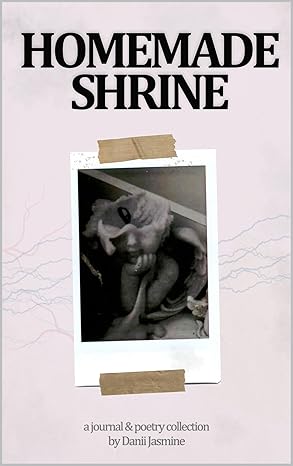
Danii Jasmine’s collection of poetry is an evocative exploration of love, loss, and identity filtered through the lens of surreal nostalgia and unfiltered introspection. Each poem feels like stepping into a dreamscape—full of vivid imagery, shadowy emotions, and fleeting memories that are as unsettling as they are beautiful. From suburban settings steeped in twilight gloom to the intimate mundanity of a whispered phone call, Jasmine builds a deeply personal shrine to a fractured but deeply felt life.
What struck me first was Jasmine’s ability to tether seemingly mundane details to existential depth. In “Sunshinelater”, for instance, the suburban setting of “empty houses” and “flower-embroidered pillowcases” morphs into a melancholic reverie, turning ordinary imagery into a commentary on fleeting happiness. Her writing radiates a blend of resignation and quiet rebellion, making the familiar feel alien.
Another standout is “Brandy Melville”, where Jasmine captures the turbulence of toxic intimacy. Lines like “I wrote five paragraphs about neglect” and “the people around me…recognize this resigned sad version” reveal a raw vulnerability. Yet, the poem avoids outright despair, weaving in a dark humor that feels both defiant and self-aware. This complexity—pain wrapped in sharp wit—is one of the book’s greatest strengths.
I also loved “The Common Emigrant”, where Jasmine meditates on the fragility of beauty through the imagery of a butterfly trapped in a killing jar. It’s a delicate yet chilling metaphor for human relationships, artistic capture, and the cost of preserving beauty at the expense of life. Her descriptive language, like “the overwhelmingly sweet stench of ethyl acetate,” lingered with me long after reading, a testament to her skill with sensory detail. The collection’s relentless introspection might not appeal to readers looking for lightness or clear resolutions. But for those who crave poetry that pushes boundaries and reflects raw human experiences, this is an unapologetically visceral offering.
HOMEMADE SHRINE is perfect for anyone who enjoys emotionally charged, visually rich writing. It’s for readers who are not afraid to sit with discomfort, who seek beauty in the jagged edges of life, and who relish peeling back the layers of language to uncover the raw, pulsing heart beneath.
Pages: 102 | ASIN : B0DJLBCSTH
Literary Titan Gold Book Award: Poetry

The Literary Titan Book Award recognizes poets who demonstrate exceptional artistry and proficiency and push the boundaries of language and expression. The recipients are poets who excel in their technical skills and evoke deep emotional responses, challenge thoughts, and illuminate new perspectives through their work. The award honors those who contribute to the literary landscape with their unique voices and powerful words.
Award Recipients


Visit the Literary Titan Book Awards page to see award information.


