Blog Archives
Chasing Rescue: Surviving Narcissistic Abuse
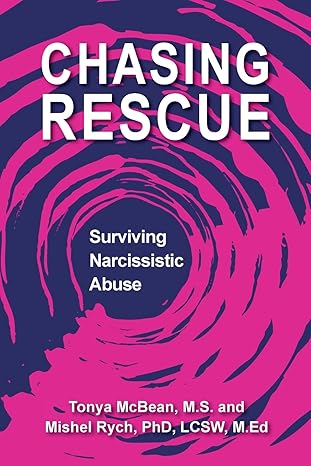

Chasing Rescue is a heartfelt guide to understanding, surviving, and healing from narcissistic abuse. Written by Tonya McBean and Dr. Mishel Rych, the book combines intimate storytelling with therapeutic insights. McBean recounts her own harrowing experience of living with a narcissistic partner, from the early love-bombing to the eventual unraveling of her life, while Dr. Rych offers clinical context and coping strategies to help others navigate similar abuse. Together, they provide not only validation but also a structured path toward reclaiming one’s identity, self-worth, and peace.
McBean’s writing is vulnerable and bold. Her story of enduring emotional, financial, and psychological abuse is gripping, and at times, it made me angry, heartbroken, and fiercely protective of her and her children. The strength it must’ve taken to survive, let alone write about it so openly, is staggering. There were moments I had to set the book down just to sit with the heaviness. But then I’d pick it back up, because she also writes with hope. She shows us what healing looks like. It’s not a smooth climb, but a jagged, stubborn trek with bruises and breakthroughs. That authenticity made it impossible not to root for her.
Dr. Rych’s sections are where the light really comes in. Her insights explain the patterns and psychology behind narcissistic behavior and how it messes with a person’s mind and soul. She breaks down clinical terms in a way that feels like a friend gently guiding you through a storm. The blend of practical advice, spiritual encouragement, and psychological framing helps the book land its punches without leaving you hopeless. I especially appreciated the call to action, that healing is our responsibility, not our fault. That resonated with me.
This book is not just a memoir, and it’s not just a self-help guide. It’s a lifeline. I’d recommend Chasing Rescue to anyone stuck in the confusion of an abusive relationship, to those recovering from one, or even to people supporting someone through it. If you’ve ever doubted your reality or felt alone in your pain, this book will show you that you’re not crazy, and you’re not alone. It’s messy, it’s painful, and it’s real, but it’s also full of strength and redemption.
Pages: 134 | ASIN : B0F9BBK62J

You Are Not Alone, You Are Not To Blame

The Lion & The Narcissist leads readers through a gripping personal journey of emotional manipulation, psychological trauma, spiritual resilience, and, ultimately, self-liberation. Why was this an important book for you to write?
This book was definitely more of a calling than a plan. I can’t say that I planned to write the book. I literally just began writing. It began with journaling just to make sense of “my narcissist’s lies”. When people say the lies are crazy making they are absolutely, 100%, unequivocally correct. Narcissists engage in the highest level of deception which robs their victims of reality. The first part of my life I had to regain control of was my very sense of reality and the only way to do that was by writing everything down. For me personally, writing also became an integral part of managing my medical treatments and navigating the legal system. Few people know that it was through researching and writing I was equipping myself to be my own advocate in systems poorly equipped to help victims of narcissistic abuse. No one was able to help me understand what I had just experienced and few people were interested in holding my abuser accountable. Everyone just wanted to give me a band-aid and tell me “I would be ok”. Most of all writing this book supported my healing by helping me identify and label what I had experienced and why. Researching miraculously led me to resources that could actually help me. I also believe writing this book gave me the courage to hold my abuser accountable without backing down in fear. The more I learned about the tactics narcissists use and the effects this nefarious form of abuse had on innocent people the more passionate I became about making some kind of change. These wicked individuals must be held accountable and people had to be warned that they exist. The best part was it did not end there for me. I was compelled to seek deeper meaning in it all and that is what led me to the most important book ever written…..the Bible. I am certain the entire process was God’s call on my life to seek Him, find Him and surrender to Him. While my experience is something I don’t wish anyone to endure, I would not trade in the person I have become having survived, trusting the Lord was beside me every step of the way. I would never trade my relationship with Jesus Christ for anything in the world. Writing my book led me to Him and has given me a testimony to teach about His goodness and mercy.
What were some ideas that were important for you to share in this book?
This is a really hard question to answer. Hindsight, reading my book years after writing it, I think the most important idea to share is just how difficult it is for a victim of narcissistic abuse to explain it to others. Narcissists are so incredibly cunning, malicious and depraved that our very human nature makes it hard to believe they exist. The reality is not just that narcissists not only exist but they are a real manifestation of evil masquerading themselves as good and ordinary people. Even I learned over the years we can’t tell people what a narcissist or narcissistic abuse is, we have to show them so they can identify it for what it is. Equip them with hard truths. By nature I don’t think people want to believe evil exists in our own relationships and/or families. By avoiding the truth we open ourselves up to dangers allowing it to destroy us. I think the most important idea I could have shared by writing the book is the effects such behaviors can have on our lives and warn others of the detriment allowing and tolerating abuse is to our lives: physically, mentally and spiritually.
What is a common misconception you feel people have about Narcissistic Personality Disorder (NPD)?
I have two very strong opinions on this. The number one misconception I feel some people have about narcissistic personality disorder is that the narcissist will or can change. This is probably the most dangerous misconception out there. As a Christian, this is difficult to reconcile because we know God can do all things and His arm is not too short to save anyone. The understanding I have come to believe is narcissists are reprobate minds. Hallmark traits of NPD are pride, arrogance and the sense of entitlement traits that point to self adoration in the narcissist rather than a love for God. NPDs also lack self-reflection and accountability, making them resistant to both repentance and calling on God to save them. Statiscally, narcissists do not change. Believing they will only prolong the abuse the victim does not deserve. This misconception can cost someone their life. The second misconception I feel about NPD is labeling it a mental illness. NPD is a personality disorder which differs greatly from mental illnesses that can be treated. I believe personality disorders are a spiritual disease, a state of the person’s soul. A reprobate mind is a person who chooses to live in perpetual sin having little, if any desire to please God. Narcissists, like psychopaths and sociopaths live corrupt and extremely selfish lives. Sin and corruption have become justified and acceptable in people who have NPD. Sadly, reprobate minds are people whom God ultimately rejects and has left to their own devices. Standing firm in hard truths God has revealed in His word, it is my opinion NPD is a clear manifestation of evil in our world.
What is one thing that you hope readers take away from your book?
I hope that after reading my book readers can walk away with a clear understanding of what narcissistic personality disorder is, identify a toxic relationship and understand the dangers of being in relationships with narcissists. Ideally I hope that educating others on the topic prevents people from entering into relationships with dangerous personalities by helping them identify red flags and run.,,,,,fast and far! Sadly there are many who are currently in relationships with people who are causing them harm. For those people I hope my book helps them to understand they are not alone, they are not to blame and they are not helpless. There is no shame having fallen for someone who didn’t reveal their true nature in the beginning. That is what predators do. There is no shame in not having seen the red flags. There is no shame for having tolerated some of the things we have tolerated out of the kindness in our own hearts. But now is the time for you, the reader, to Get Up and say enough is enough. It is time for you to Stand Up knowing that you are a son or daughter of the King who created you to be loved. His promises are true and He will take you by the hand and never stop fighting for you. It is not going to be easy but you will come to the other side.
Awarded a Doctorate of Nursing Practice (DNP), Katherine has been an advanced practiced nurse teaching in higher education for over 20 years. She holds multiple degrees, honors and certifications. In addition to earning a Master’s of Degree (MSN) in nursing focused on nursing education and doctorate in leadership and policy change, she is recognized as a neuro-linguistic programming practitioner by the International Guild for Neuro-Linguistic Programming. Her passion is to educate those tormented by abuse. She helps others better understand narcissism, how victims are targeted and snared in a den of deception, then trapped in a cycle of narcissistic abuse. Her story helps victims navigate recovery in a society still ill-equipped to help victims of this complex and poorly understood type of abuse.
Using storytelling, the protagonist in her memoirs transforms from victim to triumphant. The layers used in this thrilling allegorical literary work are woven with scientific evidence based research about narcissistic personality disorder(NPD) and the effects of its abuse on the mind, body and soul.
By targeting victims, narcissists guarantee success by taking advantage of people they view as having weak boundaries. Mixed with nonfiction, the metaphorical use of the lion paints a vivid picture of the dynamics between narcissists and empathic or codependent victims. After reading this book, it becomes clear how strategies such as love bombing, hoovering, gaslighting, projection, blame shifting, and ghosting are used to create a trauma bond. Providing definitions for terms which are personified in a raw, real life depiction of how tactics can diminish one’s self-esteem, self-worth, and self-identity readers will become well-informed. The tactics and their effects are creatively exposed in this well- articulated testimony.
Using informative writing grounded in science the book provides a clear picture of the progression and escalation of abuse. Strategies used to gain and maintain control are organized using the stages of the narcissistic cycle of abuse. Readers can identify clearly how they were targeted and groomed within phases of idealization, devaluation and discard illustrated in this book. Katherine explains characteristics of and goes deeper to validate how narcissists practice master manipulation in order weaken and destabilize their victims and reveals how they can gain control.
Narcissistic abuse uses all forms of intimate partner abuse including emotional, psychological, sexual, spiritual and physical abuse. Unrecognized it can completely break the human spirit and in some cases escalate into domestic violence. Through this provocative and personal testimony the dangers of exploitative relationships are confirmed.
The declaration of truths, overcoming the trauma, developing a strong identity and inner strength found in Christ will inspire any reader. Katherine’s journey can teach victims there is a way out of the darkness in the lion’s den.“In the midst of my awakening, I recognized that I was fighting with the devil himself, but that I was never alone. Although I was a victim largely of my own choices, the Holy Spirit within me, revealed there was a battle coming against me and I was going to win.” -K. Tsiampas
The Lion and the Narcissist
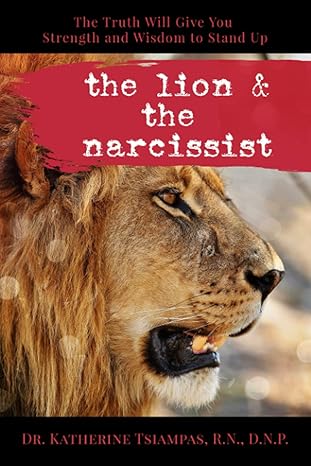
The Lion & The Narcissist is a piercing and powerful memoir by Katherine Tsiampas that details her experience in a relationship with a man she later identifies as a narcissist. Drawing rich metaphors between narcissistic abuse and the predatory nature of lions, Tsiampas leads readers through a gripping personal journey of emotional manipulation, psychological trauma, spiritual resilience, and, ultimately, self-liberation. With a voice both fierce and vulnerable, she unpacks the psychological patterns of Narcissistic Personality Disorder (NPD) and how these patterns infiltrated every corner of her life, faith, and identity.
Tsiampas compares narcissists to lions—majestic on the outside, deadly beneath the surface. The way she sets the tone early makes it clear this isn’t just about psychology—it’s about survival. I couldn’t stop reading. The writing is intense and deeply poetic. Sometimes, it felt like I was holding my breath.
Tsiampas’s honesty is brutal in the best way. When she shared the moment she realized she was prey—emotionally vulnerable after a breakup, working tirelessly, raising two kids, and still blind to the danger—I felt that deep in my gut. “To the narcissist, all this…made me the prey he perceived would never fight back”. Her self-awareness, especially in hindsight, is admirable. She doesn’t sugarcoat anything, even her own compliance. I found myself nodding, sometimes crying, especially when she describes how easily charm, flattery, and attention can seduce someone who just wants to be seen and loved.
What stayed with me the most was how she frames narcissistic abuse as not only psychological warfare but also a spiritual battle. Her faith is woven throughout the story—not preachy, but personal and grounding. She talks about God as her anchor, the Holy Spirit guiding her, and the voice that told her to “Get up.” There’s something powerful in watching someone reclaim not just their sense of self but their sacred worth. I needed that reminder. Her description of the discard phase, when the narcissist leaves his victim completely shattered, is absolutely heartbreaking and terrifying.
The Lion & The Narcissist is a wake-up call and a guide for anyone who’s ever found themselves lost in a relationship that felt too good to be true and then turned into a nightmare. I would recommend this book to women who are healing from emotional abuse, to therapists seeking firsthand insight, and to anyone who needs to remember that they are not alone. It’s especially powerful for women of faith who have been taught to endure silently. Katherine Tsiampas reminds us that God doesn’t ask us to stay with predators. He asks us to get up. And fight. And survive.
Pages: 270 | ASIN : B0961NPXZ7
Champions Needed: Unlocking the Potential of Family Advocacy in Assisted Living and Memory Care
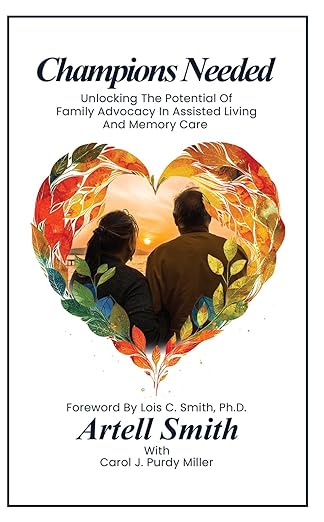
Champions Needed is a book about stepping up when it matters most. It’s a guide for family members who find themselves in the role of advocate for loved ones in assisted living and memory care. The authors, Artell Smith and Carol J. Purdy Miller, bring personal experience and professional insight to a subject that is often overwhelming and emotional. They explain what an advocate—or “champion”—should do, from understanding legal rights to navigating daily challenges within long-term care communities. More than just a practical guide, this book is a heartfelt call to action, emphasizing that advocacy can directly impact a loved one’s quality of life.
The authors don’t sugarcoat the realities of long-term care. Right from the foreword, written by a long-term care resident, the book makes it clear that aging and assisted living can be isolating, frustrating, and sometimes even neglectful. The authors acknowledge that care facilities are often overburdened, and without an engaged family advocate, things can slip through the cracks. Chapter 1 sets the tone, stating plainly that senior loved ones deserve the best, and that “poor advocacy for a loved one in a long-term care community has immediate and sometimes life-threatening consequences.” That’s a sobering statement, but it’s true. This book makes sure you understand the stakes.
The most valuable sections focus on specific advocacy skills; communication, persistence, problem-solving, and emotional intelligence. The authors highlight how advocates should approach conversations with staff, using real examples of how different communication styles can either escalate conflicts or resolve issues smoothly. One of my favorite parts was the dialogue example in which a champion calmly negotiates to get food for a resident who missed lunch. Instead of demanding a meal, the advocate works with the caregiver, finding a collaborative solution. That’s the kind of practical advice that’s immediately useful.
At times, the book can feel a bit overwhelming, not because of the writing style (which is clear and approachable), but because of the sheer amount of responsibility it places on family members. The authors recognize this, though, and offer encouragement throughout. The chapter on “The Continuing Journey” reinforces that advocacy is not about perfection but persistence. The book also includes checklists, self-evaluation tools, and guidance on choosing a care facility, making it as much a practical workbook as a thought-provoking read.
Champions Needed is a must-read for anyone with a loved one in long-term care. It’s particularly useful for those who are new to the role of advocate, providing both emotional support and practical guidance. If you want to ensure your loved one gets the care and dignity they deserve, this book will equip you with the knowledge and confidence to step up.
Pages: 148 | ASIN : B0D5JYQ59Z
Manipulative Brainwashing

In Hello Flower, you share with readers your experience as a victim of narcissistic abuse and give them the tools necessary for breaking free from abusive relationships. Why was this an important book for you to write?
I never imagined this could happen to me. Not in a million years. The shocking realisation that I wasn’t alone, that this was a textbook pattern of abusive behaviour carried out by so many made me want to help identify the signs, write in stark personal detail something which people might recognise and realise that their feeling of ‘ something off’ isn’t imagined but all too real. It was also important to dispel the myth that this is yet another ‘label’ and to demonstrate the horrific reality of living with a monster disguised as the person you trust the most.
I appreciated the candid nature with which you told your story. What was the hardest thing for you to write about?
I think my initial instinctive answer to this question was remembering and writing about my Dad, his hope, belief, and optimism for me and my happiness, then I realised that writing about him was relatively easy. The hardest thing was writing about the original ‘love stories’ going back over and reliving how love-struck and naive I was each time, it made me really angry to see how I had been conned but it was necessary so I could help the reader understand why I fell for him and how that manipulative brainwashing starts. Writing that was sickening but key to unlocking the entire narrative.
What is one misconception you believe many people have about leaving an abusive relationship?
Please let me have two! The first is thinking it is easy to leave, to walk away from something which hurts you seems so straightforward to the uninitiated, I’ve often been asked ‘How come you put up with it for so long?’ a painful but understandable question. The trouble is when you are wrapped up in this sort of relationship you don’t believe you should walk away, you want to try harder, do more which simply results in a deeper entrapment. The other misconception is that once you are out you are fine, it’s over, time to just carry on and ‘let it all go’, if only. It takes a long long time to unravel all that damage, you improve, you do move on, but you are never quite the same.
What is one thing you hope readers take away from your experience?
If any of it relates if even a tiny part of my book is familiar I hope, going forward, they raise their boundaries because in doing so it is the first step in saying what is and isn’t acceptable. It’s quite the game changer when you had none in place before.
Author Links: GoodReads | Substack | Amazon
Self-deprecating, heartbreaking, and sometimes funny, this is ultimately a realistic and revealing insight into how even the strongest person can be susceptible to the most insidious form of abuse—and yet find the courage to walk away and shine again.
Hello Flower

Hello Flower: A Real Life Story of Narcissistic Love and Invisible Abuse, by Martina Gruppo, is a compelling and insightful non-fiction biographical account that delves into the pervasive and insidious nature of narcissistic abuse. Gruppo’s narrative is a stark reminder that narcissism, an often unseen and underestimated form of abuse, can ensnare even the most resilient individuals. The subtlety and unpredictability of this psychological manipulation make it a particularly dangerous form of harm.
In Hello Flower, Gruppo provides victims and readers with the tools to recognize and recover from narcissistic abuse, offering practical advice for those currently in abusive relationships or those who have managed to break free. Her writing is raw and genuine, showcasing her talent as a storyteller and her bravery in recounting her own harrowing experiences of manipulation, humiliation, and mental abuse at the hands of a narcissist. Gruppo’s candid reflection on her youthful naivety adds a poignant layer of vulnerability to her story. Gruppo’s publicized recounting of her experiences is both urgent and captivating, making the book a gripping read. Her words serve as a soothing balm for those who have endured similar trauma, helping them to identify and understand the disorder. She encapsulates the despair of dealing with a narcissist in a powerful statement: “It doesn’t matter what you do, say, how you dress, or how hard you try—you simply aren’t there. You don’t matter.” This painful truth, especially when the narcissist is a close family member or partner, is the first step toward healing.
This book is an invaluable resource for anyone seeking to understand narcissism and its effects. Gruppo’s work is not only an educational tool but also a guide for those looking to reclaim their lives and self-worth after enduring narcissistic abuse. Her insights and encouragement help readers emerge stronger and ready to live life to the fullest.
I highly recommend Hello Flower to anyone seeking to learn about narcissistic abuse or to find solace and guidance on their path to recovery. Martina Gruppo’s book is a testament to resilience and a beacon of hope for those striving to heal from invisible wounds.
Pages: 258 | ASIN : B0D4VTQLDK
Walking Wounded

From Depression to Contentment: A Self-Therapy Guide is a book that provides help for readers who are experiencing depression and desire an alternative to outside therapy. It presents well-researched techniques and methods that are straightforward to implement. Why was this an important book for you to write?
Actually, the book title addresses depression because my publisher is very firm: each book should seem to limit itself to one problem. However, psychotherapy doesn’t actually work like that. With suitable modification, essentially the same tools will provide a path out of chronic anxiety, addictions, anger… basically, human suffering. This is because, as I say in the book, classifications like in the Diagnostic and Statistical Manual are basically science fiction.
Second, the therapy bit is only halfway, from ongoing agony to “normal,” which is the walking wounded. Then the tools of positive psychology and Buddhist psychology allow you to rise WAY above that.
This book is the distillation of decades of my personal experience, study, and therapeutic practice. I wrote it to be of service to as many people as possible, then a few more.
How much research did you undertake for this book and how much time did it take to put it all together?
In a way, no research at all — specifically for this book. When I started university, I decided not to go into Medicine because it was a 6-year course, then at least 4 more years of training. Then, overall I spent 14-and-a-half years as a student. And in my profession, you don’t ever stop learning. A condition of being registered is continuous study. And even though I retired in 2013, I have kept up with new research, just from interest.
So, while this research and study were not for the book, all that information and knowledge is in there. Well, it is, up to the publication date. It’s annoying, but when I sent my time machine in for service, they returned it to an alternative universe. What’s happened since is only marginal, but it doesn’t matter all that much, because therapy, including self-therapy, will work if three conditions are present, as Carl Rogers has described. These are empathy, love of the kind Buddha, Jesus and many other sages have told us to give to everyone, and genuineness. That last one is that it has to be honest.
What were some ideas that were important for you to share in this book?
• Chronic emotional suffering beyond what the situation warrants is always due to the interaction of
several factors. One of them is childhood trauma, as seen through the child’s eyes.
• Depression, chronic anxiety and the like are not due to faulty brain chemistry.
• Using the tools I teach in the last part of the book, you can live a contented life in any situation.
What is one thing that you hope readers take away from From Depression to Contentment?
The more you give, the more you get, and also the more you grow.
Author Links: GoodReads | Twitter | Facebook | Linkedin | Mastodon | Website
Every tool in this book is based on research, but presented in an easy to understand, easy to apply manner.
With homework assignments, you will find your inner strengths, uncover the true source of happiness and develop great resilience.
Learn how to put the philosophies of all great religions to practical use, even if you are an atheist.
This program can help you start a new life – one of meaning, positivity and purpose.
Unlike instructional books, this book is not only useful but also enjoyable.
From Depression to Contentment: A self-therapy guide
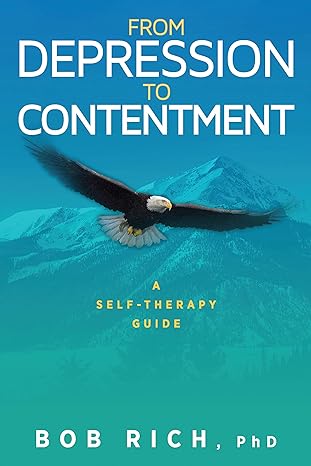
From Depression to Contentment: A Self-Therapy Guide, by Bob Rich, is an enlightening and approachable book that tackles the complex topic of depression. Rich’s book is not just a clinical discourse but a practical guide filled with empathy that draws from the author’s own experiences and psychological expertise.
Rich’s writing style is both engaging and easy to understand, a breath of fresh air in the often technical world of psychological self-help books. His personal anecdotes add a level of authenticity that’s both relatable and inspiring. The book’s approach of viewing depression not just as a medical issue but as a perspective on life is a refreshing angle. It challenges readers to rethink their own views on depression, making it an engaging read for anyone interested in mental health.
The book is skillfully structured, guiding the reader through various strategies, from basic self-care to deep psychological work. Particularly impressive is the chapter on “Controlling Depression,” where Rich introduces practical methods to reframe negative thoughts, encouraging a proactive stance in dealing with depressive thoughts. It is worth noting that some readers may find the chapter on spirituality less applicable, depending on their personal beliefs.
The conclusion of the book underscores a crucial message – the importance of actively applying these strategies in one’s life. This is where Rich’s guide distinguishes itself; it’s not just informative but also motivational.
From Depression to Contentment is a highly recommended read for anyone who is struggling with depression or has an interest in mental health. It’s particularly suited for readers seeking a blend of professional insight and practical, easy-to-implement strategies.
Pages: 157 | ASIN : B07PGQMP4Q




 LITERARY TITAN