Blog Archives
Evenings on the Edge of Death


Evenings on the Edge of Death is a deeply personal work of poeticized nonfiction about the long afterlife of family trauma, the erosion of memory, and the complicated work of loving people who have also caused pain. Theodore McDowell builds the book as a series of collages centered on his mother, father, sister, marriage, and finally the experience of saying goodbye. The form suits the subject beautifully. Memory rarely arrives as a clean narrative, and McDowell doesn’t force it into one. Instead, a beach, a baseball glove, a glass of whiskey, a rosary, a wheelchair, a field of wheat, or the sound of water can suddenly open a door to another time. The result feels less like being told the story of a life than being invited inside the way that life is actually remembered.
At the center of the book is a family wounded by an abusive father and by the silence that grows around abuse. McDowell returns to those wounds from different angles, especially through his relationships with his mother and his sister Rachel. The opening poem establishes the emotional vocabulary immediately, placing a father’s violence beside wheat fields, church bells, maternal tenderness, and a child’s bewildered questions about God. What gives these poems their staying power is McDowell’s willingness to let contradictory feelings occupy the same room. He can rage at his father and still search for the damaged man inside him. He can adore his mother while admitting resentment, exhaustion, and even the terrible wish for her suffering to end. He can grieve Rachel’s suicide while continuing to wrestle with guilt over not saving her. Forgiveness here isn’t a neat resolution. It’s an ongoing argument between memory, love, anger, faith, and the child who still wants an explanation.
The book widens considerably in the poems about marriage. Here, McDowell brings the same searching attention to intimacy, addiction, estrangement, reconciliation, aging, and the fear of losing the person who has witnessed your life. In one poem, a couple plants seeds while wondering whether they’ve truly fallen in love; in another, thirty-nine years of marriage are remembered through happiness, miscarriage, addiction, recovery, service, and the simple act of holding hands on a porch as death approaches. These poems show one of McDowell’s strongest gifts: he finds emotional weight in physical things. Hands, weather, flowers, rooms, rivers, photographs, and worn objects keep carrying the story when abstract language would be too easy. His recurring Christian imagery sits alongside Buddhist meditation, blues music, nature, and art, giving the book a spiritual restlessness that feels earned.
By the final section, death has become less a single event than the book’s constant horizon. McDowell writes about hospice, nursing homes, dementia, the indignities of the body, forgotten names, and the fear that a whole human life might vanish when nobody remains to remember it. Yet the book keeps moving toward preservation. Again and again, writing becomes an act of keeping faith with the dead, with the damaged self, and with moments of beauty that would otherwise be lost. The closing poems return to the book’s rivers, grief, childhood wounds, faith, and questions of identity, but the final movement is toward grace and self-creation. Evenings on the Edge of Death turns the fragments of a wounded life into something enduring: a fierce, tender testament to memory, love, and the grace of still becoming.
Pages: 171 | ASIN : B0CVJ4PR85

Drinking From God’s Well

Theodore McDowell’s Drinking From God’s Well: Exploring the Journey From Trauma to Renewal and Recovery is a book-length poetry collection shaped as a spiritual and autobiographical account of addiction, mental illness, family trauma, grief, recovery, and faith. Its three-part structure moves from “The Struggle to Survive” through “Releasing the Pain” and finally to “Life on Life’s Terms,” giving the collection a clear emotional progression from crisis toward a more settled form of acceptance. McDowell writes repeatedly from the most difficult regions of his life: homelessness, substance abuse, a traumatic brain injury, bipolar disorder, estrangement from his children, the deterioration of his marriage, his sister’s suicide, his mother’s dementia, and his own encounters with suicidal despair. Yet the collection treats these experiences as parts of an ongoing spiritual life. The result is poetry that functions at once as memoir, confession, prayer, lament, and meditation on how a damaged life can be gathered into meaning.
McDowell’s strongest poetic feature is his recurring network of images. Jazz is especially important. Saxophones, improvisation, rhythm, silence, and blues become ways of understanding marriage, grief, mental illness, and recovery. Nature serves a similar purpose. Redbud trees, morning glories, egrets, lakes, storms, and falling leaves give physical form to emotional states that might otherwise remain abstract. These repeated images also create continuity across poems written from different stages of life. A storm can embody marital conflict in one poem, while morning light becomes an image of reconciliation in another. Water shifts from danger and uncertainty to cleansing, grace, and renewal. McDowell’s Christian imagery is equally persistent, but his faith is rarely presented as effortless certainty. God is questioned, resisted, cursed, sought, and finally experienced through suffering, forgiveness, human intimacy, and ordinary moments. This tension gives the spiritual dimension of the book much of its substance.
The collection is particularly effective when McDowell turns from his own suffering toward the people who endured its consequences. Poems about his wife and children complicate the recovery narrative by insisting that sobriety alone can’t repair years of injury. In “An Amends to My Daughter,” the speaker tries to listen without defending himself as his daughter describes the damage addiction caused during her childhood. The emotional turning point arrives not with easy reconciliation but with her quiet statement, “I finally feel heard.” That moment captures one of the book’s central understandings of forgiveness: healing requires attention, accountability, time, and the willingness to remain present before another person’s pain. Throughout the collection, marriage is treated with similar seriousness. Love appears as desire, memory, resentment, caretaking, endurance, physical intimacy, companionship, and spiritual shelter. McDowell’s imagery can be highly concentrated, sometimes layering biblical, musical, natural, and erotic references within the same poem, but that density reflects the way the book understands memory itself. The past is continually resurfacing inside the present, transformed by age but never entirely erased.
Drinking From God’s Well has broadened from survival and recovery into a meditation on aging, mortality, gratitude, and the sacred character of ordinary life. Grandchildren, morning coffee, gardening, family meals, walks, music, a wife’s presence in another room, and the simple experience of waking sober acquire the significance that earlier poems gave to catastrophe. McDowell doesn’t portray renewal as the disappearance of trauma. In “Trauma and Grace,” he describes the continuing work of recovery as “finding the miracle / within the marrow of suffering,” while accepting wounds and scar tissue as part of the foundation of renewal. That idea provides an apt description of the entire collection. Drinking From God’s Well is a sustained poetic attempt to integrate suffering into a life that can still contain faith, intimacy, beauty, responsibility, and joy. Its final achievement is not a declaration that the past has been conquered, but a vision of a person able to inhabit his whole history and still recognize grace within it.
Pages: 310 | ASIN : B0D48ZDSRL
Evenings on the Edge of Death
Evenings on the Edge of Death is Theodore McDowell’s deeply personal work of poeticized nonfiction, built from memories of childhood trauma, dementia, family violence, mental illness, marriage, addiction, faith, and grief. McDowell arranges the book as a series of emotional collages, moving through his relationships with his mother, father, sister, wife, and finally toward his own reckoning with aging and death. The form suits the subject beautifully. Memory rarely arrives in neat chronological order, especially when trauma and dementia are involved, and these pieces return again and again to certain images, gestures, places, and wounds. A nursing home window, a childhood beach, a glass of whiskey, a cathedral, a river, a garden, a hand reaching for another hand. The repetition gives the book the feeling of someone sorting through a lifetime and asking which memories have shaped him, which have damaged him, and which might still save him.
Some of the book’s strongest writing comes from McDowell’s willingness to hold love and injury in the same frame. His father can be frightening, abusive, wounded, and finally vulnerable. His mother is nurturing and beloved, but she also becomes inseparable from the complicated family history she helped sustain. His sister Rachel carries the scars of abuse into mental illness, addiction, and suicide, leaving her brother with grief that refuses any easy resolution. The poems about her are particularly haunting because McDowell keeps reaching past the manner of her death toward the girl she once was, the sister who danced, painted, dreamed, and made him feel safe. That movement is central to the whole book. He keeps trying to recover the person from the tragedy. Even forgiveness remains complicated. It isn’t presented as a clean moral achievement, but as something unfinished, painful, necessary, and sometimes beyond reach. The book understands that family love can survive alongside anger, and that grief often keeps both alive.
The later sections widen the emotional range as McDowell turns toward marriage, aging, illness, and the possibility of losing his own memory. His marriage becomes another place where the past keeps pressing on the present, but it’s also where tenderness, endurance, physical intimacy, disappointment, forgiveness, and companionship are allowed to coexist. The spiritual dimension grows richer here as well. Christianity is central, but McDowell’s religious imagination is restless and searching, filled with cathedrals, crucifixes, resurrection, Buddhist meditation, prayer, nature, doubt, and an almost physical hunger for grace. He repeatedly finds the sacred in ordinary things: cards played on a porch, hands joined during a walk, flowers in a garden, a wife waiting beside a hospital bed. One of the book’s most affecting ideas is that remembering someone can itself become an act of love. After his mother’s death, the speaker understands himself as her “memory keeper,” carrying her forward through stories and gestures passed to another generation.
By the final pages, Evenings on the Edge of Death has become more than a record of what happened to one family. It’s an inquiry into what remains after memory fails, bodies weaken, relationships fracture, and the people who knew our stories disappear. McDowell doesn’t leave the reader stranded in that darkness. His final movement toward self-creation and grace feels earned precisely because the book has spent so much time among bruises, hospital rooms, graves, addictions, regrets, and unanswered prayers. In the closing poem, fly fishing becomes an image of casting back into memory and trauma while still standing in the living current, and the book ends with the possibility of being made new even in old age. Evenings on the Edge of Death turns a lifetime of bruises, broken memories, love, and loss into something enduring: a testament to the stubborn grace that can still find us when almost everything else has slipped away.
Pages: 171 | ASIN : B0CVJ4PR85
Love Her Blind & Other Poems

Love Her Blind & Other Poems is a restless, emotionally exposed collection that moves through romantic betrayal, childhood violence, family memory, aging, faith, mental illness, and the strange negotiations required to survive all of them. David Somerfleck’s poems often begin with an ordinary object or encounter, then push it into a more charged psychological space. A rocking chair becomes part of a child’s understanding of violence, a bicycle becomes both escape and resistance, and a grandfather becomes something nearly cosmic. The collection’s range is clear in titles such as “My Grandfather’s God,” “Bicycle Rider,” “What I Didn’t Know About Love,” “Tall Time,” and “Mum.”
Somerfleck writes in a dense, image-driven style, piling physical detail onto memory until the past feels immediate and unstable. His strongest poems let metaphor deepen the experience rather than simply decorate it. In “Bicycle Rider,” reading and riding give the speaker a way to move beyond family cruelty, even when that cruelty follows him into sleep and imagination. In “My Grandfather’s God,” ancestry, nature, grief, and belief merge into a vision of blood moving through soil, roots, trees, and stars. These poems don’t treat memory as a tidy record. Memory becomes a living environment, full of weather, animals, wounds, voices, and figures that appear larger than life.
The book’s emotional center is its ongoing attempt to understand love without simplifying it. Love appears as tenderness, obsession, protection, grief, dependency, and renewed possibility. “What I Didn’t Know About Love” begins with harsh, dangerous images, but gradually makes room for a love that can be delicate, clear, and newly understood. That movement gives the collection more than darkness. Even when the poems enter frightening or surreal territory, they keep reaching toward connection, whether through a partner, a parent, a grandparent, an animal, a remembered landscape, or the act of writing itself.
What makes the collection memorable is the sense that every poem has been wrestled out of experience rather than calmly observed from a distance. Somerfleck’s voice can be raw, funny, grotesque, affectionate, angry, and unexpectedly gentle, sometimes within the same piece. The result is a book that feels intensely personal while still opening outward toward questions many readers will recognize: what families pass down, how pain changes perception, why love survives its own damage, and how imagination gives us somewhere to go when reality closes in. Love Her Blind & Other Poems turns bruised memory into fierce, strange music that keeps sounding after the page goes quiet.
Pages: 90 | ASIN : B0GN54HFYQ
Living in the Long Shadow: Surviving a Legacy of Mental Illness
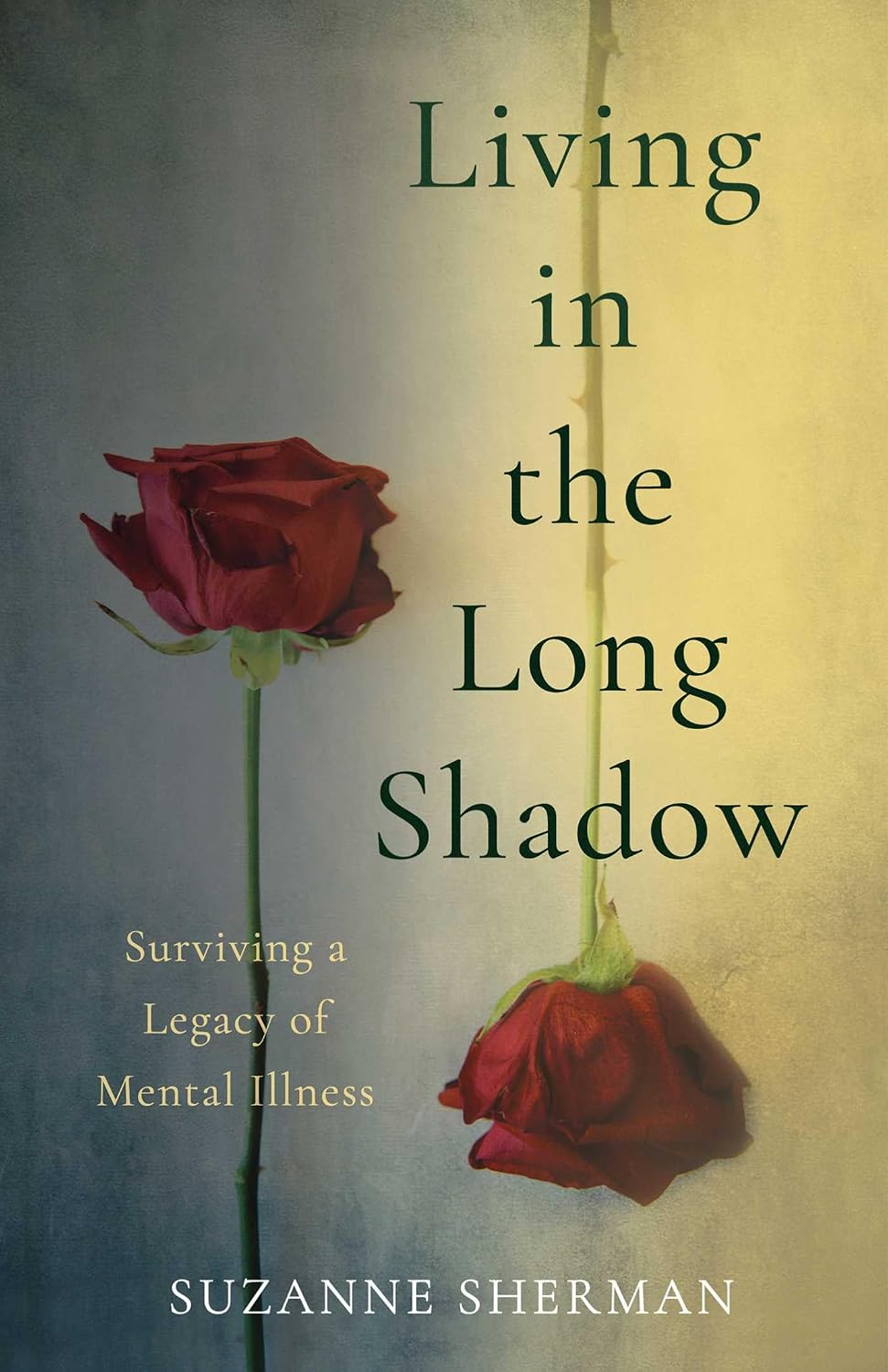

In Living in the Long Shadow, author Suzanne Sherman revisits her childhood as the daughter of Marilyn, a gifted, loving, musically alive woman whose schizophrenia slowly reshapes the family’s world, and then follows the aftermath of Marilyn’s suicide into Sherman’s adulthood. The memoir moves through West Los Angeles childhood scenes, divorce, sibling fracture, hospitals, medication, silence, and grief, but it’s never only a book about damage. It’s also about memory doing its careful work: a child in Sequoia learning to “listen” to the forest with her mother, a birthday cake left suspended in terror, a candlelight peace march led by Marilyn’s guitar and trembling hope, and, years later, roses drifting on the San Francisco Bay like an impossible answer.
I was taken by the book’s refusal to flatten Marilyn into her illness. Sherman writes about her mother’s frightening absences with clarity, but she also restores the radiance that illness couldn’t fully erase. I believed in Marilyn as the woman who made one-sleeved dresses for a daughter in a cast, who turned an environmental poem into a song, who planted lemon trees and noticed birds hatching under the trellis. That tenderness makes the pain sharper. The memoir understands that love and fear can live in the same room, sometimes in the same breath, and Sherman has a rare gift for letting those contradictions remain unsettled.
The writing is intimate, precise, and quietly devastating. Sherman’s structure, moving between childhood recollection and the approaching knowledge of her mother’s death, gives the book a haunted pulse. I found that approach emotionally true, because grief rarely arrives in a straight line. Some passages feel almost unbearably vivid, especially the small domestic humiliations and terrors: the father who insists on logic, the child learning to manage adults’ moods, the sister’s volatility, the stepmother’s cool judgments around food. The ideas beneath the story are equally strong. The book asks what children inherit when a family cannot name what’s happening, and what it costs when mental illness is met with denial, shame, or inadequate care. The density of pain is heavy, but I didn’t find it excessive. It felt earned, the way an old house creaks because every beam remembers.
I finished this memoir moved by its sorrow, but also by its steadiness. Living in the Long Shadow is not a simple recovery story, and that’s part of its grace. It’s a book about surviving what can’t be repaired, then finding language tender enough to hold it. I’d recommend it to readers of reflective memoirs, especially those interested in family trauma, mental illness, suicide loss, complicated mother-daughter love, and the long work of making peace with the past.
Pages: 312 | ASIN : B0GPJ4ZSDG
Beauty and Toughness
Splenditude follows a literary-minded woman coping with mental illness and looking for love and a fulfilling life in 1990s Chicago. What was the inspiration for the setup of your story?
Beginning the novel at an Irish wedding highlights Deirdre Collins’ ethnic and religious roots. Chicago is introduced in its beauty and toughness, foreshadowing that Deirdre’s expectations of a traditional trajectory for her life will be upended.
Did you plan the tone and direction of the novel before writing, or did it come out organically as you were writing?
I outlined the novel before I started to write it, using a Save the Cat format as a general guideline. Some plot changes were made during the writing, but I am more of a planner than a pantser.
There was a lot of time spent crafting the character traits in this novel. What was the most important factor for you to get right in your characters?
I wanted Deirdre Collins, the protagonist, to change from an unreliable narrator to a reliable narrator as she moved toward the positive. I also wanted to show Max Fletcher’s humanity in spite of his troubles and missteps.
Can we look forward to more work from you soon? What are you currently working on?
I am working on a short story collection which will be published by High Frequency Press next year, and a novel about children and gun violence slated for 2027.
Author Links: GoodReads | Amazon
Chasing Rescue: Surviving Narcissistic Abuse
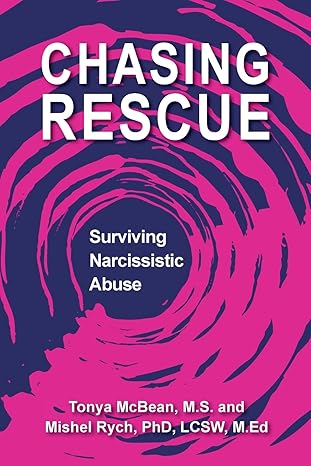
Chasing Rescue is a heartfelt guide to understanding, surviving, and healing from narcissistic abuse. Written by Tonya McBean and Dr. Mishel Rych, the book combines intimate storytelling with therapeutic insights. McBean recounts her own harrowing experience of living with a narcissistic partner, from the early love-bombing to the eventual unraveling of her life, while Dr. Rych offers clinical context and coping strategies to help others navigate similar abuse. Together, they provide not only validation but also a structured path toward reclaiming one’s identity, self-worth, and peace.
McBean’s writing is vulnerable and bold. Her story of enduring emotional, financial, and psychological abuse is gripping, and at times, it made me angry, heartbroken, and fiercely protective of her and her children. The strength it must’ve taken to survive, let alone write about it so openly, is staggering. There were moments I had to set the book down just to sit with the heaviness. But then I’d pick it back up, because she also writes with hope. She shows us what healing looks like. It’s not a smooth climb, but a jagged, stubborn trek with bruises and breakthroughs. That authenticity made it impossible not to root for her.
Dr. Rych’s sections are where the light really comes in. Her insights explain the patterns and psychology behind narcissistic behavior and how it messes with a person’s mind and soul. She breaks down clinical terms in a way that feels like a friend gently guiding you through a storm. The blend of practical advice, spiritual encouragement, and psychological framing helps the book land its punches without leaving you hopeless. I especially appreciated the call to action, that healing is our responsibility, not our fault. That resonated with me.
This book is not just a memoir, and it’s not just a self-help guide. It’s a lifeline. I’d recommend Chasing Rescue to anyone stuck in the confusion of an abusive relationship, to those recovering from one, or even to people supporting someone through it. If you’ve ever doubted your reality or felt alone in your pain, this book will show you that you’re not crazy, and you’re not alone. It’s messy, it’s painful, and it’s real, but it’s also full of strength and redemption.
Pages: 134 | ASIN : B0F9BBK62J
Strength and Fortitude

Tapestry blends historical fiction with memoir, wrapping readers in vivid, often haunting vignettes of women’s lives shaped by hardship, resilience, and a relentless fight for identity and survival. What was the inspiration for the setup of your story?
The inspiration was from learning my suspicions of my DNA were true, it was the answer I needed to research. As I child, I heard many whispers of my ancestors, it has stayed with me for all of my adult life, however, once the proof of my inquiries was confirmed, I felt it was time to write about the strength and fortitude that my female ancestors lived with.
Did you find anything in your research of this story that surprised you?
Yes, I had no idea that my Aunt Marg was treated with such disdain by the women in my family and that the ‘nasty operation’ I was informed about, would now be termed as medical abuse. I was also surprised at how the Patriarchal legal system termed it as a necessary determent to solve a psychological illness.
What were some themes that were important for you to explore in this book?
The themes came naturally. Each century I wrote about lived very differently from the world we know today. So each century was explored for the differences in the ways women were accepted into society.
I find a problem in well-written books; in that I always want there to be another book to continue the story. Is there a second book planned?
Most definitely the next one is called The Weavers. A story about how we as women keep our tribal stories together. A more modern-day look at the telling of stories in all genres.
Author Links: GoodReads | X (Twitter) | Facebook | Website | Amazon
The journey begins with a mystical exorcism, where soft candlelight dances with shadows, illuminating the ghosts of the past. The narrator calls upon the whispers of her maternal ancestry, inviting them to “come sit with me.” Through this intimate connection, she delves into the lives of the women who came before her-women who stood against the injustices of their time.
These brave souls challenged societal norms, battling the rigid confines of religion, the cruelty of bullying, and the pervasive sexism that marked their world. Many were wrongfully accused of witchcraft, faced the sting of racism, and suffered under the harsh grip of patriarchal oppression. But their struggles did not end there-they also confronted the condescending snobbery and judgment of a matriarchal society that refused to understand their defiance.
Tapestry is a profound exploration of the fortitude and strength of these women, who fought battles on every front yet never lost their spirit. Their stories, once whispered through generations, are now immortalized in this book-a testament to their enduring courage, wisdom, and resilience. Rich in historical detail and deeply personal in its reflections, Tapestry invites readers to connect with the powerful legacies of women who defied the odds and carved their place in history.
Weaving together the past and present, this book is a celebration of female strength, a poignant reminder of the injustice they faced, and an inspiring tribute to their unyielding will. Tapestry: The Book of Lost Worlds will leave readers moved, inspired, and empowered by the incredible stories of women who dared to challenge the world around them.


