Blog Archives
I Have to Laugh So I Don’t Cry

Adventures in Online Dating is a humorous chronicle of your plunge into the unpredictable world of online dating, sharing the good, the bad, and the utterly bizarre encounters you have had while swiping. What inspired you to share your journey into the shallow end of the pool?
Honestly? I needed to laugh about it or I’d cry! After diving into online dating, I quickly realized I wasn’t alone in experiencing the absurd, awkward, and occasionally wonderful moments that come with swiping through profiles. Every bizarre encounter felt like a story that needed to be told — not just for entertainment, but to help other women feel less alone in the chaos.
I wanted to create something that said, “Hey, this is messy, it’s weird, and sometimes it’s downright ridiculous — but you’re not crazy for trying.” If my misadventures could make someone laugh while they’re navigating their own dating journey, then every awkward coffee date was worth it.
How did you decide what stories to include and leave out in your book?
Great question! I focused on stories that highlighted the full spectrum of online dating — the hilariously bad, the surprisingly good, and everything in between. I wanted readers to see themselves in these experiences, so I chose encounters that illustrated common themes: catfishing, ghosting, first-date disasters, unexpected connections, and those moments where you question your life choices.
I left out anything that felt mean-spirited or too personal to the other person involved. The goal was to share my perspective and lessons learned, not to embarrass anyone (except maybe myself! Okay, and Steve – F*ck that guy!). If a story made me laugh out loud while writing it or taught me something valuable about dating or myself, it made the cut.
What advice do you have for women who are looking to jump into the dating pool?
Keep your sense of humor and your standards high. Online dating can be overwhelming, but remember — you’re not shopping for a discount couch; you’re looking for a genuine connection. Don’t settle just because you’re tired of swiping.
Here’s my practical advice:
● Trust your gut. If something feels off, it probably is.
● Meet in public places. Always. Safety first.
● Don’t take rejection personally. It’s not about your worth; it’s about compatibility.
● Take breaks when you need them. Dating fatigue is real.
● Laugh at the absurdity. You’ll have stories to tell, I promise.
● Know your dealbreakers. And stick to them.
Most importantly, remember that you’re already whole. You’re not looking for someone to complete you — you’re looking for someone to complement the amazing life you’re already building.
What do you hope is one thing readers take away from your story?
That you can laugh your way through life’s messiest moments — and come out stronger on the other side. Online dating is just one chapter in the bigger story of figuring out what you want and who you are. Whether you find love, find yourself, or just find some hilarious stories to share with friends, the journey is worth it.
I hope readers close the book feeling less alone, more empowered, and ready to embrace whatever comes next — whether that’s another swipe, another date, or the decision to take a break and focus on themselves. Life’s too short not to laugh at the chaos.
Author Links: Website | Facbook | GoodReads | X | Instagram | New York Blog | Tik Tok | SELINN FINE ART STUDIO
By S.E.Linn
Forget saving the world—she’s just trying to survive dating apps.
Join author S.E. Linn on a wild and hilarious journey through the chaotic world of online dating in her new memoir, “Adventures in Online Dating.” From the cringe-worthy encounters with a man and his cat-hair-covered adult toy, to the emotionally unavailable “Viking” with a wife and spa plans, this book is a rollercoaster ride of modern love. But amidst the laughter and relatable moments, lies a cautionary tale of the dangers of swiping right.
Meet the fearless and unapologetic main character as she navigates the treacherous waters of online dating, armed with biting wit and brutal honesty. If you’ve ever said, “there are no normal men left,” or Googled “how to exit a date without faking your death,” this book will make you feel grateful for never going on that second date.
And for those who have survived the trials of dating apps, you will feel less alone and less likely to respond to that guy holding a fish.
Adventures in Online Dating: True Stories from the Shallow End of the Dating Pool


Adventures in Online Dating is a hilarious and raw chronicle of one woman’s plunge into the unpredictable world of online dating. Through a series of short, punchy stories, S.E. Linn lays out the good, the bad, and the utterly bizarre encounters she’s had while swiping, matching, and meeting strangers. Each chapter reads like a cautionary tale, equal parts outrageous comedy and quiet confession, with lessons tacked on at the end that feel both tongue-in-cheek and hard-won. The tone is cheeky and confessional, and it never takes itself too seriously. Still, beneath all the cringe-worthy moments and wild characters, there’s a steady thread of resilience and humor that ties it together.
I found myself laughing in places, then wincing in secondhand embarrassment in others. The writing is sharp, conversational, and brutally honest. There’s no glossing over details, even when they make the storyteller look vulnerable or naïve, and that’s what makes it feel so real. Some stories had me howling, like the cat-hair-covered horror show, while others left me shaking my head at how bad people can be at basic decency. At times, it felt like swapping stories with a friend over wine, where the laughter helps mask the sting of frustration underneath. That intimacy pulled me in.
What I especially liked is how the author doesn’t play the victim. She frames these trainwrecks of dates as both ridiculous and educational, a way to laugh at what would otherwise be disheartening. That perspective made the book oddly uplifting. I’ll admit, though, there were moments where the humor veered into the absurd, and I had to pause to decide if I was amused or disturbed. That unpredictability is part of its charm. It’s messy and chaotic, just like dating itself, and it’s refreshing to see it told without the usual sugarcoating or cliché happy endings.
I’d recommend this book to anyone who has braved the trenches of online dating or is curious about what really happens when you dive into the apps. It’s perfect for readers who like their memoirs raw, funny, and a little outrageous. If you’ve ever needed reassurance that your own dating misadventures aren’t the worst ones out there, this book will make you feel seen and keep you laughing all the way through.
Pages: 105 | ASIN : B0FFNQ8NY9

Hikeological Escape

When I opened Hikeological Escape, I expected a straightforward travel memoir, but what I found was a layered story of self-discovery told through two epic journeys: the Camino Santiago and the Pacific Crest Trail. Chris “Windscreen” Homan begins in Saudi Arabia, stuck in an expat life that feels suffocating, and from there his story unravels into a series of steps, literal and spiritual, that lead him through mountains, deserts, and questions of faith, belonging, and identity. It’s not just a story about hiking. It’s about what happens when someone walks away from conformity and comfort in order to face the messy, liberating chaos of being human.
What struck me most was the honesty in Homan’s writing. He doesn’t polish his doubts or hide his discomfort. He lets them sit in the open. There’s humor here, sometimes dark, sometimes lighthearted, and it balances well against the rawer moments of pain or uncertainty. At times I laughed at his dry commentary, and other times I felt the weight of his solitude press down on me. The descriptions of trail life, like cowboy camping, battling hunger, and trading banter with strangers, made me feel like I was walking alongside him, sweating under the same sun. Yet beneath all of that, I could sense the real story: the struggle of someone trying to reconcile a fractured sense of purpose with the beauty of the present moment.
I also admired how he handled spirituality. There’s no preaching, no easy answers. Instead, the book lingers in the gray space between faith and skepticism. He questions, he wrestles, he admits what he doesn’t know. I felt both challenged and comforted by his willingness to leave questions unresolved. His alter ego, Windscreen, gives the narrative a slightly mythic quality, and I liked how it blurred the line between storytelling and confession. The voice is casual, almost like a long conversation with a good friend who isn’t afraid to tell you the truth, even if it stings a little.
By the end, I realized this isn’t just a book about hiking or travel. It’s a meditation on freedom, risk, and what it takes to feel alive. I would recommend Hikeological Escape to anyone who feels stuck in their own routines, anyone who’s toyed with the idea of walking away, or anyone who just loves a good story about taking chances. Homan reminds us that sometimes losing the path we thought we needed is exactly how we find ourselves again.
Pages: 332 | ASIN : B0FJZQWP94
Humor is Like Social WD-40

The Awkward Optimist’s Guide to Human Connection is a hilarious, insightful, and refreshingly honest look at the challenges of social interaction. Why was this an important book for you to write?
The Awkward Optimist’s Guide to Human Connection grew from my own spectacular failures at small talk and my uncanny ability to say “you too” when waiters tell me to enjoy my meal. After decades of collecting enough awkward moments to fill a museum (or is that a mausoleum?), I realized I wasn’t alone in this special kind of social purgatory—and that maybe my pain could be everyone else’s comedy gold.
Writing this book was important to me because I believe humor is like social WD-40—it makes the squeaky, uncomfortable parts of life glide a little smoother. Plus, it felt therapeutic and cathartic to transform my most cringe-worthy moments (like the time I waved back at someone who was actually hailing a taxi) into stories that might make others feel better about their own social blunders.
Beyond the comedy, I wanted to create an antidote to those insufferable Instagram influencers who make authentic connection look as effortless as their “candid” sunset yoga poses. Real human connection isn’t filtered or perfectly lit—it’s messy, sometimes awkward, and occasionally involves spinach in your teeth during important conversations. Take a look at my podcasts and YouTube casts. They are not NPR Perfect-are you kidding? They are perfectly awkward and authentic.
Ultimately, this book is the guide I wish I’d had during my own journey—a reminder that we’re all just awkward optimists hoping someone will laugh at our jokes and forgive us for accidentally calling our boss “mom” that time in a staff meeting. Everyone else was laughing, so I joined in. That was awkward.
What were some ideas that were important for you to share in this book?
The core ideas I absolutely had to share in “The Awkward Optimist’s Guide” emerged from years of underfunded research (read: embarrassing myself in public and taking mental notes). Some of the most important concepts include:
First, the “Three-Second Rule of Overthinking” – not the one about eating food off the floor, but rather my discovery that giving yourself more than three seconds to analyze a social situation is like falling down a rabbit hole lined with your most embarrassing memories. Action before anxiety became my mantra.
I also needed to debunk the “Perfection Myth” – this bizarre cultural notion that everyone else is navigating social waters like graceful dolphins while you’re flopping around like a caffeinated seal. The truth is we’re all seals. Some just hide their flippers better.
The concept of “Authenticity as a Superpower” was crucial to include. I found that when I finally stopped performing what I thought was a convincing impression of a socially adept human and just showed up as my awkward self, people actually connected with me more. Turns out, vulnerability is like social catnip.
And finally, the idea that “Connection Happens in the Cracks” – those unplanned, unfiltered moments when someone sees you spill coffee all over yourself and instead of pretending to be perfect, you both laugh until your sides hurt. Real relationships aren’t built during flawless dinner parties; they’re forged in shared catastrophes and mutual weirdness.
I wrote this book to give permission to the awkward optimist in all of us to stop waiting until we’ve figured it all out, because spoiler alert: none of us ever do.
What is one piece of advice you wish someone had given you when you were younger?
One piece of advice I wish someone had given me when I was younger? “Your awkwardness isn’t terminal—it’s your personality’s immune system fighting off inauthenticity.”
Throughout my teens and twenties and thirties and forties, I treated my social awkwardness like a contagious disease that needed to be quarantined. I spent approximately 60% of my mental energy trying to appear “normal” in social situations (worrying about what others were thinking), 30% replaying my conversational fumbles in excruciating detail, and the remaining 10% avoiding eye contact with anyone who witnessed said fumbles.
No one told me that those cringe-worthy moments—like the time I confidently waved at my crush across the cafeteria only to realize I had ketchup smeared across my face like war paint—were actually building my resilience muscles. Or that the person who called out “enjoy your haircut” after I left the barbershop (to which I brilliantly responded “you too” to someone clearly sporting a shaved head) would become one of my closest friends because we bonded over mutual awkwardness.
If I could go back, I’d tell young me to save the energy I spent trying to be a smooth operator and redirect it toward something more achievable—like solving cold fusion or teaching cats to respect personal boundaries. Because eventually I learned that people don’t connect with your highlight reel; they connect with the blooper reel you’re brave enough to share.
So, my advice? Embrace the awkward early. It’s not the obstacle to connection—it’s the express lane.
What is one thing that you hope readers take away from The Awkward Optimist’s Guide to Human Connection?
If readers take just one thing from The Awkward Optimist’s Guide to Human Connection, I hope it’s the liberating realization that everyone else is also mentally rehearsing conversations before they happen and then performing extensive post-mortems afterward. We’re all members of the same neurotic book club—some of us just have better covers.
I still remember the day this truth hit me: I was standing frozen in the grocery store, contemplating whether saying “I like your shirt” to the really pretty cashier would come across as friendly or deeply unsettling and creepy. Then I noticed the person behind me muttering what appeared to be their own same conversation script under their breath. That’s when it clicked—we’re all out here simultaneously terrified of each other and desperately wanting to connect. It really hit me after the COVID 19 Pandemic. We needed understand personal connection again.
My fondest dream is that somewhere, someone will read this book in public, laugh out loud at a particularly embarrassing anecdote (probably the chapter about my disastrous attempt to network using only movie quotes), and the stranger next to them will ask what they’re reading. They’ll strike up a conversation, both fumbling through the social niceties, until one of them bravely acknowledges the awkwardness—and in that moment of shared humanity, a real connection will form.
Because ultimately, that’s the paradoxical magic I hope readers discover: our collective awkwardness isn’t the barrier to connection—it’s the bridge. So next time you accidentally text “Love you!” to your plumber or walk into a room and immediately forget why you’re there (I do this a lot!), remember you’re not failing at being human. You’re actually doing it exactly right. As awkward as it is, your call to action is to go buy my book. I can guarantee it will be a mistake worth making.
Author Links: GoodReads | Facebook 1 | Facebook 2 | Website | Reedsy | Kobo | IngramSparks
The guide navigates both digital and physical social landscapes, acknowledging that forming meaningful relationships in either realm can feel like trying to perform surgery while wearing oven mitts. Through chapters like “The Science of the Awkward” and “The Zoo, The Bar, and The Museum: Pickup Lines in the Wild,” readers explore how their most embarrassing moments might actually be their most endearing.
Unlike traditional dating and social skills manuals that promise to transform readers into charismatic smooth-talkers, this book embraces authenticity in all its messy glory. It suggests that waiting three hours to craft the perfect “casual” text message or accidentally walking the wrong way after saying goodbye are universal experiences that make us human rather than social failures to be corrected.
The author positions social mishaps as future anecdotes waiting to happen, teaching readers how to transform their most cringe-worthy encounters into entertaining stories. The book also offers unexpected perspectives on modern social phenomena, suggesting that being ghosted might be a hidden blessing and that failed attempts at wit might create more memorable connections than polished pickup lines.
Written for anyone who’s ever felt like a caffeinated rhinoceros in a world of graceful gazelles, the guide serves as both a practical manual and a permission slip to embrace one’s authentic self. It promises not transformation into a social butterfly, but rather the confidence to flutter awkwardly and own it. The result is a humorous yet insightful exploration of human connection that turns social anxiety into social advantage, one uncomfortable encounter at a time.
The Awkward Optimist’s Guide to Human Connection- A Field Manual For The Socially Ambitious
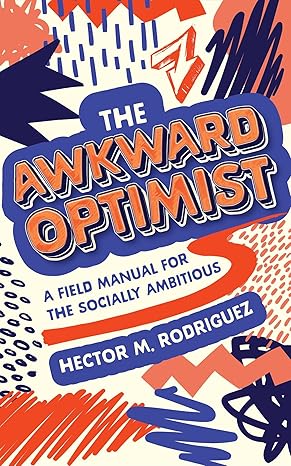
Hector M. Rodriguez’s The Awkward Optimist’s Guide to Human Connection is a hilarious, insightful, and refreshingly honest look at the challenges of social interaction. It’s part self-help, part comedy, and 100% relatable for anyone who has ever fumbled their way through small talk or tried (and failed) to master the art of a good pickup line. Structured as a “field manual” for the socially ambitious, the book breaks down everything from deciphering body language to navigating the terrifying world of dating apps. It reassures readers that awkwardness isn’t just inevitable—it’s a rite of passage on the road to building real human connections.
Rodriguez’s writing style is the best part of the book. He doesn’t drone on with clinical psychology or rigid rules; instead, he infuses every chapter with sharp wit, self-deprecating humor, and painfully relatable anecdotes. Take, for example, his breakdown of pickup lines in The Anatomy of a Pickup Line: A Postmortem. He dissects pickup lines with surgical precision, complete with real-world examples of just how cringe-worthy they can be. The book feels less like a lecture and more like a conversation with a friend who has been through it all and is here to make sure you don’t make the same mistakes.
One of the book’s standout strengths is its deep dive into nonverbal communication. The chapter Reading the Room and the Person’s Nonverbal Cues is packed with practical advice on how to interpret body language, but it’s never dry or clinical. Rodriguez presents it as a detective game—one where your mission is to decode subtle gestures, posture shifts, and even the dreaded forced smile. His discussion of the “Duchenne smile” (the real vs. fake grin) is both fascinating and useful, but what makes it memorable is the way he wraps it in humor. Instead of feeling like homework, it feels like an adventure in social sleuthing.
The book also shines in its breakdown of different social environments. Rodriguez goes beyond the obvious and explores places like libraries, museums, and even farmers’ markets as unexpected but prime locations to meet new people. The Safari of the Soul: Meeting People in Unexpected Places chapter made me laugh, especially the section about striking up conversations at the zoo. He encourages readers to embrace the weirdness of life and find opportunities for connection in the most unexpected places, reinforcing the book’s overarching message: human interaction is messy, awkward, and often ridiculous, but that’s what makes it fun.
The Awkward Optimist’s Guide to Human Connection is a must-read for anyone who struggles with social interaction, dating or just wants to laugh at the absurdity of human connection. If you want a book that embraces the chaos, teaches you useful skills while making you chuckle, and reassures you that awkwardness is just part of the process, then this is for you.
Pages: 153 | ASIN : B0DW4KTH76

Embrace Crankiness

Cranky Superpowers: Life Lessons Learned from the Common CrankaTsuris Chronicles is a collection of thought-provoking and humorous stories about the challenges people face in their everyday lives. What was the inspiration for this collection of stories?
My first book was a children’s book titled The Last Surviving Dinosaur: The TyrantoCrankaTsuris, and a reviewer wrote that I didn’t talk about overcoming crankiness. But the whole point was to embrace crankiness. I started a blog, and I wanted to be both funny but to highlight that since this is about all of us, I wanted to explore how it can be our strength.
What were some ideas that were important for you to share in this book?
Patience, empathy, overcoming obstacles, and finding strength inside of us when we have those cranky moments.
What is one thing that you hope readers take away from Cranky Superpowers?
I hope that readers will see themselves in the stories, and find inspiration to take on life’s challenges that we all face.
What is the next book that you are working on, and when will it be available?
My third Snoodles book. Snoodles in Space: Episode 2. The Zoodles Strike Back will be available in late Winter/Early Spring.
Author Links: GoodReads | Facebook | Website
Peppered with captivating tales, both fresh and familiar, “Cranky Superpowers” unveils the often-missed hilarity in our everyday grumbles and groans. But it’s not all laughter—this witty guide offers priceless insights into our hidden “Cranky Superpowers,” powers that when harnessed correctly, can ignite a more understanding, patient, and positively cranky version of ourselves.
“Cranky Superpowers” is a rollicking journey of self-discovery, one that not only entertains but enlightens. So, put on your favorite cape and tights, and get ready to unlock your potential, unleash your better self, and find a little bit of humor in the perfectly imperfect art of being human.
Cranky Superpowers: Life Lessons Learned from the Common CrankaTsuris Chronicles

Cranky Superpowers: Life Lessons Learned from the Common CrankaTsuris Chronicles is an engaging anthology blends humor, wisdom, and fresh takes on life’s everyday challenges. Penned by Stephen Joseph, the book captivates readers with its playful narrative style and colorful array of characters, dilemmas, and solutions.
From its initial pages, the collection charms with its witty language and imaginative spins on timeless fairy tales. As you turn each page, stories unfurl that will evoke laughter and spark moments of reflection. Joseph’s adept handling of language and his flair for surprising narrative twists ensure that every reader will discover delightful segments to savor, no matter their comedic taste. Tailored for casual reading, it’s an excellent companion for your living room table, beckoning for spontaneous dives into its light-hearted world. Given its brevity, it’s also a fitting choice for brief intervals, like waiting times, as it promises easy immersion without the commitment of lengthy plots.
But don’t let its comedic facade fool you. Amidst its humor, the collection also offers valuable life lessons, guiding readers through challenges such as impatience, weariness, or overwhelming dynamism. While certain tales deliver unadulterated amusement, others provoke introspection, further enhancing the allure of decoding their underlying messages. Though the distinctions among the various CrankaTsuris forms may be subtle, they create an intriguing quest for readers to decipher and relate to. Each CrankaTsuris, much akin to Pokémon, boasts its distinct traits: some demand control, others call for proactive measures, and a few signify attributes worth cherishing. This vagueness beckons readers to delve deeper, enriching their engagement.
Cranky Superpowers is an enchanting compilation, interweaving sheer entertainment with occasional idiosyncrasies. This treasure chest of humor and insight is undoubtedly worth exploring. Dive in for a read that teeters on the brink of excellence, and you won’t be disappointed.
Pages: 246 | ASIN : B0CH1FTZSV
Higher Connections


Higher Connections: Humor and Inspiration from a Certified Public Pothead talks about the good, the bad, and the ugly experiences of marijuana use by authors Eric and Alexandra Right. In a truthful recount of how they came to be involved with the plant, the Right’s tell of their struggle with everything in life; adolescence, religion, occupational aspirations and marriage and how it’s brought a deeper and more meaningful connection to his life and in turn both of their relationships.
Chapter 7: ‘Buckle Up- It’s Your Turn’, was a personal favorite. This is a step-by-step guide to follow in order to achieve a profound connection with someone (regardless of your marijuana stance) with a key message: TALK ABOUT YOUR FEELINGS.
For readers who may be skeptical, this enlightening book goes through the historical purpose and use of marijuana, stemming back thousands of years and demystifies misconceptions. The Right’s use analogies to compare the feeling of a marijuana high to some of the biggest stories witnessed during the era in which the Bible was initially created; which gives this book a poetic and artful flair. Alongside this we are educated about the legislative order, ancient medicinal properties and given a comparison of marijuana to other things in our everyday environment that the health impacts of which most humans go unaware. This revealing book contains useful information like standard toxicities in alcohol or tobacco as well as the impact of processed meats and kids music.
Higher Connections: Humor and Inspiration from a Certified Public Pothead is a light-hearted read that is filled with facts and figures that is given character and brought to life by two hilarious narrators. It makes for a stereotype smashing and informative read. For curious readers or for expert Mary-Jane users, this book shines a refreshing light onto the use of holistic drugs and how adults sometimes need help getting through life in general.
Pages: 297 | ASIN: B0B7Z2MGH8



 LITERARY TITAN