Blog Archives
Survival, Hope, and Resilience

The Lilacs I Once Knew: Friddie’s Poems is more than a collection of poetry; it is the story of a woman who was unjustly impressed and her story of survival against inhumane conditions. What inspired you to share her works with the world?
The Lilacs I Once Knew: Friddie’s Poems is inspired by a deep commitment to honoring Friddie’s incredible journey of resilience and hope amidst the horrors of unjust imprisonment. Her powerful story of survival against inhumane conditions needed to be shared to give voice to the silenced and highlight the enduring human spirit. By sharing her works, I aim to preserve her legacy and shed light on the historical atrocities she endured.
How did you go about deciding what photos and quotes to include along with Friddie’s poetry?
Deciding which photos and quotes to include with Friddie’s poetry involved meticulous curation to ensure each element complemented and enhanced the emotional depth of her poems. I selected images that visually represent the themes of her poetry, such as survival, hope, and resilience. The quotes were chosen for their ability to encapsulate the essence of Friddie’s experiences and to provide context, creating a powerful and immersive reading experience.
What do you hope is one thing readers take away from Friddie’s poetry collection?
I hope readers take away a profound sense of empathy and awareness of the historical injustices faced by Friddie and countless others. Through her poetry, I aim to inspire readers to recognize the strength and resilience of the human spirit in the face of unimaginable adversity. Additionally, I hope Friddie’s story encourages reflection on the importance of preserving and sharing personal histories to ensure that such stories are never forgotten.
Are there more poems or writings from Friddie that you plan to publish in the future?
Yes, I plan to publish more of Friddie’s poems and writings in the future, but for a different audience. While in prison, Friddie also wrote books and poems for children, each carrying a greater message about pursuing justice, kindness, and dealing with adversity. I am currently working on this project to ensure that her inspiring words reach a broader audience and continue to impart important lessons and values.
Author Links: GoodReads | Facebook | Website | LinkedIn | Amazon
At 18, Friddie married a charming, charismatic scientist named Freddy; but their union was tragically short.
Just two weeks after the wedding, Freddy disappeared, and Friddie was unjustly accused of a crime she had never committed. She spent nine years in a Romanian prison, followed by four years in a communist labor camp.
Despite the harsh and inhumane conditions, Friddie found solace in writing poetry.
Friddie’s poems reflect her journey through life, imprisonment, and hope. They speak of joy, loss, fear, resilience, and the indomitable human spirit.
After her death, her family discovered hundreds of letters and postcards where Friddie shared her poems with her cousin, Aaurica.
Friddie’s story was first told in the award-winning novel Where the Lilacs Bloom Again(StoryTime World, 2022). Now, her powerful words are brought to life in this collection.
The Lilacs I Once Knew: Friddie’s Poems


The Lilacs I Once Knew: Friddie’s Poems is a captivating poetry collection with a compelling backstory. Roni Rosenthal meticulously restored and translated these works to share Friddie’s tale with the world—an account of a talented Romanian poet unjustly imprisoned during the war and communist era.
Each poem in the collection breathes life into Friddie’s emotions, evoking a spectrum of feelings such as hope, love, betrayal, and misery. One of the most poignant sections depicts Friddie’s journey of healing and self-forgiveness. Her profound words create a sense of shared healing with the reader. Through her reflections and vivid contrasts of nature and war, readers gain a renewed appreciation for life. The collection’s variety of rhyming patterns and unique structural elements keep readers engaged and curious throughout. Roni Rosenthal’s translation skillfully preserves the original message and rhythm of the poems, ensuring their impact remains intact. The book’s design complements Friddie’s touching words beautifully. Impactful images, quotes, and photos of Friddie and her family are thoughtfully placed throughout the book, enhancing the emotional resonance of each section and bringing Friddie’s story to life.
The Lilacs I Once Knew is heartbreaking, promising, and beautiful. It honors the memory of one of the many victims of inhumanity and serves as a testament to the enduring power of poetry and resilience.
Pages: 167 | ASIN : B0D9RK929F

We Must Never Lose Hope
Where the Lilacs Bloom Once Again is based on the true historical experiences of generations of a Jewish Romanian family and their acquaintances before World War II. Why was this an important book for you to write?
There are two main reasons that led me to write this book and to reveal my family’s stories. It was especially important for me to publish the book now.
The personal motive relates to my father’s death.
In December 2009 my father passed away. I went home for the funeral and found an old family photo album, a handwritten family tree, and a note that read “Write their stories, tell the world what really happened to them.”
And so, I did.
I wrote this book to tell my family’s stories. I wrote this book to give the silenced stories a voice.
My second motive for writing this book relates to the increasing incidents of anti-Semitism that we are experiencing these days. I believe with all my heart that history is doomed to repeat itself.
We must keep telling, we must share our past, we must learn from history, otherwise, the truth may be lost, and hate is doomed to be repeated.
What research did you undertake for this book to ensure you got all the details right?
The book is a culmination of 12 years of family research. I was able to find a lot of supporting and personal documents, but there are still many questions that remain open.
After my father’s funeral I returned back home. I had the old family album, the handwritten family tree and many questions.
I started researching. I read everything I could find about the history of Romania in general and the history of the Jewish communities in Romania in particular. I interviewed dozens of people, relatives who are still with us, and their children and grandchildren who knew little or some about their family’s history in Romania.
For many hours, I sat in the archives and read, researched and asked. I was able to find some old personal documents as birth certificates, photos of graves, and more.
I reached out to Jewish organizations and other research groups via social media and Facebook groups. I also received help from an organization who research the communist crimes
The puzzle is not complete. I continue to research and learn and dig into every piece of information.
The Romania’s archives and databases are few and limited, but I refuse to give up. I continue to search, to look for more answers, and I will not rest until I find the last piece of the puzzle.
What were some ideas that were important for you to share in this book?
The family I grew up in was loving, warm and close-knit. My father was an honest, hard working man who believed in the values of modesty, humility, and honesty. I admired those qualities in my father. Family was a top value for Dad and from a young age he made sure to visit the “elders” in the family, respect them, and learn from their wisdom.
In this book I present the family stories on which I grew up and was educated upon. Honest and kind people who had to deal with an oppressive and murderous regime. My great-grandmother Rosa, who lost her brother and his family in the Iasi massacre, my grandmother Aurica (Golda) who had to flee and leave behind everything that was familiar to her, and my grandmother’s cousin, Friddie, an innocent young girl who fell in love with the wrong man, was arrested, tortured, accused of a crime she didn’t commit, and spent 13 years in prison and in labor camp.
And despite all the suffering they went through, they continued to believe in compassion, in justice, in the kindness of mankind.
What is one thing you hope readers take away from your book?
We must remember, we must respect our elders, learn from their wisdom, and we must never lose hope. There is always a new day, a better world, a world where humanity will succeed in overcoming evil. We should never forget our history, and we should never let evil overcome.
Author Links: GoodReads | Twitter | Facebook | Linkedin
After calling off her wedding to a young, parentally-approved accountant, she escapes to a city on the coast, where she meets a scientist-perfumer named Freddy. He is the true love she has been looking for—and a ticket to her dream.
Soon, though, that dream turns into a nightmare she never could have predicted.
Friddie’s story of incredible hardship is interwoven with the stories of her family. We follow her Aunt Rosa’s life as the glue of her household, even though she loses her husband in mysterious circumstances; her Uncle David, who dreams of becoming a schoolteacher and starting a family in Iași, and her cousins, who uproot their lives in Bucharest to start again in Israel.
In this tragic-heroic novel, the true stories, the victims, and the small moments of happiness are revealed in the Danube’s labor camps, under the fascist-dictatorial and communist rule that has been a part of Romania for so many years.
Based on the true experiences of a Jewish Romanian family, Where the Lilacs Bloom Once Againunearths stories that could so easily be lost to the passage of time. This family’s tale has emerged at a critical time, to show the need for compassion and kindness, even in the hardest moments.
About the author
Roni (Aharona) Rosenthal, PhD, was born in Haifa, Israel. She is named after her grandfather Aharon, who passed away eight months before her birth.
Roni is the Director of Judaic Studies and a Hebrew Literature Professor at the University of Maryland, Baltimore County. This is her third novel.
Where the Lilacs Bloom Once Again
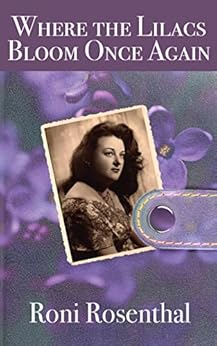

Where the Lilacs Bloom Once Again is based on the true historical experiences of generations of a Jewish Romanian family and their acquaintances before World War II. The novel focuses on Friddie, a young woman of Romanian descent who dreams of living freely. At eighteen, Friddie rebelliously cancels her marriage and, against her family’s wishes, marries Freddy. Their union is short-lived however, leading to years of adversity for Friddie. Her story is told alongside that of her family members, like Aunt Rosa, Uncle David and her Cousins who are victims of the dictatorial and communist rule that plagued Romania for years.
It is clear from the author’s narration that Friddie’s story is an important landmark in the family’s history, passed down from generation to generation. Although I felt the stories were disconnected at the beginning, they slowly came together with different perspectives. It is a tragic story of a large family that was scattered abroad due to anti-Semitism. It is sadly ironic that Freddie, who dreams of living as a free woman, spends the better part of her youth locked up under the worst circumstances.
This thought-provoking and impassioned novel showcases the gruesome loss of lives, grief and the inhumanity during one of the most difficult times in human history. Some of the scenes are graphic, featuring explicit descriptions of maiming, slavery, genocide, and infanticide. Despite these, a love story is forged in the most unlikely place, reestablishing the theme of keeping hope alive when things seem hopeless.
The author’s writing style is easy to follow and how she tells the story keeps the reader engaged throughout. There are heartbreaking moments, but the book also shares wisdom and great life lessons. Where the Lilacs Bloom Once Again by Roni Rosenthal is a tragic but beautiful story that is evocative and heart wrenching but ultimately uplifting.
Pages: 203 | ASIN: B0BC5LF1KQ



 LITERARY TITAN