Blog Archives
Expectation Underneath the Emotion

In The Reset Self, you help readers understand how early family dynamics, social pressures, and constant performance create resentment, anxiety, and burnout. Why was this an important book for you to write?
I wrote this book because I kept seeing the same pattern over and over again, in myself and in other people. Smart, capable, self-aware individuals who were doing everything “right,” but still felt exhausted, resentful, or quietly disconnected from their own lives.
The common thread wasn’t a lack of effort or insight. It was that they were trying to improve a version of themselves that was never really theirs to begin with.
Most of us are living in roles we learned early on, roles that helped us stay safe, be accepted, or be loved. But those roles don’t disappear when we grow up. They just get more sophisticated. And eventually, they start to cost us.
This book exists because I wanted to offer something different. Not another way to fix yourself, but a way to question who is doing the fixing in the first place.
You make a distinction between the “role-self” and the real person. How did you come to recognize that difference in your own life or work?
It didn’t happen all at once. It was more of a slow realization that the way I was showing up in different areas of my life felt… consistent, but not necessarily true.
I could see how my reactions were patterned. Predictable. Almost scripted. Especially in moments of stress or conflict. And when I looked closer, those patterns always traced back to something learned, not something chosen.
That’s when the distinction became clear. There’s the version of you that was built through conditioning, through expectations, roles, and adaptation. And then there’s something underneath that, something quieter but more stable.
The “role-self” reacts automatically. The real person has choice.
Once you see that difference, even briefly, you can’t unsee it. And that’s where real change starts.
Of all the tools you introduce, which one tends to create the biggest shift for readers when they try it?
The biggest shift usually comes from something very simple: recognizing the expectation underneath the emotion.
Most people think they’re reacting to what happened. But they’re actually reacting to what they believed should have happened.
When someone starts catching that in real time, “What did I expect here?” everything changes. Because suddenly the reaction makes sense. It’s not random. It’s not a personality flaw. It’s a script being broken.
That moment creates space. And once there’s space, there’s choice.
It’s subtle, but it’s one of the most powerful shifts in the entire process.
What is one thing you hope readers take away from The Reset Self?
That they are not broken.
Not in a surface-level, reassuring way, but in a very literal sense. The exhaustion, the anxiety, the resentment, it’s not evidence of something wrong with them. It’s evidence of something learned that no longer fits.
If someone can walk away with that and start questioning the roles they’ve been living inside of instead of trying to perfect them, then the book has done its job.
Because from that point on, they’re no longer trying to fix themselves. They’re starting to come back to themselves.
Author Links: GoodReads | Website | Amazon
You don’t need a better self. You need freedom from the one you were trained to be.
Most people spend their entire lives feeling lost, anxious, overwhelmed, or painfully disconnected from themselves, not because something is wrong with them, but because they’ve been living inside a conditioned identity that never truly belonged to them.
The roles you learned in childhood, the Good One, the High-Achiever, the Strong One, the Fixer, the Peacemaker, helped you survive, but now they keep you stuck in cycles of self-sabotage, people-pleasing, perfectionism, overthinking, emotional trauma patterns, anxiety, and self-doubt. These roles shape your decisions, your relationships, your boundaries, and even your sense of purpose.
The Reset Self introduces a revolutionary perspective: You’re not failing to “find inner peace,” “love yourself again,” or “discover your purpose in life.” You simply can’t build a peaceful life on top of a self that isn’t actually yours.
Inside this book, you’ll learn how to:Recognize the hidden conditioning behind feeling lost in life and not knowing who you really are.
Identify the role-based patterns fueling your anxiety, overthinking, emotional exhaustion, and resentment.
Break cycles of self-sabotage and negative thinking without forcing yourself into toxic positivity.
Heal emotional trauma, including toxic childhood conditioning, through nervous-system based practices that work in real life.
Use the Fingertips Principle to stop trying to control what was never yours to manage.
Run Non-Compliance Experiments that retrain your nervous system to feel safe when you stop over-giving and start choosing yourself.
Untangle your sense of purpose from expectations, guilt, or external validation.
Feel emotions without feeding them or turning them into spirals of overthinking and fear.
And for the first time, this edition includes a new and urgent topic: The Social Media Self — how comparison, unrealistic standards, curated “perfect lives,” and constant performance pressure distort your identity and steal your peace. Learn how to reset the part of you that feels behind, invisible, or never enough.
This book is not another mindset hack, manifestation trick, or habit-building routine. It’s a practical, grounded, psychologically-informed method for stepping out of the identity you were conditioned into, and returning to the person underneath.
Perfect for Readers Who Feel:“I feel lost in life and don’t know who I am anymore.”
“I want to find myself again after years of overthinking, people-pleasing, or burnout.”
“I want to heal emotional trauma, anxiety, or self-doubt without endlessly reliving the past.”
“I want inner peace, but I don’t know how to get there.”
“I’m tired of performing. I want to feel real again.”
The Reset Self is a guide for anyone ready to stop performing a life they never chose, and finally live the one that is actually theirs.
If you’re exhausted from healing, striving, or trying to be “enough,” this book will show you the way home to yourself.
The Reset Self


The Reset Self is a self-help book that argues you are not broken, you are over-conditioned, and most of your pain comes from living as a “role-self” instead of as a real person. Seravyna Böhm walks through how early family dynamics, cultural pressure, and constant performance teach you to become the Strong One, the Good Child, the Fixer, or the High-Achiever, then shows how expectation scripts and the nervous-system load of constant over-compliance turn into anxiety, resentment, burnout, and numbness. The heart of the book is a set of simple tools, like Role Naming, Expectation Tracking, the Fingertips Principle, Non-Compliance Experiments, Feeling Without Feeding, and the Daily De-Script, all aimed at helping you step out of old roles in real time and act from choice instead of fear.
I really like the core idea that “you are conditioned, not defective.” It feels kind, and it also feels sharp. The shift from “I need to fix myself” to “I learned this role, and I can unlearn it” has a surprisingly strong emotional impact. I also appreciate how clearly the book names common identities like the Strong One or the Peacemaker and then maps them to concrete patterns in work, family, and healing spaces. The chapter on the “invisible engine of misery” and the expectation–resentment loop hit hard for me, because it turns messy feelings into something you can actually see and work with. The latter material on ethics, choice, and accountability keeps the method from slipping into selfishness. It keeps repeating that understanding conditioning explains behavior and does not excuse harm, and that balance feels very grounded and humane.
I appreciated the writing and structure overall, especially the warm, steady voice that often feels soothing and reassuring. The author takes time with each idea, circling around it in a way that lets the message really sink in, with phrases and examples that come back like friendly reminders. The strong use of metaphor and direct address creates an intimate, conversational feel, which works well. The focus stays almost entirely on lived experience, which keeps the material accessible. What stood out most to me is that the tone remains compassionate, clean, and practical, and the case examples keep the tools grounded in real life.
I would recommend The Reset Self to anyone who feels like the “responsible one,” who is burned out from people-pleasing, or who has done a lot of therapy and self-work and still feels strangely stuck. It’s especially well-suited to high-functioning, over-thinking adults who look fine on the outside and feel empty or angry on the inside. As a clear, gentle guide for unhooking from old roles, easing the nervous-system load, and making everyday choices from something that feels more like your actual self, it is thoughtful, practical, and genuinely encouraging.
Pages: 231 | ASIN : B0GBZWFMRN

Digital Stressors

Anxiety Reset 30 Days to Find Calm is a structured 30-day guide to understanding and managing anxiety based on science-backed strategies to assist readers in identifying patterns and mastering self-regulation techniques. Why was this an important book for you to write?
The city that I live in has the youngest average population age in Canada. Also, the highest suicide rate. This comes along with depression and anxiety. Initially, I wanted to help children, but I realized that children learn by mirroring their parents. Thus, I needed to write an anxiety book for adults, not in a lazy way, and also doing something that other books in the genre are not doing.
How much research did you undertake for this book, and how much time did it take to put it all together?
Great question, it took many months of research and around 23 updates leading to the current version available on Amazon. It has been a second full-time job on top of my regular day job. My 3-week vacation this year was almost entirely spent on the book in some component of its updating/advertising, etc.
What were some ideas that were important for you to share in this book?
The idea that we have not evolved to deal with all the modern-day digital stressors and combined inputs that the world demands our attention/focus. Even when grieving, there are so many triggers that our ancestors never faced. Digital Pictures, radio music, connected yet disconnected friends.
What is one thing that you hope readers take away from Anxiety Reset 30 Days to Find Calm?
Any tool that they find beneficial. I realize that most people may not have the energy or time to complete the full 30 days; however, using the summaries at the back and emergency regulation sheets, the chances are high that someone finds a tool that improves their life or someone in their circle’s life. That is a win for me and for humanity.
Author Links: GoodReads | X (Twitter) | Facebook | Website | Amazon
Anxiety overwhelms body and mind, impacting millions of adults in today’s chaos. Anxiety Reset: 30 Days to Find Calm delivers a science-backed, 30-day program tailored for busy adults—a 463-page workbook with narrated pages, relaxing videos via scannable QR codes, and emergency relief cards for instant support.
Inside: • 4-part system to build skills daily • Practical exercises for adult life • Emergency relief techniques and cards • Flexible, schedule-friendly practices • Advanced resilience strategies
What Sets It Apart: Combat workplace stress and digital overload with neuroscience and psychology, enriched by color illustrations, tracking sheets, and multimedia—every page narrated, with day-specific video QR codes.
Your 30-Day Journey: • Days 1-5: Unravel Your Anxiety Triggers • Days 6-10: Master Emergency Techniques • Days 11-20: Cultivate Daily Calm • Days 21-30: Achieve Lasting Mastery • Bonus: Quick-reference guides
Ideal for professionals, parents, or anyone seeking clear, comprehensive tools. Launch your reset today and take control of your emotional well-being!
Stoic Solutions. Simple Steps to Tranquility. A Handbook of Stoic Principles to Overcome Mental Distress.
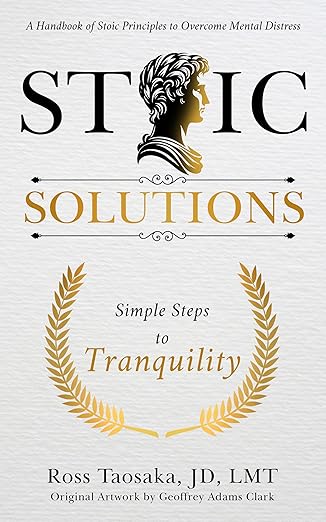
Stoic Solutions, by Ross Taosaka, offers a thoughtful and practical dive into the enduring wisdom of Stoic philosophy. The book explores how timeless teachings from ancient Stoics like Marcus Aurelius, Seneca, and Epictetus can help modern readers tackle stress, anxiety, and uncertainty. Through clear explanations and actionable advice, Taosaka connects the principles of Stoicism to everyday challenges, encouraging readers to build mental resilience, gain clarity, and find peace amid life’s chaos.
What stood out to me most was the way Taosaka distilled complex ideas into bite-sized and relatable lessons. He writes with a conversational tone that feels like talking to a wise friend, and the examples he uses, both historical and modern, help ground these ancient teachings in the real world. The chapters feel like they’re designed to be referenced again and again, each one filled with practical steps to shift your mindset and take control of your emotions.
The integration of history adds depth and credibility to Taosaka’s advice. I found his summaries of Zeno’s stoic founding and Marcus Aurelius’ reflections fascinating and easy to grasp. Often, philosophy books feel bogged down with theory, but Taosaka strikes a perfect balance. His personal anecdotes and real-world strategies, like reframing adversity and focusing on what you can control, make the book relatable and actionable. He even tackles misconceptions about Stoicism, like the idea that it’s all about suppressing emotions, showing instead how it fosters strength, balance, and purpose.
Chapter 7: Temperance – Managing Desires and Emotions really hit home for me, especially the section on living with intention. The idea of starting each day with a clear purpose felt like a breath of fresh air in my often chaotic mornings. The advice to ask, “What virtues do I want to embody today?” or “How can I practice moderation in my actions and thoughts?” was such a simple yet profound shift. I tried it, and it was amazing how setting that mental roadmap calmed my mind and gave me direction. Instead of being pulled in a hundred different directions, I felt grounded and focused. The phrase, “It’s like giving your mind a calming mantra to follow, keeping you grounded and centered,” perfectly captured how this practice helped me let go of stress and approach my day with clarity. It’s such a small change, but it made a huge difference in how I navigate both my emotions and my to-do list.
One of my favorite aspects of the book overall was its structure. The chapters build on one another, creating a sense of progress as you read. And Geoffrey Adams Clark’s illustrations add a creative vibe to the experience.
I highly recommend Stoic Solutions to anyone looking to improve their mental well-being and find a clearer path through life’s challenges. Whether you’re new to Stoicism or already familiar with its teachings, this book has something to offer. It’s perfect for those feeling overwhelmed by modern stress or for anyone curious about philosophy’s practical side.
Pages: 199 | ASIN : B0DLV9Z99N
Past Abuses and Struggles

A Mad Box of Rain shares your story of surviving and recovering from the sexual, physical, emotional, mental, institutional, and substance abuse you experienced in your childhood and teenage years. Why was this an important book for you to write?
I recently wrote this as a wedding gift for my second wife and her two teen children. I also have two teen sons. I found it difficult to verbally communicate with them about past abuses and struggles as a teen; and they had no real understanding of what growing up in Memphis in the 1980s meant, seeing that we live in Portland, Oregon. I wrote the book in six months, and I think it does a decent job explaining this to them. Mom and wife were the main editors.
How did you decide what to include and leave out in your memoir?
There were a lot of euphemisms that I took out based on the advice of a senior editor. I also had to change the names of a lot of the characters in order to protect their anonymity. I left out or changed a few details as well in order to continue the protection. It was very important to me not to break any innocent’s anonymity.
What was the most challenging part of writing your memoir, and what was the most rewarding?
The most challenging was opening myself up fully to the reader about my thoughts and feelings going through a lot of the abuse I endured. I had to be raw and honest with myself. Those feelings were not easy to feel. The most rewarding was the closeness I felt towards loved ones who supported me through this. I truly felt encouraged and loved. I was also very excited to be a finalist in this year’s Storytrade Book Awards.
What do you hope is one thing readers take away from your story?
That overcoming adversity makes you a stronger and better person. Don’t settle, be the good person you were meant to be. Don’t let anyone ever take that away from you.
Author Links: GoodReads | Website | Amazon
A fabulous and incredibly moving coming of age tale, Brian narrates his experiences growing up in a small southern town outside of Memphis, TN in the 1980’s, and how he survived and overcame personal tragedies dealing with abuse ranging from sexual to institutional. His emotional capacity to interweave the impact of childhood trauma with critiques on the overall mental health system serves as an honest and raw look at broader social issues. His introspective commentary and personal anecdotes help provide a deep connection to the reader with a conclusion that is extremely enlightening.


